

By Dr James Halden, Senior Fellow in Foreign Policy
The central policy error in dealing with us and russia is to treat the relationship as an updated Cold War script. It is not. The better starting point is a harder one: Washington and Moscow remain capable of imposing global costs on one another and on the wider international system, yet the mechanisms that once limited escalation have eroded. The result is a rivalry with fewer habits of restraint, weaker arms control architecture, and more pathways through which bilateral tension can disrupt G7 and G20 business.
History matters here, but not as nostalgia. The US Department of State’s historical record shows that formal relations between the United States and Russia date back to the early nineteenth century, and the relationship has long alternated between tactical cooperation and strategic suspicion. That pattern still frames present choices. Periods of limited alignment have usually been narrow, interest-based, and temporary. Mistrust has been the enduring condition, not the exception.
For policymakers in London, Ottawa, Berlin, Paris, Rome, Tokyo, and Brussels, the immediate question is not whether this rivalry can be solved. It is whether it can be bounded at acceptable cost. That requires a framework that connects military risk, sanctions durability, alliance cohesion, and institutional deadlock rather than treating them as separate files.
Two theatres deserve particular attention. Arms control now sits close to institutional collapse, with direct implications for crisis stability and nuclear signalling. Arctic security, once treated as a specialised regional issue, has moved into the core of economic diplomacy, maritime access, infrastructure protection, and allied force posture. For the UK, this means policy can no longer rely on rhetorical firmness paired with fragmented implementation. It requires scenario planning, allied coordination, and selective engagement where risk reduction still serves British and wider G7 interests.
Table of Contents
- Introduction The End of an Era Not the End of History
- A Legacy of Shifting Alliances and Enduring Mistrust
- Mapping the Strategic Flashpoints of 2026
- The Mechanics of Economic Pressure and Sanctions
- How Bilateral Rivalry Shapes G7 and G20 Agendas
- Three Scenarios for the Post-Ukraine Era
- A Policy Roadmap for Global Governance Leaders
Introduction The End of an Era Not the End of History
Policymakers who treat today’s US-Russia confrontation as a rerun of the late twentieth century will misread both the risks and the available tools. The Cold War had a recognisable architecture. This period doesn’t. Today’s rivalry operates through overlapping theatres, weaker verification mechanisms, sanctions networks, Arctic militarisation, and contested summit diplomacy.
The result is a more fragmented strategic environment. Escalation risks remain highest in the military domain, but the political effects now radiate through energy, shipping, technology, and multilateral negotiation. In practice, that means G7 and G20 leaders can’t cordon off security from economics in the way they once tried to.
Policy test: If a US-Russia dispute can alter maritime access, alliance readiness, or the credibility of summit commitments, it’s no longer a bilateral issue.
For the UK, this is more than a matter of solidarity with allies. It is a direct question of European security design, North Atlantic resilience, and the rules that govern coercion below the threshold of direct war. British policymakers sit at the intersection of all three.
The strategic task isn’t to restore an earlier era. It’s to build a narrower, harder form of stability suited to a relationship that remains adversarial but still too consequential to ignore.
A Legacy of Shifting Alliances and Enduring Mistrust
The modern US-Russia relationship is often misread because policymakers compress two centuries of interaction into a single Cold War template. The longer record shows something harder to manage and more relevant to current G7 and G20 deadlock. Washington and Moscow have alternated between limited cooperation and strategic suspicion, with each side carrying forward incompatible lessons about order, security, and status.
A relationship shaped by selective cooperation
Formal diplomatic ties date to the early nineteenth century, according to the Office of the Historian at the US Department of State’s account of US relations with Russia. That long record matters less as a symbol of continuity than as evidence that rivalry has rarely been total. Even at moments of deep mistrust, both states have found reasons to preserve channels for negotiation, crisis management, or transactional cooperation.
History offers several examples. Imperial Russia aligned politically with the Union during the American Civil War. The United States and the Soviet Union then became wartime allies against Nazi Germany, a partnership that was military in function but never grounded in political trust. The alliance ended quickly because the underlying dispute was not only ideological. It concerned the structure of European security, the legitimacy of buffer zones, and the distribution of influence after major war.
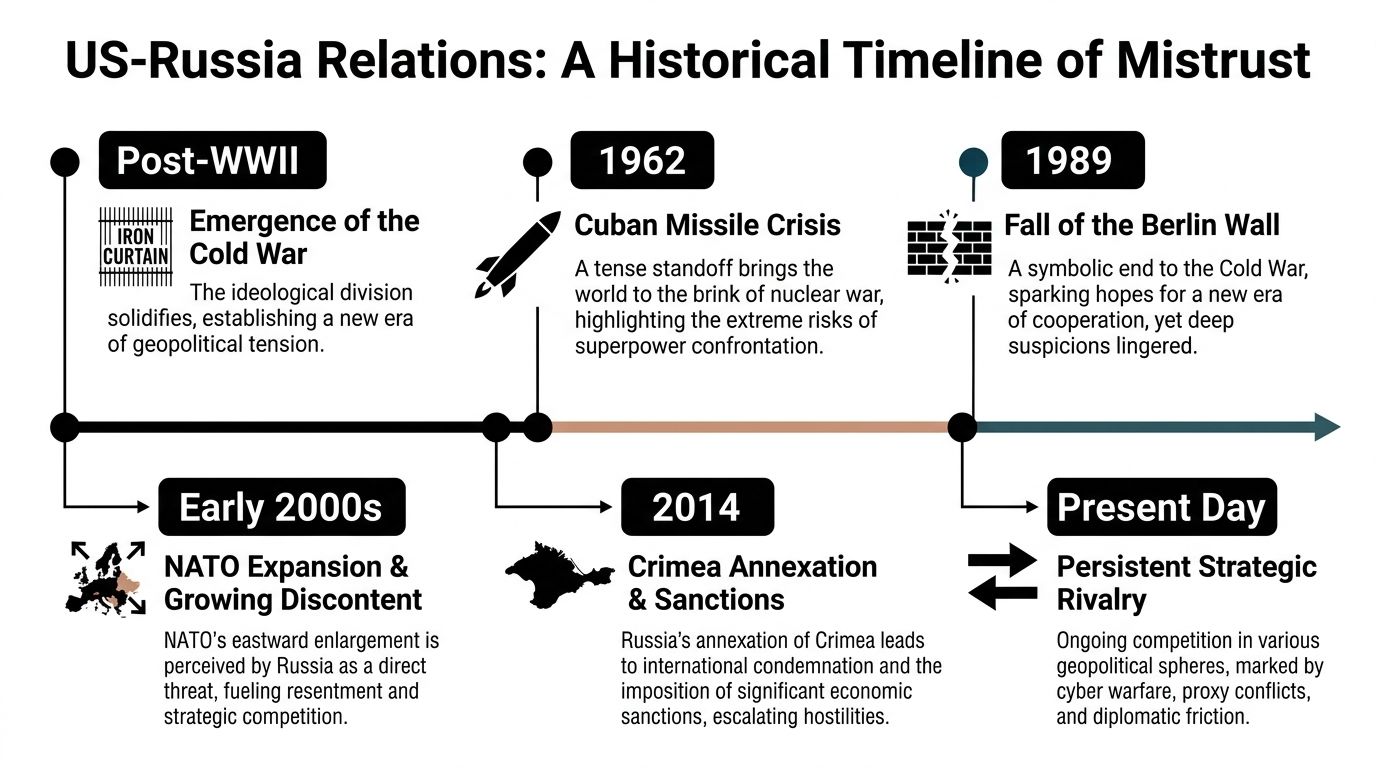
That pattern persisted after 1991. The post-Soviet opening produced meaningful cooperation on nuclear security and arms reductions, but it did not settle the deeper argument over Europe’s security architecture. As the Congressional Research Service review of US-Russian relations notes, the relationship has repeatedly been shaped by disputes over NATO enlargement, regional intervention, and the terms of post-Cold War order. The strategic implication is straightforward. Periods of cooperation have usually rested on specific shared interests, not on a convergent view of the international system.
Why historical memory still affects policy choices
Historical memory is not decorative rhetoric in this relationship. It informs threat perception.
Russian statecraft has long linked security to depth, frontier control, and recognition as a major power. That does not justify coercive behaviour, but it helps explain why Moscow often interprets alliance movement, missile defence, and military access near its borders as tests of status as well as security. US policy has generally approached the same issues through deterrence, treaty rules, and alliance commitments. Those frameworks are not easily reconciled because they answer different strategic questions.
The result is a recurring negotiation failure. Washington tends to ask whether Russian conduct complies with established rules. Moscow tends to ask whether the rules themselves reflect a balance it considers legitimate. In G7 and G20 settings, that mismatch matters because it turns even narrow agenda items into arguments about hierarchy, recognition, and institutional authority.
A less obvious lesson follows from the historical record. The periods of relative stability were usually built on bounded arrangements with verification, not on expansive language about partnership. That is the relevant precedent for 2026, especially as policymakers consider the future of arms control and Arctic security. Both files involve military risk, prestige, and access. Both also lend themselves to limited, technically framed bargains if governments keep objectives narrow and compliance measurable.
For the UK and its partners, the policy conclusion is practical. Treat US-Russia history as a guide to mechanism design, not as a script. Where interests overlap, pursue issue-specific agreements with inspection, data exchange, or incident-prevention measures. Where interests diverge, avoid rhetorical formulas that promise strategic convergence neither side intends to deliver.
Mapping the Strategic Flashpoints of 2026
The defining risk in 2026 is not a single crisis. It is the simultaneous erosion of the arrangements that once separated competition from miscalculation. For G7 and G20 policymakers, the operational question is no longer whether Washington and Moscow are in conflict. It is which arenas can still be contained, which now interact, and where limited technical agreements remain possible.
Arms control after the last treaty
The most immediate flashpoint is the scheduled expiry of New START on February 5, 2026. The treaty remains the last bilateral instrument placing verified limits on US and Russian strategic nuclear forces. The US Department of State summary of New START sets out the treaty’s central limits: 1,550 deployed warheads, 700 deployed ICBMs, SLBMs, and heavy bombers, and 800 deployed and non-deployed launchers.
Those numbers matter less as symbols than as planning constraints. For more than a decade, they gave both sides a shared reference point for force posture, notifications, and verification. Russia’s suspension of treaty participation in 2023, as recorded by the Arms Control Association’s New START overview, did not end strategic deterrence. It weakened visibility into how deterrence is managed.
That loss of visibility has direct consequences for allies. NATO planners must hedge against uncertainty in warhead loading, launcher readiness, and future breakout capacity. The UK should treat this as a practical warning for force planning and alliance consultation, not only as an abstract arms control setback. Once verification disappears, intelligence estimates carry more political weight and usually attract wider disagreement across allied capitals.
A second-order effect is already visible. Without a standing verification regime, arms control becomes harder to isolate from the broader political conflict over Ukraine, sanctions, and military signalling. That linkage raises the chance that a technically narrow negotiation is delayed by unrelated disputes.
The wider field of confrontation
Arms control is the clearest strategic breakpoint, but the wider pattern of competition matters just as much. The main theatres are Ukraine, cyber operations, energy pressure, and the Arctic. Each has a different escalation ladder. Each also places different strains on G7 unity and G20 agenda management.
| Domain | US Strategic Objective | Russia Strategic Objective | Key Tensions / Assets |
|---|---|---|---|
| Nuclear arms control | Preserve strategic predictability and verification | Avoid unilateral constraint while retaining deterrent advantage | New START expiry, suspended inspections, uncertainty over follow-on mechanisms |
| Ukraine-related security competition | Sustain pressure on Russian revisionism and defend European order | Secure favourable terms and resist Western encroachment | Battlefield outcomes shape alliance cohesion and escalation risk |
| Cyber and grey-zone activity | Protect critical systems and deter interference | Compete below the threshold of direct conflict | Persistent ambiguity, deniability, and asymmetric cost imposition |
| Energy and economic coercion | Reduce strategic dependence and constrain war capacity | Use trade, market influence, and adaptation to absorb pressure | Sanctions enforcement, rerouted trade, political signalling |
| Arctic security | Protect access, allies, and sea lanes | Expand military depth and strategic warning coverage | Military basing, maritime access, North Atlantic routes |
The Arctic deserves more attention than it usually receives in summit communiqués. As sea routes, undersea infrastructure, and northern military positions become more contested, the region is shifting from a peripheral file to a test of deterrence management. For the UK, this is not a remote theatre. It affects North Atlantic reinforcement, intelligence coordination with Nordic allies, and the protection of maritime approaches.
Historical patterns prove relevant. US-Russia relations have periodically stabilised when competition was channelled into bounded arrangements with narrow objectives and measurable compliance. In 2026, the best candidates for that approach are strategic stability talks and Arctic incident-prevention measures, not grand bargains about the entire relationship.
Policymakers should therefore rank flashpoints by their capacity to produce spillover across institutions, not by media attention. A cyber incident can be absorbed. The collapse of arms control, combined with military friction in the High North, would carry broader effects for NATO posture, G7 coordination, and the already strained ability of the G20 to separate economic governance from hard security conflict.
The Mechanics of Economic Pressure and Sanctions
Economic statecraft has moved from transactional diplomacy to coercive pressure. That shift is one of the clearest markers of how us and russia changed over time.
From transactional diplomacy to coercive statecraft
In the nineteenth century, economic exchange could redraw the map through agreement rather than punishment. Russia sold Alaska to the United States in 1867 for $7.2 million, ending Russian colonial presence in North America, in a deal described in the historical overview of Russia-United States relations. The same source notes that the territory covered 586,412 square miles and was larger than the UK, France, and Germany combined.

That episode matters because it shows what economic ties once did in this relationship. They served as instruments of accommodation and geopolitical adjustment. Today, they are more often used to impose costs, restrict access, and signal strategic resolve.
Sanctions now work through several channels at once. Governments target finance, trade, technology transfer, transport, and elite access. The objective isn’t only economic pain. It is to narrow an adversary’s room for manoeuvre, complicate procurement, and raise the political cost of prolonged confrontation.
For officials examining this toolkit, this analysis of cyber sanctions and illicit financial flows is useful because it shows how sanctions effectiveness increasingly depends on enforcement architecture rather than announcement value.
What sanctions can and cannot do
Sanctions are strongest when policymakers are clear about their purpose. Three different aims often get blurred together:
- Constraining capability: limit access to inputs, finance, or technology relevant to warfighting and strategic resilience.
- Signalling cohesion: demonstrate that G7 governments can absorb coordination costs and maintain common red lines.
- Securing favorable conditions: shape the terms on which negotiation might later occur.
What sanctions can’t do reliably is produce automatic policy reversal. States under pressure adapt. They reroute trade, substitute suppliers, build workaround mechanisms, and reframe external pressure as proof of strategic siege. That doesn’t make sanctions irrelevant. It means sanctions are part of a larger contest of endurance.
The video below captures the broader logic of coercive economic competition in the current international environment.
For G7 and G20 policymakers, the practical implication is disciplined design. If the political objective is unclear, sanctions can widen the conflict without improving bargaining power. If the objective is precise, sanctions can still shape choices even when they don’t deliver rapid concessions.
How Bilateral Rivalry Shapes G7 and G20 Agendas
US-Russia rivalry no longer sits neatly in security dossiers. It spills into summit diplomacy, trade risk, maritime resilience, and alliance burden-sharing. That’s why G7 and G20 agendas often become arenas where bilateral tensions are refracted rather than resolved.
Why Arctic security now sits inside economic diplomacy
One underexamined example is Wrangel Island. Russia’s military fortification there includes the Sopka-2 radar, operational since 2016, and that posture has implications well beyond a remote Arctic location, according to reporting on the Wrangel Island radar base and its strategic consequences. The issue matters to the UK because it touches the GIUK Gap, a critical North Atlantic chokepoint linked to submarine transit and NATO maritime vigilance.
The same source states that UK Ministry of Defence reporting from 2025 found Russian submarine incursions near UK waters rose 40% in 2024-2025. It also notes that Arctic routes affect 15% of UK LNG imports. Those figures convert a bilateral territorial-security issue into a concrete G7 concern involving energy security, alliance reassurance, and maritime domain awareness.

Summit diplomacy changes character; a G20 agenda item on trade resilience or supply routes can’t be detached from military geography if that geography influences insurance, transit risk, and political signalling among major powers.
The multilateral cost of bilateral antagonism
The multilateral damage appears in three ways.
First, rivalry consumes negotiating bandwidth. Ministers spend time managing language, sequencing meetings, and preserving minimum consensus rather than building forward policy. That doesn’t show up in communiqués, but it shapes what doesn’t get done.
Second, bilateral confrontation forces issue linkage. Arms control affects summit trust. Arctic disputes affect shipping and energy. Alliance deterrence affects the tone of economic cooperation. Once these linkages harden, even technical working groups operate under political constraint.
Third, middle powers pay the coordination cost. The UK, Canada, Germany, Japan, and others must reconcile alliance commitments with the need to preserve some functioning multilateral process. That balancing act is visible in debates about security language, sanctions alignment, and what counts as legitimate engagement.
A useful reference point for this broader institutional stress is this assessment of the G20 amid geopolitical crisis, which captures how strategic conflict increasingly shapes forums originally designed around macroeconomic cooperation.
Multilateral paralysis often begins with a bilateral dispute, but it rarely ends there.
For G7 and G20 policymakers, the deeper lesson is that procedural neutrality isn’t enough. If bilateral rivalry can restructure the operating environment of a summit, governments need deliberate mechanisms to protect core agenda items from strategic spillover.
Three Scenarios for the Post-Ukraine Era
Scenario planning is more useful than prediction because it disciplines assumptions. The post-Ukraine environment won’t be defined only by how the war ends. It will be shaped by whether the US and Russia rebuild any bounded rules for competition.
The unresolved Arctic dimension is a good test case. The 1990 USSR-USA Maritime Boundary Agreement remains a source of tension, and the account of that agreement and its implications notes that 30% of North Sea shipping faces risks from Russian grey-zone tactics in adjacent corridors. That fact links an Arctic boundary problem directly to trade security.

Scenario one renewed cold war
In this path, confrontation hardens into durable bloc politics. Diplomatic channels stay narrow. Military signalling intensifies. Economic relations remain shaped by denial, restriction, and adaptation rather than selective reopening.
The Arctic under this scenario becomes another theatre of signalling. Maritime boundaries remain legally unsettled in practice, military infrastructure expands, and shipping risk is increasingly priced as a strategic variable. G20 meetings continue, but economic cooperation is subordinated to security positioning.
For the UK, this would require a sharper fusion of trade and deterrence policy. North Atlantic resilience would become a standing rather than episodic concern.
Scenario two tense and transactional coexistence
This is the most plausible path if leaders decide they need some restraint without political rapprochement. Rivalry continues. Sanctions remain. Trust stays low. Yet governments carve out narrow mechanisms where uncontrolled competition is too dangerous.
In this model, Arctic disputes don’t disappear. They become subjects for practical management. Maritime communication, deconfliction, data-sharing on specific incidents, or limited fisheries and shipping understandings become possible because the alternative is unmanaged risk.
This review of G7 performance on regional security for Ukraine is relevant here because it highlights a wider lesson. Coalitions work best when they define concrete security tasks rather than broad political aspirations.
A stable hostile relationship is still hostile. But it is often safer than an unbounded one.
Scenario three strategic realignment
This is the least likely path, but policymakers shouldn’t dismiss it. A major external shock could reorder priorities. If another strategic pressure becomes dominant, Washington and Moscow could find limited incentive to compartmentalise more aggressively or to reopen restricted channels.
That wouldn’t mean trust or partnership. It would mean hierarchy. States often cooperate most effectively when they don’t like one another but dislike another risk more.
Under this scenario, Arctic disputes could become bargaining space rather than symbolic battlegrounds. G20 trade discussions might absorb more technical cooperation around routes, fisheries, or emergency communication, even while broader rivalry persists.
The key point across all three scenarios is this: the Arctic isn’t peripheral. It is a proving ground for whether future US-Russia competition is bounded, unmanaged, or selectively stabilised.
A Policy Roadmap for Global Governance Leaders
The immediate priority for G7 and G20 policymakers isn’t grand settlement. It’s disciplined risk management backed by credible institutional choices.
What G7 governments should do now
First, pursue an interim verification agenda tied to the end of New START. If a full successor treaty isn’t available, governments should still press for limited transparency arrangements, regularised notifications, and politically binding reporting channels. The objective is modest but vital. Reduce uncertainty before uncertainty reshapes force planning.
Second, treat the Arctic and North Atlantic as a connected theatre. UK, Nordic, North American, and NATO planning shouldn’t separate remote Arctic installations from Atlantic maritime security. Intelligence fusion, undersea monitoring, and political signalling must align.
Third, design sanctions policy around clearly ranked objectives. Governments should distinguish between measures intended to constrain capability, those meant to preserve alliance unity, and those intended to create bargaining advantage. Blurred goals produce strategic drift.
What G20 diplomacy should protect
The G20 can’t solve core US-Russia disputes, but it can prevent those disputes from hollowing out all other agendas. That requires disciplined agenda protection.
Policymakers should focus on:
- Shielding trade-security workstreams: keep shipping resilience, supply routes, and crisis-response discussions operational even during high political tension.
- Preserving technical dialogue: maintain expert-level channels on nuclear risk, maritime incidents, and critical infrastructure where possible.
- Using issue-specific coalitions: when full consensus fails, smaller groups should still advance practical cooperation on discrete global risks.
The broader strategic insight is simple. Stability in us and russia relations won’t come from sentiment, symbolism, or summit theatre. It will come from whether leaders can build narrow mechanisms that survive mistrust.
That’s the standard G7 and G20 governments should now adopt. Not optimism. Not fatalism. Operational discipline.
Global Governance Media brings together policymakers, analysts and practitioners working at the sharp edge of multilateral decision-making. If you want more evidence-based analysis on G7 and G20 strategy, arms control, Arctic security and the future of global governance, explore Global Governance Media and join the policy conversation shaping the next round of international choices.