

By Arun Mehta, Senior Policy Analyst
One reservoir on the Blue Nile has altered the strategic calculus of an entire region. The Grand Ethiopian Renaissance Dam is large enough to shape power supply, seasonal water management, diplomatic bargaining, and investor risk across Northeast Africa. For policymakers, that scale places dams in Ethiopia well beyond the category of domestic public works. They are now part of a wider test of how states pursue development under conditions of climate stress, rising electricity demand, and contested transboundary resources.
A narrow focus on the GERD obscures the larger pattern. Ethiopia's dam programme spans hydropower, irrigation, flood control, and multi-purpose storage across several river basins. Taken together, these assets point to a long-horizon state project aimed at reducing energy poverty, expanding agricultural production, and strengthening national integration through infrastructure. The policy significance lies in the portfolio, not only in the flagship project.
That broader view matters for the G20.
Ethiopia's dams sit at the intersection of low-carbon industrialisation, food security, regional stability, and development finance. They can support a cleaner electricity mix and widen the physical basis for growth. They also increase the premium on basin-level coordination, environmental safeguards, data sharing, and credible operating rules among riparian states. The strategic question is therefore larger than whether Ethiopia should build dams. It is whether regional institutions and international partners can help shape a framework in which dam development supports both national transformation and cooperative management of shared water systems.
Table of Contents
- Introduction The Strategic Importance of Dams in Ethiopia
- Ethiopia's National Water and Energy Blueprint
- The Dam Portfolio Beyond the GERD
- Powering a Nation and Irrigating Growth
- The Geopolitical Fulcrum The GERD and Nile Basin Relations
- Environmental and Social Sustainability Questions
- Financing Governance and Future Policy Pathways
Introduction The Strategic Importance of Dams in Ethiopia
More than an infrastructure story, Ethiopia's dam programme is a state-building strategy with consequences that extend across food systems, electricity markets, and transboundary diplomacy. The country's major water works link power generation, irrigation planning, and flood management to a single policy objective: converting hydrological resources into long-term economic capacity.
That strategic logic explains why dams in Ethiopia matter far beyond the engineering sector. These assets shape the reliability of electricity supply, the productivity of agriculture, and the credibility of the state's development model. They also concentrate risk. A project portfolio designed to support growth at home can alter water expectations downstream, expose weak environmental governance, and test the ability of regional institutions to manage shared rivers under political strain.
Core judgement: Ethiopia's dams are instruments of national transformation, but their long-term value depends on stronger governance at both national and basin levels.
For G20 delegations, the Ethiopian case deserves attention as more than a dispute over a single flagship project. It is a live test of how emerging economies pursue low-carbon development through large-scale infrastructure in shared ecosystems. The policy challenge is not whether development should proceed. It is how to support energy expansion, agricultural resilience, and climate adaptation without increasing the risk of interstate confrontation or shifting ecological costs onto more vulnerable communities.
A narrow focus on the Grand Ethiopian Renaissance Dam misses the wider picture. Ethiopia's dam strategy is better assessed as a portfolio. Some projects are designed to generate power, others to support irrigation or water storage, and together they reveal a broader governing ambition: greater control over the timing, location, and economic use of water. That makes Ethiopia an important case study in 21st-century resource governance, where development goals, energy transition, and regional cooperation are no longer separate policy tracks.
Ethiopia's National Water and Energy Blueprint
Hydropower and irrigation sit at the center of Ethiopia's development model because the country combines large river systems with low historical electricity access, high exposure to rainfall variability, and a long-standing need to reduce reliance on imported fuels. In that context, dams are not isolated engineering works. They are instruments for industrial policy, food security, fiscal stabilization, and state-building.
This logic has produced a durable policy direction across political periods and river basins. Older assets, irrigation schemes, and newer hydropower projects point to the same strategic objective: greater public control over how water is stored, released, and converted into economic value. The result is a national blueprint that links electricity generation, agricultural planning, and territorial integration more tightly than outside commentary often assumes.
Water control as economic strategy
Three domestic priorities explain the consistency of this approach.
- Power system expansion: Hydropower is expected to supply large volumes of domestic electricity and support future power exports.
- Agricultural risk management: Irrigation and storage reduce exposure to erratic rainfall and strengthen production in drought-prone areas.
- State reach and cohesion: Large water projects extend public investment into peripheral regions and tie infrastructure planning to national integration.
The strategic point is broader than energy supply. Control over water timing matters almost as much as control over water volume. A government that can store seasonal flows, shift releases across months, and coordinate dams with irrigation schemes gains more room to manage drought, support industry, and shape regional development.
That has direct implications for how Ethiopia approaches external pressure. Dam operations are linked to domestic legitimacy and long-horizon development planning. International requests on filling schedules, data sharing, or operating rules are therefore filtered through a wider concern about preserving policy autonomy.
Why a portfolio view matters
A single-project lens obscures the governing model. Ethiopia's dam strategy is better understood as a portfolio of assets with different purposes, time horizons, and political functions. Some projects are designed primarily for electricity, others for irrigation or storage, and several serve more than one objective. What binds them together is not a uniform technical design but a common state logic: water should be treated as managed infrastructure rather than an uncontrolled natural endowment.
That reading changes the policy assessment in two ways.
First, it explains why the programme has continued despite financing constraints, construction delays, and diplomatic contestation. The dam agenda is tied to structural economic goals, not only to the symbolism of a flagship project. Second, it shows why external engagement focused only on crisis de-escalation around the Nile is too narrow. Decisions on finance, safeguards, watershed management, and grid integration all shape the performance of the wider portfolio.
The relevant unit of analysis is the national water and energy system, not only the most visible dam within it.
For G20 governments, this matters because Ethiopia represents a wider policy challenge that will recur elsewhere. Emerging economies are pursuing low-carbon growth through large infrastructure in shared basins, often before basin institutions and domestic safeguards have caught up. Effective cooperation will require more than calls for restraint. It will require frameworks that recognize Ethiopia's growth incentives while improving transparency, environmental governance, and rules for managing shared rivers.
The Dam Portfolio Beyond the GERD
More than 20 dam projects sit within Ethiopia's wider water infrastructure pipeline and operating base, according to the article's earlier portfolio discussion. That scale matters because it shifts the policy question from a single high-profile dispute to the management of an interconnected national asset base with regional consequences.
A portfolio view changes the analysis. Ethiopia is not pursuing one symbolic structure. It is building a layered system across multiple basins and functions, including hydropower, irrigation, storage, and flood control. Some assets are mature and operational. Others remain under construction or are still framed as medium-term planning priorities. The common feature is strategic intent. Water infrastructure is being used to support industrial policy, food production, and state capacity at the same time.
A long historical arc
Ethiopia's dam strategy has developed over decades, not in one political cycle. Earlier projects established administrative, engineering, and financing templates for large water control. Later schemes expanded the rationale from electricity supply to agricultural modernization and regional development. That continuity helps explain why the dam agenda has outlasted fiscal pressure, technical delay, and diplomatic contention.
It also widens the risk register.
A single-project lens misses the cumulative pressures that emerge across a national portfolio. Sedimentation in one catchment can reduce generation efficiency. Poor watershed management upstream can shorten asset life downstream. Weak coordination between reservoirs can lower system performance even when individual dams are technically sound. Social consent also has to be maintained across multiple project sites, not secured once.
Selected projects in Ethiopia's wider dam system
| Dam Project | River Basin | Primary Function | Current Position in the Portfolio |
|---|---|---|---|
| Grand Ethiopian Renaissance Dam | Blue Nile basin | Hydropower | Flagship generation asset with cross-border implications |
| Koysha | Omo basin | Hydropower | Major expansion project in the southern power system |
| Gilgel Gibe III | Omo basin | Hydropower | Large operating asset with system-level importance |
| Aba Samuel Dam | Awash-linked drainage context | Water supply and power history | Legacy infrastructure with continuing domestic relevance |
| Alwero Dam | Baro-Akobo basin | Irrigation and storage | Agricultural water management asset |
| Genale Dawa VI | Genale-Dawa basin | Hydropower | Part of the newer generation pipeline |
The table is useful partly because of what it does not claim. Publicly available information is uneven across projects, and that is a policy issue in its own right. Limited disclosure makes it harder for lenders, neighboring states, and domestic stakeholders to assess cumulative hydrological effects, fiscal exposure, and safeguard performance across the system.
Multilateral engagement can add practical value in this context. G20 governments and development institutions should treat Ethiopia's dams as a portfolio governance challenge. That means supporting basin data-sharing, reservoir operation planning, sediment and watershed management, and stronger disclosure standards for environmental and social assessment. It also means linking dam policy to broader questions of rural transformation and food systems, particularly where irrigation assets shape local livelihoods and land use, as discussed in this analysis of water, rural development, and food security.
For external partners, the strategic conclusion is clear. Project-by-project diplomacy is too narrow. Ethiopia's dam programme should be assessed as a national development platform whose benefits and risks depend on how the whole system is financed, coordinated, and governed.
Powering a Nation and Irrigating Growth
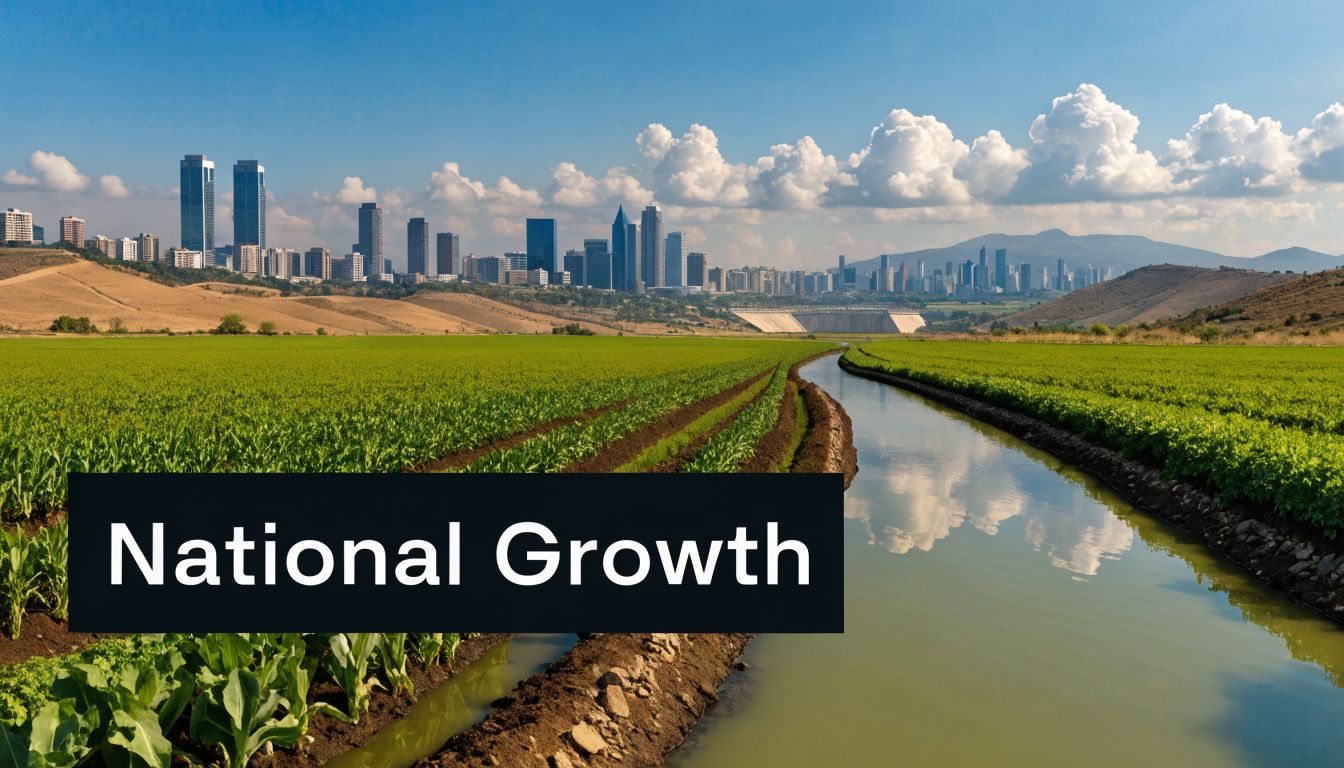
Nearly four in five Ethiopians still depend at least partly on agriculture for their livelihoods, while electricity access and reliability remain uneven across regions. That is why the dam programme matters beyond engineering. It sits at the intersection of state capacity, rural resilience, and the country's longer-term energy transition.
Electricity as state-building infrastructure
For Addis Ababa, hydropower is more than an energy source. It is a fiscal and political instrument. Domestic generation can reduce pressure on imported fuels, support industrial policy, and improve the credibility of public institutions if power reaches businesses, hospitals, schools, and households with greater consistency.
That distinction matters. Installed capacity has political value, but delivered electricity has economic value. Countries that build large hydropower assets without matching investment in transmission, maintenance, and distribution often discover that generation alone does not produce industrial transformation. Ethiopia's experience will be judged by whether dams become part of a functioning power system rather than a collection of headline projects.
The broader portfolio reinforces that point. As noted earlier, Ethiopia is pursuing a pipeline that extends well beyond the GERD. In policy terms, this creates both an opportunity and a systems challenge. A larger hydropower base can support electrification, manufacturing, and regional power trade. It also increases exposure to hydrological variability, operational bottlenecks, and financing strain if planning across projects is weak.
For G20 policymakers, the implication is straightforward. Support for Ethiopia's energy transition should focus less on ribbon-cutting and more on grid performance, reservoir coordination, and utility reform.
Irrigation as economic security
The irrigation side of the portfolio receives less diplomatic attention, but it may have the wider social effect. In a country where rainfall variability can quickly translate into food insecurity, water storage changes planting decisions, crop intensity, and local income stability. Dams linked to irrigation therefore shape economic security as directly as dams linked to electricity shape industrial growth.
This gives Ethiopia's dam strategy a broader domestic logic than the international debate often recognizes. A multipurpose reservoir can serve as energy infrastructure, drought insurance, and an agricultural asset at the same time. That wider function helps explain why dam construction retains political support even when individual projects face delays, cost pressures, or external criticism.
The development case, however, depends on distribution. Irrigation gains are not automatic. They hinge on who gets water, which crops are favored, whether smallholders are included, and how land and watershed management are handled over time. The interaction between water systems, rural livelihoods, and food production is examined in this analysis of water, rural development, and food security.
A portfolio view leads to a less obvious conclusion. The economic return on Ethiopia's dams may depend as much on governance at the point of delivery as on the size of the structures themselves. Power that does not reach productive users and irrigation that bypasses vulnerable communities will weaken the development bargain that justifies these investments. Power and water systems that are reliable, equitable, and integrated into broader planning will strengthen it.
The Geopolitical Fulcrum The GERD and Nile Basin Relations
More than one major economy depends on the Nile, but one upstream project now shapes the basin's strategic calculus more than any other. The GERD is the point at which Ethiopia's domestic dam portfolio becomes a regional governance test. Its significance lies less in engineering spectacle than in its ability to alter how risk is distributed across a shared river system.
Why the dispute persists
The central issue is operational control during uncertainty. Once a reservoir of this scale begins storing and releasing water, technical decisions about timing, seasonal coordination, and drought response become questions of sovereignty, exposure, and political trust. That is why negotiations repeatedly stall on procedures that might appear narrow to outsiders. Data exchange, filling schedules, dispute resolution, and dry-year operating rules determine which government absorbs risk when rainfall weakens.
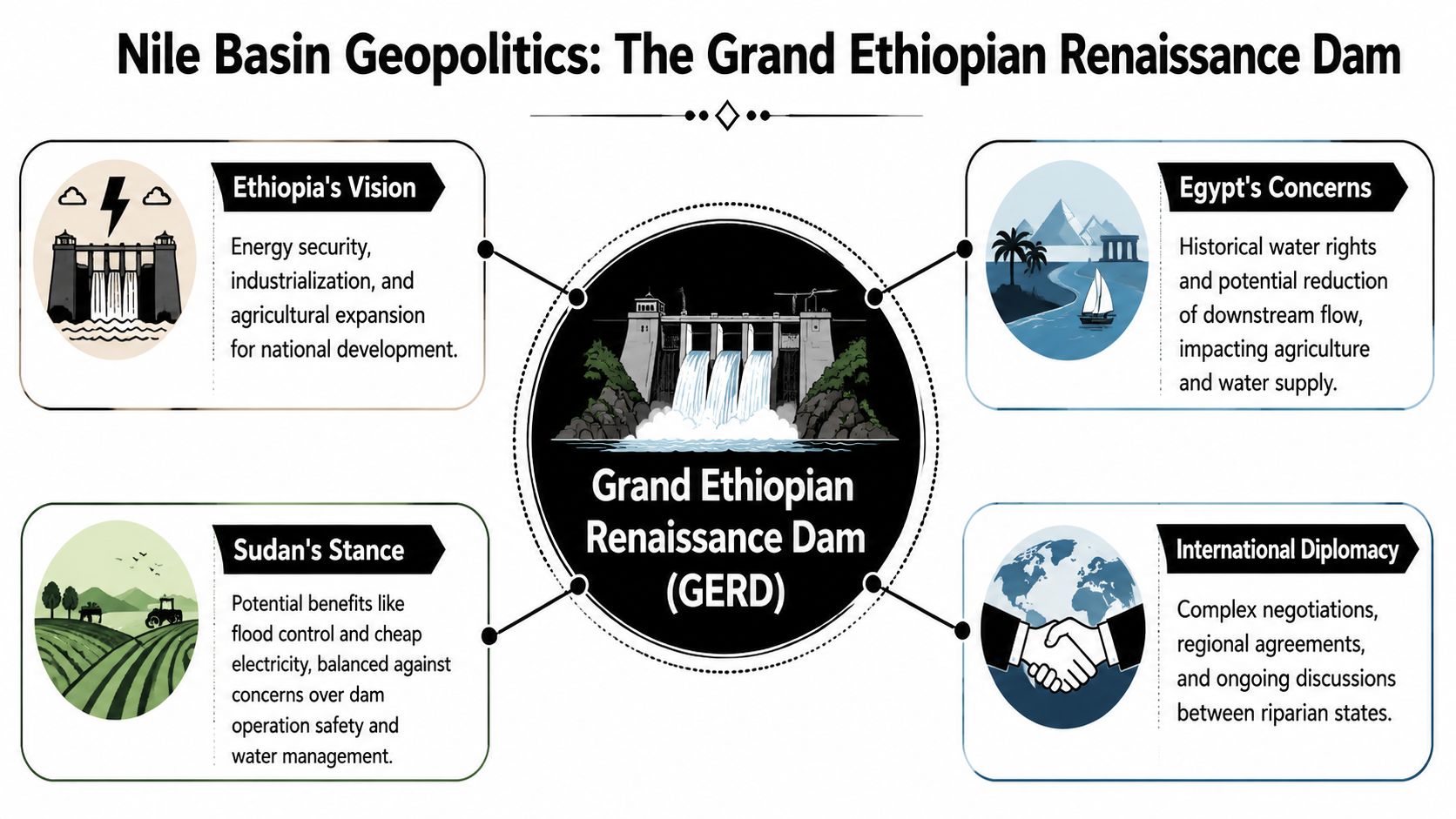
This is also why the GERD should not be treated only as a bilateral confrontation between Ethiopia and Egypt. Sudan sits in a more complex position, with potential gains from regulated flows and electricity trade alongside concerns over dam safety, notification standards, and coordination with its own water infrastructure. A portfolio view of Ethiopia's dams helps explain this broader dynamic. The country is not building a single symbolic structure. It is building a development model in which upstream storage, power generation, and state capacity reinforce one another. Neighbours therefore assess the GERD not as an isolated asset, but as the leading edge of a longer-term shift in basin management.
A visual summary helps clarify the diplomatic positions.
Three national logics
Ethiopia's position is anchored in sovereign development. Addis Ababa sees the GERD as a national infrastructure project financed and defended as part of a wider effort to expand electricity supply, reduce energy poverty, and strengthen industrial prospects. Any arrangement that appears to give downstream states effective veto power over core operations is therefore politically difficult to accept.
Egypt approaches the issue from downstream dependency. Its concern is not the existence of Ethiopian hydropower in itself, but the possibility that weak rules on filling and drought management could transfer unacceptable water-security risk downstream. Cairo accordingly prioritises predictability, legal clarity, and binding commitments during stress periods.
Sudan's logic is more conditional. It has reasons to support coordinated operation if that improves flood management and energy access, yet it also needs timely information and credible mechanisms for joint management. In practical terms, Sudan often has the strongest interest in turning broad political positions into day-to-day technical cooperation.
Each capital is acting rationally within its own security framework. The persistent failure has been institutional. The basin still lacks a trusted mechanism that can convert competing national priorities into stable operating rules.
What this means for regional stability and international cooperation
Three policy implications stand out.
- Shared basins need permanent operating frameworks. Ad hoc summits can reduce immediate tension, but they do not replace standing arrangements for hydrological data, drought protocols, and coordinated releases.
- Transparency is a security instrument. Routine information-sharing lowers the chance that seasonal water stress is interpreted as coercion or bad faith.
- Energy transition policy now intersects with river governance. Hydropower can support decarbonisation and electrification while still generating cross-border instability if governance lags behind infrastructure.
For G20 governments, the GERD is best understood as a precedent for a wider class of disputes. As states invest in climate-aligned infrastructure on shared rivers, friction will grow wherever engineering outpaces institutions. The policy task is not to slow development by default. It is to link finance, technical assistance, and diplomatic support to cooperative basin rules from the outset.
That lesson has a wider environmental dimension as well. Long-term basin stability depends not only on dam operations, but also on catchment health, erosion control, and upstream land management. Multilateral support for ecosystem restoration that strengthens shared water security can therefore reduce risk at lower political cost than headline negotiations alone.
Environmental and Social Sustainability Questions
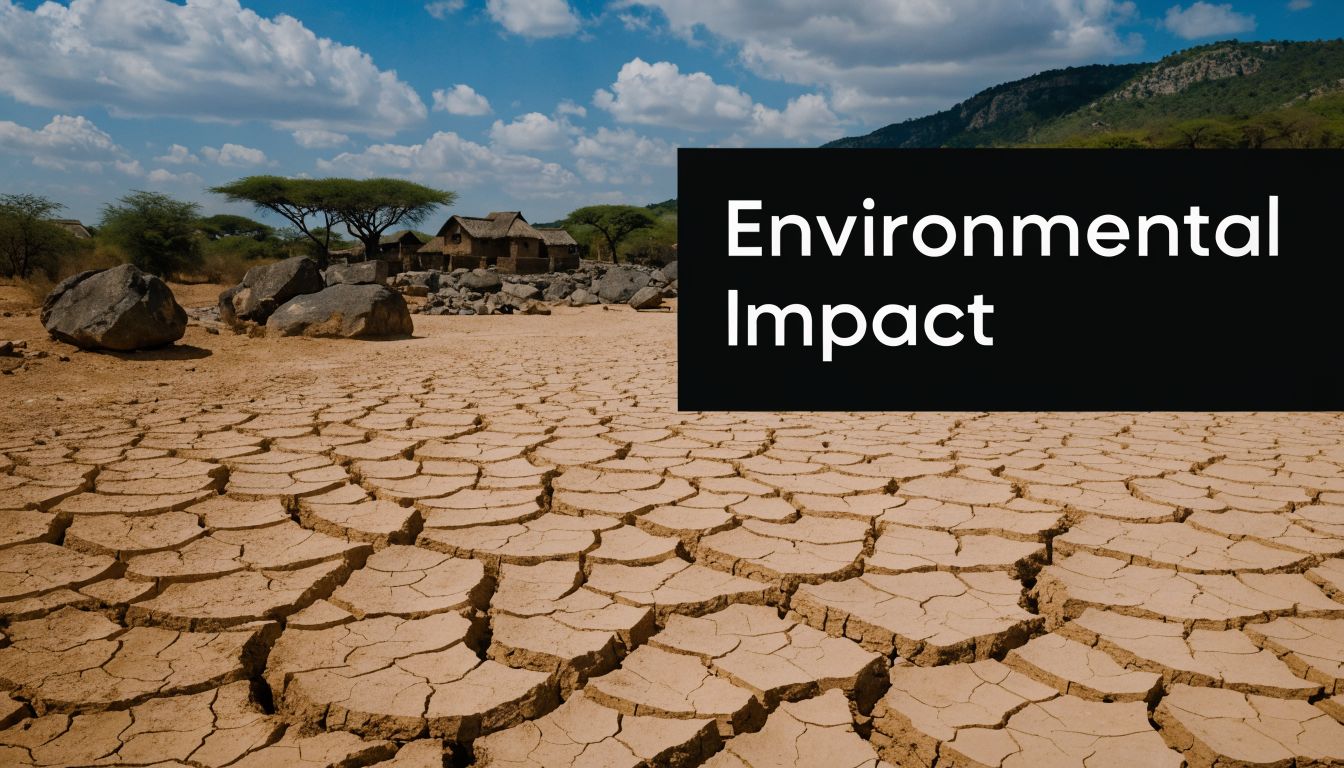
Hydropower can reduce fossil fuel dependence and expand electricity access. It can also shift environmental risk and social cost onto specific regions and communities if planning stops at the turbine hall. In Ethiopia, that tension is central to the durability of the country's dam portfolio.
The development trade-offs are real
The strategic question is broader than whether a single project generates power on schedule. It is whether Ethiopia can convert dam construction into a stable development model that protects livelihoods, maintains reservoir performance, and limits ecological stress across shared river systems. That requires policymakers to treat social safeguards, catchment management, and long-horizon monitoring as part of core infrastructure policy.
GERD has made this issue visible, but the underlying challenge applies across the wider dam portfolio. Resettlement pressures, altered river ecology, changes in local flood regimes, and sediment accumulation are recurring features of large storage projects. Low-carbon infrastructure does not remove these trade-offs. It changes their form.
Catchment condition shapes infrastructure performance
Sediment is often treated as a technical maintenance issue. In practice, it is a governance issue that begins far upstream with land use, deforestation, soil erosion, and agricultural pressure in the catchment. If those drivers are left unaddressed, reservoir capacity declines faster, turbine efficiency can suffer, and operating flexibility narrows during hydrological stress.
This has direct policy implications for G20 partners. A dam programme should be assessed as a linked system of civil works, watershed management, local administration, and social legitimacy. Financing the structure without financing the basin institutions around it creates a predictable gap between design performance and real-world outcomes.
That is why ecosystem restoration approaches that strengthen shared water security belong in the same conversation as power generation targets and transmission planning.
Social legitimacy matters as much as engineering quality
Displacement is not only a compensation problem. It affects income stability, land access, local trust in state institutions, and the political acceptance of future projects. Where communities perceive that national gains are being purchased through local loss, opposition can persist long after construction ends.
Environmental oversight has a similar time horizon. One-time impact assessments are rarely enough for assets designed to operate for decades under shifting rainfall patterns and rising climate variability. Ethiopia's dam strategy will therefore be judged not only by megawatts installed, but by whether ecological monitoring and community grievance systems remain credible after commissioning.
Four conclusions follow:
- Resettlement policy needs a long-term livelihood focus. Cash compensation on its own does not address loss of land, employment disruption, or social fragmentation.
- Catchment restoration should be funded as infrastructure protection. Soil and water conservation upstream support reservoir life and operating reliability downstream.
- Environmental monitoring has to continue after construction. River ecology, fisheries, floodplain dynamics, and water quality can change over time.
- Climate volatility increases the cost of weak safeguards. More variable flows make poor land management and delayed social response harder to absorb.
A sustainable dam strategy is defined by governability. Ethiopia's experience shows that the essential test is whether engineering ambition is matched by institutions that can manage environmental pressure, public consent, and long-term basin health.
Financing Governance and Future Policy Pathways
The next phase of Ethiopia's dam story will be decided less by engineering ambition than by governance quality. That applies inside Ethiopia, across the Nile basin and within international financing systems. The encouraging fact is that the GERD already demonstrates a degree of technical governance capacity that can serve as a base for broader cooperation.
Technical governance is a diplomatic asset
According to the Webuild project profile for GERD, the dam uses real-time sensor networks distributed through internal galleries to monitor hydrostatic pressure, reservoir levels, concrete joint integrity, structural displacement and turbine performance. The same source describes a 175 m high dam, 1,800 m in length, with 10.4 million m³ of RCC structural volume and three spillways designed for 30,200 m³/s probable maximum flood discharge.
Those details matter beyond engineering. They show that Ethiopia can operate advanced infrastructure using modern monitoring systems. For a G20 audience, this should change the conversation from whether governance capacity exists at all to how that capacity can be extended into data transparency, basin-wide confidence building and bankable safeguard regimes. That is directly relevant to debates on mobilising investments for sustainable infrastructure amid global crises.
A practical multilateral agenda
A serious policy response should combine development support with dispute prevention. Five priorities stand out.
- Create standing operational dialogue. Ethiopia, Sudan and Egypt need durable technical channels focused on reservoir communication, seasonal planning and drought response.
- Support transparent data protocols. Shared hydrological and operational reporting would reduce uncertainty more effectively than political signalling.
- Tie finance to watershed outcomes. Funding structures should reward catchment management, sediment control and social safeguard performance.
- Shift from water allocation rhetoric to benefit-sharing design. Energy trade, flood management and coordinated planning can create a larger cooperative space than zero-sum flow politics alone.
- Use the G20 as a standards platform. Members can align expectations on disclosure, environmental safeguards and transboundary risk assessment for major renewable infrastructure.
The broader lesson is straightforward. Dams in Ethiopia should not force a binary choice between development and stability. With stronger institutions, they can contribute to both. Without them, even technically advanced projects will remain politically fragile. The task for international partners is to help build the cooperative architecture that Ethiopia's infrastructure strategy now requires.
Global water and energy politics won't get simpler, but they can become more governable with sharper analysis and better policy design. For more decision-ready briefings on infrastructure, climate diplomacy and G20 cooperation, visit Global Governance Media.