


By Dr. Elena Markovic
The most revealing fact about modern data protection isn't how many complaints people file. It's how few complaints lead to formal regulatory action. In the UK, the Information Commissioner's Office completed processing 36,049 data protection complaints in 2024, yet regulatory action was taken on only 1 out of the 25,582 complaints it received, according to Statista's overview of online privacy in the UK. That gap underscores the practical realities of global data governance. Data rights are expanding on paper, while states, regulators, and organisations are struggling to enforce, operationalise, and reconcile them in practice.
That tension is fragmenting the global digital order. The digital economy depends on constant cross-border movement of personal, commercial, and behavioural data. Governments, meanwhile, are tightening control over how data is collected, where it moves, who can access it, and when public authorities can override private expectations of confidentiality. What began as a privacy debate has become a contest over security, trade, industrial policy, and administrative power.
The UK offers one of the clearest case studies. Its post-Brexit reforms show how a state can preserve the language of rights while recalibrating the balance between individual protections and sovereign discretion. That pattern now matters far beyond Europe. It is shaping digital diplomacy, AI governance, health data policy, and the future of international cooperation itself.
Table of Contents
- The Data Governance Paradox in a Connected World
- The GDPR Model as a Global Benchmark
- A World of Divergence Major Regional Regimes
- Navigating the Impasse of Cross-Border Data Flows
- Enforcement Realities and the Compliance Deficit
- Future Frontiers AI Health Data and Geopolitics
- Policy Pathways for a More Coherent Digital Future
The Data Governance Paradox in a Connected World
Data protection regulations were built to impose order on an environment that doesn't respect borders. That's the paradox. Cloud services, digital payments, online advertising, logistics systems, and AI development all rely on data moving continuously across jurisdictions. Yet the legal frameworks governing that data are becoming more territorial, more politically charged, and less interoperable.
For policymakers, this isn't a narrow compliance issue. It is a question of statecraft. Rules on consent, retention, localisation, algorithmic review, and breach reporting now influence trade negotiations, law enforcement cooperation, investment decisions, and diplomatic trust. A ministry of justice may frame data protection as a rights issue. A finance ministry may see the same rules as market infrastructure. A security agency may treat them as constraints to be worked around.
That divergence is why the global debate has moved beyond copying the European model. The EU's GDPR established a rights-based grammar for modern privacy governance, but many governments are now adapting that grammar to local priorities. Some emphasise consumer transparency. Others prioritise strategic sectors, law enforcement access, or digital sovereignty. The result is a growing patchwork in which organisations face overlapping obligations that often pull in different directions.
A more useful way to think about this field is through governance trade-offs, not just legal doctrines. Every regime must answer the same underlying questions:
- Individual control: How much authority should citizens have over collection, reuse, and deletion of their personal data?
- State access: When should governments be able to compel disclosure for security, fraud detection, taxation, or public administration?
- Economic openness: How easy should it be for firms to transfer and process data across borders?
- Administrative realism: Are regulators able to enforce the rights they codify?
The harder truth is that no country answers all four questions consistently.
Practical rule: The sharper a state's strategic interest in security, industrial policy, or digital sovereignty, the less likely its data protection regime will remain purely rights-based.
That's why global cooperation needs a different ambition. Full legal harmonisation isn't realistic. Interoperability is. The task for international bodies is to build enough common ground for trusted transfers, comparable safeguards, and mutual recognition where possible. Work on data governance frameworks for international cooperation is increasingly valuable because it treats data regulation as part of wider institutional design, not just privacy compliance.
The GDPR Model as a Global Benchmark
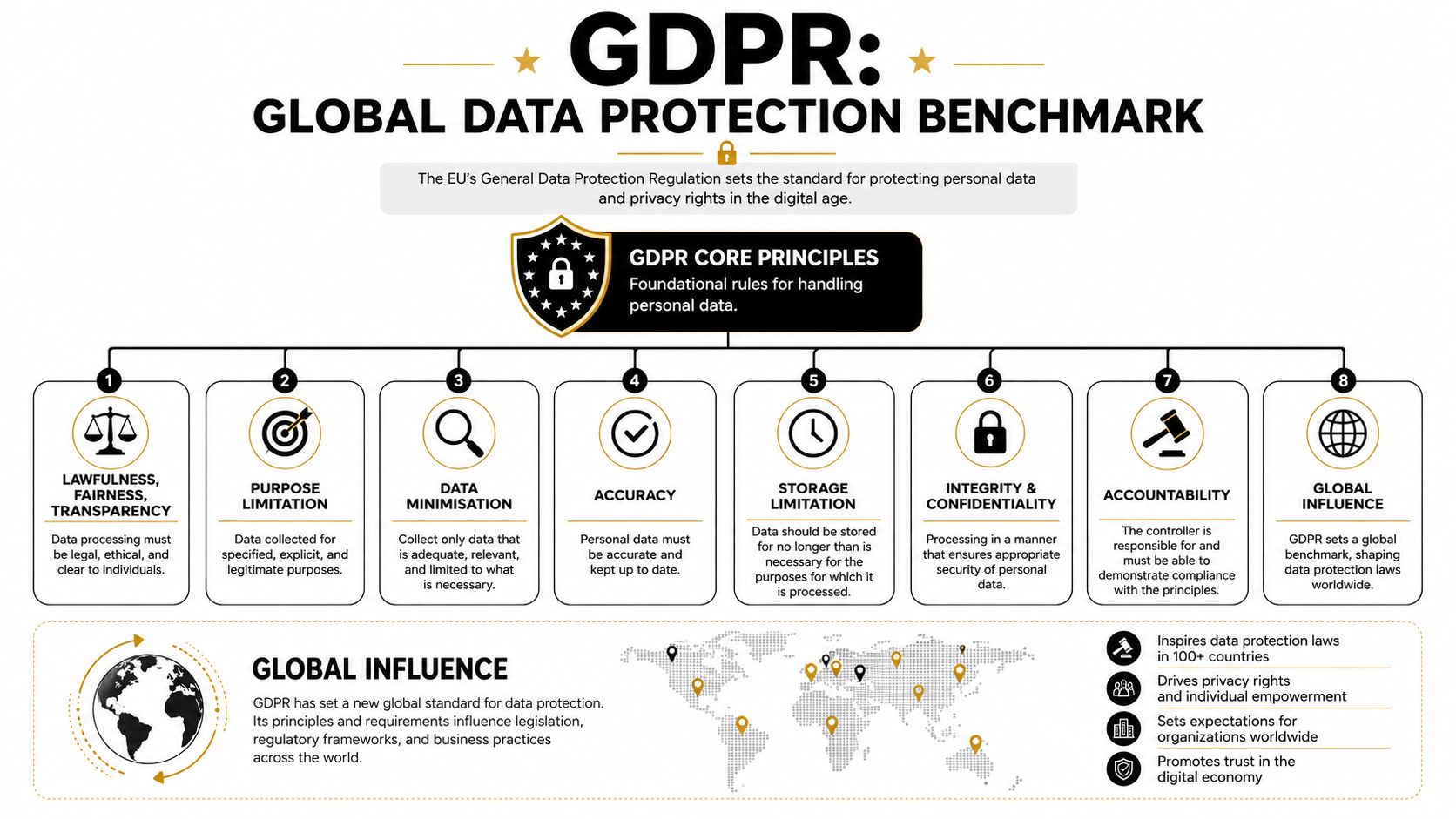
The GDPR became influential because it offered more than a list of rules. It set out a theory of power. Personal data could no longer be treated as an asset that organisations freely harvest and manage internally. The regulation reframed data processing as an activity that must be justified against the rights and expectations of the individual.
Why the GDPR became the reference point
Its core principles are familiar because they map to intuitive limits on institutional power. Purpose limitation says data collected for one reason shouldn't be repurposed for another. Data minimisation asks organisations to take only what they need, much like a customs authority that can inspect a bag but can't seize everything in it by default. Storage limitation rejects the habit of retaining information indefinitely because digital storage is cheap.
Those principles matter because they change the burden of proof. The question is no longer whether an organisation can find a business use for data after collection. The question is whether it had a lawful and proportionate reason before collection.
That framing has travelled globally because it is administratively legible. Regulators can audit it. Courts can interpret it. Companies can translate it into policies, records, and technical controls. For teams that need a compact operational reference, understanding GDPR requirements is useful because it connects the legal theory to implementation choices organisations must make.
The logic behind the legal bases
A key feature of the UK GDPR, which preserves the broader GDPR architecture in this area, is that it recognises six distinct and exclusive legal bases for processing personal data: consent, performance of a contract, legitimate interest, vital interest, legal requirement, and public interest. Organisations must establish one valid basis for each processing activity before it begins, and consent requires a clear affirmative action rather than pre-ticked boxes or inactivity, as outlined by CookieYes in its summary of UK GDPR legal bases.
This matters strategically because it prevents organisations from keeping several justifications in reserve and choosing whichever is most convenient later. A lawful basis isn't a narrative device. It is a commitment about why the processing exists.
That discipline is one reason the GDPR became a benchmark far beyond Europe. It is demanding, but it is conceptually coherent. It treats privacy as something designed into systems, contracts, interfaces, and governance processes from the start.
The GDPR's real export was not a penalty model. It was a decision model.
Its influence also reflects market reality. Multinational firms often standardise around stricter regimes because fragmented internal rules are difficult to govern. Once the GDPR shaped procurement questionnaires, vendor assessments, contract clauses, and product design norms, it started functioning as a de facto international baseline even where local law differed.
A World of Divergence Major Regional Regimes
The headline trend in data protection regulations isn't convergence. It's selective borrowing. Governments adopt familiar privacy language, then embed it in very different political and economic projects. The result is a world in which laws may look superficially similar while producing very different obligations in practice.
The same vocabulary, different state projects
California's privacy framework is commonly read through a consumer protection lens. It focuses heavily on disclosure, choice, and restrictions on data use in market settings. Brazil's LGPD borrowed much of the rights-based structure associated with European privacy law, but it sits within its own constitutional and institutional context. China's PIPL is often discussed alongside GDPR because of its wide-ranging scope, yet its surrounding governance model gives state authority and national policy objectives a much more central role.
The UK is especially important because its divergence is more subtle. It didn't reject the GDPR template outright. It kept much of the inherited architecture while adjusting specific pressure points where ministers and regulators saw room for flexibility, competitiveness, or administrative reform.
According to Usercentrics' summary of UK GDPR compliance changes, the UK GDPR came into effect on January 29, 2021, and a major reform followed on February 5, 2026, when core provisions of the Data (Use and Access) Act 2025 entered into force. Those changes introduced recognised legitimate interests, reduced the age of consent to 13, and marked the most substantial shift in the UK framework since Brexit.
That combination is politically significant. The UK is signalling that alignment and divergence can coexist. It wants a framework legible to European partners and global firms, but it also wants room to adjust how rights, innovation, and public authority are balanced domestically.
A country doesn't need to abandon a regulatory model to repurpose it. It can keep the structure and change the centre of gravity.
Key Global Data Protection Regimes at a Glance
| Region/Law | Core Philosophy | Extraterritorial Scope | Maximum Penalty |
|---|---|---|---|
| EU GDPR | Rights-based governance centred on individual autonomy, purpose limits, and accountability | Broadly influential in cross-border business practice | Qualitatively severe |
| UK GDPR and DUAA reforms | Rights framework with post-Brexit recalibration toward flexibility, recognised legitimate interests, and state operational needs | Applies to organisations targeting the UK market | Up to £17.5 million or 4% of annual global turnover for serious breaches |
| California CCPA/CPRA | Consumer rights and market transparency with emphasis on notice, choice, and business obligations | Reaches organisations doing business with California residents | Qualitatively significant |
| Brazil LGPD | Comprehensive privacy law influenced by European logic but adapted to national legal institutions | Extends beyond purely domestic actors in practical effect | Qualitatively significant |
| China PIPL | Personal information protection combined with strong state oversight and national governance priorities | Structured to affect overseas entities in relevant cases | Qualitatively severe |
This comparative picture matters because multinational compliance can't rely on vocabulary alone. “Consent”, “legitimate interests”, “public interest”, and “sensitive data” may appear across regimes, but they don't carry identical policy meanings. In one jurisdiction, the central concern may be user autonomy. In another, it may be digital market discipline. In a third, it may be state visibility into strategic data.
That's why one-size-fits-all governance programmes are becoming less viable. The policy question is no longer which regime will dominate globally. It is whether enough interoperability can be preserved to avoid a world of permanent legal friction.
Navigating the Impasse of Cross-Border Data Flows
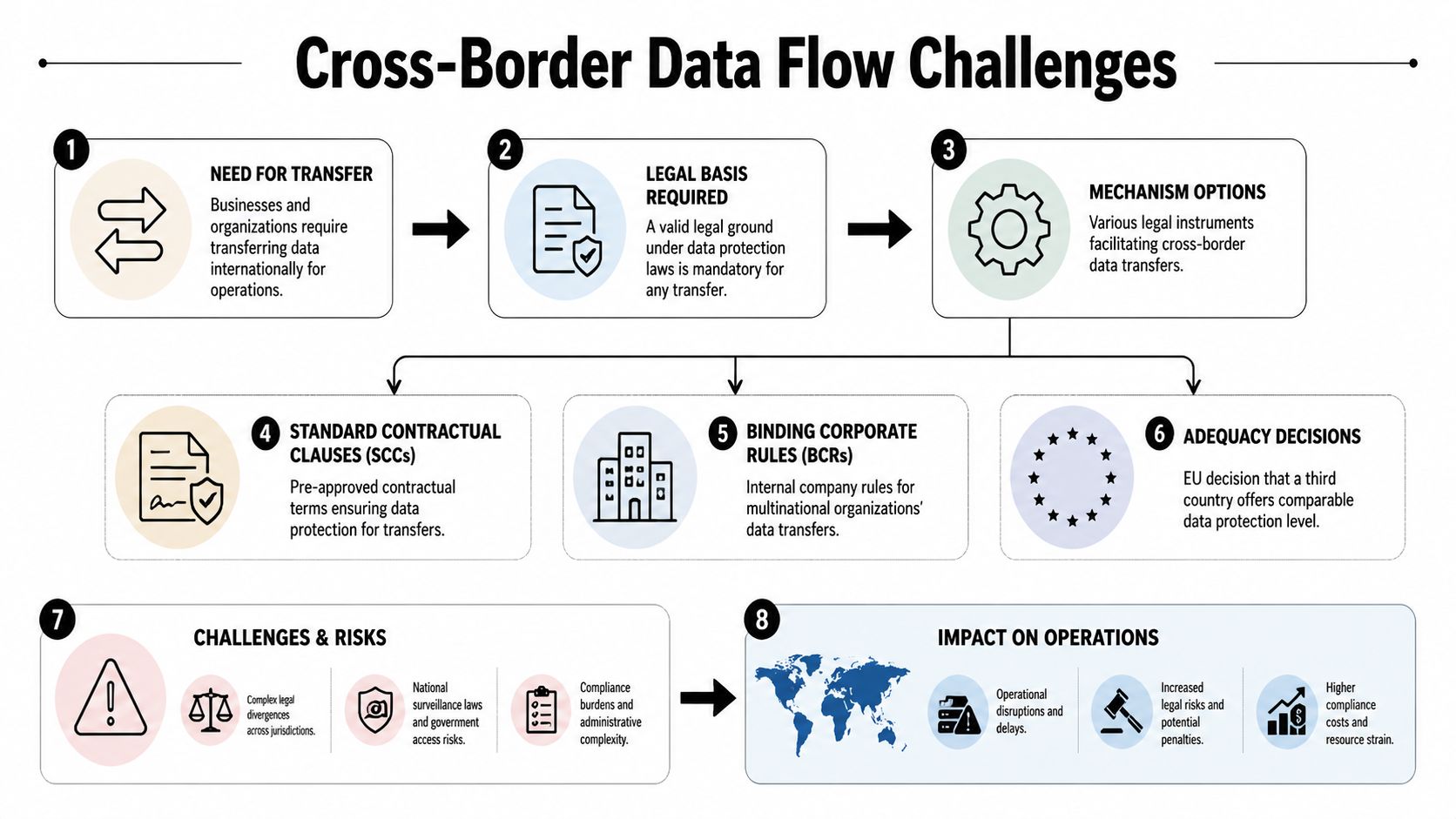
Cross-border data transfers sit at the fault line between privacy law and geopolitical reality. Everyone involved in a digital economy needs them. Regulators scrutinise them because once data leaves one legal system, rights and remedies can weaken quickly.
Why transfer mechanisms matter
The main legal tools are conceptually straightforward. Adequacy decisions amount to a judgment that another jurisdiction offers a sufficiently comparable level of protection. Standard Contractual Clauses are pre-approved contractual commitments intended to preserve safeguards after transfer. Binding Corporate Rules perform a similar function within multinational groups by creating internal obligations for intra-group data movement.
What complicates matters is that these mechanisms only work if the broader legal environment doesn't undercut them. That is why the legal and political aftershocks of Schrems II were so significant. The case exposed a structural problem that still defines global data governance: private contracts cannot fully neutralise public surveillance powers.
This isn't only a European issue. It is a recurring problem wherever one jurisdiction conditions transfers on rights-based safeguards and another reserves broad state access powers. The legal mechanism may appear stable until a court, regulator, or civil society challenge asks a more basic question. What happens to the data when state interests intervene?
A practical discussion of managing AI data security risks is useful here because AI systems magnify this tension. They rely on large, distributed data environments, but the more strategic and sensitive the data becomes, the harder unrestricted transfer becomes to defend.
The strategic risk behind legal transfers
For firms, transfer compliance is often treated as a documentation exercise. For governments, it is increasingly a sovereignty issue. The disagreement matters because legal uncertainty can disrupt procurement, cloud architecture, internal analytics, fraud monitoring, and research collaboration.
Three strategic implications follow:
- Transfers are now trade issues: Restrictions on moving personal data affect digital services, finance, health research, and advanced manufacturing.
- Surveillance law shapes commercial risk: A company may satisfy contractual requirements yet still face transfer instability if foreign state access is deemed disproportionate.
- AI intensifies jurisdictional conflict: Training, testing, and deployment often depend on multi-country data access, making transfer restrictions operational rather than theoretical.
The broader debate on internet governance in the global digital order is relevant because cross-border data flow disputes are no longer technical annexes to trade policy. They are central to how states define trust, jurisdiction, and control in the digital sphere.
Legal transfer mechanisms don't remove political risk. They package it into forms that can be challenged later.
That is why even replacement frameworks between major economies often remain fragile. They may restore operational continuity for a time, but they don't dissolve the underlying conflict between privacy commitments and intelligence or law-enforcement powers.
Enforcement Realities and the Compliance Deficit
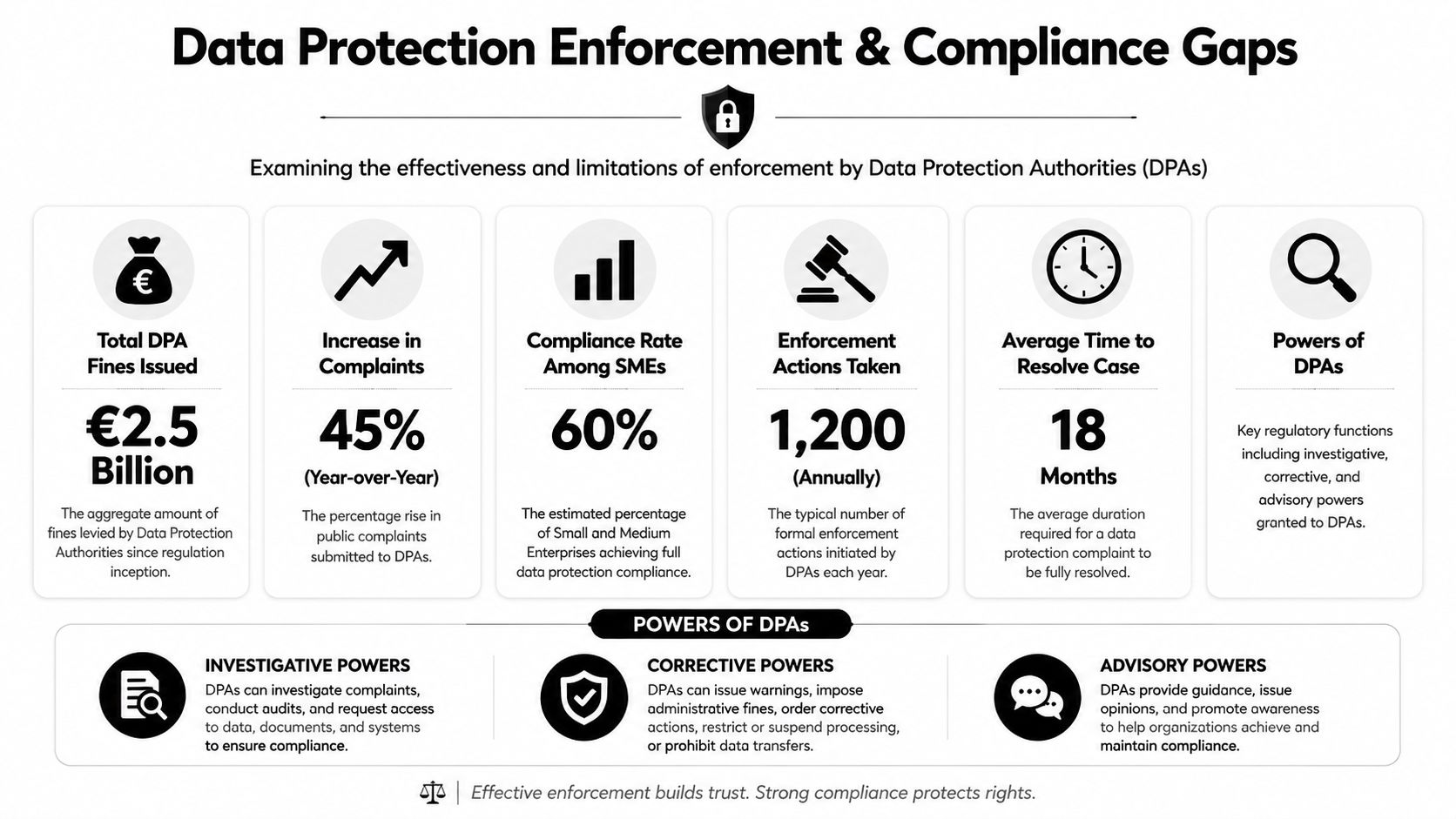
Enforcement is where the global data governance debate stops being abstract. Rights on paper matter far less if regulators lack the staff, technical expertise, or political backing to turn them into repeatable outcomes. That gap is widening as governments promise stronger individual protections while also reserving broader powers for security, industrial policy, and public administration.
Rights inflation, capacity constraints
The UK illustrates the problem clearly. As noted earlier, complaint volumes remain high, but formal regulatory action reaches only a small fraction of cases. The point is not that the Information Commissioner's Office is inactive. The point is that any regulator facing mass complaints, fast-changing technology, and limited resources must ration its attention.
That administrative reality has strategic consequences. It shifts the system away from universal enforcement and toward selective signalling. Authorities tend to prioritise cases with systemic implications, visible consumer harm, or precedent value, while many other complaints are resolved through guidance, mediation, or closure without a major sanction. For citizens, that can weaken confidence in the practical value of legal rights. For firms, it can create a distorted incentive structure in which formal legal exposure is high, but the probability of close scrutiny is uneven.
The result is a compliance deficit, not solely an enforcement deficit. Large organisations often build programmes designed to withstand public controversy and regulator questions, yet still tolerate weak internal discipline in lower-visibility processing. Smaller entities may conclude that modest enforcement rates justify delay, especially where compliance costs compete with other operational pressures.
The wider policy lesson is uncomfortable. Expanding rights without matching supervisory capacity can produce a system that is more expressive than effective.
Compliance pressure starts before enforcement
Even so, selective enforcement does not reduce day-to-day legal exposure. Under Article 33 of the UK GDPR, controllers must report certain personal data breaches to the ICO within 72 hours of becoming aware of them, as summarised by GRC Solutions on GDPR breach requirements. Under Article 32, controllers and processors must apply security and governance measures proportionate to risk, including pseudonymisation and encryption of personal data, with significant penalties available for serious failures, according to DLA Piper's UK data protection overview.
Those duties shape behaviour long before any enforcement notice arrives. Boards decide how much incident readiness to fund. Procurement teams choose vendors with stronger or weaker audit trails. Product teams decide whether data minimisation is treated as a design constraint or a legal afterthought. In sectors handling sensitive records, operational discipline also depends on technical assurance, including forms of medical industry security testing that identify weaknesses before a breach turns into a reporting event.
A credible compliance posture usually includes four elements:
- Decision records: Clear documentation of why processing occurs, which lawful basis applies, and who authorised the activity.
- Security controls: Encryption, pseudonymisation, access restrictions, and vendor oversight matched to the sensitivity of the data involved.
- Incident discipline: Escalation routes that let legal, technical, and executive teams assess reportability quickly.
- Retention rules: Defined schedules for deletion or review, rather than indefinite storage driven by convenience.
The UK's post-Brexit trajectory gives this issue broader significance. Its reform agenda seeks to reduce administrative friction and support innovation, while preserving enough continuity with European standards to protect international data flows. That balancing act reflects a larger global pattern. States are not choosing between rights and control in a clean way. They are trying to preserve both, then relying on under-resourced institutions and private compliance teams to manage the contradiction.
That matters for international cooperation. If enforcement intensity, state access powers, and compliance expectations diverge too far, formal convergence in legal text will not produce real interoperability in practice. The harder question is no longer who has the most rights on paper. It is which jurisdictions can build supervisory systems, corporate accountability, and technical governance that make those rights durable under economic and security pressure. The debate over governing AI in Society 5.0 points in the same direction, because algorithmic governance will expose the same institutional weakness at greater speed and scale.
Future Frontiers AI Health Data and Geopolitics
The next phase of data protection regulations will be shaped by two forces that don't naturally fit together. AI systems require broad access to data, iterative testing, and adaptive decision-making. States increasingly want more data access for fraud detection, security, and strategic governance. Citizens, at the same time, expect stronger rights over automated outcomes and more control over sensitive information.

Automated decisions and state access
The UK's recent reforms show this tension in unusually direct form. The Data (Use and Access) Act confirms that individuals can request human review of harmful automated decisions, while also granting agencies powers to compel banks to share targeted financial activity data without prior consent, as described in the source material on the Act's operational implications at this briefing discussion.
That combination matters because it doesn't merely add rights. It redistributes discretion. Private actors may face stronger obligations to explain or revisit automated decisions, while public authorities gain wider practical access to data in the name of fraud control or administrative efficiency.
For compliance teams, the result is contradictory pressure. They may need to build more rigorous review mechanisms for algorithmic outputs at the same time as they expand data-sharing capabilities for state requests. In governance terms, the citizen is protected and exposed simultaneously.
The wider policy debate on governing AI in Society 5.0 captures why this matters beyond the UK. AI governance is no longer separable from data governance. A rule on automated decisions is also a rule on evidence, accountability, system design, and institutional trust.
Health data and strategic exceptions
Health data sharpens the issue further because it carries both intimate personal significance and obvious public value. Health ministries, research institutions, and life sciences firms all argue, often with good reason, that strict data limits can impede scientific progress and public health planning. Privacy advocates respond, also with good reason, that exceptional access granted during one policy cycle tends to persist into the next.
The UK Data Protection Act 2018 contains a notable research and archiving pathway. It permits storage of personal data for longer periods than standard retention minimisation would otherwise allow, provided safeguards such as data minimisation and pseudonymisation are implemented. It also creates a route for processing sensitive data for scientific purposes without establishing new consent in certain circumstances, provided the data is not used for incompatible decisions affecting the data subject, as explained by DPO Consulting's overview of the UK Data Protection Act.
That's a rational accommodation to research needs. It is also a reminder that data protection regimes always contain exceptions where collective goals outweigh individual control. The policy challenge is not eliminating such exceptions. It is governing them transparently.
For organisations handling medical or health-adjacent systems, technical assurance matters as much as legal drafting. Sector-specific guidance on medical industry security testing is helpful because health data governance fails quickly when security validation lags behind legal obligations.
A second strategic exception involves erasure rights. In the UK, public discussion often imports broad Article 17 logic from EU debates without accounting for national exemptions linked to Parliament and national security. The practical effect is that the “right to be forgotten” can be much narrower in security-related contexts than many citizens assume.
This later discussion adds a useful policy lens:
The geopolitical conclusion is straightforward. Data protection is no longer only about shielding the individual from private misuse. It is also about defining when states may override individual claims in pursuit of security, economic integrity, public administration, and strategic research.
Policy Pathways for a More Coherent Digital Future
The fragmentation of data protection regulations won't be solved by waiting for a single global rulebook. That outcome is politically implausible. But the current trajectory, where states borrow privacy language while diverging on state access, transfer rules, and enforcement design, carries mounting costs for trade, innovation, and democratic trust.
What governments should do now
G7 and G20 governments should focus on interoperability over uniformity. That means aligning around a narrower set of common commitments that can travel across legal systems even when full harmonisation is impossible.
A workable agenda would include:
Common baseline principles for trusted transfers
Governments should agree on minimum safeguards for proportionality, redress, security controls, and oversight where personal data crosses borders. The objective isn't identical surveillance law. It is reducing the legal shocks that occur when transfer mechanisms collide with opaque state powers.Shared standards for automated decision review
If human review rights are becoming a core protection in AI-enabled administration and commerce, countries should define a common operational floor for when review is available, who conducts it, and what explanation individuals can receive.Stronger rules for exception governance
National security, anti-fraud, scientific research, and public health exceptions should be documented with clearer oversight, scope limits, and review mechanisms. Exceptions are inevitable. Opacity is not.Administrative investment in enforcement capacity
Rights without institutional capacity weaken public confidence. Governments should fund regulators, specialist investigators, and technical audit capacity so that complaints systems do more than absorb public frustration.
Public trust depends on whether rights can be exercised in practice, not on how elegantly they are drafted.
What multilateral forums can still achieve
International organisations can still play a useful convening role even in a fragmented environment. The OECD, G7, G20, and relevant UN bodies are well placed to advance practical interoperability in four areas.
- Terminology alignment: common meanings for concepts such as high-risk processing, sensitive data, meaningful human review, and adequate safeguards.
- Model cooperation tools: templates for transfer assessments, regulator dialogue, and cross-border incident coordination.
- Sector guidance: especially for finance, health, and AI, where state interests and private data processing are tightly entwined.
- Peer review mechanisms: structured comparison of how jurisdictions operationalise rights and exceptions, rather than just how they draft them.
The private sector also has a role that goes beyond box-ticking. Firms that embed privacy by design, document lawful basis choices clearly, and prepare for cross-border legal volatility will be better positioned than those that treat compliance as a static legal memo. In a fragmented environment, governance discipline becomes a strategic asset.
The broader choice for policymakers is not between deregulation and digital isolation. It is between managed interoperability and unmanaged fragmentation. The first preserves room for innovation and cross-border cooperation. The second invites recurring legal disputes, weaker public trust, and a more brittle digital economy.
Global data governance is entering a decisive phase, and informed multilateral leadership matters. For more policy analysis on digital regulation, AI, trade, and international cooperation, explore Global Governance Media and join the wider conversation on building a more trustworthy and coherent digital future.