


By Alex Morgan
Is housing inequality an unavoidable by-product of urbanisation and migration, or is it the cumulative result of policy choices that governments can change? For G20 decision-makers, that question matters because housing is not merely a welfare file. It shapes labour mobility, household resilience, social cohesion, and the credibility of the state itself.
The policy relevance is becoming harder to ignore. In the UK, one frontline organisation recorded a 30 percent increase in requests for housing support in a single year, a sharp signal that vulnerability can deepen quickly even in advanced economies, as noted in this profile of Positive Action in Housing. When demand rises that fast, housing policy stops being a narrow administrative concern and becomes part of macroeconomic risk management.
That is why positive action in housing deserves a wider frame. It is best understood not as an NGO niche, but as a strategic tool for governments trying to reduce entrenched disadvantage, stabilise communities under pressure, and improve the efficiency of public spending. Housing insecurity pushes costs into emergency services, education systems, migration management, and local government. Housing stability does the reverse.
A serious growth agenda needs to start from the institutional basics of how households participate in the economy. That broader economic lens is well developed in work on the foundations of economic activity, and housing belongs at the centre of it.
Table of Contents
- Introduction Housing as a Pillar of Economic Stability
- Unpacking the Concept What is Positive Action in Housing
- The Legal and Ethical Mandate for Action
- A Global Snapshot Comparative International Approaches
- The Ripple Effect Evidence of Socio-Economic Outcomes
- Designing Your Policy Framework Key Levers and Choices
- Implementation Safeguards and Performance Monitoring
- Conclusion Integrating Housing into the Global Governance Agenda
Introduction Housing as a Pillar of Economic Stability
Why does housing still sit at the margins of macroeconomic strategy when it shapes labour mobility, household resilience, fiscal pressure, and social cohesion?
Governments often classify housing as a social sector expenditure. In practice, it functions as core economic infrastructure. Where housing is stable, workers can remain attached to employment, children face fewer disruptions to education, and public services spend less time responding to avoidable crises. Where housing systems are exclusionary or overstretched, the costs spread across health systems, local government, policing, migration administration, and labour markets. The connection between shelter and productivity is not rhetorical. It sits within the wider foundations of economic activity.
This matters for G7 and G20 policymakers because housing instability can weaken inclusive growth even when headline economic indicators appear sound. A labour market can generate jobs while workers still cannot live near them. A city can attract investment while lower-income households are pushed into insecure tenures, overcrowding, or informal arrangements. Those pressures do not remain local for long. They increase fiscal strain, intensify political grievance, and reduce trust in institutions.
Positive action in housing should be understood against that backdrop. It is a policy instrument for correcting persistent access failures that formally neutral systems leave in place. Generic housing policy can expand supply or standardise rules, but it often misses groups facing language barriers, discriminatory screening, inaccessible application processes, irregular income patterns, disability-related constraints, or weak documentary histories. If those barriers are left untouched, governments absorb the consequences elsewhere in the system.
For ministers focused on stability, the strategic question is not whether to target disadvantage, but how to do so with legal discipline and clear public purpose. Well-designed positive action allows states to direct limited administrative and financial capacity toward documented barriers before they harden into homelessness, labour market detachment, or neighbourhood-level instability.
Housing instability is rarely an isolated social problem. It is usually a coordination failure across labour, welfare, migration, and local governance.
That point changes the policy frame. Positive action in housing is not only about fairness for affected households. It is also about state capability. Governments that can identify exclusion early, intervene proportionately, and monitor outcomes are better positioned to protect social stability and sustain broad-based growth.
Unpacking the Concept What is Positive Action in Housing
Positive action in housing means taking proportionate steps to reduce disadvantage or remove barriers faced by groups that are under-served or exposed to systemic exclusion in the housing system. It is an intervention logic, not a slogan. The purpose is to correct unequal conditions that ordinary, formally neutral policy leaves in place.

A practical analogy helps. If equal opportunity is opening the same door to everyone, positive action is building a ramp when some people were never able to reach the door in the first place. The point isn't permanent preference. The point is fair access to the system's actual benefits.
What positive action is and is not
Positive action is often confused with positive discrimination. That confusion weakens policy debate. In most legal systems, giving automatic preference solely because of a protected characteristic is treated very differently from taking measured action to address a documented disadvantage.
Three distinctions matter:
- Barrier removal, not blanket preference: Positive action identifies obstacles such as language barriers, discrimination, inaccessible application processes, or poor access to legal advice, then designs remedies around those barriers.
- Proportionate response, not open-ended entitlement: Measures should fit the problem and be reviewed over time.
- Outcome realism, not abstract neutrality: Governments can't assume that formally identical treatment produces substantively fair outcomes when the underlying conditions are unequal.
How it appears in housing practice
In housing, positive action can include targeted advice services, multilingual casework, priority pathways for groups facing documented exclusion, accessibility standards, anti-discrimination enforcement, and community-led support structures that help people use their rights in practice. It can also shape procurement, funding criteria, local partnership design, and data collection.
Practical rule: If a policy treats everyone the same while known barriers remain in place for some groups, it may be administratively neutral but substantively ineffective.
That is why positive action in housing sits between two weak extremes. One says universal policy is always enough. The other treats targeted support as unfair. Both miss the central governance question, which is whether public action is capable of correcting structurally uneven access to safety, affordability, and legal protection.
The Legal and Ethical Mandate for Action
Policymakers need more than good intentions. They need a defensible basis for intervention. Positive action in housing rests on both legal principle and ethical necessity, provided measures are proportionate, evidence-led, and directed at identifiable disadvantage.

Legal foundations
At the international level, the right to adequate housing is embedded in the broader architecture of economic and social rights. Regional human rights frameworks and domestic equality regimes then shape how states translate that principle into practice. In the UK context, the Equality Act 2010 is widely understood to permit proportionate action aimed at overcoming disadvantage or increasing participation where need is established.
That legal distinction matters. Governments are not being asked to abandon equal treatment. They are being asked to recognise that equal treatment sometimes requires differential measures when exclusion is systemic, not accidental.
Ethical grounds for intervention
There are three ethical arguments that should resonate across G20 systems.
- Historical correction: Housing markets and public institutions often carry the legacy of exclusion. Ignoring that history preserves its effects.
- Institutional legitimacy: Residents are more likely to trust public systems when those systems acknowledge and address predictable patterns of disadvantage.
- Economic inclusion: Households that can secure stable housing are better placed to participate in work, education, and civic life.
These aren't competing rationales. They reinforce one another. A housing system that leaves specific groups trapped in recurring instability will eventually produce broader fiscal and political strain.
The threshold for credible action
Positive action should meet a high standard. Policymakers should be able to answer four questions clearly:
- What disadvantage is being addressed?
- Which group is affected and how do we know?
- Why won't universal policy solve this on its own?
- How will proportionality and review be maintained?
A lawful housing intervention is not one that avoids differentiation at all costs. It is one that can justify differentiation with evidence, purpose, and restraint.
That is the ethical centre of the issue. Positive action in housing is not an exception to fairness. In many cases, it is the mechanism through which fairness becomes operational.
A Global Snapshot Comparative International Approaches
What can G20 policymakers learn from housing systems that treat inclusion as an instrument of economic management rather than a residual welfare function?
Comparative practice shows that positive action in housing is not a single programme design. It is a policy approach that operates through different institutional channels depending on market structure, legal tradition, and state capacity. The strategic question is less about which country has the "best" model and more about which mechanism can correct identifiable access barriers without weakening overall system credibility.
A broader benchmark is available in this review of G20 performance on housing systems and institutional delivery. The central governance issue is whether housing institutions can translate formal equality into measurable access for groups that face persistent exclusion.
International Models of Positive Action in Housing
| Country/Region | Primary Model | Key Policy Levers | Target Focus |
|---|---|---|---|
| UK | Community and charity-linked targeted support alongside statutory duties | Advice services, tenancy support, anti-discrimination casework, local authority referral pathways | Refugees, minority ethnic households, people facing housing discrimination |
| Netherlands | Mainstreamed social housing systems | Regulated non-profit provision, allocation systems, municipal coordination | Broad affordability with scope for targeted access measures |
| Austria | Public-interest housing provision | Long-term supply planning, limited-profit development, affordability rules | Middle and lower income households, urban stability |
| Canada | Mixed local policy tools | Inclusionary zoning, municipal planning powers, partnership-based delivery | Affordability pressures and inclusion in high-demand areas |
| South Africa | State-led redress and subsidy approaches | Subsidies, settlement upgrading, post-apartheid redistribution measures | Historically disadvantaged communities |
The comparison matters because each model assigns the burden of inclusion differently. In the Netherlands and Austria, a larger regulated housing sector allows governments to pursue inclusion through mainstream allocation and supply policy. In the UK and Canada, where provision is more fragmented, targeted support and local partnerships often carry more of the practical burden. In South Africa, housing policy still has an explicit redress function shaped by historical exclusion at national scale.
This produces a less obvious conclusion. Positive action is easier to sustain politically when it is embedded in ordinary housing institutions rather than presented as an exceptional add-on for a small number of groups. Systems with stable public-interest supply can incorporate targeted access rules with less administrative friction and less political contestation because the overall stock is larger and allocation choices are not perceived as zero-sum to the same degree.
The UK illustrates a different lesson. Where statutory systems are complex and unevenly accessed, community organisations often perform a public-function role by connecting formal rights to actual entry points in the housing system. That role has implications beyond individual assistance. It can reduce administrative failure, improve take-up among excluded groups, and give local authorities better intelligence on where universal schemes are not reaching intended populations.
Policy design should therefore start with institutional diagnosis. Governments need to ask whether the binding constraint is supply, allocation, legal enforcement, administrative access, or trust in public agencies. Different constraints require different forms of positive action. Expanding social stock, refining allocation rules, funding specialist intermediaries, and improving local referral systems are not interchangeable tools. They address different failures.
For G7 and G20 governments, the wider implication is strategic. Housing inclusion affects labour mobility, fiscal pressure, social cohesion, and the credibility of public institutions. Comparative experience suggests that positive action is strongest when treated as part of economic governance, with delivery channels chosen to match the structure of the housing system rather than the preferences of any single ministry or sector.
The Ripple Effect Evidence of Socio-Economic Outcomes
The strongest argument for positive action in housing is not moral language alone. It is the evidence that housing interventions create benefits beyond the households directly assisted.

Research from Children's HealthWatch found that a 5 percent increase in subsidised housing removes cost-burdened households from housing stress and also reduces the likelihood that remaining households experience overcrowding by 20 percent, because market pressure eases more broadly, according to the Children's HealthWatch report. That finding should matter to finance ministries as much as housing ministries. It shows that targeted housing investment can improve conditions even for people who don't receive a unit directly.
The wider implication is straightforward. Housing policy has spillover effects. Better housing availability can lower pressure elsewhere in the market, reduce overcrowding, and improve household financial breathing room across a larger population than beneficiary counts alone would suggest.
Why market spillovers matter
Traditional programme evaluation often falls short. Governments count units, placements, and case completions. They don't always capture reduced crowding, lower crisis demand, or improved stability for adjacent households. Positive action in housing should therefore be assessed not only by direct outputs, but by how it shifts system conditions.
That broader anti-poverty lens is central to debates on breaking the cycle of poverty and inequality through housing, where secure housing functions as a platform for mobility rather than a stand-alone service category.
A useful discussion of housing's wider social role appears below.
What policymakers should count
A serious economic case for positive action in housing should include more than supply numbers. It should examine whether interventions reduce instability, improve affordability, and lower the intensity of crisis response.
- Direct effects: fewer households in acute housing stress, fewer unresolved cases of overcrowding, stronger access to affordable options.
- Indirect effects: lower pressure in local rental markets and reduced competition for scarce low-cost homes.
- Institutional effects: less fragmentation between support services, landlords, and local authorities.
Housing policy generates returns through prevention. The savings rarely appear in one budget line, which is why weak coordination often understates its value.
For G20 governments, that is the strategic takeaway. Positive action in housing is not a marginal social add-on. It is one of the clearest examples of how targeted intervention can improve both equity and system efficiency.
Designing Your Policy Framework Key Levers and Choices
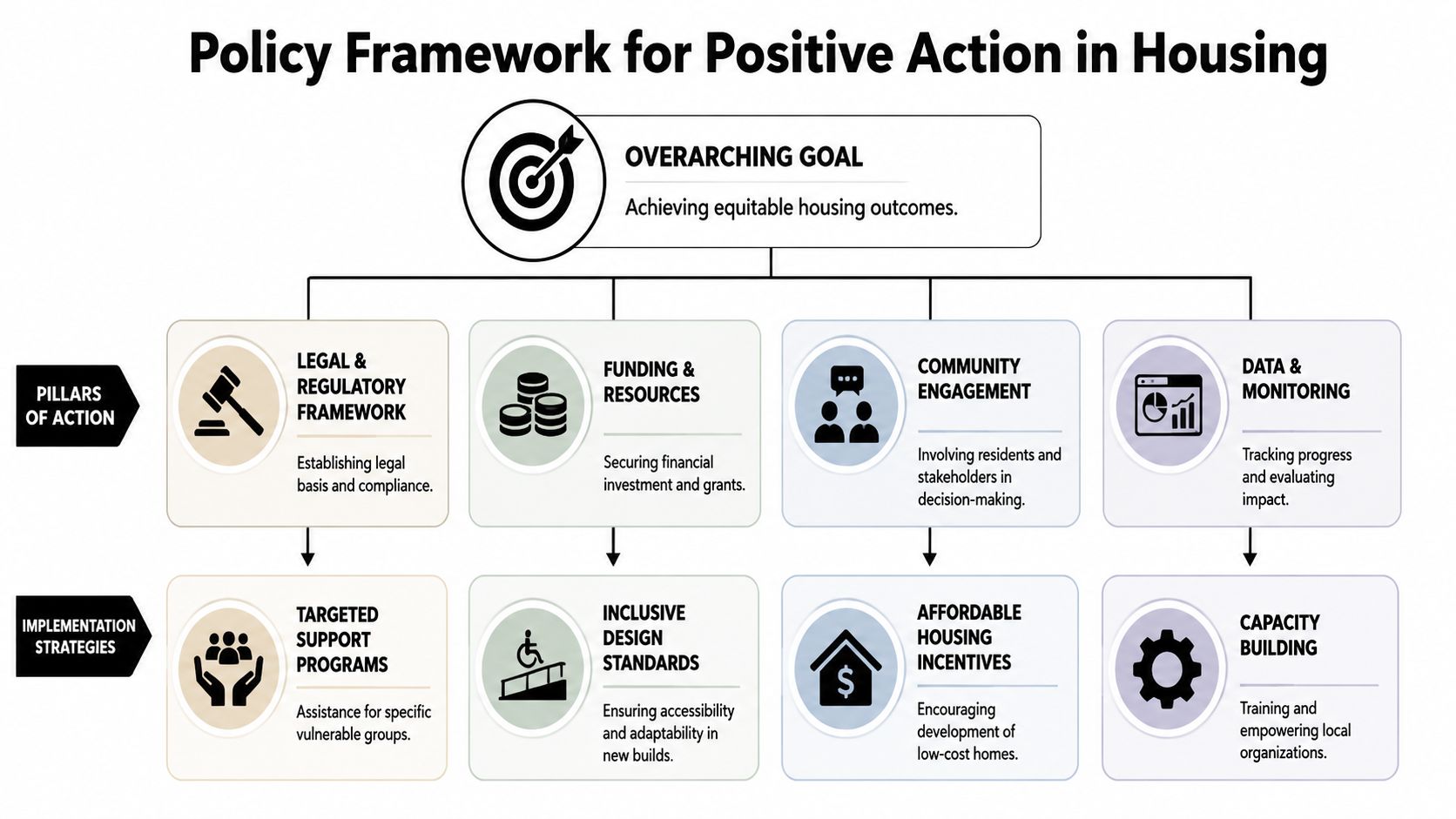
Good intentions collapse quickly without a usable policy architecture. Positive action in housing needs clear choices on targeting, delivery, funding, and accountability. Those choices should follow the structure of disadvantage rather than ideological preference for a single model.
One workable example comes from the UK. Positive Action in Housing's Housing Equality Action Unit supported 808 adults and children from 37 countries facing issues including discrimination, overcrowding, and disrepair, as set out in the organisation's annual report. The underlying lesson isn't that every country needs the same institution. It is that community-led governance can address complex housing barriers effectively when policy design takes affected communities seriously.
Four design choices that determine success
Targeting
The first question is who the intervention is for. Some governments will target by protected characteristic where disadvantage is documented. Others will use geography, migration pathway, family status, disability, or housing condition. The right answer depends on the barrier being removed.
Delivery
The second question is who should act. In some contexts, local authorities have the reach and legitimacy to deliver directly. In others, trusted community organisations are better placed to support households that distrust or struggle to deal with official systems.
Funding
The third question is how to finance action. Policymakers can combine direct subsidy, grant funding, procurement conditions, planning gain, or matched local financing. The key is not the instrument alone. It is whether the funding model rewards prevention and inclusion rather than short-term crisis throughput.
Capacity
The fourth question is whether institutions can execute. Even strong legislation fails if frontline staff lack training, data systems are weak, or referral pathways are fragmented.
A practical decision screen
Before launch, policymakers should test any proposal against a short decision screen:
- Does it address a defined barrier: The intervention should solve a specific access problem, not gesture at fairness in general terms.
- Can frontline actors deliver it: If implementation relies on local discretion, staff need clear authority and guidance.
- Will the target group use it: Community trust, language access, and procedural simplicity matter as much as formal entitlement.
- Can results be monitored: If outcomes can't be tracked, the programme will drift into symbolic compliance.
Many housing reforms stall when they focus on legislation and underinvest in operating model. Positive action in housing works when legal permission, community reach, and administrative design are aligned.
Implementation Safeguards and Performance Monitoring
Targeted housing policy attracts scrutiny, and it should. That is why implementation safeguards are not bureaucratic decoration. They are central to legitimacy. Eligibility rules must be clear. Appeals processes must be available. Review points must be built in so governments can show that measures remain necessary and proportionate.
The other half of the task is monitoring. Output metrics alone are weak guides. Counting homes allocated or cases opened doesn't tell ministers whether households are becoming more stable or merely moving through a stressed system more quickly.
What should be monitored
UK practitioner guidance recommends tracking 7 to 9 key indicators rather than relying only on rent payment data. It also stresses that rent burden should be treated as a leading indicator of instability, because households spending more than 30 to 35 percent of income on housing face increased eviction risk even before arrears accumulate, as outlined in the practitioner guide on housing stability.
That guidance is especially valuable because it moves monitoring upstream. Instead of waiting for formal default, it asks institutions to identify risk earlier.
A stronger performance architecture
A credible monitoring framework should combine three layers:
- Household indicators: rent burden, arrears trajectory, lease compliance, involuntary exits, and other signs of financial stress.
- Property or programme indicators: turnover, debt reduction, repair outcomes, and case resolution patterns.
- Neighbourhood indicators: local opportunity conditions, service access, and patterns of concentration or exclusion.
The best housing dashboards don't just record failure after the fact. They help teams intervene before failure becomes expensive.
That changes governance behaviour. Housing stability stops being the sole concern of resident support staff and becomes a shared operational responsibility across property management, casework, local partnerships, and public agencies.
Safeguards that preserve public confidence
Monitoring alone isn't enough. Positive action in housing also needs procedural safeguards that protect fairness.
- Transparent eligibility criteria so the rationale for targeting is visible.
- Time-bound review mechanisms so interventions can be adjusted or withdrawn when conditions change.
- Independent challenge routes so residents and providers can contest decisions.
- Consistent data standards so local results can be compared across jurisdictions.
Many programmes either earn or lose trust at this stage. If governments can show that targeted housing measures are evidence-led, reviewable, and operationally disciplined, political resistance becomes easier to manage and outcomes become easier to defend.
Conclusion Integrating Housing into the Global Governance Agenda
Positive action in housing should be treated as a governance instrument, not a peripheral social concession. It has a legal basis, an ethical rationale, and a practical role in correcting barriers that universal policy often leaves untouched. For G20 governments dealing with affordability stress, migration-linked pressure, and uneven local capacity, that makes it directly relevant to state performance.
The strongest case is strategic. Housing instability weakens labour participation, increases administrative cost, and deepens social fragmentation. Well-designed positive action can do the opposite. It can reduce preventable crises, improve access to rights, and make public systems more credible for groups that otherwise remain shut out.
The international implication is clear. Housing belongs within the same policy conversation as inclusive growth, fiscal resilience, and social stability. Governments that still treat it as a silo are likely to pay more later, in more expensive parts of the state.
For deeper analysis on housing, inclusion, and multilateral policy design, explore more from Global Governance Media. If you work in government, an international organisation, or a policy-facing institution, subscribe to its briefings and register for upcoming summit coverage to stay ahead of the decisions shaping the global housing agenda.