

By Daniel Okoye
Britain's Nigerian population can't be understood through a single story of success. The most useful starting point is the official baseline: in England and Wales, 191,183 usual residents reported Nigeria as their country of birth in 2011, rising to 270,768 in 2021, an increase of 79,585 people, or about 41.6% according to the Office for National Statistics release on Nigerians in the UK. That is large enough to matter not just for local authorities and labour markets, but for bilateral diplomacy, higher education planning, health service design, and migration governance.
That growth also sits inside a bigger transformation of Britain itself. Nigerians in Britain are part of a country where the foreign-born population reached about 10.7 million in the combined 2021/22 Census, with 16% of the UK population born abroad, as summarised in Statista's overview of the Nigerian population in the United Kingdom. Yet the policy conversation still tends to flatten Nigerians in Britain into one of two caricatures: either a uniformly high-achieving diaspora or a migration-control problem.
Neither frame is adequate. A more serious reading shows a bifurcated reality. One part of the community is tied to skilled work, universities, professional sectors, and transnational family support. Another part faces status insecurity, barriers to services, labour-market vulnerability, and in some cases severe destitution. Policymakers who ignore that split will misread both the opportunities and the risks.
For UK and G20 stakeholders, that distinction matters because it shapes everything from visa policy to remittance expectations, from NHS access to UK-Nigeria cooperation. It also raises a broader governance question explored in this analysis of connected global communities: how should states engage diasporas that are economically important, socially rooted, and internally unequal at the same time?
Table of Contents
- Introduction A Diaspora Reshaping Britain
- Historical Context and Contemporary Scale
- Demographic and Socio-Economic Profile
- Economic Cultural and Scientific Contributions
- Navigating Challenges and Systemic Barriers
- Remittances and Development Linkages Re-examined
- Conclusion Policy Pathways for UK-Nigeria Cooperation
Introduction A Diaspora Reshaping Britain
The strongest policy insight about Nigerians in Britain is simple: this is no longer a niche diaspora issue. It is a mainstream question of state capacity, labour-market management, public-service design, and bilateral strategy. The census rise recorded in England and Wales over the last decade shows a community with both demographic weight and institutional relevance.
The second insight is less obvious but more important. Nigerians in Britain are often discussed through visible success stories in professional life, education, entrepreneurship, and public culture. Those contributions are real. But they coexist with a less visible population dealing with immigration insecurity, weak access to support, and exposure to exclusion in housing and low-paid work.
Britain doesn't face a single “Nigerian diaspora issue”. It faces two linked policy tasks at once: how to retain and integrate talent, and how to prevent vulnerability from hardening into long-term exclusion.
That duality has implications for several departments at once. The Home Office is dealing with migration routes and legal status. Universities and local authorities are dealing with student settlement pressures. The Department of Health and Social Care faces questions of trust and service access. The Foreign, Commonwealth and Development Office has an interest in how diaspora ties shape the broader UK-Nigeria relationship.
Post-colonial ties and changing mobility channels
The UK-Nigeria migration relationship rests on deep post-colonial connections in language, education, law, and professional pathways. Over time, those links have supported different kinds of mobility. Some movements were tied to long-settlement migration and family formation. More recent flows are increasingly shaped by higher education and work-related routes.
That matters because the policy instruments are different. A settlement-era frame points officials towards housing, schools, citizenship, and local integration. A work-and-study frame points them towards employer sponsorship, graduate retention, tuition dependence, and visa transitions.
Historical Context and Contemporary Scale

Between 2011 and 2021, the Nigeria-born population recorded in the census for England and Wales increased by more than two-fifths, rising from 191,183 to 270,768, as noted earlier. That pace of growth places Nigerians among the more consequential migrant-origin populations in Britain's major urban and institutional systems.
A second census marker sharpens the policy picture. In 2021, 271,390 people in England and Wales wrote in Nigerian as their ethnic group. Country of birth and ethnicity measure different things, but the near alignment of those two counts is analytically useful. It suggests a population that is not defined only by recent arrivals, yet is still closely tied to first-generation migration. For central government and local service providers, this distinction is critical, as demand in schools, health services, political representation, and community support does not map cleanly onto visa status or migrant stock alone.
Post-colonial ties and changing mobility channels
Britain's relationship with Nigerian migration was shaped first by empire, then by post-colonial institutional continuity. English language education, common-law traditions, professional accreditation routes, and university links created durable channels for movement. Family formation and long-settlement migration were part of that history, but they no longer explain the whole pattern.
The composition of mobility has changed. Contemporary inflows are more tightly linked to higher education and sponsored employment, with universities, employers, licensing bodies, and visa transition rules now playing a larger role in shaping who arrives, who stays, and who faces instability after entry. That shift helps explain the dual structure visible across the wider Nigerian-origin population in Britain. One segment is concentrated in skilled professions and formal institutions. Another sits closer to the edge of precarity, especially where legal status, housing, labour conditions, or access to support are less secure.
Reading the census baseline correctly
The census figures cited here cover England and Wales rather than the whole UK. That is a limitation of scope, not a weakness in the underlying evidence. For policy purposes, the data still carry significant weight because England and Wales contain most of the UK population and the largest concentration of the public institutions that shape integration outcomes.
The baseline is therefore practical as well as descriptive. It helps departments estimate pressure on health, education, housing, and local authority services. It also helps ministers avoid a recurring policy error. Treating Nigerians in Britain as a uniformly high-performing diaspora obscures the presence of a more vulnerable subgroup whose needs are less visible in headline accounts of educational and professional success.
| Measure | Figure |
|---|---|
| Nigeria-born usual residents in England and Wales, 2011 | 191,183 |
| Nigeria-born usual residents in England and Wales, 2021 | 270,768 |
| Increase over the decade | 79,585 |
| Approximate percentage increase | 41.6% |
| People writing in Nigerian as ethnic group in 2021 | 271,390 |
Policy implication: Nigerians in Britain should be treated as a large, internally differentiated population with implications for labour-market planning, local public services, and social cohesion, rather than as a single high-achieving migrant bloc.
Demographic and Socio-Economic Profile
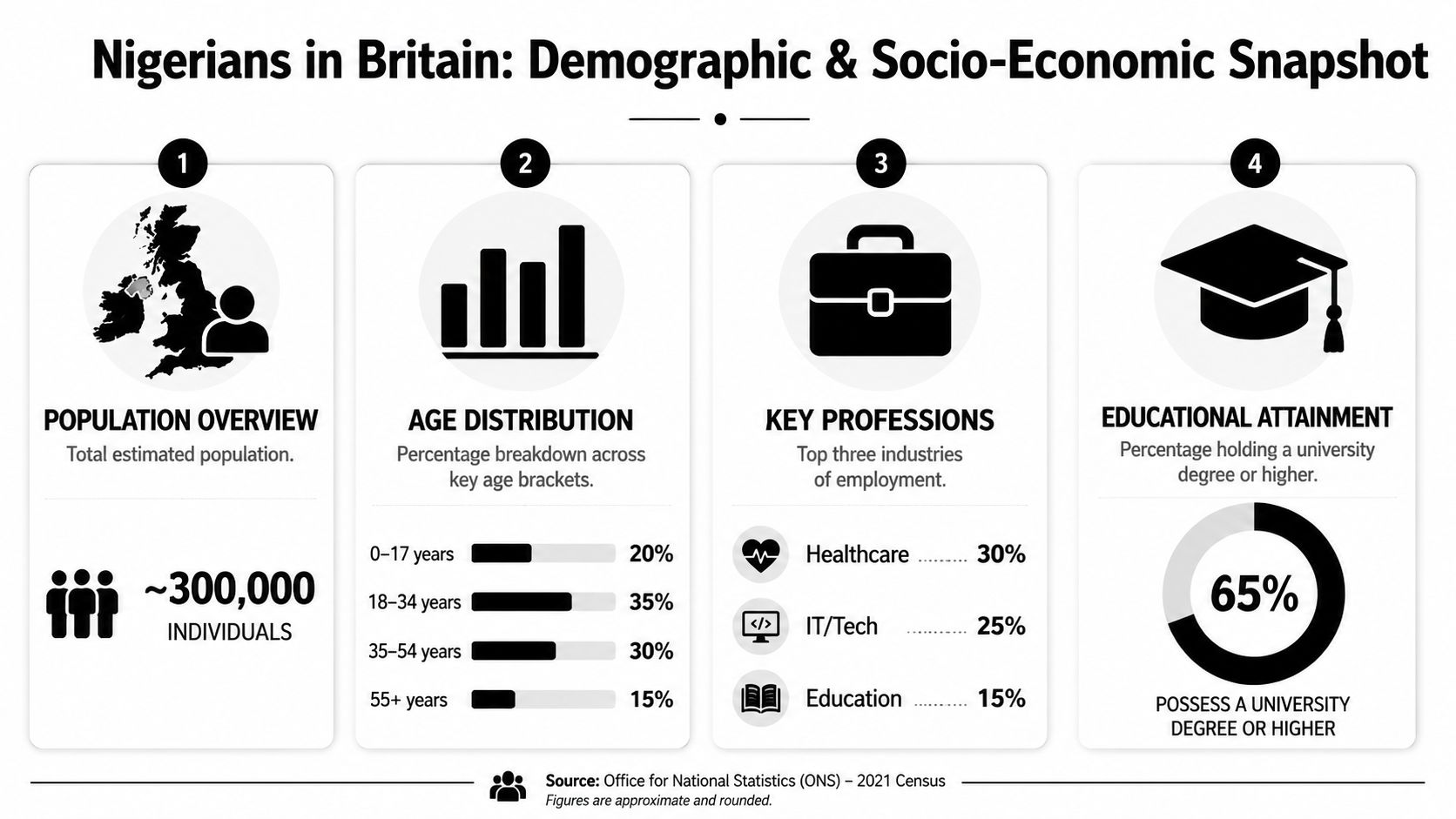
The sharpest insight into current inflows comes from visa composition rather than stock numbers. Reporting based on UK Office for National Statistics data indicates that around 52,000 Nigerians immigrated to the UK in the year ending December 2024, with 27,000 arriving on work-related visas, 22,000 on study visas, and 3,000 through other categories, as reported in the Guardian Nigeria coverage of 2024 Nigerian migration to the UK.
That mix matters more than it first appears. It points to two strong pipelines operating at once. One is linked to labour demand and sponsored work. The other is linked to tuition-paying students and the wider higher education economy. These routes shape not only entry to Britain, but also later questions of retention, family formation, and long-term settlement.
A migration system driven by work and study
A community built through work and study channels has a different socio-economic profile from one dominated by family reunion or humanitarian pathways. It tends to interact more intensely with employers, universities, licensing bodies, private rental markets, and post-study visa rules. That creates opportunities for mobility, but also points of institutional friction.
Three policy consequences follow.
- Labour-market exposure: Work-route migrants are directly affected by sponsorship rules, sectoral shortages, and employer compliance systems.
- University dependence: Study-route migrants are tied to tuition finance, accommodation pressures, and the uncertain transition from education to employment.
- Status volatility: Movement between visa categories can create periods of instability even for people who initially enter through lawful and high-skilled routes.
Visa composition in the year ending December 2024
The current flow profile can be summarised clearly.
| Visa Category | Number of Immigrants |
|---|---|
| Work-related visas | 27,000 |
| Study visas | 22,000 |
| Other categories | 3,000 |
This is the key point for ministers. Nigerians in Britain are not only a settled community with established roots. They are also a live policy interface between the UK labour market and the UK university system. If either system becomes more restrictive, costly, or unpredictable, the effects won't be abstract. They'll show up in staffing pipelines, student recruitment, graduate transitions, and bilateral perceptions of fairness.
A work-and-study profile makes Nigerians in Britain unusually sensitive to policy changes that originate outside “diaspora policy” itself, especially decisions on student migration, sponsorship compliance, and post-study work.
Economic Cultural and Scientific Contributions
Nigerians in Britain contribute to national capacity through a wide institutional footprint, but the policy significance lies in how unevenly those gains are distributed. The public narrative often concentrates on visible success in medicine, finance, academia, technology, and the arts. That account is partly accurate. It is also incomplete, because it can obscure a second reality of insecure work, stalled professional recognition, and undercounted care labour within the same diaspora.
For UK decision-makers, that duality matters more than celebratory rhetoric. A diaspora can expand state capability and still contain groups whose skills are underused or whose work remains informal, temporary, or poorly protected. The right policy question is therefore not whether Nigerians contribute. It is how British institutions convert education, expertise, entrepreneurship, and cultural capital into sustained economic value across the whole distribution, rather than only for those already positioned to succeed.
Contribution across core systems
The strongest evidence of contribution is institutional rather than symbolic. Nigerians are present in sectors where the UK faces long-running capacity pressures and international competition for talent.
- Health and care: Nigerian-trained and Nigerian-origin staff support service delivery across clinical and care settings, particularly where domestic recruitment has struggled to meet demand.
- Higher education and research: Nigerian students, lecturers, and researchers add fee income, specialist knowledge, and international linkages that strengthen university ecosystems.
- Technology and business formation: Nigerian professionals and founders connect the UK to fast-moving transnational networks in digital services, finance, trade, and creative enterprise.
- Arts, media, and public life: Nigerian-origin creatives and commentators shape British culture in ways that influence publishing, music, broadcasting, fashion, and civic debate.
These contributions are economically relevant because they sit inside systems the UK already depends on. Health staffing, university finance, innovation diffusion, and cultural exports all affect productivity, soft power, and Britain's international attractiveness.
The overlooked split within contribution
The more difficult point is that the same community can contain both high-performing professionals and a less visible subgroup facing insecurity. Skilled migrants may enter regulated professions but still encounter delays in credential recognition, sponsorship dependence, or occupational downgrading. Others work below qualification level, cycle through unstable jobs, or shoulder unpaid family and community support that rarely appears in labour-market analysis.
This bifurcated profile has direct policy implications. It means headline stories about achievement can lead institutions to miss barriers affecting a substantial minority. It also means aggregate success should not be treated as proof that integration systems are functioning well for all entrants.
A more effective policy approach would align visa design, labour standards, and recognition frameworks with actual pathways into work. The case for this is wider than the Nigerian diaspora alone, and is reflected in broader arguments for a migration system that works for workers, employers, and receiving states.
Why this matters for British competitiveness
For G20 and UK stakeholders, the strategic issue is state performance. Countries gain when they can attract skilled people, absorb them efficiently into productive sectors, and retain trust across migrant communities over time. They lose when bottlenecks push qualified workers into underemployment or when cultural contribution is celebrated while structural exclusion is ignored.
Britain's comparative advantage will depend less on headline inflows than on institutional conversion rates. Can the NHS recruit and retain international staff on fair terms? Can universities turn student inflows into research strength and graduate productivity? Can professional and regulatory systems recognise overseas training quickly enough to prevent skill waste? Can labour enforcement reach those in the diaspora who are least visible to policymakers?
The standard “high-achieving diaspora” frame misses this governance test. Nigerians in Britain are contributing to British prosperity, culture, and science. The larger policy challenge is to widen the share of the community able to contribute at full capacity, while reducing the gap between celebrated excellence and hidden precarity.
Navigating Challenges and Systemic Barriers

The most persistent policy error is to treat underuse of public services as evidence of low need. Mental health access shows why that fails. A 2025 study on Ghanaian and Nigerian youths in London found that Black African people in the UK were among the least likely to access mental health support, with only 2,907 per 100,000 using NHS mental health, learning disability, and autism services in the year to March 2023, compared with 4,820 per 100,000 White people, according to the Taylor & Francis study on service access and trust.
That gap should not be read as a simple matter of personal preference. The same study points to cultural misalignment, delayed help-seeking, and reliance on crisis pathways. In policy terms, the question isn't only whether services exist. It's whether families trust them, understand them, and see them as workable before a crisis develops.
Mental health access as a governance test
For Nigerians in Britain, especially families navigating schools, youth systems, and immigration pressures, mental health access becomes a proxy for a wider state relationship. If public institutions are experienced as culturally distant or authority-heavy, people are more likely to wait until distress becomes acute.
That has three governance implications.
- Service design matters: Cultural competence can't sit at the margins of commissioning.
- Schools are essential: Many families first encounter support systems through education settings rather than clinical ones.
- Status concerns distort access: Fear of authority can shape help-seeking, especially where immigration insecurity shadows everyday life.
This broader challenge aligns with the need for migration systems that work in practice rather than only on paper, a theme reflected in this discussion of pathways for migration to work for all.
The risk of policy blind spots
The danger for ministers is segmentation. One part of government may see Nigerian professionals as labour-market assets. Another may see Nigerian students as an export sector. Another may deal with crisis presentations in health or local welfare. Without coordination, the state sees fragments rather than a population.
A better approach starts from one premise: Nigerians in Britain are internally diverse, but many of the barriers they face are institutional, not individual. That means solutions have to extend beyond outreach slogans.
When people enter support only at crisis point, the policy failure usually began much earlier, in trust, communication, or the design of the frontline service.
Remittances and Development Linkages Re-examined
Diaspora policy often assumes that outward financial support is a stable feature of migrant life. For Nigerians in Britain, that assumption is too blunt. Many households do support family members, invest, and maintain strong obligations across borders. But remittance capacity depends on legal status, earnings stability, housing security, and the cost of living in Britain.
The strongest corrective comes from evidence on hardship. Recent reporting notes that undocumented Africans, including Nigerians, have faced such severe destitution in the UK that some are sleeping in bins and on streets, as described in BusinessDay's report on fear of deportation and extreme precarity. This is not the dominant public image of Nigerians in Britain. It is, however, part of the policy reality.
The problem with the success-only narrative
A success-only narrative creates two distortions. First, it encourages officials to overestimate the economic resilience of the diaspora as a whole. Second, it obscures distributional differences inside the community. A sponsored professional, an international student under financial strain, an overstayer, and a worker in insecure employment do not have the same capacity to absorb shocks or support relatives abroad.
That matters for development strategy. If remittances are treated as guaranteed, policymakers may neglect the UK-side conditions that make them possible in the first place.
A more realistic lens includes:
- Income security: Regular support to families abroad depends on stable earnings, not just employment in name.
- Housing and legal status: People facing exclusion at home in Britain cannot be assumed to remain dependable transnational providers.
- Route-specific vulnerability: Students, undocumented migrants, and low-paid workers face different constraints from established professionals.
What this changes for UK and Nigerian policymakers
For the UK, the implication is straightforward. Integration policy is also development policy by another route. When people can work lawfully, access services, and avoid destitution, their transnational economic role is more sustainable. When they cannot, both Britain and Nigeria bear the consequences.
For Nigeria, the message is equally important. Diaspora engagement should not rely on a myth of uniform prosperity. It should recognise that some Nigerians in Britain are thriving, some are stabilising, and some are highly exposed. Related debates on civic support and social responsibility across Africa are also reflected in this perspective on charity and Africa.
Conclusion Policy Pathways for UK-Nigeria Cooperation

A serious policy framework for Nigerians in Britain has to start by rejecting a single-story approach. This population is strategically important to Britain's labour market, universities, and public institutions. It is also internally unequal. That combination should shape policy design.
A practical policy agenda
UK and bilateral stakeholders should focus on five priorities.
Build better cross-department coordination. The Home Office, Department of Health and Social Care, Department for Education, local authorities, and the FCDO shouldn't treat Nigerians in Britain as separate administrative categories with no shared strategy.
Protect workable transitions between study and work. A large share of current inflow is tied to these routes. If transitions become opaque or unstable, Britain weakens both its higher education proposition and its skilled labour pipeline.
Improve culturally competent mental health access. The evidence on underuse among Black African populations points to a trust and design problem, not just an information problem.
Target vulnerability without criminalising it. Destitution among undocumented Africans, including Nigerians, should be treated as a public policy concern with implications for housing, health, safeguarding, and community stability.
Update diaspora engagement models. UK-Nigeria cooperation should distinguish between high-skilled professionals, students, long-settled families, and precarious subgroups, rather than speaking about “the diaspora” as if it were economically uniform.
The strategic case for a dual-track approach
The most effective model is a dual-track one. One track should maximise contribution by making Britain more capable of retaining and integrating Nigerian talent. The other should reduce vulnerability by addressing status insecurity, service mistrust, and exclusion before they spill into crisis systems.
That approach is in Britain's interest. It strengthens universities, employers, communities, and bilateral ties with Nigeria. It is also the only framework that matches the evidence. Nigerians in Britain are neither a simple success story nor a simple policy problem. They are a major contemporary diaspora whose internal diversity now demands more nuanced governance.
Global Governance Media brings together the kind of evidence-led analysis that policymakers need when migration, health, development, and diplomacy overlap. If you're shaping UK, G20, or multilateral strategy, explore more reporting and briefings from Global Governance Media and use its coverage to inform practical, cross-border policy decisions.