

By Eleanor Hart, Senior Policy Adviser
Most multilateral failures aren't caused by a simple lack of political will. They result from leaders misdiagnosing collective action problems and then applying institutions that don't change behaviour, don't sustain trust, or don't align costs with benefits. That's the counterintuitive lesson running through labour organisation, electoral politics, and collective litigation in the UK, where the evidence shows that coordination can fail at the start, fail during management, and even fail after mobilisation has already occurred.
For G7 and G20 delegates, that matters because climate stability, pandemic preparedness, supply-chain resilience, and maritime security all depend on the same underlying question. Can governments design rules that make cooperation rational, durable, and politically legitimate? If the answer is no, summit communiqués become substitutes for strategy. If the answer is yes, even difficult cooperation becomes governable.
Table of Contents
- Why Collective Action Problems Define 21st Century Governance
- Understanding the Logic of Collective Failure
- Diagnosing Governance Failures Across Global Domains
- Policy-Focused Case Studies in Collective Action
- A Toolkit of Institutional and Incentive-Based Solutions
- A Practical Roadmap for G7 and G20 Decision-Makers
- The Imperative for Multilateral Leadership
Why Collective Action Problems Define 21st Century Governance
The central test of modern governance isn't whether leaders can identify threats. It's whether they can organise cooperation under conditions where each actor has a reason to delay, defect, or shift the burden to others. That is the practical meaning of collective action problems.
Climate negotiations illustrate the pattern. Every major economy benefits from a stable climate, but each government also faces domestic pressure to protect short-term competitiveness, industrial jobs, and energy affordability. Public health works the same way. States benefit from surveillance, preparedness, and rapid information-sharing, yet they often hesitate when disclosure appears politically costly.
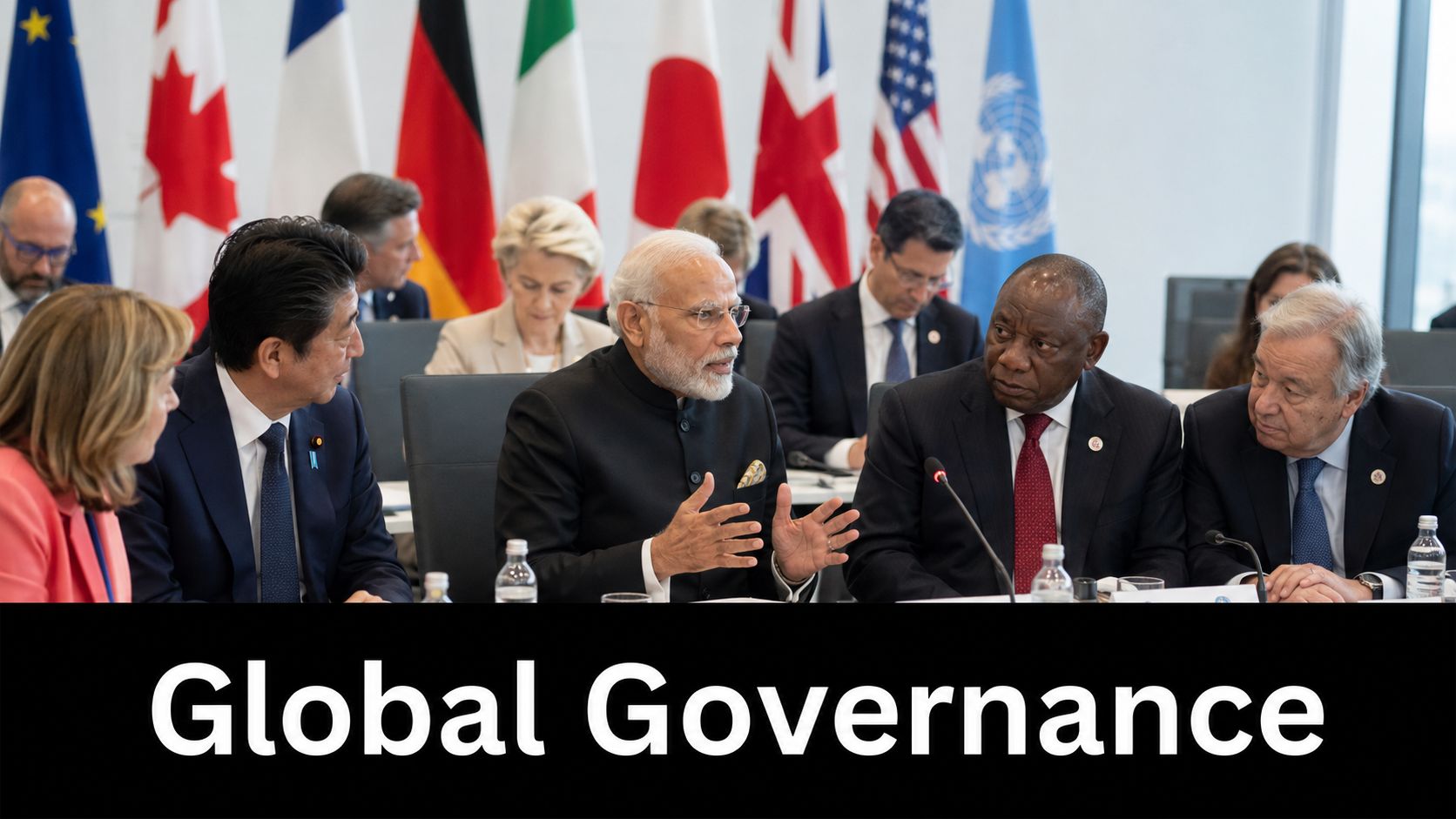
This is why effective statecraft begins with diagnosis, not rhetoric. Leaders who treat collective action failures as mere communication problems usually add forums, statements, and voluntary pledges. Leaders who recognise them as incentive problems build compliance systems, financing structures, and decision rules that make cooperation the least risky option. That distinction should sit at the centre of any serious agenda for mobilising multilateralism.
Why governance keeps slipping into crisis
Three failures recur across domains:
- Misaligned incentives: Individual states, firms, or voters gain from behaviour that weakens the collective outcome.
- Weak initiation mechanisms: Actors agree in principle but no one wants to pay the upfront cost of organising.
- Poor maintenance design: Even after cooperation begins, trust, legitimacy, and compliance erode.
Collective action problems aren't peripheral governance issues. They are the mechanism through which many governance systems break down.
For G20 delegates, the strategic implication is straightforward. The hardest part of cooperation usually isn't drafting a shared objective. It's building institutions that survive asymmetric costs, domestic political shocks, and the temptation to free-ride.
Understanding the Logic of Collective Failure
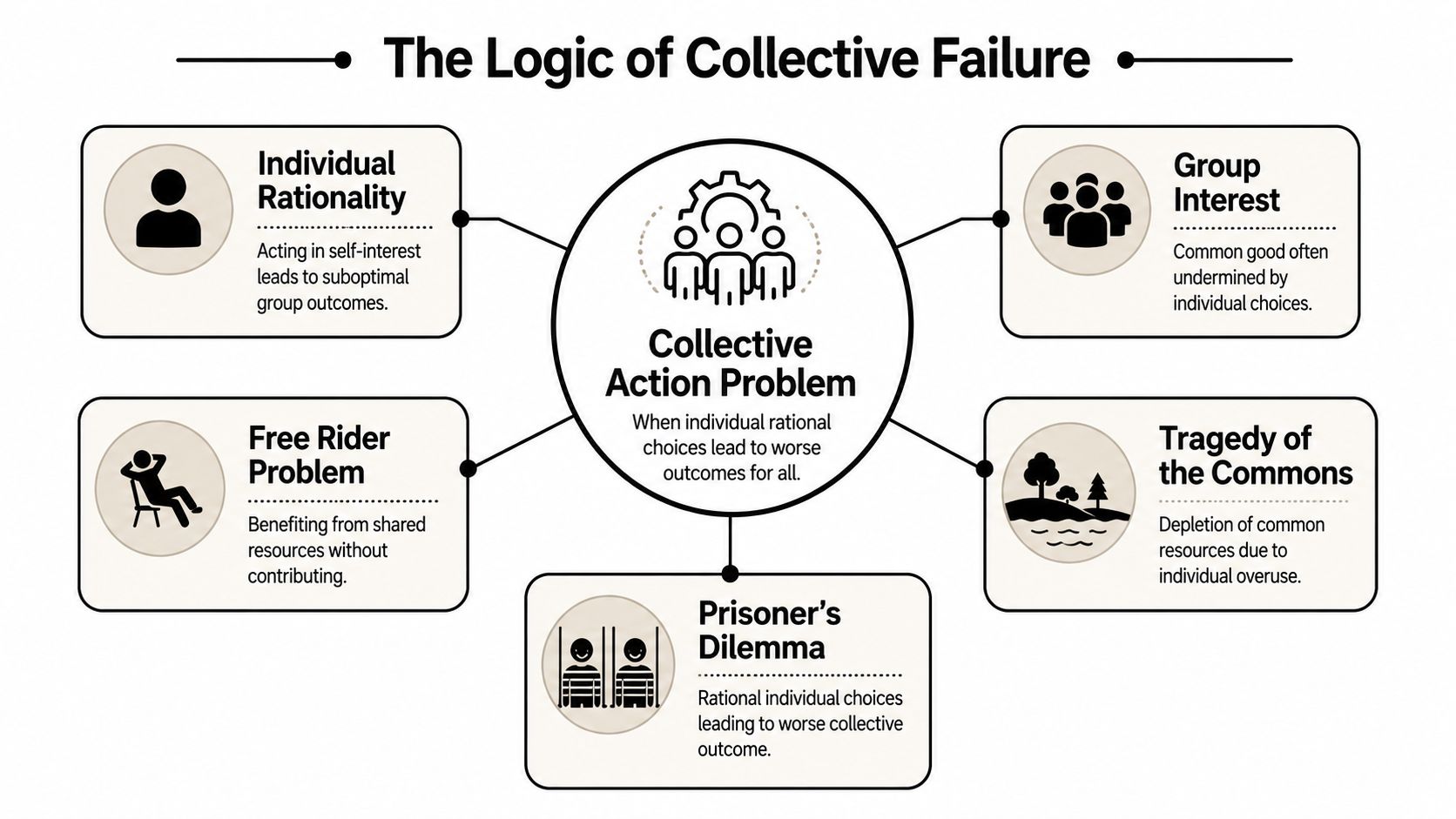
A collective action problem exists when individually rational behaviour produces a worse result for the group. The concept sounds abstract until you reduce it to a simple choice. If everyone contributes, everyone benefits. If contribution is costly and benefits are shared, each person has a reason to hold back and hope others carry the burden.
Why rational actors still fail together
Two classic models remain useful because they describe real policy dynamics with unusual precision.
Prisoner's Dilemma
Two actors would both benefit from cooperation, but each has an incentive to defect if they doubt the other will cooperate.
Tragedy of the Commons
A shared resource is depleted because each actor captures the benefit of overuse while the costs are spread across the group.
In climate policy, states face a prisoner's dilemma when each government waits for others to absorb the political cost of decarbonisation. In fisheries, states face a tragedy of the commons when each fleet gains from current extraction even though aggregate overuse undermines the stock.
The free-rider problem is the most politically familiar version. A 2026 IZA Institute of Labor Economics analysis argues that UK trade unions face eroding financial resources due to “cost disease” pressures, weakening their capacity to provide collective goods such as legal aid and strike support. That deterioration discourages some individuals from paying dues because they assume others will sustain the organisation instead, which deepens the original problem (IZA analysis of UK trade unions and collective action).
A short explainer helps clarify the institutional stakes:
First-order and second-order failures
Policymakers often stop at the first-order question. How do we get actors to cooperate at all? That matters, but it isn't enough.
First-order problems concern initiation. Who convenes, who pays, who takes the first political risk, and who supplies the public goods that make participation worthwhile?
Second-order problems concern management. Once a coalition, movement, or institution exists, who keeps it trusted, disciplined, financed, and legitimate when setbacks arrive?
That distinction matters because many institutions solve one problem and fail on the other. A treaty can attract signatures and still lack compliance. A social movement can mobilise supporters and still lose trust after defeat. A legal mechanism can promise collective recourse and still be too rigid for claimants to use in practice.
Practical rule: If a policy depends on voluntary contribution, ask two questions separately. What starts cooperation, and what keeps cooperation intact after the first setback?
That's the vocabulary senior officials need. Without it, leaders confuse enthusiasm with capacity, formal agreement with implementation, and mobilisation with resilience.
Diagnosing Governance Failures Across Global Domains
The most useful way to apply collective action analysis is diagnostic, not doctrinal. Start with the shared asset under threat. Then identify the incentive that pushes each actor away from restraint or contribution. Finally, examine whether the failure sits at the level of initiation, maintenance, or both.
A simple diagnostic for policymakers
Four domains repeatedly produce this structure.
Climate governance: The shared asset is a stable climate. The conflicting incentive is that each state wants growth, energy security, and domestic political calm. The collective outcome is under-provision of mitigation and adaptation.
Pandemic preparedness: The shared asset is global health security. The conflicting incentive is to delay costly preparedness, guard domestic supply, or withhold politically sensitive information. The collective outcome is slower detection, weaker coordination, and avoidable distrust. Communications strategy matters here, and practitioners working on PR for health campaigns understand that public cooperation often depends on whether institutions can explain shared risk credibly and consistently.
International trade: The shared asset is a predictable trading system. The conflicting incentive is to use unilateral restrictions, subsidies, or retaliatory measures for domestic advantage. The collective outcome is reduced predictability and weaker confidence in rules.
Security and maritime order: The shared asset is open, stable access to common spaces and chokepoints. The conflicting incentive is short-term geopolitical gain through coercion, burden-shifting, or selective participation. The collective outcome is fragility in deterrence and a higher cost of restoring order.
The pattern looks different in each arena, but the underlying mechanics are similar. Actors don't always oppose the collective goal. Often they prefer that someone else pays first.
Where second-order problems become political
A more subtle failure emerges after mobilisation. A 2024 longitudinal study on the UK General Election found that political trust generally increased after the election, but among non-Labour voters, pre-election collective action engagement was negatively associated with political trust (b = -0.14, ꞵ = -0.11, p = 0.025), while the association for Labour voters was nonsignificant (p = 0.235). The study used a sample of N=543 participants and shows that heavy engagement can amplify the psychological cost of defeat for losers rather than rebuild trust (Advances in Psychology study on post-election trust and collective action).
That finding has wider relevance than electoral politics. It suggests that institutions can't assume participation automatically strengthens cohesion. Under some conditions, intense mobilisation raises emotional investment so sharply that disappointment becomes institutionally corrosive.
For G20 governments, that is a warning. In climate transitions, vaccine allocation, or trade adjustment, leaders must plan for post-decision legitimacy, not just pre-decision mobilisation. If the losing side exits less trusting than before, the institution may secure formal compliance while undermining future cooperation.
Participation is not the same as durability. A system that mobilises people without managing disappointment can weaken itself.
Policy-Focused Case Studies in Collective Action
Case studies reveal a practical truth that abstract theory can obscure. Collective action problems are rarely solved by goodwill alone. They are solved, or worsened, by design.
Montreal shows what aligned design can do
The Montreal Protocol remains one of the clearest examples of effective collective action because governments built a framework that linked scientific consensus, obligations, and a shared interest in preventing wider harm. It translated a diffuse environmental threat into a governable problem with identifiable responsibilities.
Its enduring policy lesson isn't merely that states can cooperate. It's that cooperation becomes more effective when leaders narrow ambiguity, establish common expectations, and reduce the advantage of standing outside the regime. That lesson applies directly to today's climate and industrial negotiations, where broad goals often outpace enforceable architecture.
Fisheries show the cost of weak restraint
Global fisheries illustrate a harder case. The shared resource is visible, economically valuable, and politically difficult to protect because each coastal state and fleet operator faces pressure to maximise current extraction. Even where regional agreements exist, enforcement and monitoring can lag behind incentives.
Institutional weakness converts a resource issue into a strategic one. If members believe others are under-reporting, over-fishing, or evading controls, restraint becomes politically irrational. That is why maritime governance has to join resource management with surveillance, compliance, and market rules. The wider policy debate on this challenge is well captured in analysis on collective action to protect our fisheries and oceans.
UK collective proceedings show how design can block coordination
The UK offers a particularly instructive example of a collective mechanism that can generate new barriers while trying to solve old ones. Since October 2015, the Consumer Rights Act 2015 has enabled stand-alone opt-out collective competition claims through the modern UK regime, allowing authorised class representatives to bring claims for competition law breaches without prior regulatory findings (Hausfeld overview of the UK collective action regime).
Yet the structure remains tightly confined. Collective Proceedings Orders under section 47B of the Competition Act 1998 are restricted to competition law claims, and the Competition Appeal Tribunal must be satisfied that claims raise the same, similar or related issues of fact or law. That narrows aggregation and fragments disputes that cut across consumer, environmental, or other legal domains (Arnold & Porter analysis of UK collective actions).
The distribution design compounds the difficulty. A scholarly analysis notes that the opt-out system calculates damages on a lump-sum basis under section 47B(8) without estimating individual awards and prohibits exemplary damages under section 47C(2). The same analysis states that there has been only one opt-out collective action brought by a consumer organisation since 2015, which highlights low plaintiff coordination and uncertainty around how large awards would be distributed in practice (Oxford academic analysis of UK opt-out collective actions).
A second practical distinction matters in data-related cases. In the UK, Group Litigation Orders operate on an opt-in basis, while Representative Actions operate on an opt-out basis, giving claimants and counsel very different pathways to organise mass claims (legal and economic analysis of personal data-related collective actions in the UK). Collective claims for competition law breaches must meanwhile be filed exclusively at the Competition Appeal Tribunal, with a Collective Proceedings Order approved at a certification hearing before the action proceeds (Pinsent Masons guide to class actions in England and Wales).
The larger lesson is uncomfortable but important. Institutions can become collective action problems in their own right when access rules, standing requirements, or payout mechanics make participation too uncertain. In that situation, the law promises aggregation while its design deters it.
A Toolkit of Institutional and Incentive-Based Solutions
Not all collective action problems require the same remedy. Some fail because there is no forum for coordination. Others fail because the forum exists but actors still prefer to defect. Effective policy design begins by separating institutional solutions from incentive-based solutions, then deciding how to combine them.
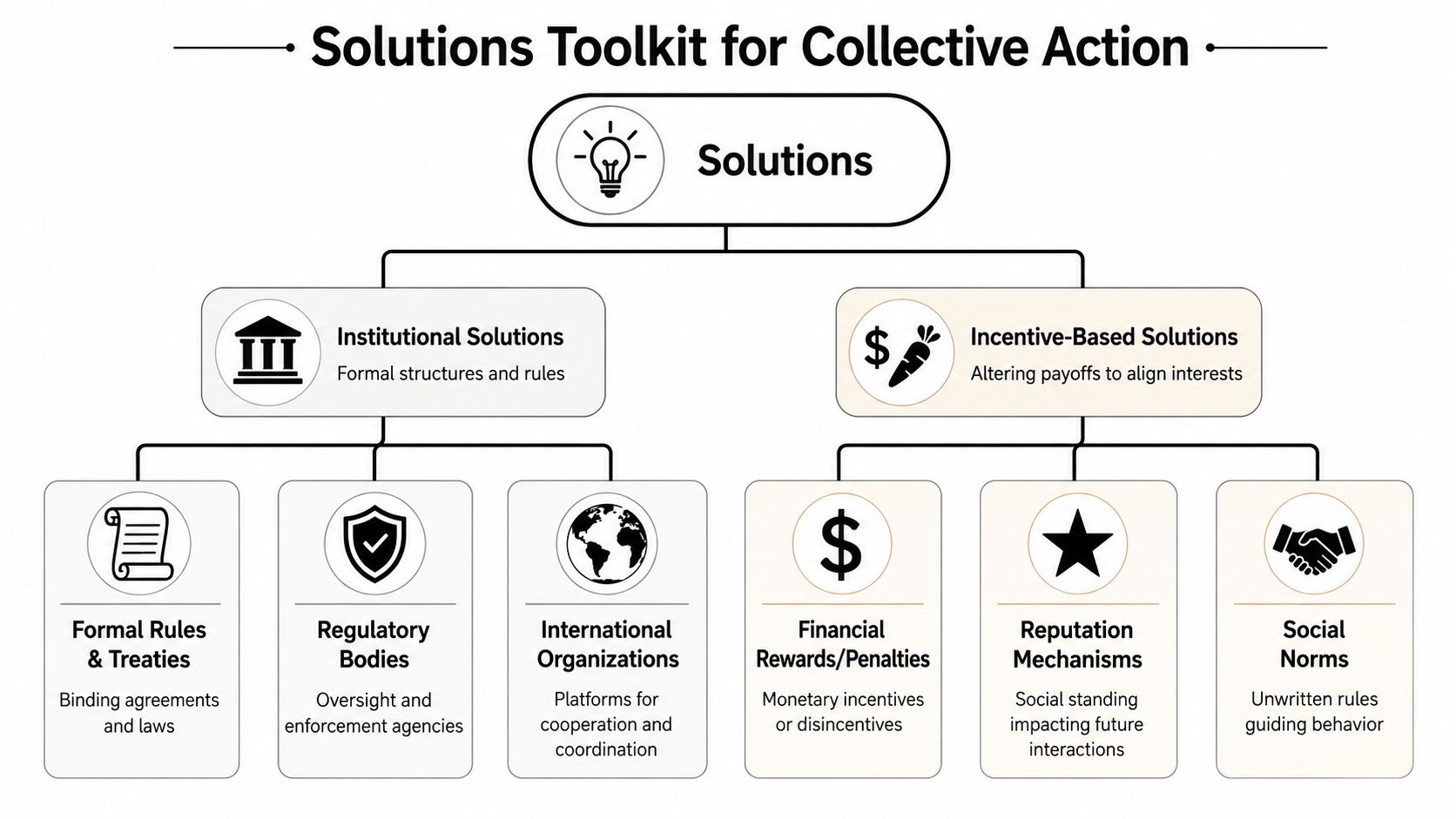
Institutional solutions
Institutional tools change the rules of the game.
- Formal treaties and compacts: These work when states need clear commitments, agreed definitions, and repeat interaction.
- Regulatory bodies and tribunals: These matter when coordination depends on certification, adjudication, or enforcement authority.
- International organisations and technical platforms: These are useful when information-sharing, surveillance, and standard-setting are the binding constraints.
Their strength is predictability. Their weakness is that formal structures can become slow, narrow, or politically over-engineered.
Incentive-based solutions
Incentive tools change the payoff structure.
- Conditional finance: Link funding, insurance access, or fiscal support to measurable cooperation.
- Trade linkage and market access: Use commercial advantages to reward compliance or raise the cost of staying outside common rules.
- Reputation and disclosure mechanisms: Increase the political cost of non-cooperation through transparency.
- Local solidarity networks: Reduce free-riding by strengthening identity, reciprocity, and mutual obligation at the level where people coordinate.
One of the most overlooked solutions sits in that final category. Research on UK communities highlights alternative ingroup-focused collective actions such as standing up for heavily affected communities after Grenfell or during the mica crisis. In 2025, 34% of affected residents in England engaged in these solidarity-driven forms of action, compared with 22% who engaged in traditional protest, suggesting that identity-based mutual support can bypass classic participation barriers (study on alternative ingroup-focused collective action).
Some collective action problems aren't solved by making participation cheaper. They're solved by making participation more socially meaningful.
Comparing solutions in practice
| Solution Type | Core Mechanism | Example Application |
|---|---|---|
| Treaty-based institution | Creates formal obligations and common procedures | Climate reporting frameworks |
| Regulatory body | Verifies compliance and adjudicates disputes | Competition or trade enforcement |
| International organisation | Provides coordination platform and technical standards | Pandemic surveillance cooperation |
| Conditional finance | Rewards contribution and penalises non-compliance | Preparedness funding tied to reporting |
| Trade linkage | Alters economic incentives through access conditions | Supply-chain or environmental standards |
| Solidarity-based local action | Builds contribution through shared identity and reciprocity | Community response after acute local harm |
The strategic point for G7 and G20 leaders is that high-level agreements and bottom-up solidarity aren't rivals. In difficult domains, they are complements. Institutions can set the frame. Incentives and identity can make the frame live.
A Practical Roadmap for G7 and G20 Decision-Makers
Leaders need a method, not just a theory. The most reliable way to address collective action problems is to treat cooperation as a design challenge with sequential stages. Each stage should test whether the proposed arrangement can survive political stress, uneven costs, and implementation fatigue.
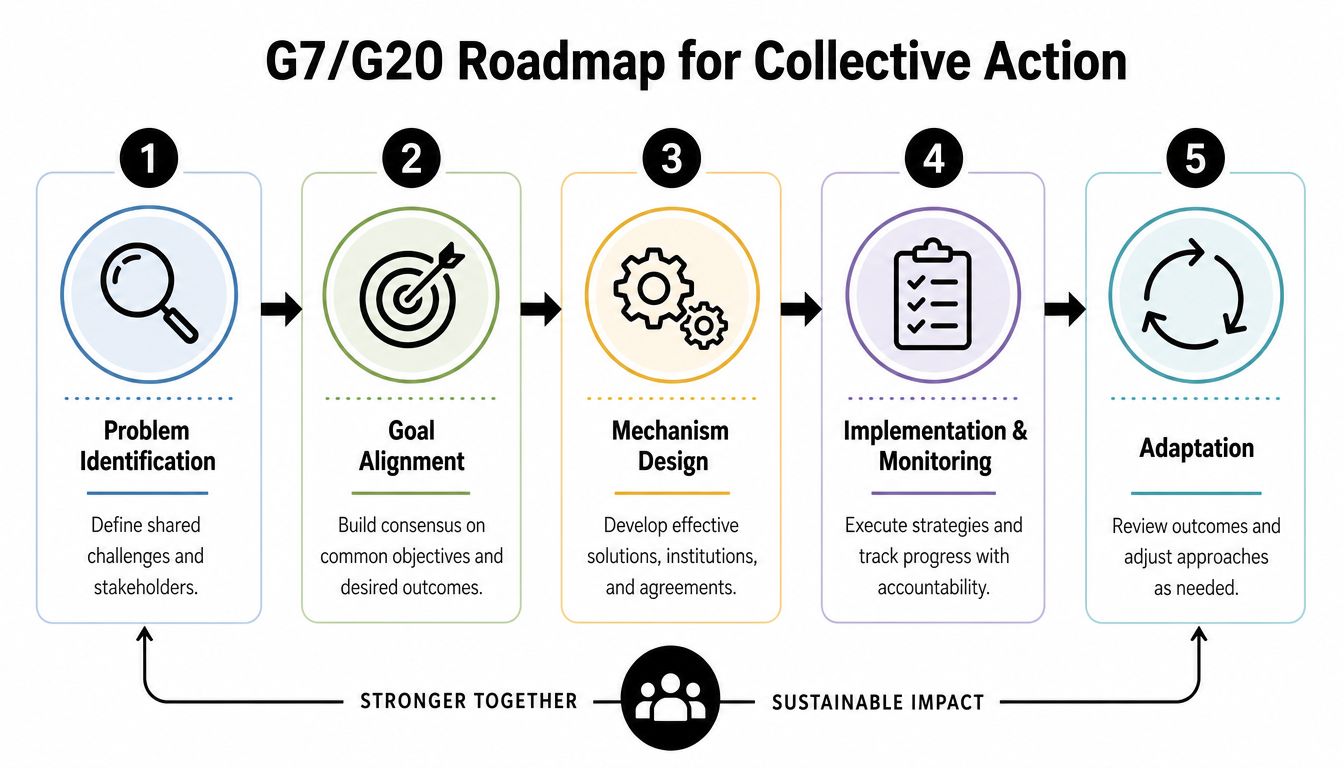
Phase 1 Frame the commons
Define the shared asset precisely. “Climate”, “health security”, or “resilient supply chains” is too broad for operational design. Officials should specify what is being protected, who benefits, who bears immediate costs, and what behaviour currently undermines the collective good.
This stage also requires separating first-order from second-order obstacles. If states agree on the objective but not on burden-sharing, the problem is one of initiation. If they have already signed up but distrust reporting, financing, or fairness, the problem is one of maintenance.
Phase 2 Build the minimum viable coalition
Not every cooperative structure needs universal membership at the start. In many domains, a coalition is credible when it includes the actors who control the critical strategic points, such as finance, standards, transit routes, market access, or production capacity.
Many summits overreach. They prioritise symbolic breadth over functional capability. A better model is to build a core coalition that can establish rules, demonstrate viability, and then widen participation. The challenge of making that work inside complex institutions is central to debates on making multilateral institutions work.
Phase 3 Align finance and incentives
Governments should ask a blunt question. Why would any actor cooperate if defection remains cheaper? If the answer is moral appeal or diplomatic pressure alone, the design is weak.
A useful checklist includes:
- Funding discipline: Who pays for the public good, and is the financing durable?
- Distributional legitimacy: Who bears visible costs first, and what compensation exists?
- Penalty credibility: What happens if members underperform or delay?
- Political usability: Can ministers defend the arrangement at home?
There is a practical lesson in organisational resilience here. A recent RePEc-listed analysis reports that UK unions faced 18% annual cost inflation since 2024, yet 41% of unions that successfully sustained collective action did so through enhanced digital coordination and localized solidarity networks (analysis of union organisation under cost pressures). The wider implication is clear. Digital tools aren't a substitute for institutions, but they can reduce coordination costs and help organisations manage second-order problems when traditional structures come under strain.
Phase 4 Monitor and adapt
No cooperative regime should rely on static design. Monitoring, reporting, and verification are not administrative add-ons. They are the machinery through which trust survives contact with reality.
A credible adaptation loop has three parts:
- Transparent reporting: Members need comparable information.
- Independent review: Data must be assessed by actors with legitimacy.
- Corrective adjustment: Rules should be revisable when incentives prove misaligned.
Durable cooperation depends less on perfect initial design than on whether institutions can detect failure early and respond before trust collapses.
This final phase is where many systems lose discipline. Leaders announce goals, launch platforms, and then treat follow-through as a technical detail. In practice, adaptation is the difference between a living institution and a ceremonial one.
The Imperative for Multilateral Leadership
Collective action problems are now the operating environment of global governance. They shape whether states can decarbonise competitively, prepare for health emergencies, stabilise trade, and protect common spaces without constant crisis management. The evidence shows that failure can begin before mobilisation, emerge during management, or intensify after participation itself.
G7 and G20 leadership should be judged accordingly. Not by the volume of declarations issued, but by whether leaders build institutions and incentives that make cooperation durable, legitimate, and politically survivable. That is the core work of multilateralism.
Global challenges won't yield to improvised coordination. For sharper analysis on multilateral strategy, summit agendas, and practical pathways for cooperation, follow Global Governance Media.