

By Eleanor Marsh
A minister is waiting outside a bilateral room. The policy line is settled, the briefing pack is marked, and the substance is sensitive. What still decides whether the meeting lands is simpler and harder at the same time. Every spoken phrase has to carry the same legal, diplomatic, and cultural meaning on the other side of the table.
That's a critical test for a language provider in government work. At G7 and G20 level, interpretation isn't an administrative add-on. It sits inside negotiation control, reputational protection, and operational continuity. A missed qualifier in a healthcare commitment, a softened warning in a sanctions discussion, or a clumsy rendering of social policy language can change how a position is received.
Against that backdrop, AA Global Language Services deserves analysis as more than a standard translation company. It has a long operating history in the UK public sector, broad language coverage, and an operating model built around continuous service delivery. Those facts matter because high-stakes multilingual communication depends less on marketing language and more on whether a provider can stand up to procurement scrutiny, frontline pressure, and public-law obligations.
Government buyers also need to think beyond linguistic competence alone. They need evidence of organisational stability, documented performance, workable safeguarding controls, and a service architecture that can support urgent calls one day and formal conference interpreting the next. The practical question isn't whether a provider can translate. It's whether officials can rely on that provider when the context is politically exposed, time-sensitive, and subject to compliance checks.
Table of Contents
- Introduction
- From Local Roots to National Partner
- Core Language Solutions for the Public Sector
- Upholding Standards with Certified Quality
- Meeting the Demands of International Governance
- Procurement and Security Frameworks
- Conclusion A Strategic Partner for Multilateralism
Introduction
A delegate enters a late-night coordination meeting after a day of draft revisions, side conversations, and shifting political signals. The room contains officials from several systems, each with different administrative cultures and different expectations of precision. In that setting, a language error doesn't just create confusion. It can alter negotiating intent.
That's why government buyers can't treat language services as a commodity. In multilateral forums, the provider becomes part of the state's operating capability. Interpreters may be handling public health terminology in one hour, social care terminology in the next, and sensitive institutional language after that. The standard for suitability is whether they can do so consistently, discreetly, and without forcing policy teams to absorb avoidable risk.
AA Global Language Services enters that discussion with a profile that's unusually relevant to government. The firm has spent years serving public bodies in the UK, including organisations that work under daily pressure with vulnerable populations, statutory duties, and urgent communication requirements. That experience doesn't automatically make a company suitable for diplomacy, but it does create a stronger evidential basis than a generic agency profile.
Practical rule: For government use, the first question isn't “Can this provider translate?” It's “Can this provider operate inside public-sector constraints without creating legal, safeguarding, or service-delivery risk?”
The more demanding the setting, the more these distinctions matter. A G7 or G20 secretariat, a foreign ministry, a health department, or a summit delivery team all need a partner that can combine linguistic range with procedural discipline. AA Global's case is strongest when assessed through that lens.
From Local Roots to National Partner
AA Global's institutional story matters because procurement teams often use operating history as a proxy for resilience. A provider that has remained active through changing public-sector demand, budget cycles, and service expectations is usually easier to assess than a newer entrant with a thinner record.
The company was officially incorporated on October 5, 2001, and grew from a two-person startup in Hull to a firm with over 30 staff members serving more than 85 public sector organizations, according to Companies House records for AA Global Language Services Limited. That trajectory says something important. It suggests organisational durability, not just commercial survival.
For a government buyer, durability has policy value. It indicates that the provider has had time to develop recruitment processes, scheduling disciplines, and account management routines that can support recurring public contracts. It also shows that public bodies have continued to place business with the company over time, which is often a stronger signal than a broad but shallow client list.
Why longevity changes the procurement picture
A long operating history doesn't prove excellence on its own. It does, however, affect risk.
- Continuity risk is lower: A provider with an established company record is easier to diligence through standard procurement checks.
- Institutional memory is deeper: Longstanding work with public bodies usually means the supplier understands how government timelines, approvals, and escalation routes work.
- Scaling is more credible: Moving from a small Hull office to a larger operation serving public organisations across the country implies that management systems matured alongside demand.
AA Global's roots in Hull also matter in a way that national procurement frameworks sometimes overlook. Regional grounding can strengthen service consistency because management, coordination, and recruitment aren't purely virtual. The company's operating footprint has remained anchored in Hull, which gives officials a clearer picture of where accountability sits.
Public procurement often rewards the supplier that can evidence stable delivery over the supplier that makes the broadest claims.
That makes AA Global more interesting than a simple company profile would suggest. Its history points to an organisation that has grown by embedding itself in the practical needs of the UK public sector. For officials thinking about summit support, departmental interpreting, or multilingual frontline communication, that's the kind of growth pattern worth taking seriously.
Core Language Solutions for the Public Sector
AA Global's service range is broad enough to map onto the actual demands government teams face, rather than the simplified categories often seen in vendor brochures. The company supports over 500 languages and dialects, delivering face-to-face, telephone, and simultaneous conference interpreting services 365 days a year to major UK institutions including the NHS and Social Services, as listed in AA Global's Devex organisation profile.
That combination of modalities matters. A summit secretariat, local authority, health body, or social policy team won't always need the same delivery method. The operational challenge is usually switching between them without loss of control.
Service range that maps to government reality
Face-to-face interpreting is still the right tool for negotiations, sensitive meetings, and settings where body language and room management matter. It suits ministerial visits, inspection meetings, safeguarding interviews, and bilateral discussions where trust and nuance carry as much weight as vocabulary.
Telephone interpreting solves a different problem. It gives public bodies a way to respond when language needs arise unexpectedly and delay would block access to services or decisions. In practice, that supports urgent assessments, call-centre interactions, and out-of-hours communication.
Simultaneous conference interpreting is the most relevant mode for large multilateral settings. It allows complex discussion to continue at pace while preserving procedural flow. That's especially important when officials are moving through dense material such as regulatory language, public health updates, or technical briefings.
AA Global also provides software localisation, which extends its relevance beyond spoken exchanges. Government increasingly communicates through digital forms, service portals, and public-facing platforms. For teams managing multilingual interfaces, a technical resource such as How to automate Django localization is useful because it shows how localisation thinking can be built into digital delivery rather than bolted on later.
A practical view of service fit
The company's offering can be summarised in procurement terms:
| Service | Primary Application | Key Feature |
|---|---|---|
| Face-to-face interpreting | Bilateral meetings, hearings, site visits | Direct support where nuance and presence matter |
| Telephone interpreting | Urgent access and frontline response | Immediate language access when delay creates service risk |
| Simultaneous conference interpreting | Summits, conferences, multilateral forums | Supports continuous discussion at scale |
| Translation and localisation | Policy papers, service materials, digital systems | Extends language access beyond live meetings |
| Cultural awareness support | Public engagement and institutional delivery | Helps teams reduce misunderstanding beyond vocabulary alone |
A government audience should read that table as an operating model, not a menu. The more useful question is which service protects policy intent under pressure. That's why a broader discussion of multilingual public communication, such as this analysis of unlocking human potential in more than one language, is relevant. It reflects the wider institutional truth that language access affects participation, legitimacy, and outcomes.
Upholding Standards with Certified Quality
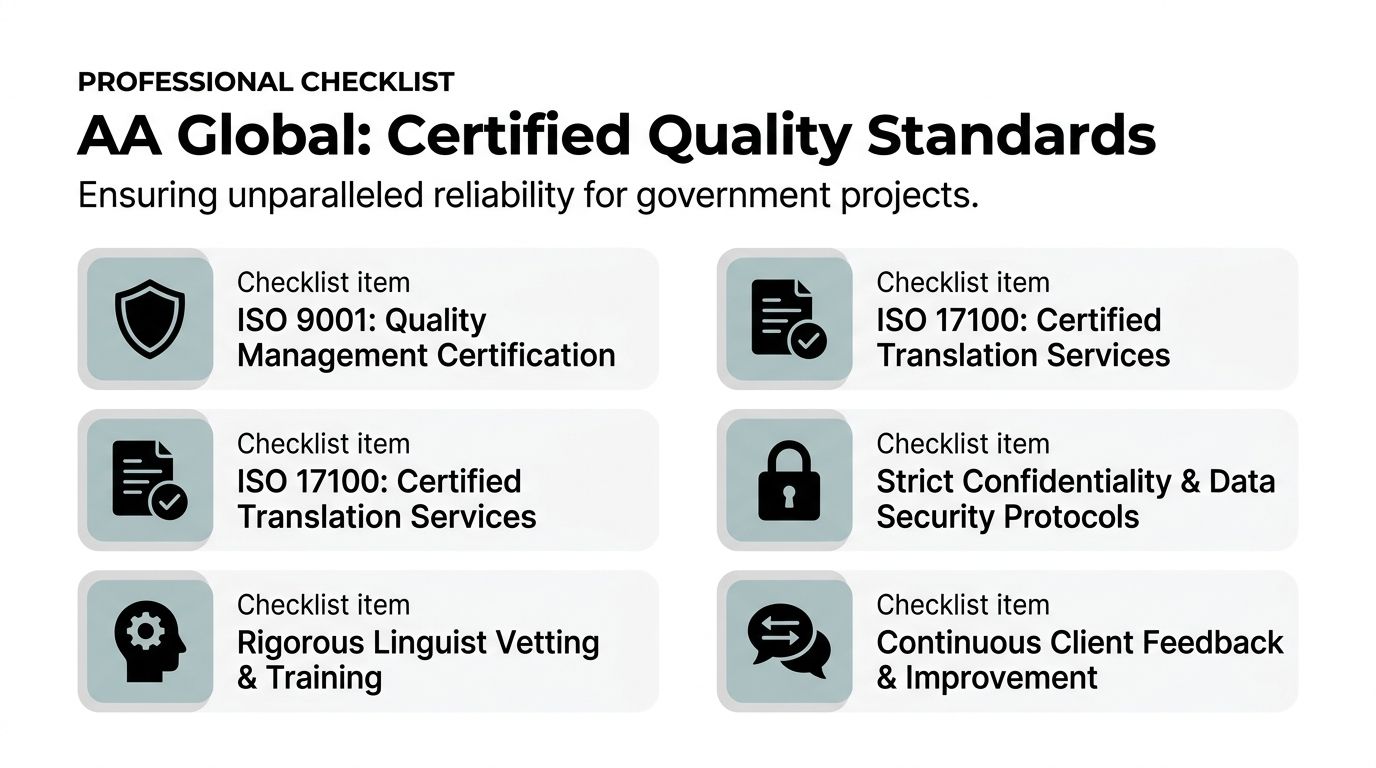
A G7 or G20 procurement team would test a language supplier against a simple question. Can this provider protect meaning, confidentiality, and response times when the communication itself carries legal or diplomatic consequences? Marketing language does not answer that question. Evidence of controls does.
Why procurement teams look for evidence, not promises
In high-stakes interpreting and translation, failure usually appears as variance rather than collapse. Terminology shifts between meetings. A linguist handles the words correctly but misses institutional register. An urgent call is answered on time, yet the exchange still creates risk because the interpreter lacks the safeguarding discipline or subject context the setting requires.
AA Global's public record provides at least one measurable indicator that matters to buyers. In a UK local authority procurement framework document, the company is described as serving more than 85 public sector organisations and achieving a 99.2% service reliability rate for emergency telephone interpreting calls. For central government, health systems, border functions, and crisis response teams, that figure is useful because emergency language access is a continuity issue. Delays affect decision-making speed, procedural fairness, and, in some cases, immediate welfare outcomes.
The security and screening point is just as important. Material already noted earlier in the article indicates that interpreters working on NHS-related assignments may be expected to hold, or obtain, Enhanced DBS clearance. For procurement officials, the significance is not the recruitment detail alone. It shows that assignments involving vulnerable people are treated as screened engagements with access controls, not as generic freelance placements.
That distinction matters in government.
What the available evidence supports
The record available in public sources supports a narrower, stronger assessment than a standard company profile would offer.
- Public-sector operating experience: The supplier is not approaching regulated public work as a new market. The local authority framework evidence indicates an established delivery history across government-facing clients.
- Measured responsiveness under pressure: The documented emergency telephone interpreting reliability figure gives buyers a testable service benchmark, which is more useful than general claims about quality.
- Safeguarding discipline: Enhanced DBS expectations are relevant for health, social care, justice, and any environment where linguists may encounter sensitive case information or vulnerable individuals.
- Quality as a control system: The available evidence points to recruitment checks, service monitoring, and managed deployment. For government buyers, that is the practical meaning of quality assurance.
The non-obvious point is that these indicators matter even beyond frontline service delivery. A supplier that can screen personnel properly, maintain consistency across assignments, and meet urgent access requirements is better positioned for ministerial visits, cross-border investigations, sanctions implementation work, and multilingual public communications during periods of political sensitivity.
Strong language provision is only one part of supplier quality. Procurement teams also need proof that the provider can screen people, control process, and deliver consistently when the margin for error is small.
For officials assessing suitability for diplomatic or security-adjacent use, that is the standard that matters.
Meeting the Demands of International Governance
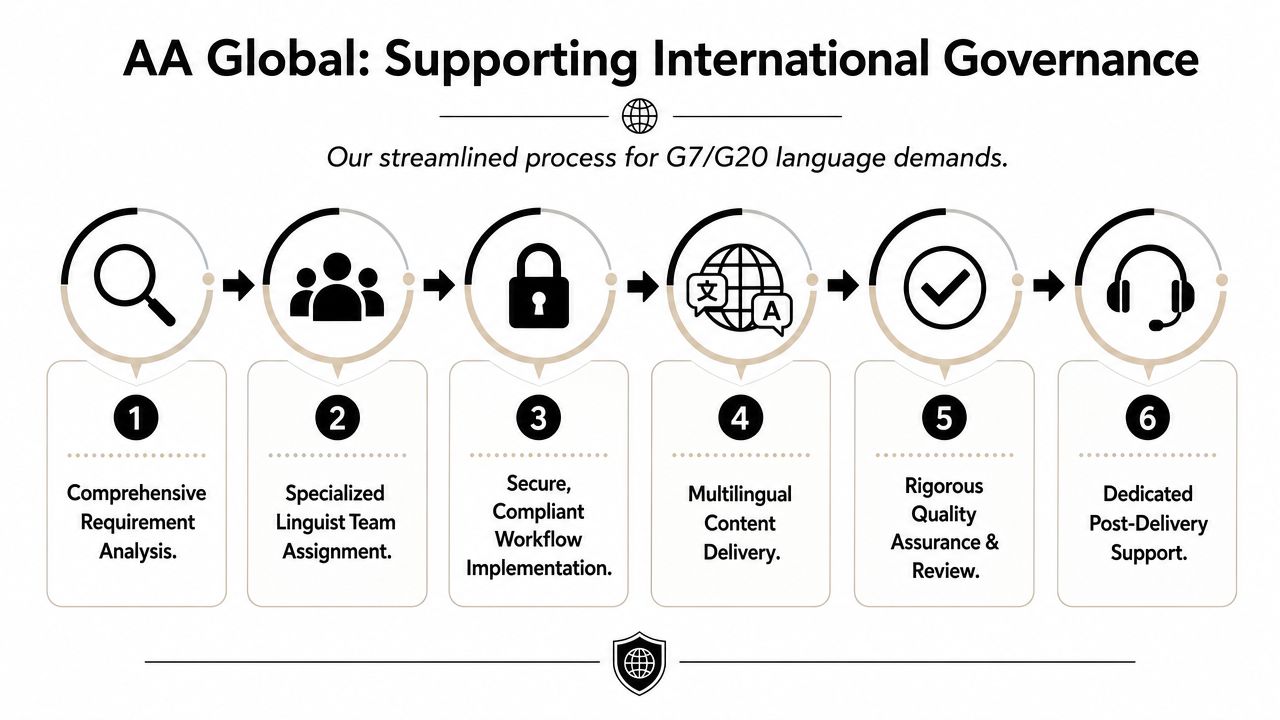
The strongest argument for AA Global in a G7 or G20 context isn't only that it offers many languages. It's that its operating model aligns with the pressures that define international governance. These settings demand availability, precision, and institutional judgement at the same time.
Why multilateral settings raise the bar
A summit environment is unforgiving. Language teams may need to support formal plenaries, side meetings, media-adjacent interactions, stakeholder engagement, and rapid follow-up communication. The provider has to move between registers without losing control of meaning.
AA Global's framework is relevant here because its operational model covers over 500 languages 365 days a year and enables UK public sector organisations to meet statutory obligations under the Equality Act 2010 by providing real-time language access, according to the Association of Translation Companies member directory entry for AA Global. For G7 and G20-related bodies, that matters in two ways.
First, it shows that the company is already positioned around continuous access rather than office-hours convenience. International work often spills outside domestic timetables. A provider built for round-the-year delivery is more likely to cope with that reality.
Second, the inclusion of rare and endangered languages in the same framework changes the procurement conversation. High-level diplomacy doesn't only involve major world languages. It can also involve refugee engagement, regional delegations, specialist community consultations, or domestic public-service interactions linked to international events. A supplier that can handle uncommon language needs is often more valuable than one optimised only for the most common pairings.
Accessibility is also a governance issue
Officials sometimes treat language access as a service issue when it's also a legitimacy issue. Institutions that can't communicate clearly with affected people struggle to implement policy fairly. In the UK public sector, the Equality Act dimension sharpens that point. Language provision can form part of how organisations make services accessible in practice.
That has direct relevance to international governance. Multilateralism isn't sustained by communiqués alone. It also depends on how states communicate commitments, rights, and services back to diverse populations. A provider that helps departments maintain real-time language access supports more than administration. It supports enforceability and public trust.
A useful way to think about AA Global in this context is as a buffer against operational friction.
- When timelines compress, round-the-year availability becomes more important than a polished brochure.
- When subject matter is specialised, broad language coverage reduces the chance that officials must compromise on access.
- When institutions face legal obligations, real-time interpretation helps turn formal duties into actual service delivery.
In multilateral work, linguistic capacity is part of state capacity.
That's the strategic insight. AA Global's relevance rises when officials stop treating language support as an outsourced convenience and start treating it as infrastructure for diplomacy, compliance, and inclusive governance.
Procurement and Security Frameworks
A government buyer approaching AA Global should assess it as they would any operationally sensitive supplier. The right question isn't whether the firm can provide interpreters on request. It's whether the service can be procured, governed, and monitored in a way that matches departmental risk tolerance.
Near the outset of any review, procurement and information teams should examine where multilingual communication sits inside their wider compliance obligations.

For many public bodies, the first practical step is market mapping. A reference point such as UK tender frameworks can help procurement officers understand the framework environment around specialist suppliers before they move into direct engagement. That doesn't replace due diligence, but it does improve the framing of the exercise.
How a public buyer should assess fit
A disciplined buyer will usually work through four questions.
- Scope clarity: Which communication modes are needed, and in which settings? A summit support contract looks different from ongoing health access provision.
- Safeguarding exposure: Will linguists interact with children, vulnerable adults, or protected case material?
- Escalation needs: What happens when language needs arise outside routine planning cycles?
- Assurance expectations: Which evidence must the supplier provide on vetting, confidentiality, and performance monitoring?
These questions matter because language procurement often fails when organisations buy volume instead of fit. A department may think it is buying interpreters when in fact it is buying emergency responsiveness, specialist terminology control, or secure handling of sensitive conversations.
The governance layer should also include a data protection lens. Officials reviewing any language-services arrangement should align contract scrutiny with broader institutional expectations around data protection regulations. In practice, that means checking what information the provider needs, how assignments are briefed, who can access materials, and how confidentiality is reinforced contractually.
Security questions that matter in practice
The source material available here supports some security-adjacent conclusions and leaves other points open. It supports safeguarding through the Enhanced DBS expectation already noted. It supports round-the-year operational responsiveness. It also supports public-sector experience in sensitive service environments.
What it does not evidence in detail are specific named technical security controls, NDA wording, or platform architecture. A prudent buyer should therefore require those details directly during procurement rather than assume them. That's not a criticism of AA Global. It's good government buying practice.
Ask for the controls that match the risk of the assignment, not the controls that happen to appear in a sales deck.
This is also where supplier conversations should become concrete. Officials should ask how briefing materials are handled, how linguists are matched to specialist subject matter, how urgent replacements are managed, and how service incidents are recorded and escalated.
Later in the process, buyers may also want a practical demonstration of service handling and workflow discipline.
For diplomatic and ministerial contexts, the key procurement conclusion is straightforward. AA Global appears strongest where the buyer values public-sector familiarity, broad linguistic reach, and proven responsiveness, then uses contract governance to test the security specifics that the public record doesn't fully spell out.
Conclusion A Strategic Partner for Multilateralism
A G7 ministerial can lose time and credibility in minutes if interpretation fails, briefing terminology is inconsistent, or an urgent language request cannot be filled outside normal hours. In that procurement context, AA Global Language Services presents as a serious candidate rather than a routine vendor.
The case for suitability rests on evidence already established in this article. AA Global has a long operating history, a visible public-sector client base, wide language coverage, and a record of urgent service delivery. Those factors matter because high-stakes government buying is not only about price or supplier scale. It is about whether a provider can support official communication under legal, political, and operational pressure.
For G7 and G20-level institutions, that distinction is practical. Language provision affects negotiation accuracy, procedural fairness, public access, and the integrity of cross-border coordination. A supplier that can handle specialist terminology, sensitive environments, and continuous demand becomes part of the state's delivery capacity for multilingual communication.
The remaining question is procurement discipline. Publicly available material gives a credible basis for due diligence, but final suitability for diplomatic or ministerial use still depends on contract testing of security controls, incident handling, confidentiality terms, and service governance. Buyers should treat AA Global as a provider that appears procurement-ready for serious consideration, then verify the controls required for the specific risk profile of the assignment.
That approach aligns with the broader policy question of how institutions preserve effective international cooperation under pressure, examined in this analysis of how multilateral institutions can function effectively.
If you're evaluating language provision for a ministry, multilateral body, summit team, or public service organisation, explore more policy analysis and decision-useful coverage from Global Governance Media.