

By Daniel Hartwell
Who, exactly, are the leaders of the free world in 2026, and what work does that phrase still do in practice? The conventional answer points to a US president, or perhaps to the G7 collectively. That answer is too shallow for policymakers who have to draft summit language, defend public spending, and build coalitions across a far more crowded field of power than the Cold War ever allowed.
The phrase matters because it is not merely descriptive. It allocates prestige, shapes agenda-setting, signals inclusion and exclusion, and frames whose preferences are treated as system-defining. In summit diplomacy, language often works upstream of policy. It tells officials which issues belong at the centre of a communiqué and which concerns are treated as peripheral, derivative, or politically inconvenient.
That is why the right question isn’t whether the label is flattering or outdated. The right question is whether it still helps democratic states organise cooperation more effectively than the available alternatives. Policymakers need a functional answer, not a nostalgic one. The term carries historical weight, but it also carries political costs. Used carelessly, it can narrow coalitions at the precise moment when broad-based cooperation is most needed.
For officials working across the G7 and G20, the phrase remains useful only if its strategic implications are understood in full. The debate is not semantic. It is operational. That is clear in current discussions of alliance credibility, public scepticism, and burden-sharing, themes that also surface in debates on defending common principles while responding to common challenges.
Table of Contents
- Defining Leadership in a Fractured World
- The Cold War Origins of a Powerful Title
- From a Single President to a Collective Forum
- How the Narrative Shapes Summit Agendas
- Critiques of the Free World Framing
- The Rise of Alternative Leadership Models
- Strategic Guidance for Policymakers and Communicators
Defining Leadership in a Fractured World
In a fractured international system, leadership no longer means simple command. It means the ability to convene, prioritise, fund, and legitimate collective action across institutions that often disagree on both diagnosis and remedy. The phrase leaders of the free world still implies a moral centre of gravity, but the policy environment itself is more conditional. Authority now depends less on rhetorical primacy and more on whether a government or forum can assemble durable cooperation.
Leadership as convening power
For policymakers, that distinction matters. A state can claim leadership rhetorically and still fail to shape outcomes if partners doubt its consistency, domestic mandate, or staying power. By contrast, a forum can exercise real leadership without a single acknowledged leader if it coordinates standards, financing, and political sequencing effectively.
That is why the term should be treated as a strategic instrument, not an inherited entitlement. It can still mobilise democratic solidarity in moments of acute crisis. But outside crisis conditions, it often confuses two different questions:
- Who speaks first: the actor with symbolic prominence.
- Who carries weight: the actor willing and able to sustain commitments.
- Who brings others along: the actor that can align multiple stakeholders with different interests.
Practical rule: If a phrase elevates status without clarifying responsibility, it usually weakens accountability.
Why the term is contested now
The phrase also collides with a wider reality. Contemporary governance is conducted through overlapping clubs, alliances, agencies, corporations, civil society networks, and regional bodies. In that context, “free world” language can sound more like bloc maintenance than coalition-building. That may still serve a purpose in some settings, particularly where deterrence and democratic signalling matter. It is less effective when negotiators need buy-in from states and non-state actors that reject inherited hierarchies.
For that reason, the phrase’s relevance in 2026 depends on context. Used with discipline, it can clarify values. Used lazily, it can harden divisions, overstate coherence, and create expectations that summit diplomacy cannot satisfy.
The Cold War Origins of a Powerful Title
The title did not emerge from constitutional design or multilateral appointment. It arose from a post-war transfer of material power. That history still matters because it explains why the phrase has always been tied to capacity as much as to values.
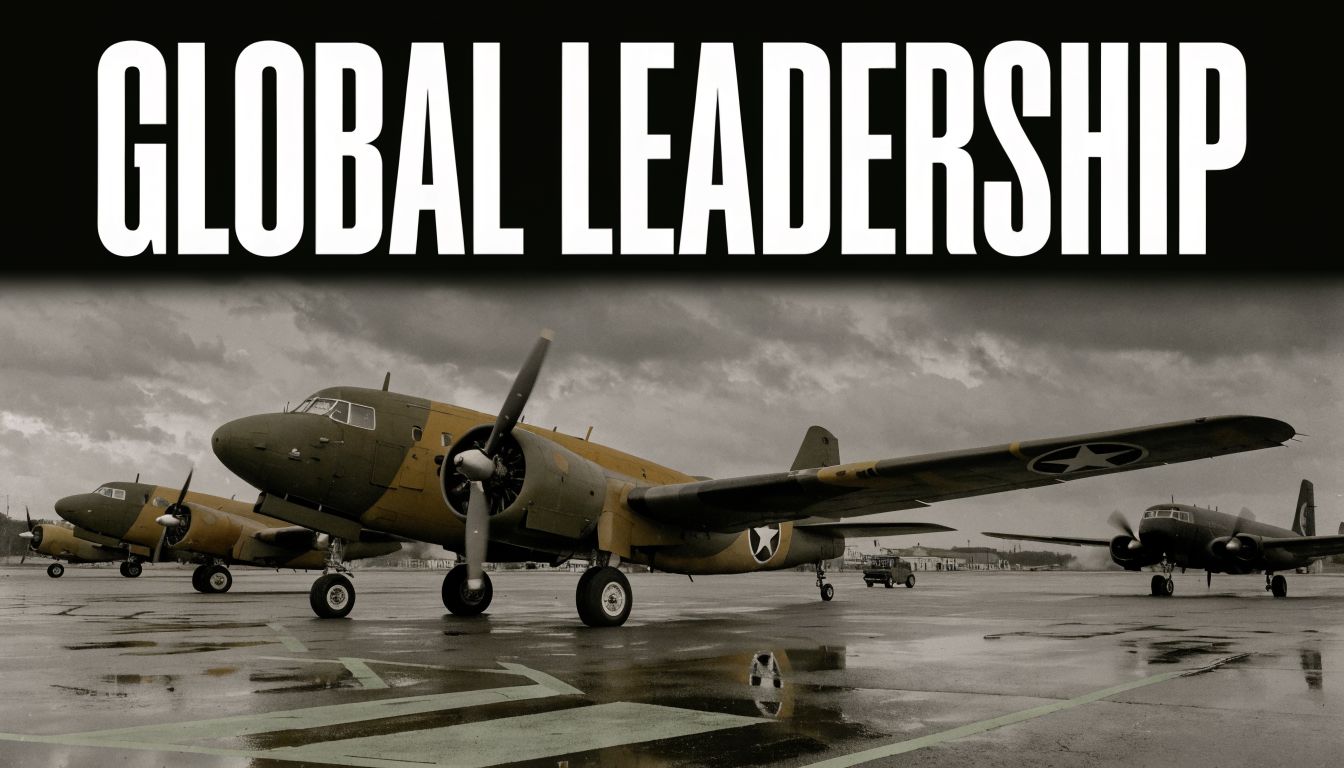
A title born from power transfer
During the late 1940s, Clement Attlee initially shared the mantle with Harry Truman, but Britain’s post-war weakness transformed that arrangement into an American monopoly of prestige and direction. According to David Gardner’s analysis of the post-war transition, the UK faced national debt at 238% of GDP in 1946, while its share of world trade fell from 23% in 1945 to 15% by 1950. That erosion of economic strength narrowed Britain’s room for strategic autonomy and pushed leadership of the Western bloc decisively towards Washington.
The symbolic shift aligned with hard institutional change. As the same analysis notes, Britain’s 1947 sterling crisis was a turning point, and by the time NATO was formed in 1949, uncontested leadership had moved to the United States. The title “leader of the free world” therefore gained force not because anyone formally bestowed it, but because American power became the organising fact around which Western security and recovery were structured.
A title that sounds moral was, from the start, inseparable from fiscal endurance, alliance management, and military scale.
Why the phrase endured
Once established, the term did more than describe hierarchy. It helped normalise it. It cast American pre-eminence as both necessary and principled, which made it easier for allies to present dependence as partnership. That rhetorical function became especially durable because it fused three claims into one label: strategic protector, political exemplar, and institutional convenor.
The historical record is easier to grasp when seen through the machinery that sustained it.
The phrase also survived because it solved a communications problem for the West. It gave disparate policies a single narrative frame. Defence commitments, economic reconstruction, and ideological competition could all be described as facets of one civilisational mission. That did not remove contradictions. It masked them well enough to preserve a coherent public story.
The title’s durability came from its utility. It turned asymmetry into legitimacy.
For present-day policymakers, the lesson is not merely historical. Language follows power, but it also helps stabilise power after material shifts have already occurred. That is why inherited labels often outlive the conditions that made them persuasive.
From a Single President to a Collective Forum
Today, the term no longer maps neatly onto one officeholder. The practical burdens once associated with a single “leader of the free world” are now distributed across a cluster of states, institutions, and summit processes. The shift is incomplete, but it is unmistakable.
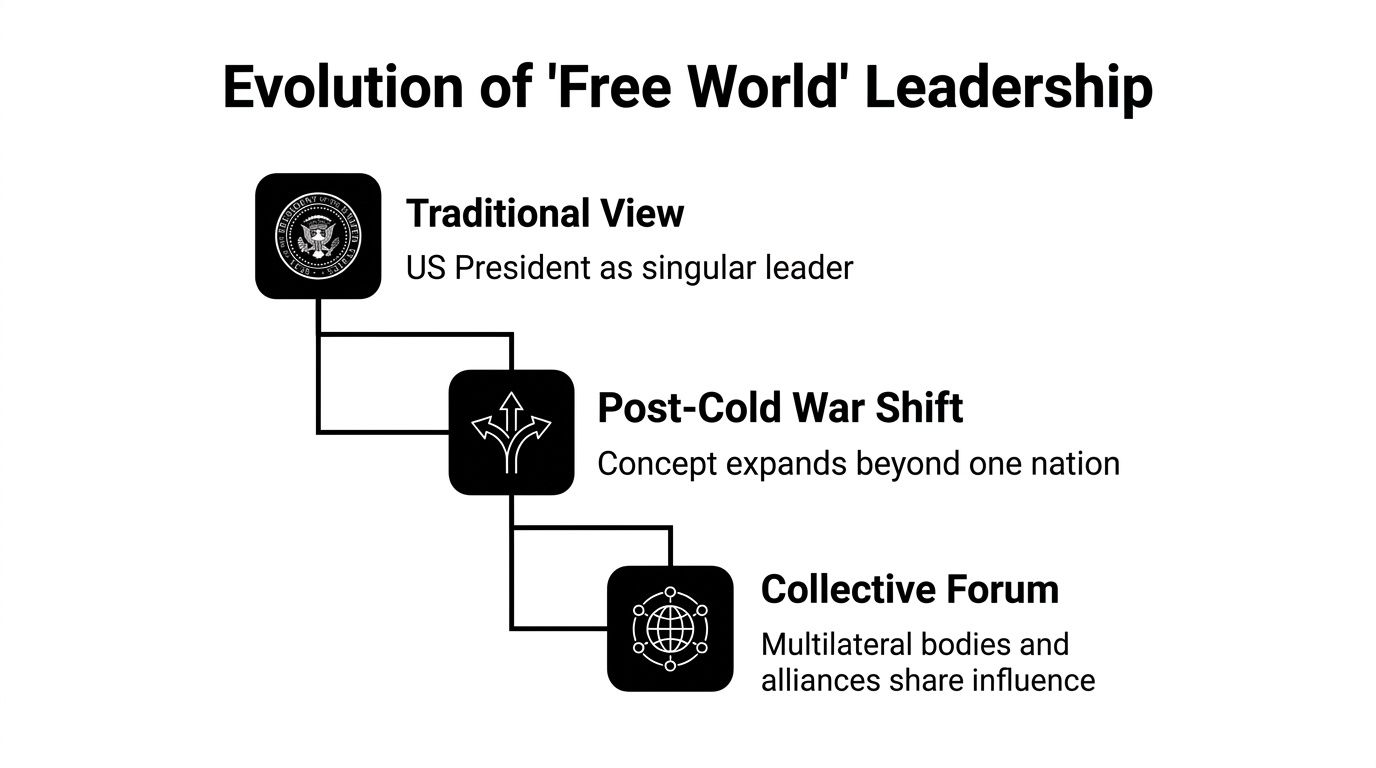
From singular authority to networked influence
The older model centred on a presidential figure who symbolised the strategic direction of the democratic West. The contemporary model works more diffusely. Leadership now appears through joint communiqués, coordinated sanctions, common technology standards, and burden-sharing arrangements that require several capitals to move in step. In effect, the phrase has drifted from personal title to ecosystem label.
That shift matters because it redistributes expectation. A G7 host government may now be judged not only by its own policy line, but by whether it can broker collective positions among partners with different economic exposures, electoral constraints, and diplomatic priorities. The language of leadership therefore moves from persona to process.
For officials tracking summit diplomacy, this is closer to the underlying centre of gravity, especially in debates over how the G20 must demonstrate leadership and build consensus.
What the collective model changes
The collective model has advantages. It reduces overdependence on a single leader’s domestic standing. It also makes democratic leadership look less imperial and more negotiated. Yet it creates new ambiguities:
| Dimension | Singular model | Collective model |
|---|---|---|
| Public recognition | Immediate and personalised | Diffuse and harder to communicate |
| Accountability | Concentrated | Shared and sometimes blurred |
| Policy durability | Vulnerable to leadership change | More resilient if institutionalised |
| Coalition breadth | Narrower by design | Wider, but slower to align |
The practical implication is that summit language now does two jobs at once. It signals shared values to allied publics while also smoothing over internal differences among member states. That makes rhetoric more carefully engineered, but often less candid.
A collective forum can still project leadership. It does so through choreography rather than command.
- The US still anchors security signalling. Even when the language is multilateral, partners often look to Washington for cues on urgency and sequencing.
- European states shape normative texture. They often push the language of rules, institutions, and legal legitimacy.
- Other G7 members broaden operational scope. They connect summit priorities to trade, technology, development, and regional diplomacy.
This is why the phrase survives despite its conceptual strain. It has adapted from a claim about one leader to a claim about a political camp. But that adaptation comes with a cost. The more collective the leadership becomes, the less plausible it is to describe it through a singular title inherited from another era.
How the Narrative Shapes Summit Agendas
Language in summit diplomacy is not decorative. It orders attention. When leaders describe themselves, implicitly or explicitly, as guardians of the free world, they highlight certain issue categories and subordinate others. The narrative creates a hierarchy of urgency.
Agenda-setting through moral hierarchy
The phrase tends to privilege issues that can be framed as tests of democratic credibility. Collective security, institutional resilience, coercion by authoritarian rivals, and the defence of rules-based cooperation move quickly to the top of the agenda because they fit the leadership script. Officials then organise briefing books, leader-level interventions, and media outputs around those themes.
That can be useful. A strong organising frame helps governments cohere around common language and avoid diluted summitry. It gives sherpas and communications teams a logic for linking otherwise separate files. Security, technology, trade resilience, and democratic legitimacy can all be presented as parts of a single strategic picture.
But the same frame also narrows policy imagination. Once a summit is cast as a stage for “free world” leadership, issues that do not fit the moral hierarchy can receive less political oxygen, even when they are central to implementation.
What gets lost when leadership becomes branding
Three distortions commonly follow.
- Practical complexity gets flattened. Problems such as development financing, migration governance, or industrial adjustment often require transactional compromise. Leadership rhetoric can oversimplify those trade-offs.
- Partners outside the club become audience rather than co-authors. If the G7 is presented as the natural director of the international order, broader participation can become secondary.
- Domestic policy gaps become harder to discuss candidly. Leaders hesitate to acknowledge inconsistency when the summit narrative depends on moral certainty.
Summit language should help negotiators widen the zone of agreement. It should not force every issue into a civilisational script.
The distinction between the G7 and G20 is operationally important. The G7 can sustain a values-heavy vocabulary because it is a like-minded forum by design. The G20 cannot work the same way for long. Its utility comes from cross-system bargaining among states that do not share the same ideological framing. Officials who carry “free world” language too directly from one forum into the other often discover that rhetorical clarity in the G7 becomes diplomatic friction in the G20.
That does not mean values language should disappear. It means communicators need to know when the function of language is coalition maintenance and when it must become coalition expansion. Those are different tasks, and they require different vocabularies.
Critiques of the Free World Framing
The strongest critique of the phrase is no longer abstract. It is political and measurable. The term asks publics to accept a broad moral narrative about Western leadership at a time when many citizens are less willing to grant that narrative automatic credibility.
Domestic scepticism is now strategic
In the UK, the gap between official alliance rhetoric and public sentiment is stark. According to the Lowy Institute’s discussion of British attitudes towards free world leadership, only 32% of Britons viewed NATO positively in 2025, down from 52% in 2021. The same discussion cites a March 2026 YouGov survey in which 41% of UK respondents said China’s economic rise erodes faith in G7 leaders.
These figures matter beyond public opinion tracking. They show that “free world” language can no longer be assumed to resonate domestically, even in core allied states. For ministers and summit communicators, that changes the calculus. A phrase designed to project confidence abroad may be heard at home as elite shorthand detached from lived economic and strategic anxieties.
The rhetoric-policy gap
The critique runs deeper than declining sentiment. The phrase also creates a standard that leaders may struggle to meet. If governments speak in universal terms about freedom and democratic stewardship, audiences will test those claims against domestic policy choices, alliance asymmetries, and uneven burden-sharing.
That is why the term can become self-defeating. It invites scrutiny not only of adversaries, but of the speakers themselves.
- It can sound exclusionary. States outside the Western core may hear a hierarchy masquerading as principle.
- It can sound stale. Younger and more sceptical publics often respond poorly to inherited Cold War vocabularies.
- It can sound selective. Any mismatch between professed values and domestic practice quickly becomes more visible.
Analytical point: The weaker the domestic consensus behind an international identity claim, the more carefully governments must use that claim abroad.
None of this means the language is unusable. It means the costs of imprecision have risen. When policymakers invoke the leaders of the free world, they are choosing more than an evocative phrase. They are selecting a frame that some audiences experience as solidarity, others as nostalgia, and still others as hypocrisy.
The Rise of Alternative Leadership Models
The erosion of a singular leadership model does not produce a vacuum. It produces substitution. Influence migrates to actors that can solve specific problems, supply specialised knowledge, or mobilise implementation capacity faster than formal state channels alone.
Influence has dispersed beyond states
That reality is visible in current UK data on summit participation. According to the Wikipedia entry summarising the relevant OECD and Chatham House findings on free world governance debates, the UK’s 2025 G7 contribution included just 8% NGO input, compared with 25% in Canada, while a 2026 Chatham House survey found 67% of UK policymakers want more private sector and civil society voices. The relevance is plain: elite state-to-state formats are no longer seen as sufficient for complex policy domains.
That matters most where technical expertise and implementation authority are distributed. AI governance is the obvious example from the cited material, but the broader pattern extends to resilience, supply chains, public health, and digital standards. Ministers can declare priorities. They cannot execute most of them alone.
Hybrid leadership is becoming necessary
The most credible emerging model is hybrid. States still confer legitimacy, funding, and treaty power. But firms, research institutions, cities, philanthropic actors, and civil society networks increasingly provide operational reach and subject-matter competence. Leadership therefore becomes less about who stands at the podium and more about who can assemble an effective governing coalition.
A useful way to think about the shift is through function:
| Function | Traditional model | Hybrid model |
|---|---|---|
| Legitimacy | State-led | State-backed but socially validated |
| Expertise | Ministerial and diplomatic | Distributed across sectors |
| Delivery | Government channels | Networked partnerships |
| Adaptability | Slow, formal | Faster, though less uniform |
This has direct consequences for summit design. If civil society and private sector actors remain peripheral, leaders will continue to produce ambitious rhetoric with weaker delivery pathways. If they are integrated earlier, agendas become less theatrical and more implementable.
The central insight is straightforward. In many of the policy areas now defining international order, authority is no longer indivisible. It is assembled. The phrase leaders of the free world struggles to capture that reality because it assumes a coherence and centrality that contemporary governance no longer reliably provides.
Strategic Guidance for Policymakers and Communicators
Officials do not need to abandon the phrase entirely. They need to use it with strategic discipline. The test is not whether the term sounds strong. The test is whether it helps build the coalition required for the task at hand.
When to use the phrase
The term still has value in narrow circumstances. It works best when governments need to signal democratic resolve, reassure close allies, or frame a sharp contrast with overt coercion and aggression. In those moments, rhetorical clarity can strengthen deterrence and reduce ambiguity among partners.
It is also more defensible in explicitly political forums among like-minded states. There, the audience already accepts a common baseline about institutions, rights, and strategic rivalry. The phrase can then function as shorthand rather than as an inflated claim of universal authority.
When to avoid it
Policymakers should be cautious in broader coalition settings, especially where participation depends on states that reject bloc language or resist inherited Western hierarchies. In those contexts, the phrase often shrinks room for manoeuvre before negotiations even begin. It can imply that some actors are invited to endorse a pre-written script rather than shape a shared agenda.
It should also be used sparingly when domestic legitimacy is visibly contested. If publics doubt alliance priorities, burden-sharing, or the consistency of values-based policy, then grand language can intensify distrust rather than repair it.
Call things by their operational purpose. If the goal is coordination, say coordination. If the goal is deterrence, say deterrence. Prestige language should never substitute for strategic clarity.
A workable communications test
Before using the phrase, officials should ask three questions.
Does the wording clarify responsibility?
If no actor is clearly accountable for follow-through, avoid lofty rhetoric.Does it widen or narrow the coalition?
If the language hardens an insider-outsider divide, choose a more functional frame.Can domestic audiences hear it without cynicism?
If not, credibility will erode faster than solidarity grows.
A more effective vocabulary often relies on specific formulations: democratic partners, coalition members, summit economies, institutional stakeholders, or allied governments. These are less romantic, but they are often more precise. Precision matters because diplomatic language should help officials negotiate, not trap them inside legacy narratives.
For communicators shaping ministerial lines, leader remarks, or summit briefs, the strategic aim should be balance. Preserve values where values mobilise action. Shift to inclusive, task-oriented language where delivery depends on broader participation. That is especially important for those leveraging strategic influence in multilateral settings.
The larger conclusion is clear. Leaders of the free world is no longer a self-evident title. It is a contested instrument. Used well, it can still rally democratic cooperation. Used poorly, it narrows coalitions, overstates legitimacy, and obscures who must do the work. Policymakers should treat it accordingly and redesign their language for a world in which leadership is shared, conditional, and constantly tested.
Global cooperation now depends less on inherited titles and more on clear strategy, credible communication, and practical coalition-building. For sharper analysis on the G7, G20, multilateral diplomacy, and the policy choices shaping international cooperation, explore Global Governance Media.