



Regulatory compliance is the strategic discipline of ensuring an organisation follows the laws, regulations, and standards that govern its activities. In the UK alone, regulatory enforcement actions produced £424 million in penalties in 2025, and serious data violations can trigger fines of up to £17.4 million or 4% of global annual turnover, which is why compliance now belongs at the centre of corporate and public-sector decision-making.
By Eleanor Hart
Compliance used to be described as a back-office function. That description no longer fits the operating environment facing governments, multinationals, universities, infrastructure providers, technology firms, and supply-chain operators. For a G7 or G20 audience, the more accurate definition is this: regulatory compliance is a system of institutional discipline that determines whether organisations can sustain trust, retain market access, and absorb geopolitical change.
The shift is structural. The UK view of regulatory convergence across sectors and borders argues that the 2026 regulatory environment requires firms to treat regulation as an “interconnected system” rather than “siloed obligations”, and points to the 2025 expansion of mandatory sanctions breach reporting to non-traditional entities such as art market participants and insolvency practitioners. That development matters beyond the UK. It shows how compliance has moved from a sector-specific checklist into a cross-border operating model.
For decision-makers, that changes the question. The issue isn't only what is regulatory compliance in the abstract. The issue is how to govern when financial rules, data duties, product standards, labour requirements, supply-chain expectations, and AI oversight increasingly overlap.
Core insight: Compliance has become a strategic language shared by regulators, boards, investors, procurement authorities, and international partners.
Table of Contents
- Introduction The Era of Interconnected Compliance
- Defining Regulatory Compliance in a Dynamic World
- The Expanding Scope of Compliance Across Global Sectors
- Enforcement and Oversight The High Cost of Non-Compliance
- Implementing Compliance in Corporate and Public Sectors
- The Future of Compliance International Coordination and AI
- Conclusion Actionable Recommendations for 2026
Introduction The Era of Interconnected Compliance
The old mental model treated compliance as an internal control problem. That view underestimates what leaders now face. Modern compliance operates more like critical infrastructure. It sits beneath market access, public procurement, investor confidence, digital operations, and cross-border trade.
An energy exporter may need to manage sanctions exposure, environmental reporting, workforce obligations, and data-handling requirements at the same time. A technology company may find that privacy, cyber resilience, public-sector procurement standards, and consumer outcomes are no longer separate workstreams. A university may not face the headline-making penalties associated with financial misconduct, yet still carry a heavy burden of proving it is meeting ongoing registration and governance expectations. That gap between visible enforcement and invisible operational burden is one of the least discussed features of the compliance debate.
Compliance is now a strategic coordination problem
For senior leaders, the practical challenge is convergence. Rules increasingly interact across domains that were once managed separately by different teams. That interaction changes the role of compliance officers, general counsel, chief risk officers, and public authorities. They are no longer checking isolated obligations. They are arbitrating trade-offs across an evolving network of legal expectations.
Three realities define this era:
- Rules travel across sectors. Reporting duties once associated mainly with finance now affect a wider set of market actors.
- Rules travel across borders. A product, dataset, or service can trigger obligations in several jurisdictions at once.
- Rules travel across functions. Legal, cyber, operations, HR, procurement, and public affairs now shape one another's compliance risk.
Good compliance doesn't slow an organisation down. It tells leaders which forms of growth are durable and which are likely to be reversed by enforcement.
The strategic test for institutions
This is why the question “what is regulatory compliance” deserves a more serious answer than “following the rules”. In practice, compliance is a test of institutional competence. It asks whether an organisation can identify obligations early, align operational decisions with those obligations, and prove to regulators, partners, and the public that its systems work.
For G20 governments and globally exposed firms, the implication is straightforward. The countries and institutions that treat compliance as part of competitiveness will be better placed to shape trade, technology standards, and trusted cross-border cooperation.
Defining Regulatory Compliance in a Dynamic World
Regulatory compliance is no longer a narrow legal function. It is an institutional capability for identifying applicable obligations, converting them into operating rules, and proving, through evidence and oversight, that those rules are working.
The older definition, "following the rules," is now too thin for cross-border markets and digitally mediated services. In practice, compliance sits inside what can be described as Interconnected Regulatory Convergence: a system in which data rules, product standards, financial controls, cyber requirements, competition policy, and public procurement conditions increasingly overlap. A decision in one domain can trigger consequences in several others, sometimes across multiple jurisdictions at once.
That changes the object of compliance itself. The task is not only to meet discrete legal duties. It is to manage collision points between regimes whose policy aims differ, but whose operational demands fall on the same institution.
From legal obligation to institutional capability
A stronger definition starts with governance. Compliance is the institutional discipline that links law, risk, operations, and accountability. Boards and senior officials use it to judge whether growth plans, procurement models, data practices, and technology deployments are legally sustainable under scrutiny.
It is critical because modern enforcement often tests systems rather than isolated acts. Regulators increasingly ask whether an organisation can show clear accountability, trace obligations to controls, and evidence remediation when controls fail. For institutions facing digital regulation, cross-border transfers, and algorithmic oversight, the policy logic behind data protection regulations across major jurisdictions illustrates how one regulatory issue can quickly become several.
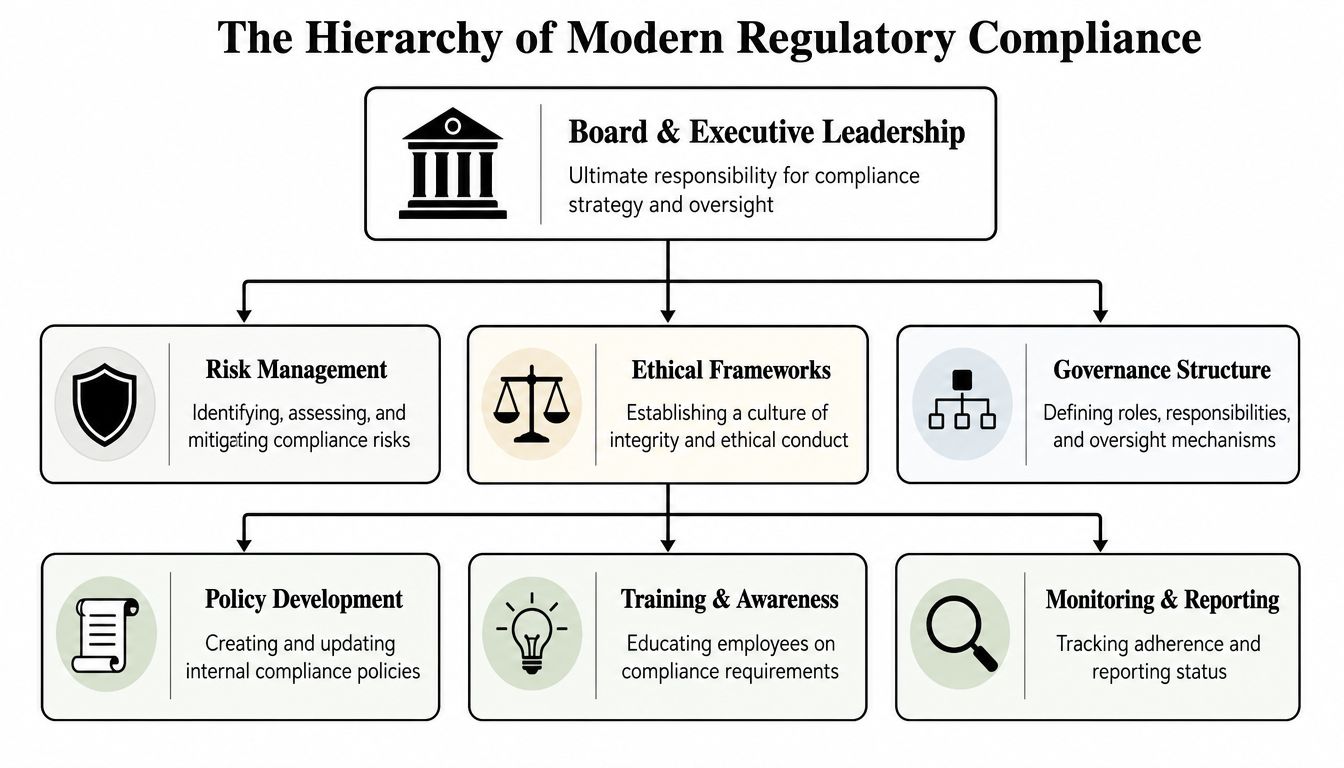
The practical distinction is simple. Law defines the obligation. Compliance determines whether the institution can execute against that obligation consistently, at scale, and in a form that can withstand regulatory review.
For leaders assessing AI deployment, privacy exposure, and digital-service accountability, this data privacy AI guide is useful because it connects high-level governance concerns to concrete oversight questions.
Three functions define whether compliance is real
Effective compliance usually rests on three functions. They are interdependent, and weakness in one often undermines the other two.
Obligation mapping
Institutions need a current view of which laws, standards, licence conditions, contractual duties, and supervisory expectations apply to each product, process, and market. This is harder than it sounds. Regulatory convergence means the relevant rule set is often assembled from several domains rather than one sector-specific code.Control translation
Legal requirements only matter operationally when they are translated into decision rights, approvals, monitoring, escalation channels, procurement terms, technical safeguards, and staff responsibilities. The test here is traceability. A regulator or auditor should be able to see how a specific obligation shaped a specific control.Evidence and assurance
Institutions must show that controls exist, function as intended, and are reviewed when risk conditions change. Many organisations discover that policy ownership, while clear on paper, is fragmented in practice. Evidence closes that gap.
Practical rule: If a policy cannot be tied to a defined obligation, and a control cannot be evidenced, the institution is not managing compliance in a credible way.
Seen this way, compliance is less a checklist than a method for governing complexity. Its strategic value lies in helping leaders determine which business models, partnerships, and technology uses remain defensible as regulatory systems become more connected.
The Expanding Scope of Compliance Across Global Sectors
Compliance now reaches into nearly every domain where states set conditions for safety, fairness, trust, or market order. That expansion matters because many institutions still organise their risk models around sector silos, even as regulation is moving in the opposite direction.
Why sector boundaries matter less than they used to
Finance remains a core compliance arena, but it no longer defines the field. Health systems must govern patient data, product safety, and research conduct. Manufacturers must align technical documentation, market-entry standards, and product marking rules. Technology firms face intensifying duties around data governance, cyber resilience, procurement eligibility, and automated decision-making. Trade-facing businesses must meet customs, sanctions, and origin requirements, often while proving that suppliers meet ethical expectations.
The UK product regime offers a concrete example of how technical compliance now intersects with market structure. Under the UK designated standards framework, product compliance is anchored in adherence to Designated Standards, and the UKCA mark became mandatory for most goods on 1 January 2025, replacing its earlier voluntary status. For goods sold in both the UK and EU, that creates a dual-compliance burden because UKCA and CE obligations sit within different legal frameworks.
That may appear narrow, but it has broad implications. It means engineering, legal, customs, documentation, and market strategy teams all need to coordinate. Compliance in this context isn't a legal footnote. It's a determinant of whether a product can move.
Regulatory Compliance Landscape by Sector
| Sector | Primary Objective | Example Regulators | Key Compliance Activity |
|---|---|---|---|
| Finance | Preserve market integrity and customer protection | FCA, prudential and conduct authorities | Sanctions controls, conduct governance, capital and reporting obligations |
| Health | Protect patients, research integrity, and sensitive data | Health regulators, medicines authorities, data regulators | Clinical governance, patient data handling, procurement assurance |
| Environment | Align economic activity with public and ecological safeguards | Environmental agencies, reporting authorities | Emissions disclosure, sustainable sourcing controls, permit management |
| Technology and AI | Govern data use, cyber resilience, and accountable automation | Data protection and digital regulators | Data governance, incident response, model oversight, procurement eligibility |
| Trade and manufacturing | Ensure products and transactions meet legal market-entry conditions | Customs authorities, product safety regulators | Rules of origin, sanctions screening, conformity assessment, technical documentation |
A wider policy lens helps here. Comparative debates on privacy and governance often reveal where obligations are converging and where they remain fragmented. For that reason, this overview of data protection regulations is a useful companion for leaders working across jurisdictions.
The most costly compliance failures often begin outside the legal department. They start in product design, vendor onboarding, contract drafting, data architecture, or market-entry planning.
The strategic lesson is that sector-specific expertise remains necessary, but it's no longer sufficient. Institutions need people who can see across regulatory domains, not just within them.
Enforcement and Oversight The High Cost of Non-Compliance
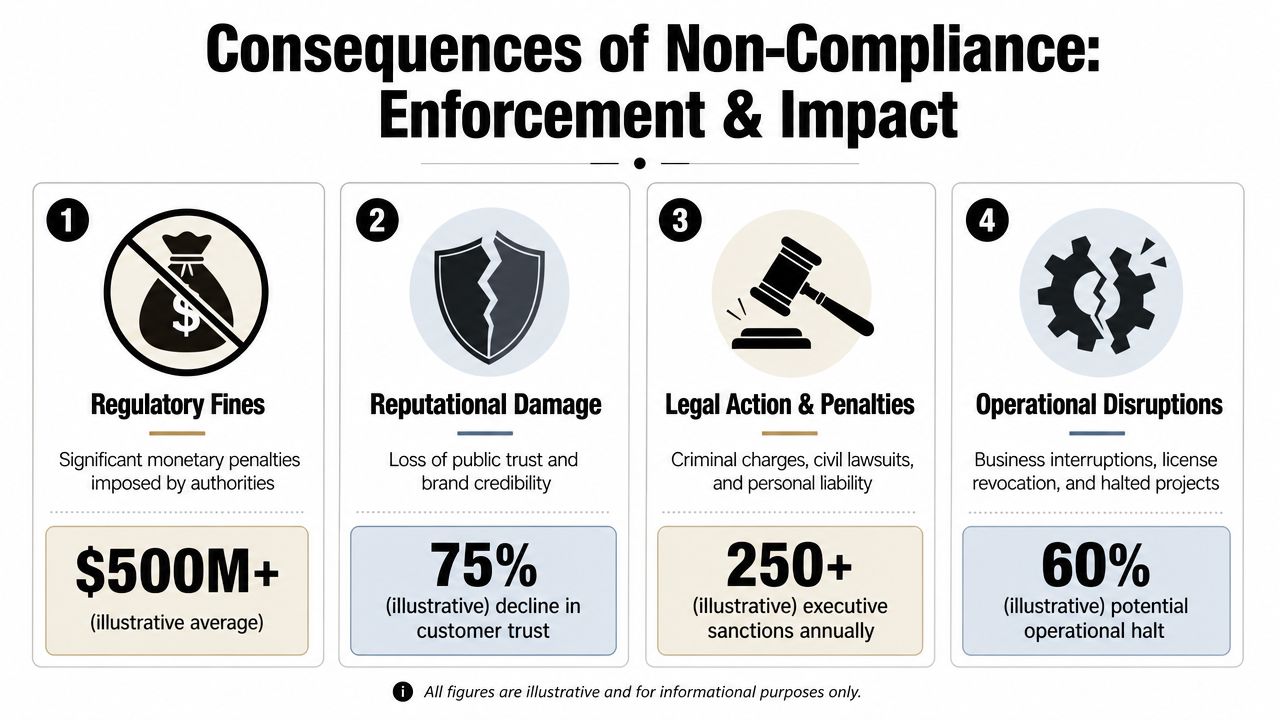
In the 2025 UK enforcement situation, regulatory actions produced £424 million in penalties across key sectors. For decision-makers, the larger signal is not the headline sum alone. It is that enforcement has become a primary mechanism through which states shape behaviour in markets where data, finance, labour, safety, and supply chains increasingly intersect.
That shift matters because non-compliance rarely stays confined to one rule set. Under conditions of interconnected regulatory convergence, a breach in one area can trigger scrutiny in several others. A data incident can become a consumer protection issue. A labour control failure can prompt tax, procurement, and reputational consequences. A financial reporting weakness can quickly raise conduct and governance questions.
How regulators create consequences
Regulators use a wider set of tools than fines. Inspections, audits, information requests, remediation orders, licence restrictions, and public notices can all change an organisation's operating position before any final sanction is imposed. In practice, oversight works through interruption as much as punishment.
For employers, the pattern is visible in routine operational areas that rarely receive board attention until a dispute arises. Leaders that want a grounded operational perspective can review these wage compliance best practices for employers, which show how payroll and scheduling controls can become regulatory, legal, and workforce risks at the same time.
Boards often underestimate exposure because they isolate the eventual penalty and miss the chain of disruption that comes first. Investigations absorb management time, delay transactions, trigger disclosure questions, strain supervisory relationships, and expose weaknesses in internal reporting. In cross-border organisations, these pressures can spread quickly when one regulator's inquiry attracts the interest of others.
Why enforcement risk is broader than fines
The UK data regime illustrates the scale of statutory exposure. The Information Commissioner's Office explains that serious infringements under UK GDPR can lead to fines of up to £17.5 million or 4% of global annual turnover, whichever is higher, under its guidance on UK GDPR fines and penalties. For large institutions, that makes privacy enforcement a board-level capital and governance issue, not a narrow legal matter.
The wider strategic point is straightforward. Enforcement now tests whether an institution can produce evidence of control across overlapping obligations, not whether it can recite the rules. Supervisors increasingly expect traceability across policies, systems, third parties, and executive accountability.
For policymakers concerned with systemic resilience, supervisory design matters as much as penalty ceilings. Debates on strengthening financial regulation for stability are relevant well beyond banking because they address a broader institutional problem: how oversight keeps pace when risks move across sectors faster than traditional regulatory silos can respond.
Board question: If regulators asked for evidence tomorrow, which obligations could your organisation prove it controls, and where would fragmented ownership still leave gaps?
Implementing Compliance in Corporate and Public Sectors
Implementation determines whether compliance functions as an operating system or remains a paper exercise. In an era of interconnected regulatory convergence, that distinction has sharpened. Institutions are no longer aligning to one rule set at a time. They are handling overlapping obligations across privacy, finance, procurement, cyber security, labour standards, competition, and sector-specific supervision, often across several jurisdictions at once.
For decision-makers, the central implementation question is structural. Can the organisation convert external legal change into internal control change fast enough, with clear ownership and evidence that stands up to review?
What strong corporate programmes have in common
Corporate implementation starts with regulatory architecture. Leadership needs a current view of which obligations apply, where they apply, and how they intersect across products, data, vendors, and business units. The hard part is not identifying a single rule. It is resolving collisions between rules that were written for different sectors or territories but now apply to the same process.
That is why mature programmes translate obligations into governance design. Policies, approval routes, control testing, incident response, and board reporting should all trace back to identifiable legal duties. Institutions that do this well treat compliance as part of operating model design, not as a legal review at the end of a project.
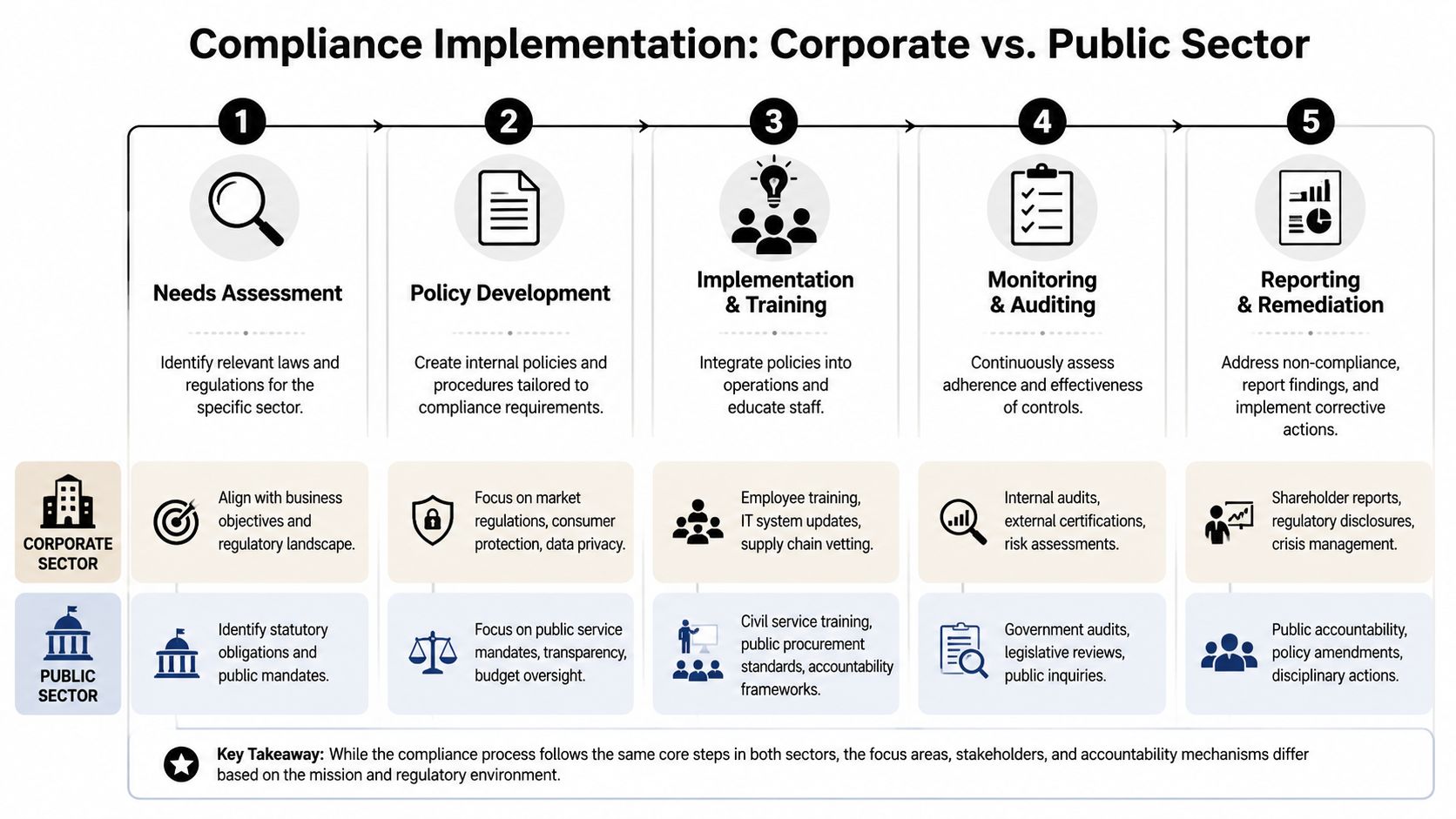
Several features appear repeatedly in stronger corporate systems:
- Defined accountability: Boards set risk appetite and oversight expectations. Executives allocate resources. Named control owners are responsible for execution and remediation.
- Traceable policy logic: Internal standards map to specific obligations, which reduces ambiguity when requirements overlap or change.
- Independent challenge: Internal audit, risk, and compliance functions test whether controls work in practice, not only on paper.
- Escalation discipline: Staff have clear reporting channels for incidents, near misses, and control failures, with thresholds for management attention.
- Decision-useful data: Organisations that invest in using data to improve compliance are better positioned to spot recurring control weakness across functions rather than treating each breach as isolated.
The strategic failure mode is familiar. Firms expand into new products, channels, or markets faster than they redesign their control environment. In a converging regulatory system, that gap grows quickly because one operational choice can trigger duties under several frameworks at once. Third-party onboarding is one example. A single vendor decision can create exposure across privacy, outsourcing, resilience, procurement, and sectoral conduct rules.
For customer-facing operations, automation adds another layer of complexity. AI tools can improve service efficiency while creating new accountability questions around monitoring, explainability, records, and customer outcomes. That is one reason the practical debate has shifted from whether to automate toward how to govern it. The operational implications are explored in AI compliance for customer support leaders.
Why the public sector carries a dual burden
Public institutions face a broader implementation challenge because they are both regulated entities and stewards of regulatory legitimacy. A ministry, regulator, university, hospital, or local authority must meet its own obligations on procurement, transparency, budgeting, records, and service delivery. At the same time, it must show that the standards it applies to others are matched by its own institutional discipline.
This dual burden has systemic implications. Weak compliance in the public sector does not stop at internal inefficiency. It can erode trust in enforcement consistency, distort market signals, and weaken confidence that regulatory burdens are being applied fairly.
Higher education illustrates the point. Universities may attract less public attention than banks or large technology platforms, yet they operate under continuous obligations tied to governance, reporting, funding conditions, safeguarding, research controls, data use, and registration status. The challenge is cumulative. Implementation depends on whether leadership can coordinate evidence, accountability, and policy execution across decentralised faculties and administrative functions.
A credible compliance system survives routine operational pressure, staff turnover, procurement constraints, and public scrutiny.
Across both sectors, the strongest implementation models share one characteristic. They are designed for regulatory change as a constant condition. That is the practical meaning of compliance under interconnected regulatory convergence. Institutions need governance structures that can absorb new rules, identify where obligations overlap, and adjust controls without repeated institutional redesign.
The Future of Compliance International Coordination and AI
AI is moving from pilot programmes into core economic and administrative functions. That shift matters because each new deployment sits inside an existing web of obligations across privacy, competition, consumer protection, procurement, sector supervision, recordkeeping, and public accountability. The future of compliance will therefore be shaped less by isolated rule changes than by interconnected regulatory convergence. Rules written for different sectors and jurisdictions increasingly meet inside the same system.

AI is accelerating the need for coordinated governance
AI does not replace earlier compliance duties. It multiplies them. A hiring model can trigger data protection, anti-discrimination, auditability, and procurement questions at the same time. A customer service system can create overlap across consumer law, cybersecurity, records management, accessibility, and platform governance. That accumulation is the strategic issue. Institutions are no longer managing one rule at a time. They are handling collisions between multiple regimes that were often designed separately.
This is why interoperability matters more than formal harmonisation. G7 and G20 economies will continue to differ on legal design, enforcement culture, and administrative capacity. But if definitions, reporting expectations, assurance standards, and supervisory signals diverge too far, firms and public bodies face a growing risk of compliance failure at the points where systems, markets, and jurisdictions intersect.
For customer-facing organisations deploying automated tools, AI compliance for customer support leaders offers a useful example of how governance questions change once AI systems begin interacting directly with the public.
The operational implication is clear. Periodic review cycles are becoming less credible as a primary control model. Institutions need governance systems that can track rule changes, test outcomes, preserve evidence, and identify where one regulatory obligation affects another. Work on using data to improve compliance is relevant here because it points toward a more continuous model of supervision and internal assurance.
What G7 and G20 leaders should focus on next
The central policy question is not whether international coordination will happen. It is whether it will happen fast enough to reduce fragmentation before fragmentation becomes a drag on innovation, trade, and regulatory legitimacy.
A practical agenda is already visible. AI governance needs clearer alignment with data protection, product safety, labour standards, and public sector procurement. Cross-border data access requires rules that protect rights without making lawful oversight unworkable. Supply-chain accountability, cyber resilience, and sanctions enforcement now operate as linked compliance domains rather than separate files inside government.
That creates a different role for compliance. It is no longer an endpoint after legislation is passed. It has become one of the main ways international cooperation is translated into market behaviour, administrative practice, and public trust.
The governance debate is broader than text on paper. The discussion below adds useful context on how institutions are thinking about future-facing compliance pressures.
For G7 and G20 leaders, the strategic objective is straightforward. Build compliance architectures that are technologically literate, internationally legible, and capable of handling overlap across sectors and borders. In an era of interconnected regulatory convergence, that is becoming a precondition for credible governance.
Conclusion Actionable Recommendations for 2026
Regulatory compliance is no longer best understood as a defensive process for avoiding penalties. It is a strategic system for preserving legitimacy, market access, and institutional resilience in an era of overlapping obligations. The leaders who still treat it as a narrow legal function are working with an outdated map.
For policymakers, the priority should be convergence without confusion. That means aligning standards where coordination reduces friction, especially in data governance, AI oversight, supply-chain integrity, and sanctions implementation. It also means writing rules that institutions can operationalise, not merely admire. If obligations can't be translated into evidence, controls, and reporting, enforcement will become inconsistent and trust will weaken.
For corporate leaders, the imperative is organisational elevation. Compliance leadership should sit close to the chief executive and board. Risk, legal, procurement, cybersecurity, HR, and operations should share a common control vocabulary rather than maintaining separate compliance universes. Institutions should also stop measuring success only by the absence of enforcement. The stronger test is whether they can demonstrate, under scrutiny, that their systems identify obligations early and manage them coherently.
Three recommendations stand out for 2026:
- Policymakers should prioritise interoperability: Where national systems differ, governments should clarify mapping and equivalence so firms can comply without duplicative uncertainty.
- Boards should demand evidence, not reassurance: Compliance reporting should show obligation mapping, control status, escalation routes, and remediation progress.
- Executives should build convergence capacity: Institutions need teams that can connect data, product, labour, financial, and trade obligations before issues become regulatory events.
Compliance is becoming a measure of state capacity and corporate quality at the same time.
That is the answer to what is regulatory compliance. It is the discipline that allows complex institutions to operate lawfully, credibly, and competitively inside a denser global rule system. In 2026, that discipline will shape not only who avoids penalties, but who earns trust.
Global Governance Media helps decision-makers turn complex regulatory and geopolitical change into practical choices. Explore more analysis, data-led features, and forward-looking policy coverage at Global Governance Media.