


By Daniel Hart
If markets allocate resources efficiently, why are G7 and G20 governments returning to industrial policy with such urgency?
The old debate treated industrial policy as a relic. The live debate is different. Leaders now face climate risk, AI concentration, fragile supply chains, and rising geopolitical rivalry. In that setting, the question isn't whether states should shape economic outcomes. They already do. The question is how to do it deliberately, transparently, and with enough discipline to avoid waste and retaliation.
That is why what is industrial policy has become more than a textbook prompt. It is now a strategic question for heads of government, finance ministries, industry departments, and multilateral institutions. Industrial policy is best understood as the organised use of public power to influence the structure of an economy: which capabilities are built, which sectors scale, where investment lands, and how resilience is protected when markets alone won't deliver those outcomes at the required speed.
For G20 leaders, that makes industrial policy less a theory than a governing toolkit. Used well, it aligns growth with public purpose. Used badly, it hardens into subsidy races, political favouritism, and weak productivity returns.
Table of Contents
- The Resurgence of the State in Economic Strategy
- From Mercantilism to the Modern Day A Brief History
- The Policymakers Toolkit Instruments and Typologies
- Global Case Studies Successes and Setbacks
- Addressing Grand Challenges Climate Tech and Security
- Evaluating Performance and Avoiding Common Pitfalls
- Conclusion A New Consensus for Multilateral Action
The Resurgence of the State in Economic Strategy
Why has industrial policy returned to the center of economic strategy? Because G7 and G20 leaders now face problems that markets alone do not solve at the required speed, scale, or level of coordination.
The challenge is not one market failure. It is a cluster of them. Clean technologies still struggle to attract enough patient capital. Digital infrastructure is concentrated in a handful of firms and jurisdictions. Supply chains for semiconductors, critical minerals, and advanced manufacturing remain exposed to geopolitical shocks. In sectors tied to national security and future productivity, private firms often underinvest because the public value of resilience, learning, and domestic capability exceeds what any one company can capture.
That is why state action has shifted from passive rule-setting to active market design. Governments are using procurement, subsidies, standards, public finance, and skills policy to shape production capacity in areas that matter for decarbonisation, AI, and economic security. The broader political shift is clear in this analysis of nation states back from the sidelines.
The UK illustrates the point. Its 2025 industrial strategy was framed around investment, jobs, the green transition, living standards, and longer-term growth in sectors with higher strategic and economic value. The underlying lesson is larger than one country. Industrial policy now works best when it is treated as a delivery system for national priorities, rather than a narrow subsidy program for favoured industries.
Execution matters as much as ambition. A strategy announced at the center only changes outcomes if firms can access support, invest with confidence, and expand capacity on a realistic timetable. For manufacturers trying to assess whether policy support is usable in practice, guidance on eligibility for manufacturing grants can matter as much as the headline strategy.
For G20 leaders, the non-obvious conclusion is this. The question is no longer whether to have industrial policy. The choice is whether to design it in ways that reduce strategic dependencies without triggering subsidy races, fragmented standards, and costly duplication across allies.
Practical rule: Start where strategic dependence is high, private investment remains too weak or too short term, and the public return from domestic capability exceeds the commercial return to any single firm.
From Mercantilism to the Modern Day A Brief History
Why does industrial policy keep returning, even after repeated claims that markets alone should determine economic outcomes?
The historical record gives a clear answer. States return to industrial policy whenever leaders conclude that open markets, by themselves, will not build enough capability in sectors tied to power, security, or long-term growth. That was true in the mercantilist era. It is true again as governments confront climate risk, strategic dependence, and the governance of frontier technologies.
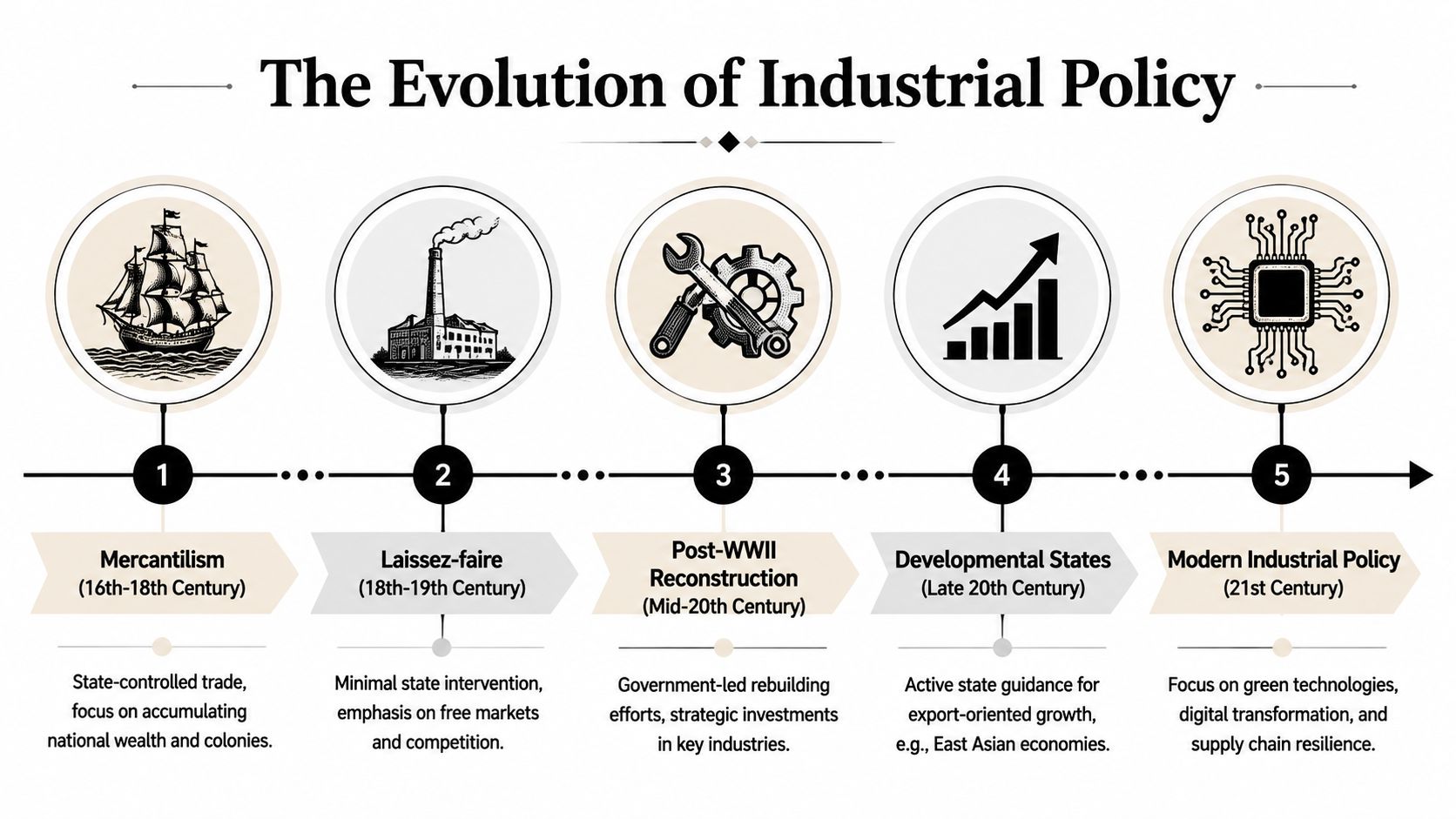
The earliest versions were explicit about power. In Britain, state efforts to recruit skilled artisans from Flanders in the 16th and 17th centuries, and Robert Walpole's 18th-century programme of subsidies and tariff protection for strategic industries, showed a pattern that still matters now. Governments used economic policy to shape production, not just to collect revenue or regulate trade, as outlined in this historical review.
The long British pattern
What changed over time was less the existence of industrial policy than its instruments and justification. In one period, the priority was naval strength or manufacturing scale. In another, it was restructuring declining industries, backing national champions, or using public ownership to preserve capacity. The same broad objective ran through each phase. Governments acted when they judged that market outcomes would leave the country exposed or less competitive.
This matters for current debates because it clears away a persistent myth. Market neutrality has rarely been the operating reality in advanced economies. The policy choice has usually been between visible and less visible forms of intervention. Tax incentives, public procurement, infrastructure planning, research support, and rules that shape private-sector investment decisions all influence which firms expand, which technologies scale, and which regions attract capital.
Why the modern revival is different
The post-war decades made state direction normal across much of the industrial world. Later, liberalisation changed the language of policy, but not the underlying practice. Governments continued to shape markets through energy systems, defence procurement, innovation funding, financial regulation, and competition policy.
What is different now is the combination of pressures. Climate change requires rapid deployment of clean energy, grids, batteries, and industrial decarbonisation. AI is creating a new contest over compute, chips, data infrastructure, and standards. Supply chain shocks have exposed the cost of concentrating production in a narrow set of geographies. Industrial policy has therefore shifted from a mainly national growth question to a wider problem of resilience, coordination, and strategic governance.
That shift has direct implications for G7 and G20 leaders. The strongest industrial strategies are no longer those that only protect domestic firms. They are the ones that build domestic capability while aligning standards, investment rules, and production capacity across partners. Poorly designed policy leads to subsidy races and fragmented markets. Well-designed policy can spread risk, accelerate deployment, and lower the cost of transition.
Industrial policy endures because governments repeatedly face the same constraint. Markets allocate capital efficiently under many conditions, but they do not automatically produce enough clean capacity, secure supply, or governed innovation in the sectors leaders care about most.
The history is useful for one reason above all. It shows that industrial policy is not an old argument revived for nostalgic reasons. It is a modern governing toolkit for leaders trying to manage decarbonisation, technological rivalry, and economic security at the same time.
The Policymakers Toolkit Instruments and Typologies
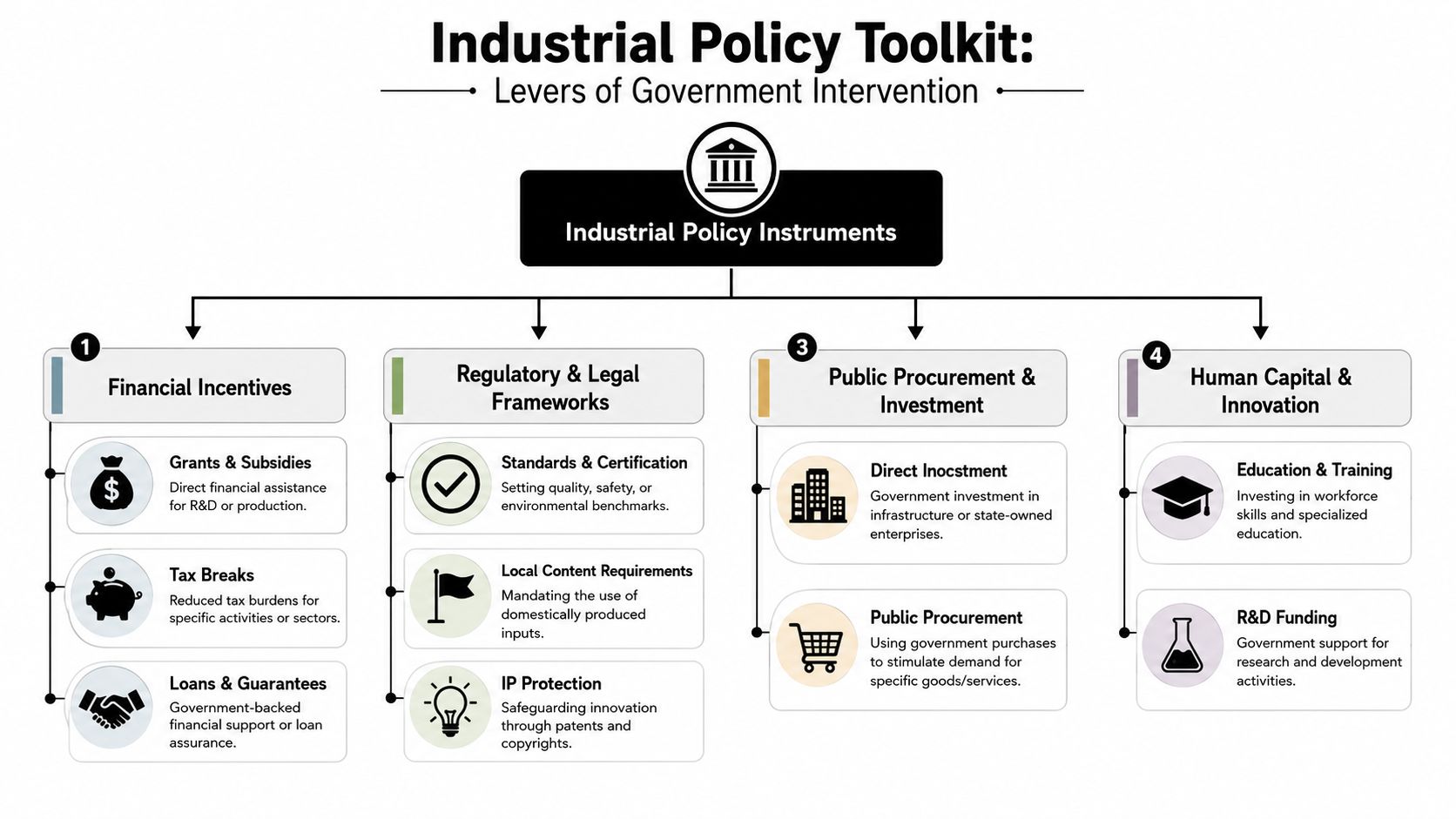
A credible industrial strategy is never one instrument. It is a portfolio. Leaders who reduce industrial policy to subsidies usually end up designing bad policy.
The better way to think about it is by function. Some tools lower cost. Others create demand. Others reduce uncertainty or build capacity over time.
Horizontal tools and vertical bets
The most important distinction is between horizontal and vertical policy.
Horizontal policy improves the environment for many firms at once. Think skills, infrastructure, financing conditions, planning efficiency, or regulatory clarity. Vertical policy targets specific sectors, technologies, or sometimes firms because governments judge them strategically important.
The UK's current approach explicitly combines both. The 2025 industrial strategy allocates £4.3 billion for advanced manufacturing, including £2.8 billion for research and development, and combines vertical interventions such as the British Industry Supercharger with horizontal policies on skills, finance, and regulation, as described in the IMF's assessment of the UK strategy.
That matters because pure horizontalism is often too weak to shift strategic outcomes, while pure verticalism can become a lobbying contest. The strongest strategies combine targeted ambition with broad capability building.
A short explainer helps clarify the distinction in practice:
| Policy type | Main purpose | Typical examples |
|---|---|---|
| Horizontal | Raise economy-wide capability | skills systems, infrastructure, finance access, regulatory reform |
| Vertical | Accelerate specific strategic sectors | sector grants, energy cost relief, R&D missions, procurement mandates |
Leaders also need to understand the mechanics behind private investment. Public support doesn't just transfer money. It changes risk calculations, project timing, and expected returns. That is why industrial policy is closely linked to facilitating private sector investment.
A useful primer on the broader logic sits here:
How leaders should choose instruments
Different policy tools solve different problems.
- Financial support works when firms face high upfront costs or uncertain payback. Grants, tax relief, and public R&D support fit here.
- Procurement matters when the state can create an early market. This is especially useful for clean technologies, defence applications, and digital systems.
- Regulation and standards shape incentives without always spending public money. They can force diffusion, establish interoperability, or create certainty for investors.
- Energy and infrastructure measures become industrial policy when they alter competitiveness in strategic sectors.
The choice should follow three tests:
What barrier blocks scale?
If the problem is weak demand, use procurement or standards. If it's high capital intensity, financing tools may work better.Is the objective capability or output?
Capability policies build know-how and ecosystems. Output policies increase production quickly. They are not the same thing.Can the state enforce discipline?
Support without performance pressure often locks in weak firms.
A strong industrial policy doesn't ask, "Which sector do we like?" It asks, "Which public intervention removes the specific barrier that markets are not fixing on their own?"
For G20 governments, the practical lesson is to treat industrial policy as a design problem, not an ideological badge. The right toolkit depends on what the state is trying to build, how fast it needs results, and whether institutions can hold recipients accountable.
Global Case Studies Successes and Setbacks
Industrial policy debates often become arguments about ideology. Real-world results suggest a better frame. State action works under some institutional conditions and fails under others.
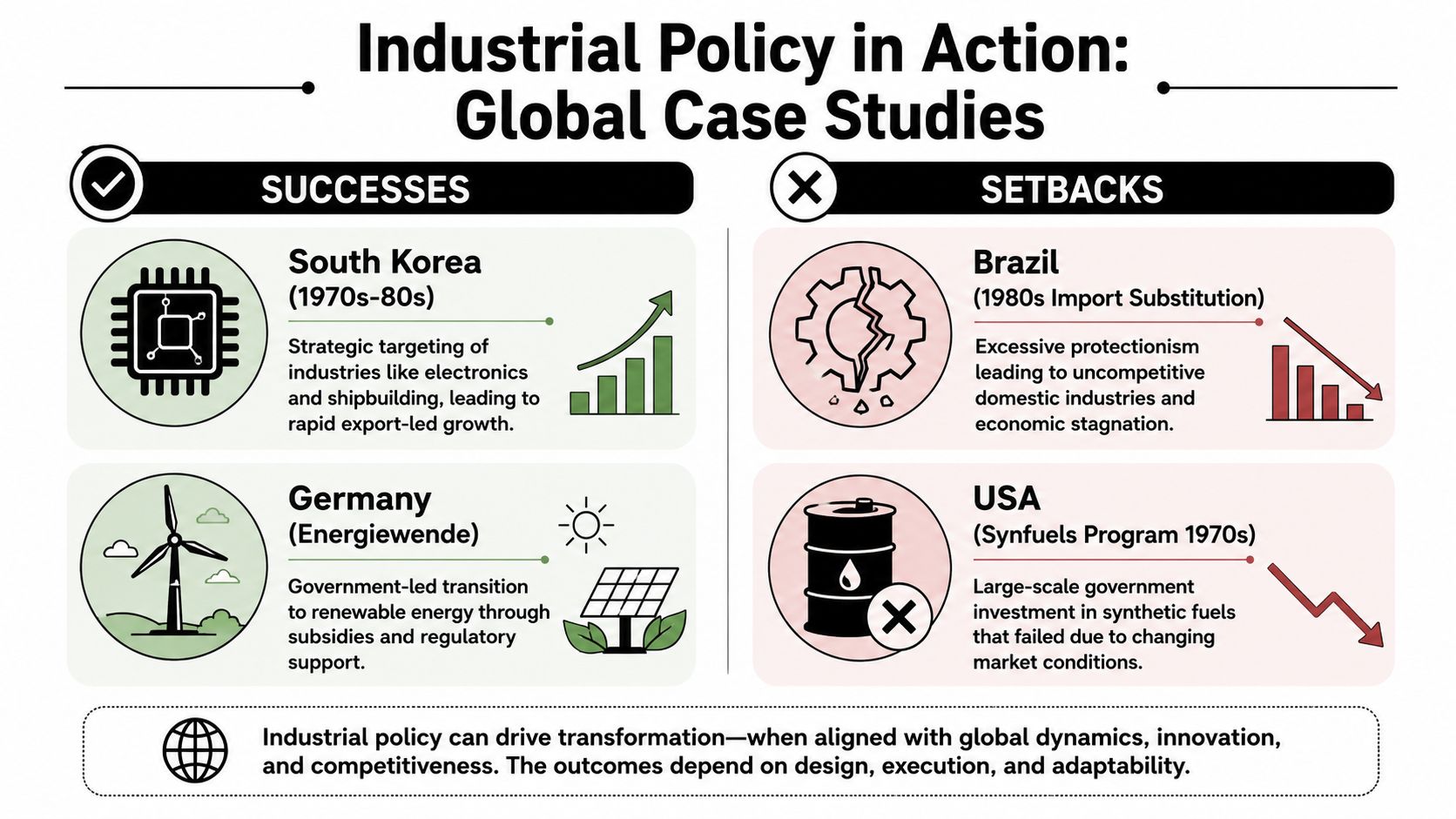
East Asian development strategies remain influential because they linked state guidance to export discipline, scale, and relentless capability building. Germany offers a different lesson. Its strength has often come less from headline national champions than from dense networks of specialised firms, technical training, engineering depth, and coordinated support structures. Those are different models, but both rely on public institutions doing more than merely stepping aside.
What transfers across countries
The transferable lesson isn't that every country should copy South Korea or Germany. It is that successful strategies usually combine four features:
- Administrative competence so policy survives beyond announcements.
- Business discipline so firms cannot rely indefinitely on public support.
- Institutional coordination across energy, skills, infrastructure, and finance.
- Strategic selectivity so governments don't spread resources too thinly.
The modern UK framework reflects that logic by narrowing attention to eight priority sectors, the IS-8: advanced manufacturing, clean energy industries, creative industries, defence, digital and technology, financial services, life sciences, and professional and business services, according to this analysis of the Modern Industrial Strategy.
That narrowing is important. Governments fail when they call everything strategic.
Why modern strategies narrow the field
Current industrial policy is also shaped by technology contests that move quickly. Battery chemistry is one example. Policymakers deciding where to back research, localisation, and grid-linked manufacturing need to distinguish between short-term cost races and long-term platform bets. For officials tracking where energy storage policy may go next, this briefing on the future of sodium-ion battery development is a useful illustration of how industrial strategy and technology pathways intersect.
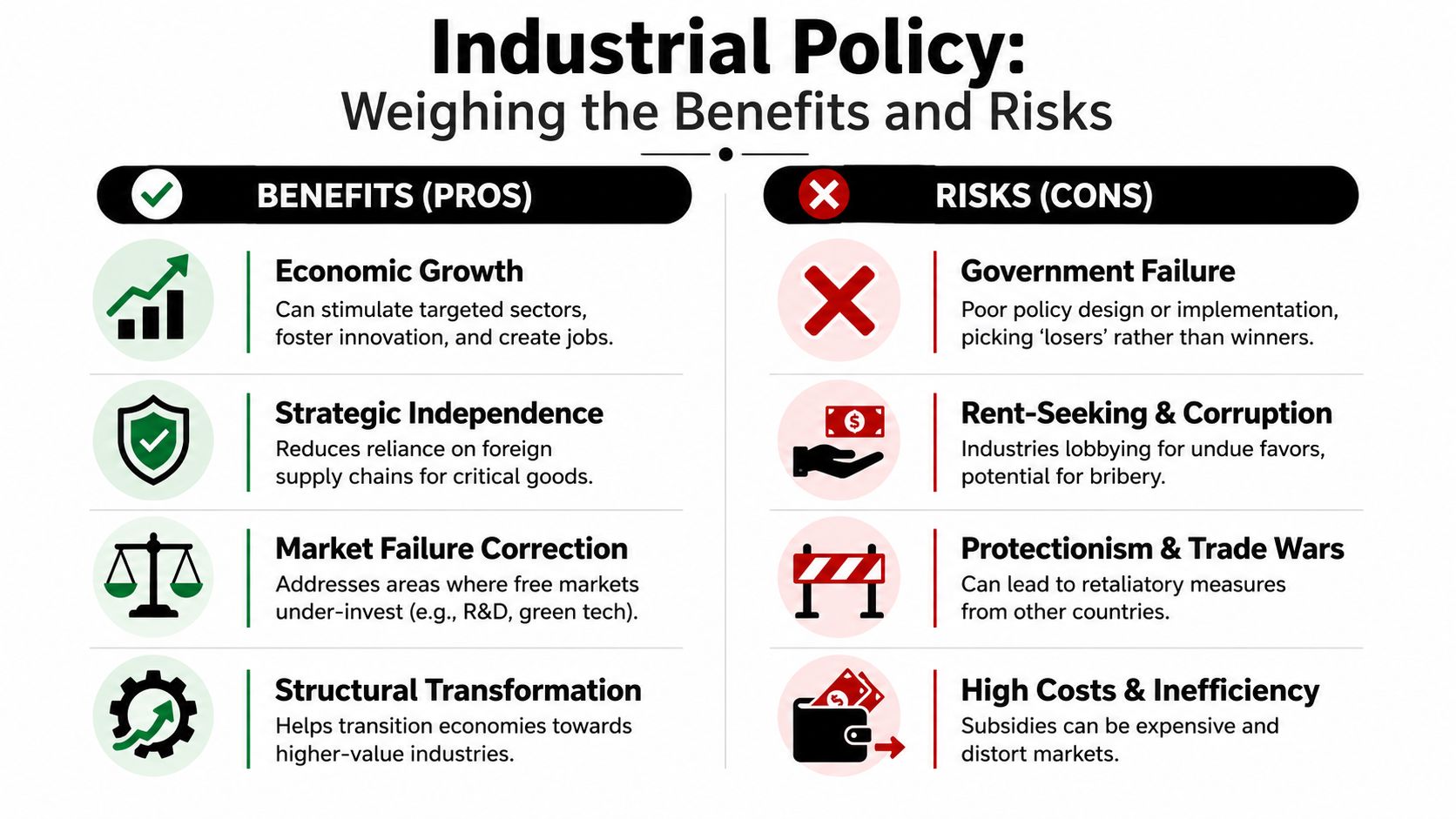
The cautionary side is just as important. Industrial policy fails when governments protect incumbents without raising performance, when political influence outruns technical evaluation, or when programmes can't adapt after market conditions change. Some countries overprotect domestic production and end up with high-cost, low-innovation sectors. Others over-subsidise fashionable technologies and create capacity without competitiveness.
A simple comparison helps:
| Pattern | Likely result |
|---|---|
| Targeting with performance discipline | Greater chance of durable capability |
| Broad protection without accountability | Greater chance of stagnation |
| Coordinated support across systems | Greater chance of scale and spillovers |
| Fragmented ministries and unstable rules | Greater chance of investor hesitation |
The key variable is rarely whether the state intervenes. It is whether officials can withdraw support, update strategy, and resist capture when the original theory stops matching reality.
For G20 leaders, that distinction is the difference between industrial policy as strategic statecraft and industrial policy as expensive symbolism.
Addressing Grand Challenges Climate Tech and Security
Industrial policy now sits at the centre of grand strategy because climate, technology, and security are no longer separable policy domains. A country can't promise decarbonisation without considering manufacturing capacity, grids, minerals, transport equipment, permitting, and workforce supply. It can't talk credibly about AI leadership without asking where compute, power, talent, and critical hardware will come from.
Climate policy now needs industrial capability
Climate ambition without industrial capability usually produces dependence. That is why governments are turning climate agendas into industrial agendas.
The UK's strategy gives one concrete example of how this works. Reporting on the plan highlighted that the British Industry Supercharger would provide 90% discounts on network charges for steel, chemicals, and fertiliser producers, while also raising concerns about exclusion criteria and the creation of a two-tier environment for firms outside priority sectors, according to The Guardian's summary of the strategy's key points and omissions. That kind of design choice shows the true challenge. Climate-linked industrial policy isn't just about ambition. It's about who gets lower costs, who scales first, and which regions are left behind.
Many of the most practical decisions happen below the headline strategy level. Firms and local authorities often need to interpret how incentives apply to equipment and installation. For a concrete example in transport electrification, this explainer on tax credits for EV equipment shows how fiscal instruments can influence adoption and deployment choices.
Leaders trying to align decarbonisation with competitiveness should also think in systems, not sectors alone. This broader discussion of climate change mitigation strategies is useful because industrial policy only works when energy, infrastructure, and demand signals reinforce each other.
AI and security have changed the stakes
AI has made industrial policy unavoidable. Governments don't need to announce an AI industrial strategy for one to exist. If they shape power access, data centre approval, chip access, public procurement, research funding, or talent rules, they are already making industrial choices.
Security adds another layer. Supply chains that once looked merely efficient now look vulnerable if they are overly concentrated or externally exposed. That is why leaders increasingly use industrial policy to de-risk strategic inputs, diversify sourcing, and preserve domestic capability in sectors they judge essential.
The implication for G20 governments is stark. Industrial policy is no longer a narrow economic instrument. It is part of how states govern transition risk.
Evaluating Performance and Avoiding Common Pitfalls
Industrial policy often fails for a simple reason. Governments announce goals, allocate funds, and then judge success by political visibility rather than economic performance.
That approach is no longer defensible. The UK evidence is a useful corrective. Empirical work for the UK indicates that a one percentage point increase in industrial policy spending as a share of GDP leads to approximately a 0.25% increase in labour productivity in targeted industries over the following two years, according to the UK government publication on new evidence for industrial policies. That is not trivial. But it is also not a miracle. It implies lag, modesty, and the need for disciplined expectations.
What should be measured
A serious evaluation framework should ask whether policy changed behaviour that markets would not have produced on their own.
That means tracking outcomes such as:
- Productivity effects in targeted sectors, not just spending disbursed.
- Private investment response, especially whether firms expand because public policy reduced risk or cost.
- Capability formation, including supply chain depth, technical skills, and innovation capacity.
- Strategic resilience, especially where governments aim to reduce dependency or exposure.
Policymakers also need to separate short-term political wins from structural progress. New facilities, ribbon cuttings, and ministerial announcements are outputs. They are not proof of competitiveness.
Why strategies fail even when money is available
The UK's earlier experience offers a direct warning. The House of Commons Library records that historical UK industrial policy from 2010 to 2015 suffered from inconsistency and coordination failures because inadequate feedback loops between economic evaluations and policy-setting allowed political considerations to override economic criteria, and that the 2025 strategy attempts to correct this through a structured 10-pillar framework, as summarised in this Parliamentary briefing.
That diagnosis matters far beyond the UK. The biggest pitfall in industrial policy isn't always choosing the wrong sector. It is failing to build institutions that learn.
A practical checklist for ministers is straightforward:
- Set exit conditions early so support doesn't become permanent entitlement.
- Create feedback loops between analysts, delivery agencies, and political leaders.
- Test regional effects because national gains can mask local exclusion.
- Review instrument fit because a financing problem, a skills problem, and a grid problem require different responses.
Public money should buy adaptation, not inertia.
For G20 governments, the discipline question is decisive. If strategy can't be evaluated, it can't be governed. And if it can't be governed, it will eventually be captured.
Conclusion A New Consensus for Multilateral Action
What should G7 and G20 leaders do now that industrial policy has returned to the center of economic strategy?
The answer is not another wave of loosely coordinated subsidies. It is a rules-based approach to state action that treats industrial policy as a modern policy toolkit for three linked pressures: decarbonisation, AI competition, and supply chain fragility. Those pressures are now shaping growth, security, and political legitimacy at the same time. Governments that act alone may win individual projects. Governments that coordinate can shape markets.
The UK's latest strategy shows why design now matters as much as ambition. Its 2025 plan ties industrial policy to net zero, regional development, and economic security. As noted earlier, international analysis suggests targeted support can raise productivity in the industries it reaches. The practical lesson is clear. Returns depend less on headline spending than on policy fit, institutional discipline, and clarity about where national action should stop and cross-border cooperation should begin.
That is the basis for a new consensus.
For G20 leaders, five design principles stand out: clear missions, narrow targeting, transparent selection criteria, regular evaluation, and cooperation in areas of shared exposure. Climate technology, health resilience, critical minerals, digital infrastructure, and advanced compute will remain competitive arenas. Yet each also contains functions where coordination serves national interest, including standards, stockpiling rules, interoperability, research protocols, and crisis-response planning.
This is now a statecraft issue as much as an economic one. Poorly designed industrial policy can harden trade friction, duplicate capacity, and raise fiscal costs without building resilience. Well-designed industrial policy can do something more valuable. It can align public investment with long-term capability, reduce strategic dependencies, and lower the risk that climate and technology competition turns into systemic fragmentation.
Industrial policy will shape the next decade. The central choice for leaders is whether to use it as a national bidding war or as a disciplined instrument within a more stable multilateral order.
For sharper analysis on industrial strategy, climate governance, economic security, and the choices facing G7 and G20 leaders, follow Global Governance Media. It's a strong destination for policy professionals who need concise, evidence-based perspectives on multilateral action and the global agenda.