



By Daniel Hart
Can white people experience racism? The public debate often treats that as a binary question. For policymakers, that's the wrong starting point.
The harder and more useful question is this: what kind of racial harm are we talking about, and what policy instrument fits it? If officials collapse every race-based slight, stereotype, institutional disparity and grievance into one category, they end up designing blunt responses to very different problems. That weakens equality policy and fuels public mistrust.
In UK law, policy analysis and sociology, the central distinction is between interpersonal racial prejudice and structural racism. The first can affect anyone. The second concerns how institutions, historical power and patterned outcomes distribute harm across groups over time. That distinction matters because governments don't legislate only against bad attitudes. They also regulate schools, labour markets, housing systems, policing practices and public services.
Senior officials need a framework that can acknowledge two things at once. White people can face hostility, stereotyping or unfair treatment because of race. But the evidence in the UK shows that systemic racial disadvantage is concentrated elsewhere. Treating those experiences as analytically identical may feel even-handed, yet it produces weak diagnosis and poor policy design.
Table of Contents
- Framing a Complex Social and Political Question
- Defining Core Concepts of Prejudice Power and Racism
- Interpersonal Prejudice Versus Structural Racism
- Evidence of Systemic Racism in the UK
- Historical Legacies and Global Perspectives
- Policy Implications for Effective Equality Strategies
- Conclusion A Roadmap for Actionable Policy
Framing a Complex Social and Political Question
Public argument about race often fails because different speakers use the same word to mean different things. One person means a racial slur. Another means a bias in recruitment. A third means patterns built into housing, policing or education. The result isn't just disagreement. It's analytical confusion.
For UK policymakers, the distinction is already embedded in the legal and institutional framework. The Equality Act 2010 protects people of all races from discrimination and defines race as including colour, nationality, and ethnic or national origins. At the same time, policy work on race has to confront a broader reality. Unequal power and historical advantage shape whose disadvantages become entrenched, cumulative and institutional.
That's why the question of whether white people can experience racism can't be answered responsibly with a simple yes or no. If the term is being used in the everyday sense of race-based hostility, then yes, white people can experience prejudice. If the term is being used in the sociological and policy sense of prejudice operating through systems of power, the answer changes.
Policy test: If a claimed racial harm appears mainly as isolated incidents, the remedy is different from a harm that appears repeatedly across institutions, data and enforcement systems.
This isn't semantic gatekeeping. It's a way to avoid category errors. A minister deciding how to revise exclusions guidance, a local authority shaping cohesion strategy, or a civil servant assessing equalities impacts needs more than rhetorical balance. They need a framework that distinguishes between individual unfairness and institutional patterning.
That framework also helps with a politically sensitive task. Officials can recognise that some white communities feel racially sidelined, particularly where economic decline, low trust and local competition over services are already acute, without treating those perceptions as evidence that structural racism operates symmetrically.
Defining Core Concepts of Prejudice Power and Racism
Why definitions matter in policy
A useful starting point is simple. Prejudice refers to attitudes, assumptions or judgments about people because of their race. Power refers to the capacity of a group to shape institutions, norms, access and outcomes. Racism, in academic and sociological discourse, is typically understood as racial prejudice plus systemic power, as discussed in this overview of white fragility and structural racism.
That definition explains why many scholars argue that white people may face racial insults or stereotypes, but don't face structural racism in the same way as racialised minorities. Researchers associated with institutions such as the Runnymede Trust have stressed that the issue isn't whether white people can be disliked because of race. The issue is whether that prejudice is reinforced by the same historical, institutional and socioeconomic constraints.
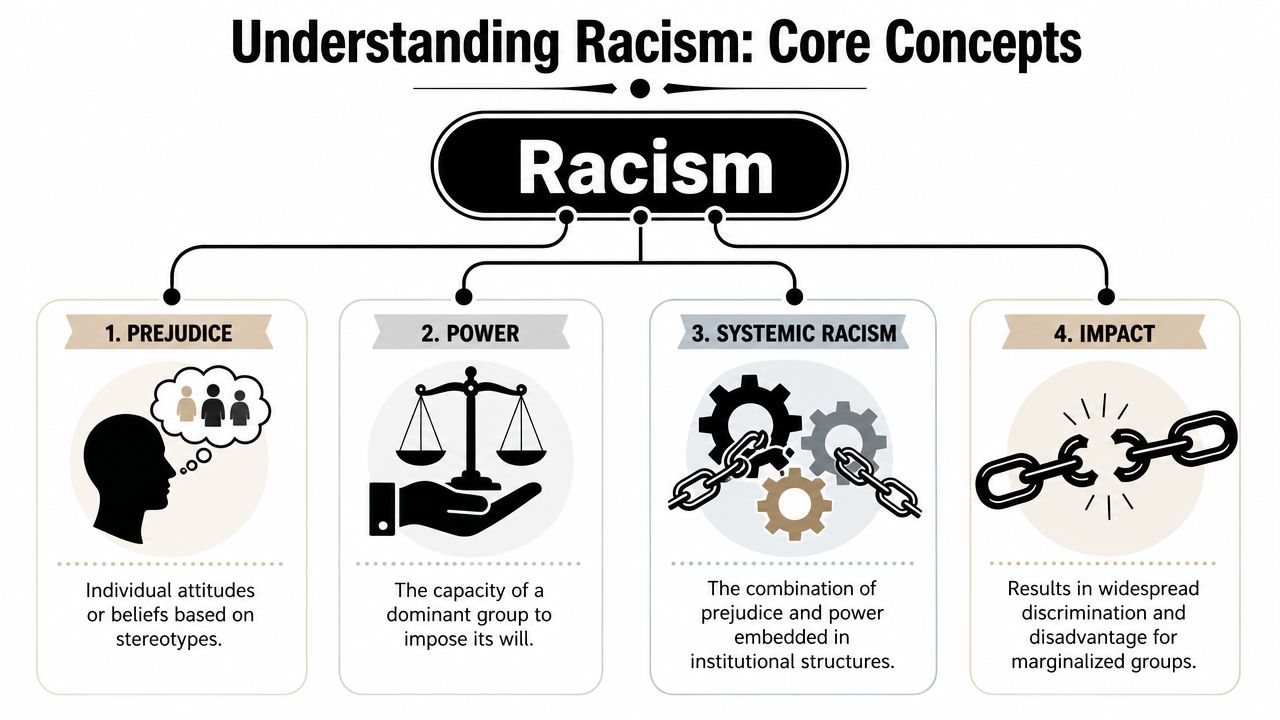
An analogy helps. Think of prejudice as a live electrical current. On its own, it can shock and injure. But it becomes a system-level force only when connected to a wider circuit of institutions, incentives and historical advantages. That circuit is what turns bias into patterned outcomes in hiring, schooling, housing, policing and representation.
Officials working on schools may find practical value in resources on developing anti-racist school communities, especially where the challenge is to connect individual behaviour, school culture and institutional rules rather than treating them as separate problems.
A practical way to think about power
Power in this context doesn't mean every white individual is powerful, or that every minority individual lacks agency. It means some groups are more likely to benefit from institutional defaults, inherited norms and historically accumulated advantage.
That's why legal equality on paper doesn't settle the issue. Formal rights matter, but they don't automatically erase unequal outcomes. In fact, equality law works best when paired with a realistic understanding of how institutions behave in practice. A related discussion of legal architecture appears in this analysis of equality in the law.
A clearer vocabulary helps governments avoid three common mistakes:
- Confusing insult with system: A racial insult is real harm. It isn't the same thing as a recurring institutional pattern.
- Treating all groups as similarly positioned: Equal legal protection doesn't mean equal exposure to disadvantage.
- Choosing the wrong remedy: Training, enforcement, resource targeting and system redesign address different kinds of problems.
When policy language is imprecise, public institutions either overreact to isolated incidents or underreact to entrenched inequality.
Interpersonal Prejudice Versus Structural Racism
Two forms of harm with different policy consequences
White people can experience race-based hostility. That can include slurs, stereotyping, exclusion or unfair treatment by individuals. Governments should treat that seriously. Public bodies have duties to prevent discrimination against all protected groups, and administrative fairness can't depend on the race of the complainant.
But structural racism is a different category. It describes recurring patterns across institutions, where one group is more likely to face disadvantage in ways that are measurable, cumulative and tied to power. UK evidence points strongly in that direction. EHRC research found that 8% of people in England and Wales reported racial discrimination in the last five years, with the highest rates among Black African people at 26% and Black Caribbean people at 22%, while only 2% of the White: English/Welsh/Scottish/Northern Irish/British group reported such discrimination, as discussed in this article drawing on UK evidence about racial discrimination.
Those figures don't show that white people never face prejudice. They show that exposure is not distributed evenly. For policymakers, that matters because prevalence, repetition and institutional concentration are what justify system-level interventions.
A fuller policy discussion of these patterns sits alongside wider work on tackling hidden inequalities.
Why symmetry misleads policymakers
The language of “reverse racism” often rests on symmetry. If any race-based prejudice is racism, then all groups must be equally capable of experiencing racism in the same sense. That sounds tidy, but it collapses unlike phenomena into one category.
| Dimension | Interpersonal Racial Prejudice | Structural Racism |
|---|---|---|
| Primary form | Individual hostility, insult, exclusion or stereotyping | Institutional patterns that produce recurring disadvantage |
| Typical scale | Incident-based | Population-level and cumulative |
| Main actors | Individuals or small groups | Public bodies, labour markets, schools, housing systems, policing structures |
| Evidence type | Complaints, testimony, case-specific facts | Disparity data, audit studies, enforcement patterns, repeated outcomes |
| Policy remedy | Redress, conduct rules, complaint handling, mediation | System redesign, accountability, targeted intervention, enforcement reform |
| Applicability to white people | Yes, in some cases | Rarely framed that way in UK policy analysis because measurable disadvantage is concentrated among racialised minorities |
Operational distinction: If removing one biased actor solves the problem, it was likely interpersonal. If the disparity survives personnel changes and reappears across settings, policymakers are dealing with structure.
This is why the question “can white people experience racism” produces more heat than light unless the speaker specifies the level of analysis. Policy becomes clearer once the categories are separated.
Evidence of Systemic Racism in the UK
Employment and labour market sorting
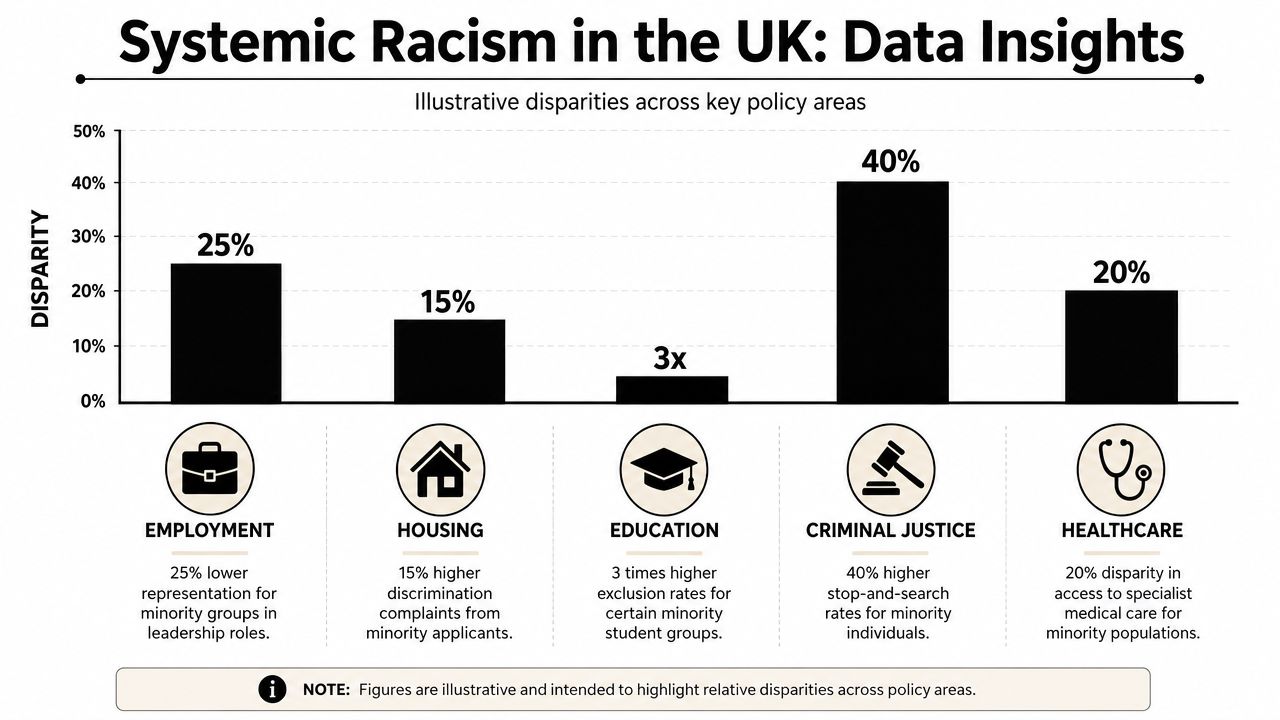
The strongest case that racism in the UK is structural comes from repeated disparities across major institutions. Employment is one of the clearest examples. UK data shows that, in 2022, Black Caribbean men experienced unemployment rates around 9.1% compared with 4.1% for White British men, and a 2021 audit found that CVs with Black-sounding names needed to send 60% more applications to receive a positive employer response than equivalent CVs with White-sounding names, as summarised in this analysis of UK racial inequality evidence.
These patterns matter because they don't describe one employer behaving badly. They indicate filtering processes embedded in recruitment and labour market signalling. Employers may not articulate racist intent, yet the outcomes still sort candidates unequally.
Housing conditions and policy inheritance
Housing shows a similar pattern. ONS 2021 data found that 32% of Bangladeshi households and 26% of Black African households lived in overcrowded housing, compared with 3% of White British households. The Joseph Rowntree Foundation links these outcomes to historical policy choices, including the 1968 and 1971 Immigration Acts, which shaped access to housing and left durable structural effects.
That matters for ministers because housing inequity isn't only about current landlord behaviour. It also reflects how past immigration, settlement and market policies structured present opportunities. Once a government recognises that, the policy question shifts from “who said what” to “which rules and incentives still reproduce unequal living conditions”.
Education and criminal justice patterns
The pattern extends beyond work and housing. In education, Black Caribbean pupils were excluded from school at a rate of 20.1 per 1,000 compared with 5.1 per 1,000 for White British pupils, according to Department for Education data cited in the verified evidence. In higher education, Office for Students data indicates that White British students attain a higher proportion of first-class degrees than Black Caribbean and Black African students in comparable subjects.
In criminal justice, the Home Office evidence cited in the verified data shows that Black people are over 1.8 times more likely than white people to be stopped and searched by police. Hate crime patterns also point in the same direction. The Office for National Statistics reported that in 2022 to 2023, 79%, or 82,270, of 104,094 recorded hate crimes in England and Wales were racially or religiously aggravated, with much of the hostility directed toward Black, Asian and mixed ethnicity victims.
Taken together, these domains show why structural racism can't be reduced to interpersonal animus. Different institutions, using different rules, still produce patterned disadvantage for many racialised minorities. That is the point policymakers must keep in view when responding to arguments that all racial prejudice is equivalent in policy terms.
Historical Legacies and Global Perspectives
Why history belongs in present policy analysis
Current racial disparities don't appear from nowhere. They are often the downstream effects of earlier decisions about migration, labour, land, welfare, citizenship and policing. In the UK housing example discussed above, the persistence of overcrowding among some minority households shows how policy inheritance works. Once governments create differential access to settlement, ownership and mobility, those choices can shape life chances long after the original law has been repealed.
That historical logic isn't unique to Britain. It's visible across states shaped by empire, slavery, segregation, settler colonialism or racialised labour systems. The forms differ, but the mechanism is familiar. Law creates boundaries, institutions normalise them, and later governments inherit the distributional consequences.
A useful comparative example sits outside the UK. For readers who want a legal-historical case study of how labour markets carry racial legacies forward, the discussion of the historical roots of Mississippi employment issues is instructive. The jurisdiction is different, but the policy lesson is transferable. Historical rules continue to shape who gets access, credibility and security.
A global governance lens
For G7 and G20 officials, this issue belongs inside broader debates on inclusive growth, migration governance, urban resilience and social cohesion. Governments often frame race as a domestic culture-war topic. That's too narrow.
Racial hierarchy has been woven into global labour flows, border regimes and development trajectories. Colonial extraction, apartheid governance and racially stratified citizenship all created international patterns that still affect mobility, wealth accumulation and institutional trust. That doesn't mean every country has the same racial order. It means policymakers should expect historical power to show up in different national forms.
The most common policy error is to treat today's disparity as if it were generated entirely by today's attitudes.
That wider perspective also clarifies why white grievance narratives can intensify in places undergoing economic stress. Declining wages, weak public services and political distrust can create fertile ground for racial explanation, even where the underlying structure of racial advantage hasn't flipped. Governments need enough historical literacy to respond without either dismissing social pain or misdiagnosing its cause.
Policy Implications for Effective Equality Strategies

The practical policy challenge isn't only how to reduce racial inequality. It's how to do so in a political environment where some white communities believe they are being ignored, displaced or unfairly blamed. The verified evidence points to a real gap here. Qualitative studies indicate that some white communities in deindustrialised regions perceive discrimination, even where quantitative evidence doesn't show equivalent structural disadvantage. That leaves local leaders trying to answer “reverse racism” narratives while keeping multiracial solidarity intact.
Officials shouldn't dismiss those perceptions out of hand. But they also shouldn't validate false equivalence. Perceived unfairness may reflect class decline, regional neglect, weak services, labour insecurity or anxiety around rapid change. If governments recode those pressures as proof that structural racism now affects white communities in the same way, they will target the wrong problem.
A practical example of where this matters is housing allocation and access. Policy design has to balance universal fairness with evidence-based targeting, especially in contested local environments. That's one reason debates around positive action in housing need careful communication as well as legal precision.
How to answer reverse racism narratives without conceding false equivalence
A sound public response has three parts.
- Acknowledge lived grievance: People can feel excluded, stereotyped or unheard. Officials should recognise that without immediately endorsing the explanatory frame attached to it.
- Separate race from distributional stress: Where the underlying driver is economic decline or service scarcity, policy should address those material conditions directly.
- Return to evidence: Structural racism should be identified by patterned outcomes across institutions, not by rhetorical intensity.
Communication principle: Governments should say plainly that all racial prejudice is wrong, while also saying plainly that not all racial harms operate through the same structures.
That distinction often lowers temperature because it avoids two unhelpful extremes. One is denying any race-based harm to white people. The other is treating every complaint as evidence that structural racism is now symmetrical.
Design principles for resilient race equality policy
Policymakers need equality strategies that are analytically sharp and politically durable.
Use universal language with targeted implementation. Frame policy around fairness, equal treatment and institutional integrity. Target intervention where the evidence shows persistent disadvantage.
Train frontline institutions to distinguish incident from pattern. Schools, police forces, housing bodies and employers need protocols that capture both complaint handling and structural review.
Integrate race with place and class analysis. Some local tensions are best understood through the interaction of race, deprivation and regional decline, not through a single-axis frame.
The following discussion offers a useful prompt for reflection on how public conversations can become more constructive:
Communicate with disciplined honesty. Don't overstate evidence. Don't retreat from it either. Public trust rises when governments can explain why a policy is universal in principle but selective in operational focus.
Measure institutions, not only attitudes. Complaints data matters, but so do exclusions, hiring outcomes, housing conditions, stop and search patterns and access to progression.
The core point is straightforward. If policymakers want effective equality strategy, they must keep the distinction between prejudice and structural racism intact. Otherwise, they risk producing policy that is rhetorically balanced but substantively inaccurate.
Conclusion A Roadmap for Actionable Policy
The most useful answer to the question can white people experience racism is conditional. White people can experience racial prejudice, hostility and discrimination by individuals. But UK evidence does not support the claim that they face structural racism in the same way as racialised minorities. That distinction is what allows law, administration and public communication to stay precise.
For senior officials, this isn't an academic dispute. It shapes what gets measured, which institutions are scrutinised, how interventions are targeted and how governments respond to polarised public narratives. A system-level problem needs a system-level remedy. An incident-level problem needs protection, redress and fair process. Mixing the two weakens both responses.
The better framework is demanding but workable. Recognise all race-based harm. Distinguish interpersonal prejudice from structural racism. Locate grievance in its proper context, including class and place where relevant. Then design policy around evidence of patterned disadvantage rather than perceived symmetry.
That approach does more than sharpen anti-racism policy. It also improves social cohesion strategy. People are less likely to distrust equality policy when governments explain clearly what they are addressing, why they are addressing it, and which evidence supports the choice.
For deeper analysis on multilateral governance, inclusive growth and evidence-led public policy, explore Global Governance Media.