

By Alex Mercer
The most consequential fact about eu bosnia and herzegovina isn't that the country has candidate status. It's that failure to deliver technical reforms is already carrying a measurable cost. The clearest example is the European Commission's decision to reduce Bosnia and Herzegovina's EU Growth Plan allocation by €108.4 million because it failed to finalise its reform plan, a direct illustration that accession conditionality now affects money, not just diplomatic language, as set out by the EU's Bosnia and Herzegovina relationship page.
That changes the policy question. For officials in Brussels, London and other European capitals, the issue is no longer whether Bosnia and Herzegovina will one day join the European Union. The sharper question is what a prolonged half-integrated, under-reformed state means for regional security, migration management, governance assistance and investment risk in the Western Balkans. Bosnia and Herzegovina's accession track has moved forward procedurally, but the operational gap between status and implementation remains the central strategic problem.
Table of Contents
- An Ambiguous Mandate EU Engagement at a Crossroads
- The Dayton Legacy and its Institutional Obstacles
- Navigating the Accession Labyrinth The 14 Key Priorities
- The Political Quagmire Blocking European Reforms
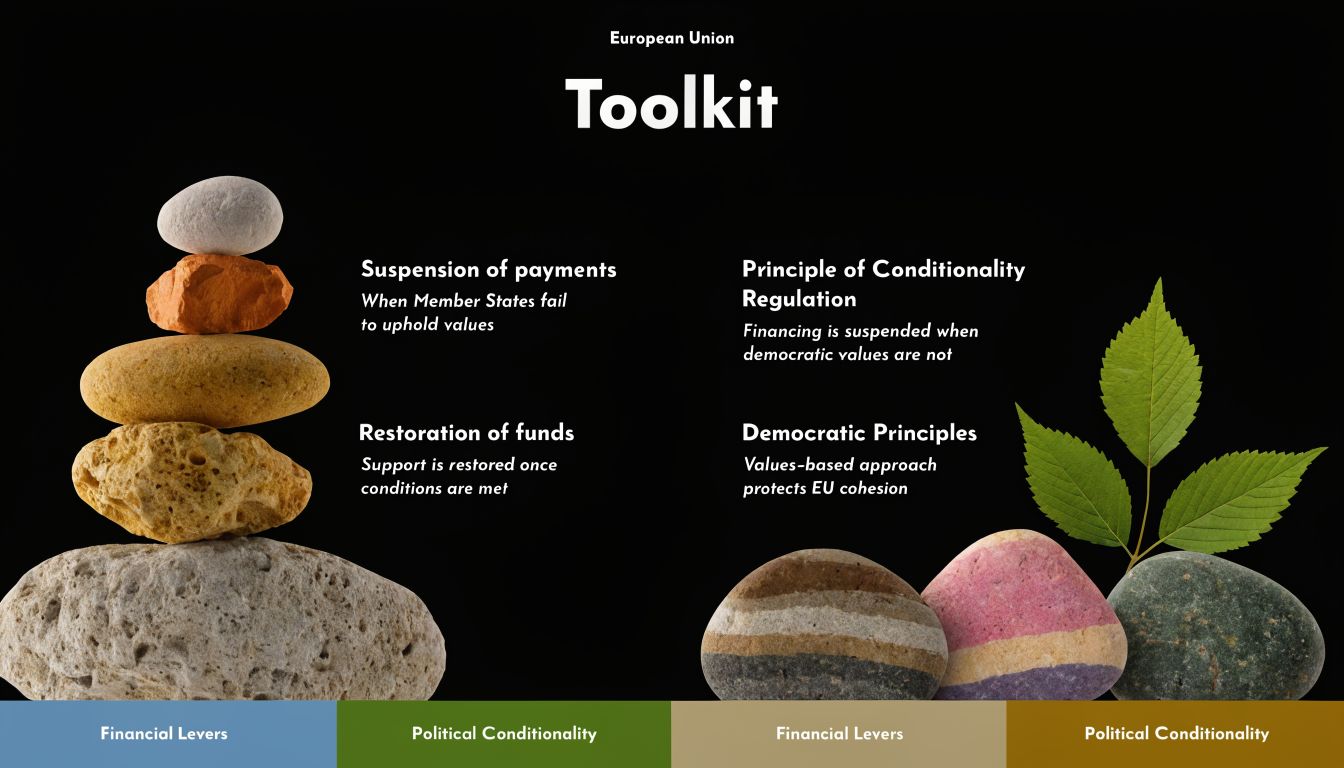
- The EU's Toolkit Financial Levers and Political Conditionality
- A Geopolitical Chessboard Regional and External Influences
- Forging a Path Forward Policy Recommendations for 2026
An Ambiguous Mandate EU Engagement at a Crossroads
Bosnia and Herzegovina is no longer a routine enlargement file. It has become a test of whether the EU can prevent institutional stagnation on its own periphery from turning into a longer-term economic and security liability.
The formal trajectory points to incremental progress. Bosnia and Herzegovina moved from potential candidate status to a membership application in 2016, then to candidate status in 2022. Yet the strategic picture remains unsettled. The European Commission's 2024 Bosnia and Herzegovina report presents the same core assessment heard for years: limited administrative capacity, persistent rule-of-law weaknesses, and repeated political blockages still constrain implementation. Candidate status therefore matters less as a diplomatic milestone than as a measure of how much institutional work remains unfinished.
That gap between symbolic advancement and operational readiness defines the current crossroads.
The strategic dilemma
Brussels has often managed difficult accession tracks by stretching time horizons and preserving political ambiguity. In Bosnia and Herzegovina, that approach carries rising costs. Delay reinforces incentives for domestic veto players to preserve fragmented authority, while reform-oriented officials lose credibility when external rewards arrive without corresponding delivery.
The issue is wider than enlargement procedure. A prolonged halfway status weakens investor confidence, slows regulatory convergence, and leaves governance gaps that hostile or opportunistic actors can use. For a country with a complex internal settlement and recurring political crises, stalled accession is not neutral. It shifts the balance toward drift.
Policy implication: In Bosnia and Herzegovina, prolonged ambiguity functions as a policy choice. It reduces pressure for institutional consolidation while increasing the likelihood of repeated external crisis management.
The UK has direct interests here despite Brexit. British policy in the Western Balkans still rests on regional stability, disruption of organised crime networks, migration management, and the resilience of the wider European security order. From that perspective, Bosnia and Herzegovina is not just an EU candidate country. It is part of the wider question of how external actors can strengthen state resilience in fragile political systems.
Why the file is now more urgent
The central policy question is not whether accession will happen soon. It is what prolonged stagnation costs in the meantime.
Those costs are tangible. Slow reform and weak policy coordination suppress the credibility of the business environment. Recurrent institutional disputes absorb political attention that should go to fiscal management, energy transition, transport connectivity, and alignment with the single market. At the same time, incomplete rule-of-law reform raises security concerns that extend beyond Bosnia and Herzegovina's borders, especially where corruption, illicit finance, and contested authority overlap.
For EU and UK policymakers, the more useful frame is state capacity rather than accession theatre. The key variable is whether Bosnia and Herzegovina's institutions can coordinate across multiple levels of government, translate EU requirements into domestic law, and enforce them with enough consistency to reduce political and economic risk. Until that changes, the accession process will remain formally alive but strategically underperforming.
The Dayton Legacy and its Institutional Obstacles
Dayton did more than end a war. It created a governing system that makes routine state action costly, slow and politically contestable. For EU policymakers, that is the core institutional fact. Bosnia and Herzegovina's accession problem begins with constitutional design, because the state disperses authority across multiple centres that can delay, dilute or block implementation.

Fragmentation is built into the state
The most important obstacle is not the absence of institutions. It is the way institutions relate to one another. Bosnia and Herzegovina has state, entity, cantonal and municipal layers with overlapping competences and different political constituencies. In that setting, policy coordination is rarely a technical exercise. It becomes a constitutional and political negotiation.
The implications go well beyond formal governance charts. Even basic state functions that support EU alignment, such as producing comparable administrative data, coordinating regulation, or applying common standards, are harder than in more centralised candidate countries. Where responsibilities are split across several levels, no single authority can reliably carry a reform from political agreement to uniform execution.
This is best understood as an interoperability problem. The system contains offices, mandates and legal competences, but it often lacks a dependable route for decisions to move across institutions without obstruction or reinterpretation. That is why wider debates on state resilience through institutional design are directly relevant to Bosnia and Herzegovina.
Why institutional design matters for accession
EU accession depends on more than passing legislation. It requires administrative consistency, legal clarity and enforcement capacity across the whole state. Bosnia and Herzegovina struggles on all three fronts because authority is dispersed and political veto points are embedded in the post-war settlement.
The standard enlargement frame often overstates the role of short-term political will. Political agreement matters, but it does not resolve the underlying transmission problem. A reform can be accepted in principle and still stall during drafting, intergovernmental coordination, adoption at lower levels, or practical enforcement. For outside actors, that distinction matters because a stalled accession track carries direct costs. It deters investment, raises compliance uncertainty for firms, and leaves space for corruption and patronage networks to exploit fragmented authority.
Three consequences follow:
- Evidence for policymaking is harder to standardise. Fragmented administrative structures make it more difficult to compare performance, measure reform progress, and identify where implementation is breaking down.
- Transposition of EU rules is slower and more uneven. Measures often have to pass through several jurisdictions and political arenas before they have legal effect.
- Enforcement gaps become structural. A law adopted at one level does not guarantee consistent application across the country.
Bosnia and Herzegovina is therefore dealing with more than political paralysis. It faces a state-capacity constraint rooted in constitutional structure. For the EU and the UK, that has strategic implications. Assistance aimed only at elite compromise will produce limited returns unless it also improves how institutions coordinate across constitutional boundaries, convert legal commitments into administrative practice, and reduce the economic and security costs of prolonged institutional fragmentation.
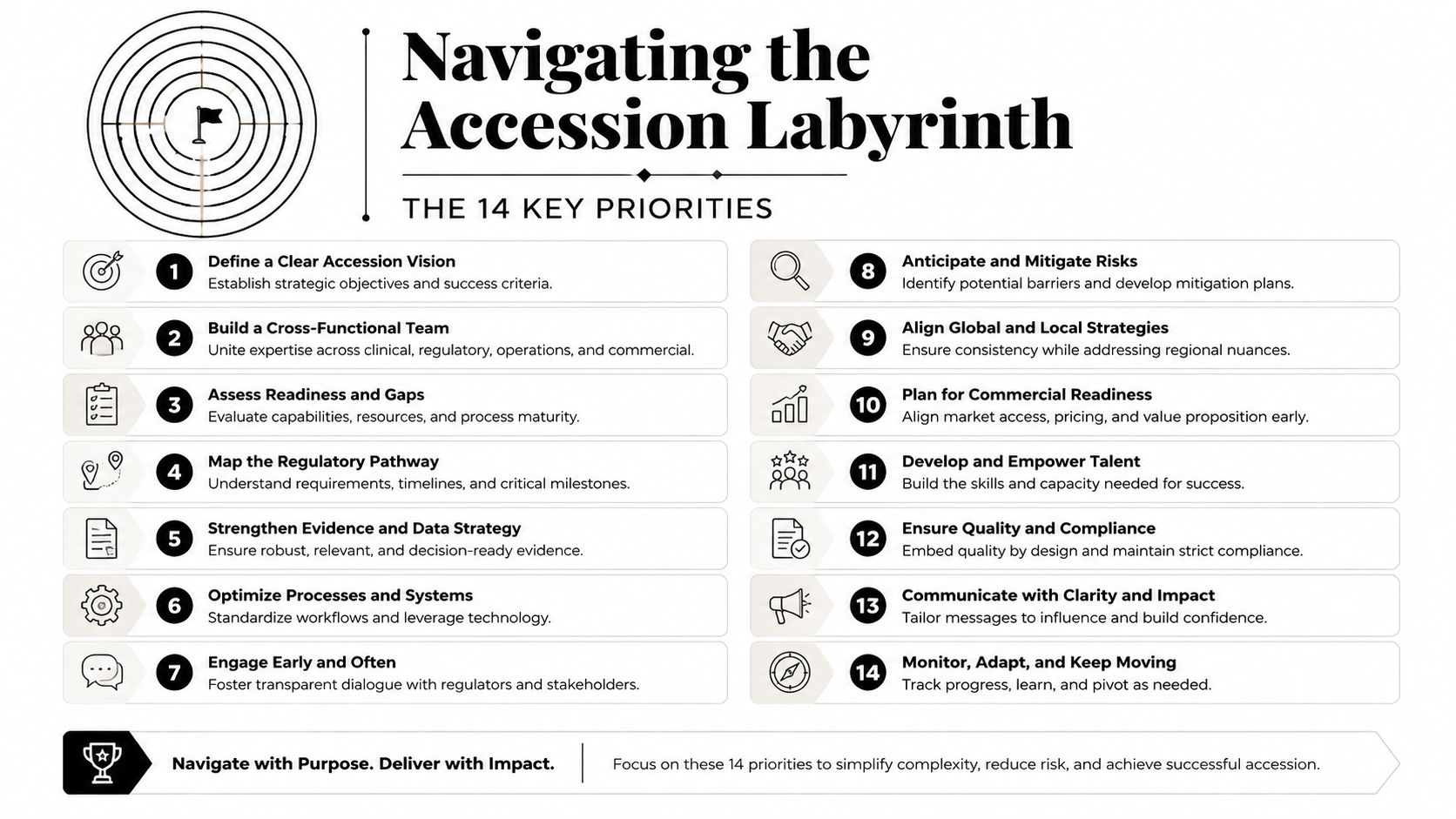
Navigating the Accession Labyrinth The 14 Key Priorities
The 14 key priorities are the EU's practical test of whether Bosnia and Herzegovina can translate political alignment into functioning state capacity. That is why the accession debate is often framed too narrowly. The central policy question is not only whether the country will join, but what prolonged partial alignment costs in foregone investment, weaker legal predictability, and a more permissive environment for political and security disruption in the Western Balkans.
From candidacy to conditional negotiations
Candidate status and the March 2024 decision to open accession negotiations marked a political advance, but not a shift into automatic progression. The European Council's March 2024 conclusions on enlargement made that clear by tying the next steps to continued reform delivery. Bosnia and Herzegovina remains in a conditional process in which legal approximation, implementation capacity and institutional coordination matter as much as headline diplomacy.
The technical burden is visible in the EU's own assistance design. The Union's Bosnia and Herzegovina integration facility prioritises support for harmonisation of national legislation, Stabilisation and Association Agreement implementation, and translation and transposition of the EU acquis, according to the EU integration facility document. This is a revealing signal about Brussels' diagnosis. The constraint is not only political consent at the top. It is also whether public institutions can convert commitments into legally sound texts, coordinated procedures and enforceable rules.
That distinction has strategic weight for the EU and the UK. A stalled accession track does more than delay membership. It prolongs compliance uncertainty for firms, raises the cost of cross-border business, and leaves governance gaps that external actors can exploit.
For reform practitioners, the lesson is familiar. Formal promises matter less than whether institutions can carry them through over time. That is why debates about rooting out corruption through enforceable governance mechanisms are directly relevant to Bosnia and Herzegovina's accession effort.
What the priorities require
The 14 key priorities are best read as an operational benchmark for a rules-based state. They are usually grouped into four reform domains:
| Reform domain | What it means in practice |
|---|---|
| Democracy and institutional functioning | More predictable decision-making, functioning representative institutions and fewer blockages across political levels |
| Rule of law | Greater judicial integrity, more credible enforcement and clearer distance between partisan bargaining and legal process |
| Fundamental rights | Alignment with European standards on rights protection, non-discrimination and public accountability |
| Public administration reform | A professional civil service able to implement, monitor and enforce EU-compatible rules |
The analytical error is to treat these priorities as a checklist of isolated reforms. In practice, they work as a stress test of state coherence. Each priority asks the same underlying question from a different angle: can Bosnia and Herzegovina take a binding obligation, allocate responsibility across multiple centres of authority, and deliver consistent application?
A practical reading of the priorities points to three administrative demands.
Legislative drafting capacity
Ministries and agencies need to produce laws and secondary legislation that align with EU requirements and survive legal scrutiny.Cross-government coordination
State, entity, cantonal and local authorities need a shared interpretation of reform obligations so that transposition does not fragment across jurisdictions.Implementation continuity
Reforms need to remain in force through electoral turnover, coalition disputes and institutional contestation.
These demands explain why technical progress in Bosnia and Herzegovina often appears uneven even when political declarations remain pro-European. The main difficulty lies in execution across a fragmented constitutional order. For policymakers in Brussels and London, the implication is straightforward. If accession remains stalled at this stage, the costs accumulate long before any formal decision on membership.
The Political Quagmire Blocking European Reforms
The technical agenda is demanding, but the more immediate obstacle is political conduct. Bosnia and Herzegovina's reform problem isn't that leaders don't know what Brussels wants. It's that domestic actors often gain more from controlled obstruction than from successful compliance.
Reform failure is political, not merely procedural
Bosnia and Herzegovina was granted EU candidate status in December 2022, and the European Council decided in December 2023 to open accession negotiations once the necessary degree of compliance is achieved, according to the European Commission's Bosnia and Herzegovina country page. The same source makes clear that the process remains blocked by internal political tensions and delayed reforms.
That sentence captures the core reality. Institutional fragmentation creates opportunities for obstruction, but political actors choose whether to use them. In Bosnia and Herzegovina, they often do. Ethno-political competition rewards veto use, symbolism and tactical escalation. Reforms that would strengthen neutral state capacity can therefore appear threatening to actors who rely on fragmented authority and constituency-based mobilisation.
This produces a familiar pattern. Leaders endorse the European path in broad terms while resisting the legal and administrative changes that would make the path real. That gap between declared strategy and operational behaviour is one of the defining characteristics of the file.
Why laws stall even when the path is clear
Several mechanisms repeatedly weaken reform delivery:
- Entity-level blocking power: Political leaders can delay state-level measures by contesting competence, sequencing or implementation terms.
- Coalitional fragility: State institutions often depend on politically brittle bargains that don't survive pressure around sensitive reforms.
- Weaponised identity politics: Ethnic representation arguments are regularly deployed not only for constitutional questions, but also for ordinary governance disputes.
- Dilution over blockage: Some reforms aren't openly defeated. They are narrowed, slowed or reshaped until they lose practical effect.
A simple analytical distinction helps here. Bosnia and Herzegovina's politics produce both visible deadlock and managed incompletion. Deadlock is easier for outside actors to spot. Managed incompletion is more damaging over time because it creates the appearance of movement without durable reform.
The result isn't simply slow accession. It is the repeated conversion of European conditions into domestic bargaining chips.
For outside policymakers, this means that broad diplomatic encouragement is insufficient. Progress depends on identifying where obstruction occurs, who benefits from delay, and which reforms can be insulated from short-term coalition disputes. The central challenge is political sequencing. Not every requirement can be advanced at once, and not every actor should be treated as equally committed to implementation.
The EU's Toolkit Financial Levers and Political Conditionality
The accession process is often described as a political test. In practice, it is also a resource-allocation system. For Bosnia and Herzegovina, that matters because delays do not postpone membership alone. They reduce access to financing, slow administrative modernisation, and widen the gap between nominal candidacy and functional integration.
Incentives are substantial, but only under disciplined use
The EU still has a wide policy toolkit in Bosnia and Herzegovina: pre-accession funding, technical support, legal screening, policy benchmarks, and staged access to integration benefits. The problem is not the absence of instruments. The problem is whether they are targeted closely enough to alter the behaviour of veto-holders who can absorb diplomatic criticism more easily than material loss.
Technical assistance deserves more attention than it usually receives in enlargement commentary. Bosnia and Herzegovina does not face only a deficit of political will. It also faces a deficit of administrative coherence. Reforms that appear straightforward in Brussels often require coordination across state, entity, cantonal and district institutions that do not share the same incentives or timelines. In that setting, implementation support is part of the political strategy, not a secondary bureaucratic service.
The same logic shapes the economic case for a more disciplined accession process. A stalled track imposes costs before any formal breakdown occurs: delayed disbursement, weaker investor confidence, and slower regulatory convergence with the single market. For UK and EU strategists assessing regional stability, those are not technical side-effects. They are part of the security picture, particularly in a region where economic frustration can reinforce wider external competition, including the patterns discussed in broader debates on US-Russia strategic competition in Europe.
Conditionality has become more credible
The harder edge of EU policy is now clearer than in earlier phases of the process. In 2024, Bosnia and Herzegovina's planned envelope under the EU Growth Plan was cut after domestic authorities failed to submit a finalised reform agenda on time, according to Radio Free Europe/Radio Liberty reporting on the Commission decision. The immediate significance is financial. The wider significance is institutional. Brussels showed that procedural non-delivery can produce a measurable budgetary consequence.
That changes the incentive structure in two ways. It raises the domestic political cost of delay for parties that previously treated reform slippage as manageable. It also gives outside actors a clearer test of seriousness. Governments can still endorse European integration rhetorically, but missed benchmarks now have more visible fiscal effects.
A concise comparison illustrates how the tools operate:
| EU instrument | Intended effect | Bosnia and Herzegovina implication |
|---|---|---|
| Technical assistance | Improve drafting, coordination and implementation capacity | Useful where institutions want to deliver, less effective where obstruction is political |
| Political conditionality | Link procedural progress to specific reform steps | Effective only when benchmarks are precise and cannot be reinterpreted domestically |
| Growth Plan financing | Reward timely, credible reform commitments | More credible after the reduction in planned funding for non-delivery |
One conclusion follows. Conditionality works only when responsibility is traceable. If every missed commitment can be dispersed across multiple institutions, financial pressure loses force and political narratives fill the gap.
The EU therefore faces a calibration problem, not a tools problem. Broad engagement remains necessary, but it should be paired with narrower benchmarks, shorter verification cycles, and clearer attribution of failure. Otherwise, Bosnia and Herzegovina will continue to incur the economic and governance costs of accession without receiving the disciplining effect that accession policy is supposed to generate.
A Geopolitical Chessboard Regional and External Influences
Bosnia and Herzegovina's accession path isn't unfolding in a vacuum. Domestic dysfunction intersects with wider regional competition, external influence and unresolved questions about European security architecture. That broader environment makes stagnation more costly than it appears in narrow enlargement debates.
A fragile economy magnifies strategic risk
Bosnia and Herzegovina is not a large economy, but it is strategically relevant precisely because fragility and geography combine. Official country data compiled in a current policy sheet place the country's population at 3,798,671 in 2024, GDP at €26.1948 billion in 2024, projected GDP growth at 1.7% for 2025, and unemployment at 12.6% in 2024 by ILO definition, as summarised by the Robert Schuman Foundation country profile. Those figures show a state with limited economic margin for political drift.
A country in that position is more exposed to governance shocks, reform delays and investor caution. In geopolitical terms, economic vulnerability broadens the room for outside actors to exploit frustration, elite competition and uneven institutional performance. It also raises the stakes of missed convergence opportunities with the EU.
Why the UK should care even outside the EU
For British policymakers, Bosnia and Herzegovina matters less as an enlargement dossier than as a regional resilience issue. A stalled accession process can deepen instability in ways that affect organised crime routes, migration management and the credibility of European crisis prevention. The continued international security role in the country, including EUFOR Althea as referenced in the EU's country material discussed earlier, underlines that Bosnia and Herzegovina is still treated as a live security concern rather than a settled post-conflict file.
The UK's position after Brexit gives it a different but still relevant role. It can't shape accession chapters directly, but it can support institutional integrity, judicial capacity, anti-corruption work and coordinated diplomacy with European partners. In strategic terms, that puts Bosnia and Herzegovina alongside wider debates about US and Russia competition in contested regions, where governance weaknesses create openings for disruptive external influence.
Three practical conclusions follow:
- Stalled accession is not neutral: It can degrade security conditions even without dramatic crisis.
- Economic underperformance has strategic effects: Weak growth and high unemployment increase political vulnerability.
- External policy must be joined up: Security assistance, governance support and economic engagement can't be treated as separate tracks.
The wider lesson is simple. Bosnia and Herzegovina becomes harder to stabilise when it is approached only as a technical applicant state and not as a geopolitical hinge in the Western Balkans.
Forging a Path Forward Policy Recommendations for 2026
The most serious mistake policymakers could make in 2026 is to keep treating Bosnia and Herzegovina as a file that can be managed through ritual expressions of support. The costs of drift are already visible. What's missing is a strategy that matches the country's institutional reality.
What Brussels should do next
The EU should move towards granular conditionality, not just broad political messaging. Funding should be tied to specific deliverables that are narrow enough to verify and difficult to cosmetically imitate. Where institutions meet technical benchmarks, financing should move quickly. Where actors block implementation, the penalty should be direct and attributable.
Brussels should also concentrate more support on administrative interoperability. Bosnia and Herzegovina does not only need new laws. It needs stronger drafting units, better cross-level coordination and clearer responsibility chains for implementation. Technical assistance works best when it is attached to concrete institutional workflows rather than generic reform narratives.
A more disciplined approach would include:
- Narrow benchmarks: Focus on reforms that can be verified through enacted measures and implementation steps.
- Sequenced incentives: Release benefits in stages tied to delivery rather than promises.
- Targeted political pressure: Identify veto players precisely instead of treating the system as uniformly constrained.
What Sarajevo and partners should prioritise
Bosnian leaders should stop framing the accession agenda as a symbolic foreign-policy orientation and start treating it as a state-functionality programme. The immediate priority is not to solve every constitutional dispute at once. It is to build momentum around a limited set of reforms that prove institutions can act coherently.
That means selecting reforms with three characteristics: they should be technically meaningful, politically defensible and administratively executable across the existing governance structure. Success on a smaller number of reforms would do more to rebuild credibility than another cycle of maximalist declarations.
External partners, including the UK, should align around practical support:
| Actor | Priority action |
|---|---|
| EU institutions | Tighten performance-based financing and sustain high-level political engagement |
| Bosnian authorities | Prioritise implementable reforms with visible administrative follow-through |
| UK and like-minded partners | Support institutional integrity, evidence-based governance and state functionality |
The objective for 2026 shouldn't be rhetorical momentum. It should be demonstrable state performance.
The strategic case is strong. Bosnia and Herzegovina's EU path is not only about eventual membership. It is about whether Europe can reduce instability on its own periphery by helping a fragmented state function more effectively under clear conditions. If that effort keeps slipping, the costs won't remain confined to Sarajevo or Brussels. They will be distributed across the wider region, including to governments that thought delay was the safer option.
For deeper analysis on European security, institutional reform and multilateral policy strategy, explore more commentary from Global Governance Media, where decision-makers and practitioners can track the debates shaping the Western Balkans and the wider international order.