

By 2025, global supply chain disruptions resulted in annual losses of approximately $184 billion for companies worldwide, and UK evidence indicates that these disruptions typically inflate operating expenses by 3 to 5% and reduce sales by roughly 7% according to Procurement Tactics' supply chain statistics roundup. That should change how G7 and G20 leaders classify the issue. Supply chain disruption isn't a technical problem for logistics teams. It's a standing threat to economic security, inflation control, industrial policy, food systems, energy reliability and political legitimacy.
The older assumption was that supply chains would revert to normal once a specific shock passed. That view no longer holds. Climate events, sanctions regimes, labour shortages, cyber incidents and transport bottlenecks now interact rather than arrive one at a time. A port delay can become a factory stoppage. A customs rule change can become a price shock. A cyber incident can disable physical movement as effectively as a flood.
For ministers and senior officials, the strategic question isn't whether disruption will recur. It's whether governments and firms can build a system that absorbs shocks without transmitting them into broader economic instability. The answer depends on public and private coordination, better data, stronger customs design, and a more serious multilateral agenda than the one currently in place.
Table of Contents
- The New Economic Imperative of Supply Chain Resilience
- A Typology of Modern Supply Chain Disruptions
- Analysing the Five Key Drivers of Global Fragility
- Tracing the Sectoral and Macroeconomic Impacts
- Three Case Studies in Global Interruption
- A Framework for Building Public and Private Resilience
- An Action Plan for the G7 and G20 in 2026
The New Economic Imperative of Supply Chain Resilience
Supply chain resilience has moved from operational management into the core of statecraft. When disruption raises business costs, compresses sales and weakens delivery reliability, policymakers don't just face a transport problem. They face pressure on productivity, public confidence and strategic autonomy.
That shift matters because the architecture of global production changed faster than the architecture of global governance. Firms built lean, distributed and highly specialised supplier networks. Governments largely kept national contingency planning, fragmented customs systems and limited cross-border crisis coordination. The result is a governance gap.
Economic security now runs through logistics
A resilient economy is no longer defined only by domestic output or fiscal headroom. It also depends on whether inputs can move across borders, whether firms can identify weak nodes early, and whether public authorities can intervene without creating more friction. That's why supply chain policy now sits beside energy security, health preparedness and financial stability.
The implication for G7 and G20 leaders is straightforward. They can't treat resilience as a sectoral sidebar. It belongs in summit communiqués, trade negotiations, customs modernisation, infrastructure planning and industrial strategy. A useful starting point is to view supply networks as part of the broader debate on global value chains and strategic interdependence.
Practical rule: If a disruption can alter prices, output, employment or access to essential goods, it belongs on the macroeconomic agenda, not just the logistics agenda.
Why bilateral fixes won't be enough
Many governments still respond to disruption through narrow, country-specific measures. Those can relieve immediate pressure, but they don't address the cross-border nature of modern fragility. A customs delay in one jurisdiction can erase efficiency gains everywhere else in the chain. A unilateral stockpiling decision can also deepen scarcity if coordination is absent.
A more useful policy lens is system resilience. That means asking three questions at once:
- Can firms see disruption early enough to act
- Can governments reduce regulatory friction during stress
- Can allies coordinate on critical goods without triggering panic behaviour
Those questions sit at the centre of any serious G7 or G20 response. They also explain why supply chain disruption should be treated as a permanent strategic file rather than a temporary crisis chapter.
A Typology of Modern Supply Chain Disruptions
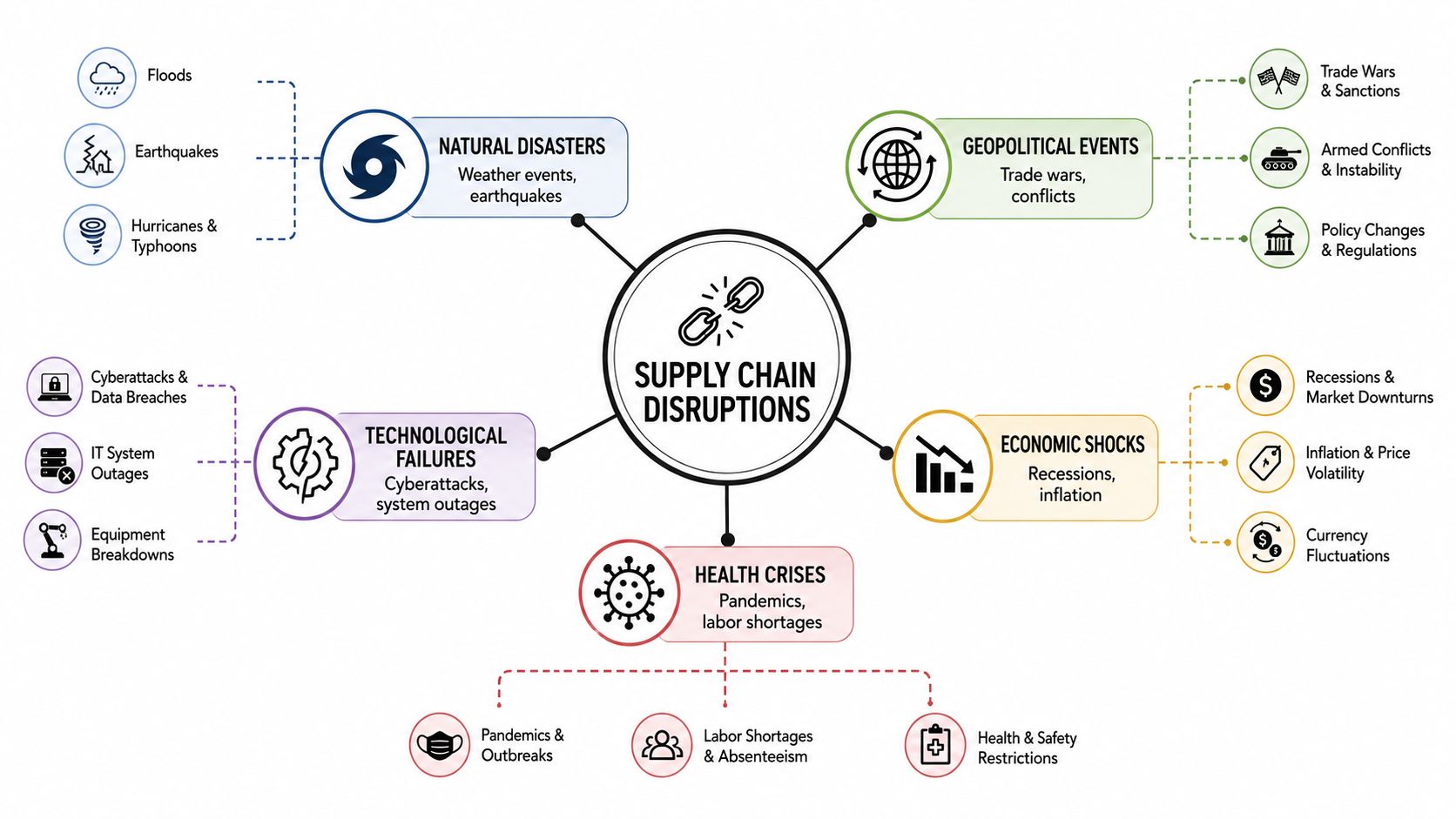
Not all disruptions are alike. Policymakers often group them together, then design blunt responses that fit none of them well. A better approach is to classify disruption by source, scope and duration. That produces a more practical diagnosis and a more credible response.
Source matters more than headlines suggest
Some disruptions are physical. Flooding, wildfire, port congestion and industrial accidents prevent goods from moving. Others are regulatory. Customs rules, sanctions compliance, border documentation and product standards can slow trade without any visible infrastructure failure. A third category is digital. Software outages, ransomware and data integrity failures can immobilise transport and warehousing systems even when roads and ports remain open.
A fourth category is health and labour related. Illness waves, absenteeism and workforce shortages can create gaps in production, haulage and processing. Maritime and overland movement in the Eastern Pacific shipping corridor illustrates why source identification matters. Weather, congestion, regulation and route dependency may look similar from the outside, but they require different interventions.
Scope determines the right level of response
A local warehouse fire and a cross-regional customs shock shouldn't be managed through the same playbook.
| Type of disruption | Typical scope | Policy implication |
|---|---|---|
| Node failure | Single facility or supplier | Rapid substitution and contingency contracting |
| Corridor disruption | Port, canal, rail link or border crossing | Rerouting, customs coordination, transport prioritisation |
| Systemic shock | Multiple sectors and jurisdictions | National crisis coordination and multilateral response |
This distinction helps officials avoid overreaction to local failures and underreaction to systemic ones.
A disruption becomes strategic when substitution is slow, visibility is poor, and multiple sectors depend on the same constrained node.
Duration changes the toolkit
A short, sharp shock behaves differently from a chronic stressor. Think of the difference between a port closure and long-term administrative friction. One demands emergency rerouting. The other slowly degrades competitiveness and planning certainty.
Three duration patterns are especially important:
- Acute shocks: Sudden and visible. Firms need immediate flexibility.
- Rolling disruptions: Intermittent delays that create planning noise and inventory distortion.
- Chronic stressors: Persistent frictions such as regulatory complexity or labour scarcity.
For G20 policymakers, the typology has one practical value above all others. It forces a disciplined question before action begins. Is the problem a shock to movement, a barrier to coordination, or a long-term degradation of operating conditions? Once that's answered, policy stops chasing symptoms and starts targeting causes.
Analysing the Five Key Drivers of Global Fragility
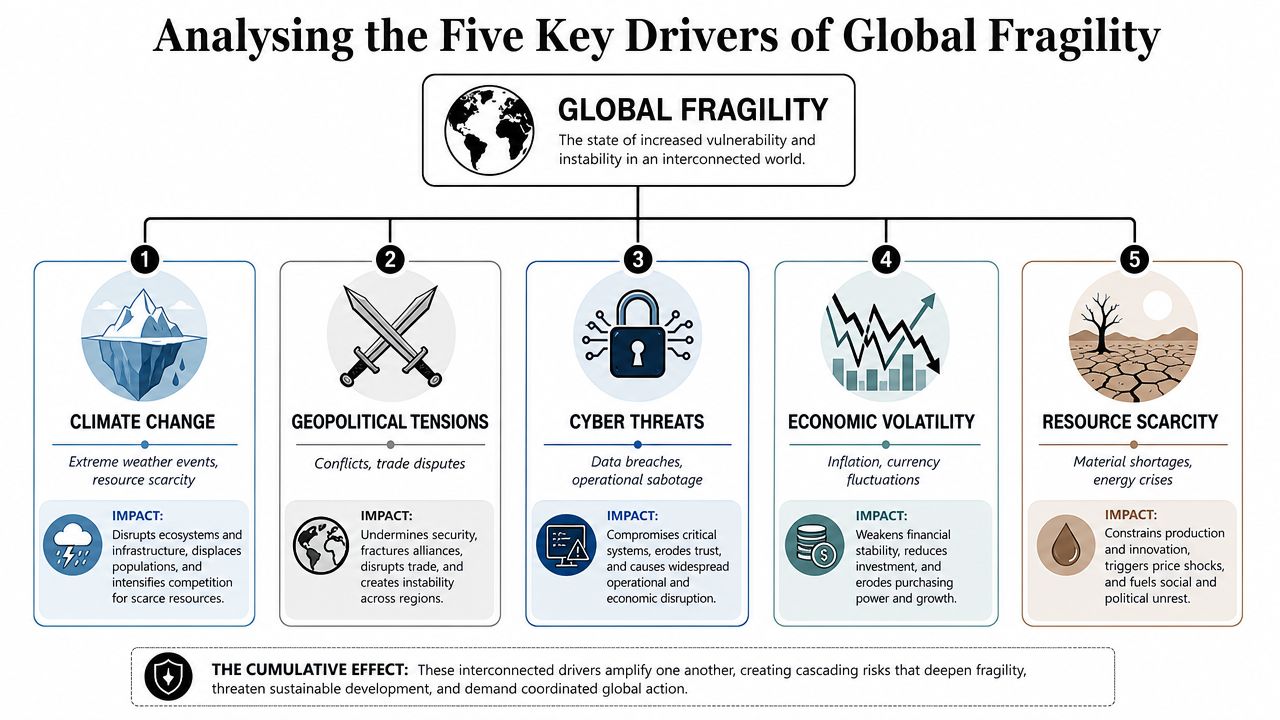
Five drivers now shape the risk environment most consistently: geopolitics, climate-related disruption, public health pressures, cyber threats and logistics bottlenecks. They don't operate in isolation. Each amplifies the others.
Geopolitics turns friction into a recurring operating cost
The most policy-relevant lesson from recent years is that trade can be disrupted without trade being formally shut down. The UK offers a clear illustration. In the UK, Brexit emerged as the dominant supply chain disruptor, with 80% of surveyed businesses identifying it as the most significant cause of disruption due to delays and administrative red tape following the 2021 Trade and Cooperation Agreement, as set out in the Coleman Parkes survey analysis hosted in the Hippocampus proceedings.
That matters because non-tariff friction is cumulative. A single form, inspection delay or standards mismatch may look manageable. Across thousands of consignments, it changes inventory models, cash flow and supplier choice. High-value sectors with tiered supplier networks feel this first.
Climate and health shocks hit capacity from different angles
Climate disruption damages infrastructure, alters navigability, interrupts power supply and raises insurance complexity. Public health crises affect the same chain through a different route. They reduce labour availability, disrupt processing capacity and shift consumption patterns at the same time. One attacks the physical environment. The other attacks workforce continuity and demand predictability.
A resilient system can't prepare for only one of those pathways. It has to assume that physical and labour constraints may coincide.
A short briefing can sharpen the policy distinction:
- Climate events damage or close assets.
- Health events reduce the people needed to operate those assets.
- Together they create longer restoration timelines and poorer forecasting.
Later in the same risk cycle, transport labour becomes a visible bottleneck. For officials tracking road freight constraints, Peak Transport's driver shortage analysis is a useful operational reference because it links labour scarcity to delivery reliability and fleet planning.
The video below usefully frames the broader strategic environment.
Cyber and logistics failures are now inseparable
Cyber risk is no longer a separate digital issue. It's embedded in physical logistics. If booking systems, warehouse management software or customs data platforms fail, cargo may sit still even when trucks, vessels and workers are available. This is why cyber preparedness belongs in supply chain planning rather than in an isolated IT silo.
Policy test: Treat any logistics platform outage as a trade continuity issue, not merely a technology incident.
Physical bottlenecks then complete the picture. Ports, border posts, inland terminals and arterial roads remain the visible points where fragility surfaces. When these systems are already operating under strain, even a minor disruption can trigger queueing effects that move quickly across sectors. That's why the five drivers should be read as a connected system of fragility, not a checklist of separate threats.
Tracing the Sectoral and Macroeconomic Impacts
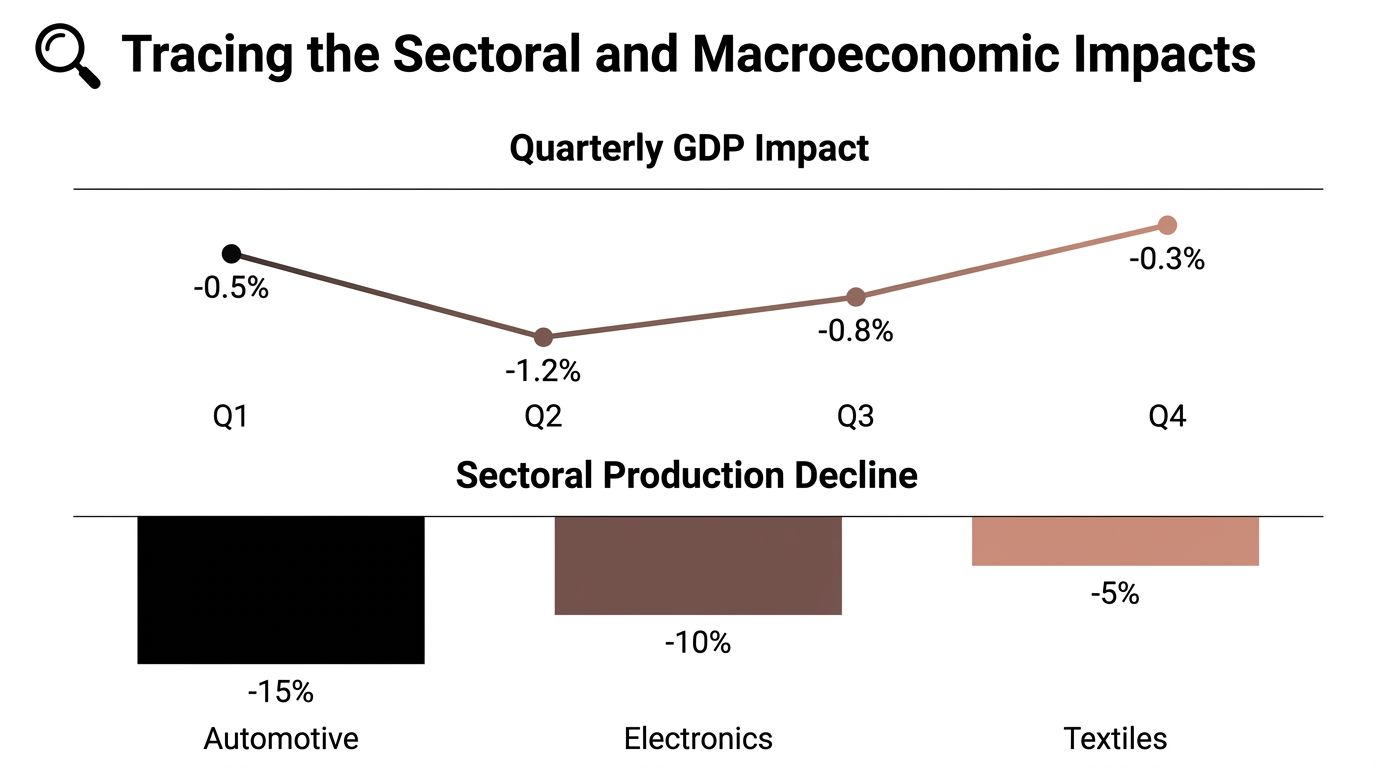
Macroeconomic damage rarely begins at the macro level. It starts with late components, unavailable labour, missing transport slots or stalled customs clearance. The effects then move outward from firm to sector and from sector to national performance.
Manufacturing and retail act as transmission channels
The UK data from early 2022 remains especially instructive. Official Office for National Statistics data showed that disruption was most acute in manufacturing and wholesale and retail trade, where exactly 30% of businesses in each industry reported global supply chain issues, according to the ONS analysis of coronavirus and EU exit impacts on UK business supply chains.
Those sectors matter because they transmit shocks in both directions. Manufacturing depends on inbound parts and materials. Retail depends on predictable replenishment and distribution. If manufacturing slows, output and exports weaken. If retail availability falls, consumers face shortages, substitutions or higher prices.
The ripple effect follows a recognisable pattern
A single disruption can move through the economy in a sequence like this:
- Input delay slows production scheduling.
- Production loss reduces available inventory.
- Distribution disruption widens geographic imbalance.
- Retail scarcity alters prices and consumer behaviour.
- Business uncertainty delays investment and hiring decisions.
That chain explains why supply chain disruption often appears in inflation data, industrial output weakness and softer business sentiment at roughly the same time.
Governments often focus on the final price effect. The more effective intervention point is earlier, where transport, customs and inventory decisions can still prevent scarcity from spreading.
Why sectoral pain becomes a fiscal problem
Once disruption spreads across sectors, ministries face second-order effects. Tax receipts come under pressure if production and sales weaken. Emergency support becomes more likely in food, fuel, health or transport. Political pressure builds for visible intervention, whether or not the state has the right tools prepared.
A useful policy distinction is between temporary cushioning and structural resilience.
- Temporary cushioning includes emergency visas, short-term waivers and ad hoc prioritisation.
- Structural resilience means diversified sourcing, infrastructure redundancy, interoperable customs systems and stronger visibility across critical supply networks.
The first buys time. The second reduces repeat exposure. G7 and G20 governments need both, but most still invest more political energy in the former than the latter.
Three Case Studies in Global Interruption
The past several years produced three distinct lessons in how disruption unfolds. One came from a transport chokepoint. One came from a systemic health crisis. One came from a technologically concentrated production network. Together, they show why a single resilience doctrine won't work.
The canal blockage and the geography of concentration
The Suez Canal blockage showed how a narrow physical corridor can create outsized consequences. The event was visible, dramatic and finite. Its lesson was simple. Geography still governs trade, and concentration risk remains one of the most underpriced vulnerabilities in global commerce.
For ministers, the policy takeaway wasn't merely about rerouting. It was about mapping where a small number of nodes control a large share of movement. Chokepoint analysis should be treated as a standard part of national resilience reviews, especially for essential goods.
The pandemic and the collapse of separate risk categories
COVID-19 was different. It wasn't just a logistics event. It disrupted labour, demand, production, health systems and border management at the same time. That complexity changed the policy baseline. It showed that supply chain disruption can originate in a non-economic shock and still become an economy-wide constraint.
The UK evidence captures how broad that pressure became. Nearly half of UK businesses, specifically 47%, experienced an increase in supply chain disruption over the preceding 12 months, according to Ivalua's UK disruption survey. That figure matters less as a standalone datapoint than as evidence that disruption became normalised across the business environment rather than confined to a few exposed industries.
Semiconductors and the politics of dependency
The semiconductor shortage revealed a third failure mode. It wasn't a single event and it wasn't only about transport. It emerged from concentrated production, long lead times, demand shifts and geopolitical tension around strategic technologies. That combination made substitution difficult and policy response slow.
A practical lesson for officials is that resilience depends on understanding tiered dependency, not just direct suppliers. Automotive and electronics chains especially rely on lower-tier inputs that many buyers don't see clearly until disruption arrives.
For port-facing logistics, local execution can still determine how much pressure reaches the wider economy. Operational planning around gateways such as Felixstowe shapes whether congestion remains manageable or cascades inland. For readers looking at that interface between national strategy and daily freight movement, Container Haulage from Felixstowe offers a grounded view of how container flows are handled at one of the UK's critical nodes.
Resilience fails first where dependency is hidden. Governments and firms usually discover that too late.
The three cases point to one shared conclusion. Policymakers need differentiated response models. Physical chokepoints require route redundancy. Systemic crises require cross-ministry command. Technological concentration requires industrial, trade and security coordination over a much longer horizon.
A Framework for Building Public and Private Resilience
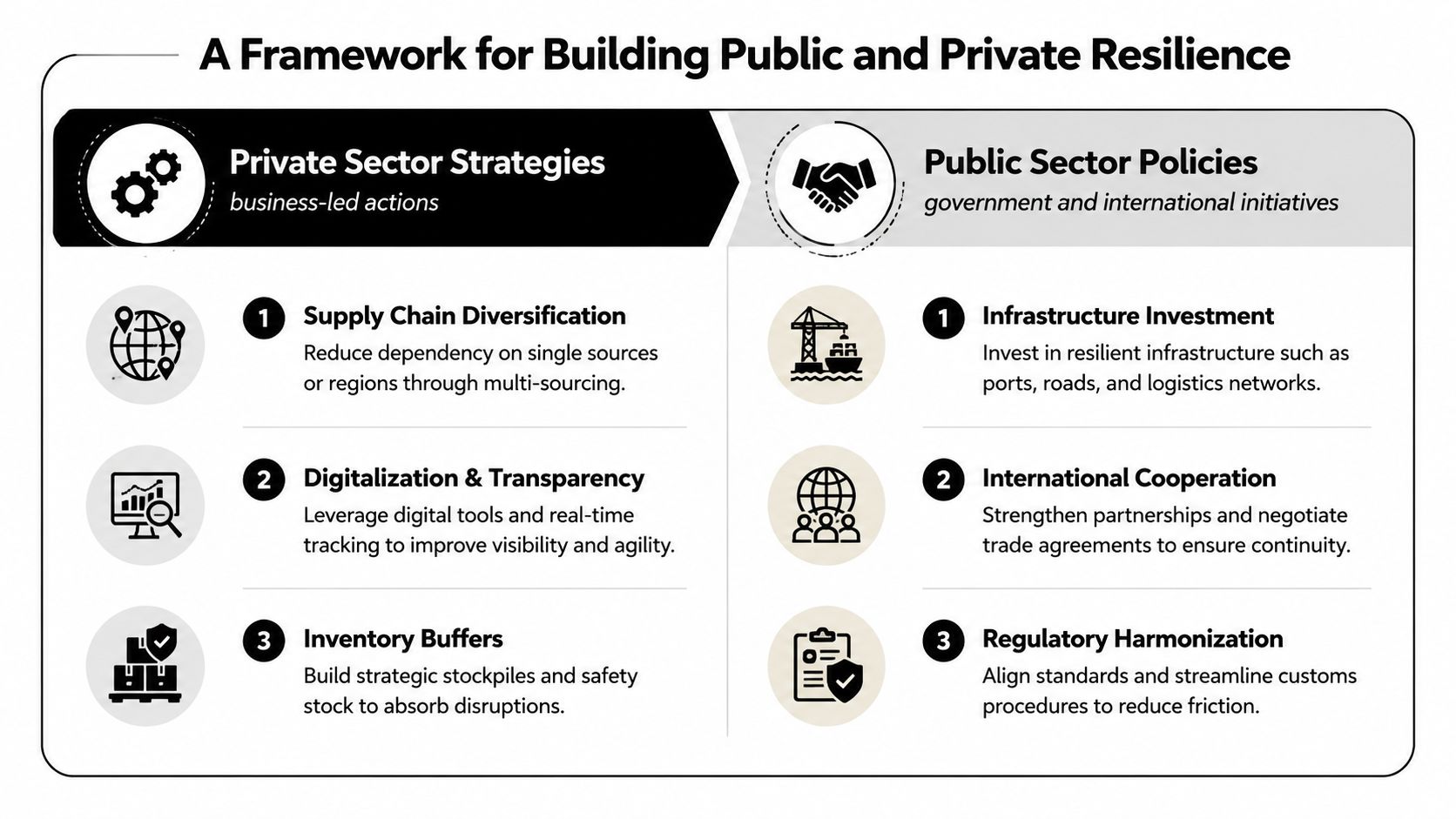
Resilience won't be built by governments alone, and it won't be built by firms acting in isolation. The public and private sectors have different tools, but their responsibilities are tightly linked.
What business leaders must do
Boards and procurement teams need to move beyond the cheapest-source model when critical continuity is at stake. That doesn't mean abandoning efficiency. It means pricing fragility properly.
A practical private-sector agenda includes:
- Supplier diversification: Firms should avoid single-region or single-node dependency where substitution would be slow.
- Digital visibility: Real-time tracking, supplier mapping and exception alerts help managers respond before delays become stoppages.
- Inventory strategy: For essential inputs, modest buffers can be more rational than ultra-lean exposure.
- Fleet and asset reliability: Transport continuity depends on uptime, not just procurement planning. For operators reviewing the basics of maintenance-led resilience, Fleetalyse's uptime strategies provide a useful operational checklist.
What governments must do
Public authorities control a different set of levers. They can simplify customs, invest in port and inland capacity, support workforce availability and create contingency mechanisms for essential goods. They can also reduce the bureaucratic friction that turns manageable delays into prolonged disruption.
The UK's temporary visa response is one example of emergency labour intervention. In September and October of a recent crisis period, the UK Government introduced temporary visas for HGV drivers carrying food and fuel, as well as for poultry workers and pork butchers, to address critical staff shortages, as documented by the UK Parliament Commons Library briefing on supply chain issues. The measure showed that governments can relieve acute pressure. It also showed how late many interventions arrive.
Strategic message: Emergency labour measures are useful, but they're a sign that resilience planning started too far downstream.
A more durable public agenda should include:
- Customs modernisation that improves speed, predictability and interoperability.
- Infrastructure investment in ports, roads, rail links and storage capacity.
- Public-private data sharing for critical goods and strategic sectors.
- International coordination so crisis responses don't create new barriers.
The customs dimension is especially important because it sits at the intersection of sovereignty and efficiency. Policymakers looking at the security-resilience balance should pay close attention to the strategic role of customs in securing the supply chains that sustain us.
The real objective is shared operating discipline
The strongest systems don't rely on perfect forecasting. They rely on better discipline across contracts, data, infrastructure and decision rights. Firms need clearer visibility and redundancy. Governments need faster, more coordinated intervention tools. The resilience premium appears when both sides prepare for interdependence rather than deny it.
An Action Plan for the G7 and G20 in 2026
The multilateral agenda should now move from diagnosis to implementation. G7 and G20 leaders don't need another abstract commitment to resilience. They need a short list of institutional moves that change behaviour across borders.
First, they should establish a shared early-warning framework for supply chain stress. That means comparable indicators on congestion, customs delays, workforce shortages and critical-input disruption. A warning system only matters if it supports predefined action between trade, transport, finance and industry ministries.
Second, they should push for interoperable digital standards across logistics and customs systems. Without common data protocols, visibility remains fragmented and crisis coordination remains slow. Technical cooperation, in this context, can deliver strategic returns.
Third, they should coordinate strategic approaches to essential goods, especially where concentration risk is high and substitution is difficult. The goal isn't indiscriminate stockpiling. It's disciplined contingency planning around what is vital for economic continuity and public welfare.
Fourth, the G20 should create a standing task force on regulatory friction in logistics. Many disruptions now arise less from physical impossibility than from administrative incompatibility. That's a solvable problem if governments treat it as a priority.
Finally, leaders should tie resilience to the wider agenda of climate adaptation, cyber readiness and industrial strategy. Supply chain disruption is where these policy domains meet in practice. The states that recognise that early will govern shocks better, protect growth more effectively and maintain greater credibility when the next crisis arrives.
Global Governance Media convenes the policymakers, analysts and institutional leaders shaping multilateral responses to risks like supply chain disruption. For more G7 and G20-focused analysis, forward-looking policy briefings and practical insight on international cooperation, visit Global Governance Media.