



By Daniel Hart, Senior Policy Analyst
The most surprising fact in climate diplomacy today isn't that ambition is rising. It's that one of the clearest examples of effective mitigation has come from a major economy that paired long-term legal discipline with practical sectoral execution. The United Kingdom has cut greenhouse gas emissions by 48% since 1990 as of 2022 and ranks 6th in the CCPI 2025, the highest among G20 nations alongside India, according to the Climate Change Performance Index country assessment. That matters because it shows something many summit communiqués still obscure. Climate change mitigation strategies work when governments treat them as economic policy, not only environmental policy.
For G7 and G20 delegates, the strategic question isn't whether mitigation is technically possible. It is whether states can align fiscal policy, industrial policy, infrastructure planning, trade rules, and political consent quickly enough to make national pledges credible. The widening gap isn't just between science and politics. It's between headline commitments and the administrative, financial, and institutional machinery required to deliver them.
That gap has direct consequences for energy security, inflation exposure, industrial competitiveness, public health, and geopolitical resilience. Countries that build credible mitigation pathways lower their vulnerability to fossil fuel shocks and create clearer investment signals. Countries that rely on distant targets without near-term implementation risk policy whiplash, stranded assets, and weakened public trust.
Table of Contents
- Introduction The Widening Gap Between Pledges and Action
- Understanding the Core Mitigation Framework
- Key Policy Levers for National Action
- Sector-Specific Mitigation Pathways
- Financing the Transition and Ensuring Robust Governance
- Mitigation in Action G7 and G20 Case Studies
- Forging Multilateral Action and Overcoming Barriers
Introduction The Widening Gap Between Pledges and Action
Mitigation now sits at the centre of macroeconomic management. Finance ministries care because climate shocks strain budgets. Energy ministries care because supply security increasingly depends on domestic clean power and resilient grids. Trade ministries care because industrial policy, subsidy competition, and carbon-related border measures are starting to reshape market access.
That is why climate change mitigation strategies can't be reduced to a list of technologies. They are choices about state capacity, sequencing, and burden-sharing. A government may support renewables, but if it neglects transmission, permitting, and industrial demand, deployment stalls. A government may endorse carbon pricing, but if households see only higher costs and no visible benefits, the political coalition weakens.
Strategic implication: The credibility of a climate pledge depends less on the target year than on whether institutions can force near-term decisions on power, buildings, transport, industry, and land.
The Paris framework created a common direction. It did not solve the collective action problem. G20 economies still face divergent energy mixes, development needs, fiscal space, and domestic politics. Some are trying to decarbonise while expanding energy access. Others are navigating industrial restructuring in regions tied to legacy fuels. Many are trying to do both at once.
For that reason, the most useful briefing for G20 delegates isn't a catalogue of aspirations. It is a sober assessment of which mitigation tools travel well across political systems, which require tailoring, and where multilateral cooperation can lower the cost of action. The central lesson is straightforward. National leadership still matters most, but national leadership is no longer sufficient on its own. Supply chains, finance, standards, and trade rules have become inseparable from mitigation outcomes.
Understanding the Core Mitigation Framework
Climate mitigation is easiest to understand as the construction of a more resilient economic house. First, governments must clean the foundation, which is the energy system. Second, they must improve the insulation, which means using energy, materials, and land more efficiently. Third, they must repair the natural surroundings, which means protecting and expanding natural systems that absorb carbon.

Three pillars that reinforce each other
Decarbonising supply means replacing high-emitting energy sources with lower-emitting alternatives and modernising the systems that carry power, heat, and industrial energy. In most economies, that starts with electricity because cleaner power enables wider decarbonisation elsewhere.
Improving efficiency and shaping demand means reducing the amount of energy and carbon required to deliver mobility, comfort, production, and services. Many governments underperform in this area. Supply-side investments are visible and politically attractive. Demand-side measures are often dispersed across households, firms, local authorities, and procurement systems.
Strengthening carbon sinks means managing land, soils, forests, peatlands, and related ecosystems so they absorb more carbon and emit less. This pillar often receives rhetorical support but limited administrative follow-through, even though it can also support biodiversity, flood resilience, and rural livelihoods when designed well.
A mitigation strategy fails when one pillar substitutes for the others. Cheap clean power cannot compensate for wasteful buildings forever. Carbon sinks cannot offset weak industrial policy indefinitely. Efficiency gains alone won't decarbonise a fossil-heavy grid.
Why governments fail when they separate the pillars
The political temptation is to organise mitigation by ministry rather than by system. That produces fragmented delivery. Energy ministries pursue supply. Housing ministries tackle efficiency unevenly. Agriculture ministries defend existing subsidy structures. Finance ministries then face a growing fiscal burden because the transition was not coordinated early.
A strong mitigation framework doesn't ask which ministry owns the issue. It asks which combination of institutions can deliver the outcome.
One reason offshore wind has become such a strong policy symbol is that it makes the systems point visible. It isn't just generation capacity. It requires seabed leasing, supply chains, ports, planning, transmission, balancing markets, and long-term contracts. The technology succeeds when governance succeeds.
This overview is also useful for multilateral forums. It shows where cooperation has the highest payoff. Shared standards can support clean industry. Development finance can reduce the cost of capital for infrastructure. Coordinated approaches to methane, shipping, aviation, and land use can prevent competitiveness concerns from paralysing domestic action.
A short primer on the wider policy context is useful before looking at instruments in detail:
Key Policy Levers for National Action
National mitigation strategies fail less from a lack of instruments than from poor sequencing, weak political design, and inadequate coordination across the state. G20 governments already know the main tools. The harder question is how to combine them in ways that survive electoral pressure, shape private investment, and limit cross-border friction.
Three levers dominate in practice: pricing, regulation, and public investment. Each addresses a different failure. Pricing internalises the cost of emissions. Regulation overcomes inertia and information problems where markets respond slowly. Public investment addresses infrastructure gaps, technology risk, and coordination failures that private capital will not solve on its own.
Pricing works when governments manage distributional risk
Carbon pricing remains attractive because one policy can influence decisions across multiple sectors. Economists value that breadth. Voters focus on visibility. Fuel, electricity, and heating costs are salient in a way that future system gains are not, which is why technically sound schemes can become politically fragile.
For that reason, the strategic question is not whether to price carbon in the abstract. It is where pricing can bite without triggering a backlash that weakens the wider transition. Large industrial sources and power generation often fit this model better than household-facing sectors, especially where lower-carbon substitutes are already available and compensation mechanisms are credible.
This is also where multilateral coordination matters. Divergent carbon prices across major economies can feed concerns about competitiveness, carbon leakage, and industrial relocation. G20 dialogue cannot erase those tensions, but it can reduce them through clearer reporting, comparable methodologies, and better alignment between domestic pricing systems and trade policy.
Regulation often delivers faster because it changes default decisions
Standards and mandates rarely attract the same policy prestige as carbon pricing, yet they often produce earlier emissions cuts. Minimum efficiency rules for buildings and appliances, vehicle standards, coal retirement schedules, and phaseout dates for high-emitting technologies give firms and households a timetable they can plan around.
That predictability matters.
Investors build factories, train workers, and contract suppliers when governments make the direction of travel hard to reverse. Regulation can also reach sectors where price signals alone are too weak, too delayed, or too politically contested to change behaviour at the required speed. Its limits are different. Poor sequencing can strand assets unnecessarily, and weak enforcement can turn ambitious rules into symbolic policy.
Public investment shapes the market that private capital later scales
In early-stage transitions, markets respond to policy architecture more than to price signals alone. Public procurement, concessional finance, guarantees, industrial policy, and direct infrastructure spending can lower first-mover risk and create demand where none yet exists at scale.
For G20 economies, this is not mainly a debate about state control versus market allocation. It is a question of who bears coordination risk. Grids, charging networks, industrial clusters, ports, and building retrofit programmes require planning horizons and risk-sharing arrangements that fragmented private actors rarely provide on their own.
The fiscal trade-off is real. So is the strategic payoff if spending is disciplined and tied to clear outcomes.
A useful way to compare the instruments is to ask what problem each one is designed to solve.
| Policy Instrument | Mechanism | Key Advantage | Primary Challenge |
|---|---|---|---|
| Carbon pricing | Puts a cost on emissions through taxes or trading systems | Can influence choices across many sectors at once | Political resistance if households and firms see costs before alternatives |
| Regulation and standards | Requires minimum performance or phases out high-emitting technologies | Creates clear compliance pathways and investor certainty | Can become rigid if poorly sequenced or weakly enforced |
| Subsidies and public investment | Uses public funds, guarantees, procurement, or concessional support | Helps build markets, infrastructure, and innovation pipelines | Can be fiscally demanding and vulnerable to political capture |
Effective national strategies usually combine all three, but not in equal measure and not at the same time.
- Use pricing where market responses are measurable and alternatives exist: Power generation and large industrial emitters often fit this model better than politically sensitive consumer sectors.
- Use regulation where compliance can be observed clearly: Buildings, vehicles, appliances, and product standards usually respond well to rules that tighten over time.
- Use public investment where coordination failures block deployment: Grids, ports, innovation ecosystems, and regional transition packages often require state-led planning and risk sharing.
Policy test: If a measure is economically efficient but politically fragile, it is unlikely to cut emissions at scale for long.
The wider implication for G7 and G20 cooperation is straightforward. National policy mixes will differ because industrial structures, fiscal space, and political constraints differ. The multilateral task is therefore not uniformity. It is to make different approaches more legible to partners, reduce the risk of subsidy races and trade disputes, and narrow the gap between national pledges and global temperature goals.
Sector-Specific Mitigation Pathways
The global mitigation gap will not close through better target-setting alone. It will close only if major economies cut emissions inside the sectors where capital is deployed, permits are granted, trade exposure is felt, and political resistance is organised.
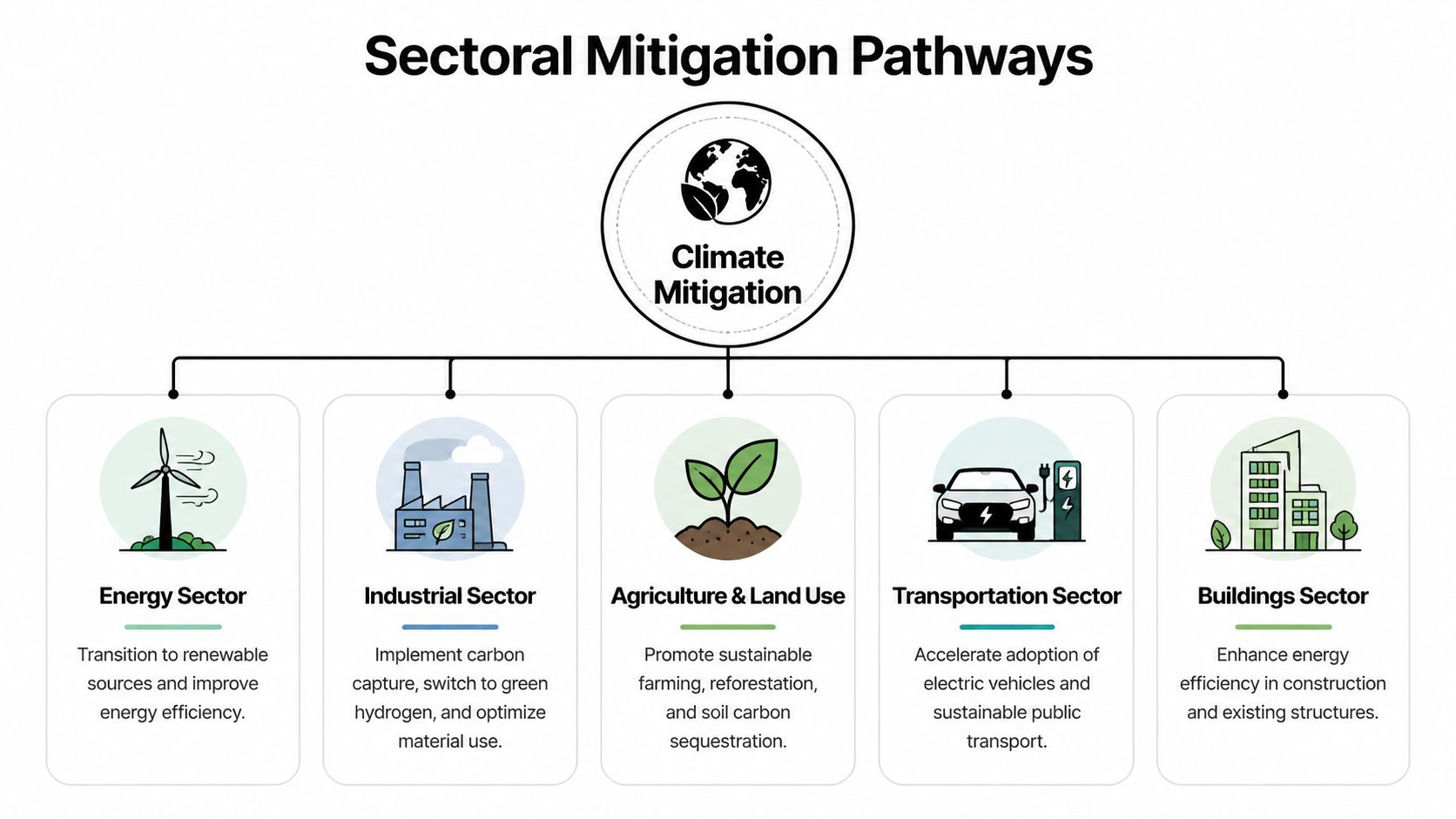
Power systems and grid readiness
Power is the strategic core of mitigation because progress in transport, buildings, and part of industry depends on cleaner electricity. The policy error seen across many G20 economies is straightforward. Governments announce renewable capacity goals but postpone the harder decisions on transmission corridors, system balancing, storage, market design, and permitting.
The UK illustrates both the opportunity and the constraint. According to the European Environment Agency's overview of climate change mitigation in Europe, the country had around 14 GW of offshore wind capacity by 2023 and has set a target of 50 GW by 2030. The strategic lesson is larger than the headline numbers. Scaling offshore wind requires grid reinforcement, port capacity, supply chain resilience, and cross-border coordination on system integration, not only turbine deployment.
For G7 and G20 governments, this is where collective action matters. Supply chains for cables, turbines, transformers, and critical minerals are international. So are the risks of bottlenecks, local-content disputes, and subsidy competition. A country can accelerate renewable generation domestically while still slowing the global transition if its industrial policy fragments trade or raises input costs for others.
Transport and the politics of adoption
Transport decarbonisation is often treated as a vehicle question. In practice, it is an infrastructure, affordability, and urban systems question.
Electric vehicles can cut emissions at scale, but adoption depends on charging networks, power system readiness, fleet turnover, consumer finance, and public confidence in reliability. Public transport, freight logistics, fuel standards, and land-use planning shape outcomes just as much as passenger car sales. Where these policies move on separate tracks, governments often spend heavily without reducing congestion, oil dependence, or inequality in access to mobility.
This creates a clear multilateral implication. G20 coordination should focus less on headline deployment races and more on interoperability. Charging standards, battery supply chains, trade rules for clean vehicles, and access to critical minerals can either lower transition costs across markets or turn transport policy into another arena for industrial rivalry.
The strongest transport strategies align decarbonisation with industrial competitiveness, urban efficiency, and consumer convenience.
Industry, buildings, and land use
Heavy industry presents the hardest trade-offs. Steel, cement, chemicals, and other emissions-intensive sectors face long asset lives, thin margins in some markets, and direct exposure to international competition. The policy question is not only which technology is available. The harder question is how governments share early transition costs without locking in permanent subsidy dependence or provoking trade conflict.
That is why industrial mitigation needs coordinated demand creation as much as technology support. Public procurement, common product standards, carbon accounting rules, and lead markets for low-carbon materials can reduce uncertainty for firms considering major capital upgrades. This is also where the wider debate on financing the transition to a green global economy becomes operational. Industrial decarbonisation fails when firms face high upfront costs, uncertain future demand, and inconsistent policy signals across borders.
Buildings present a different governance problem. The technologies are often mature, but delivery is fragmented across owners, tenants, local authorities, utilities, lenders, and contractors. Retrofit programmes fail less because the measures are unknown than because transaction costs are high and incentives are misaligned. Effective policy therefore depends on execution capacity, standardised finance, and rules that steadily tighten building performance over time.
Land use can support mitigation, but only under credible governance. Peatland restoration, forest protection, and soil carbon measures can produce climate benefits and wider ecological gains, yet outcomes are hard to measure and easy to overstate. For G20 policymakers, the main lesson is caution with accounting and seriousness on implementation. Land-based measures work best as a complement to deep emissions cuts in energy, transport, and industry, not as a substitute for them.
A practical way to assess sector pathways is to group them by implementation difficulty rather than by rhetorical appeal:
- Ready to scale now: renewable power, grid upgrades, energy efficiency, building performance standards, and many forms of end-use electrification.
- Dependent on coordination across markets and institutions: industrial clusters, low-carbon materials markets, freight reform, transmission buildout, and vehicle charging networks.
- Requiring longer policy time horizons and higher risk tolerance: hard-to-abate industrial processes, some storage technologies, and large land restoration programmes.
For G20 delegates, the strategic test is whether sector plans are investable, politically durable, and internationally coherent. A credible pathway is not one that promises the most. It is one that matches each sector's constraints with the right mix of domestic policy discipline and multilateral cooperation.
Financing the Transition and Ensuring Robust Governance
The transition doesn't stall because capital is absent in the abstract. It stalls because finance often cannot find a policy environment it trusts. That is why financing and governance belong in the same conversation.

Why capital is not enough
Public finance has three jobs in mitigation. It must fund public goods such as grids and planning systems. It must reduce risk where private investors hesitate. And it must cushion social and regional disruption when the transition changes employment patterns and local tax bases.
Private capital then scales what policy has made investable. But investors need predictable rules, credible contracts, and institutions that can approve and monitor projects. Without those conditions, climate finance pledges remain accounting exercises rather than deployed capital.
Multilateral development banks and development finance institutions are critically important. Their distinctive value isn't volume alone. It is their ability to crowd in investment, standardise project preparation, and absorb part of the policy or currency risk that prevents projects from reaching financial close. A useful discussion of the broader challenge appears in this analysis on financing the transition to a green global economy.
Governance decides whether finance lands
Strong governance gives markets confidence that mitigation policy will survive electoral cycles and administrative turnover. Independent climate councils, legally anchored planning processes, transparent reporting, and credible review mechanisms all help convert ambition into durable expectations.
Good governance also prevents a common failure. Governments often announce climate funds or investment vehicles before they have clear pipelines, local delivery capacity, or transparent monitoring systems. Money then accumulates at the top while projects stall at the point of implementation.
Three governance disciplines are especially important for G20 members:
- Credible monitoring: Governments need systems that track delivery, not just allocation.
- Institutional coordination: Climate policy fails when treasury, energy, industry, transport, and local government work on incompatible timelines.
- Subnational execution: Cities, regions, and local authorities often determine whether buildings, transport, and land-use measures materialise.
Financing is not the final hurdle after policy design. In most countries, it is the mechanism that reveals whether policy design was serious in the first place.
For summit diplomacy, the implication is clear. MDB reform, project preparation support, and stronger disclosure and reporting rules are not side issues. They are among the most impactful interventions available to multilateral actors.
Mitigation in Action G7 and G20 Case Studies
The gap between pledges and delivery is no longer mainly a question of technology. It is a test of whether major economies can turn climate targets into durable state strategy under real political and fiscal pressure.
The United Kingdom remains one of the clearest G7 examples because it combined legal discipline with sectoral execution over time. Its record matters less as a model to copy line by line than as proof that emissions cuts accelerate when governments bind long-term goals to institutions that can force periodic course correction.
The United Kingdom and the value of legal discipline
The UK is widely recognised as one of the stronger performers among advanced economies on mitigation, as noted earlier in the article. That outcome was shaped by the Climate Change Act, the use of carbon budgets, an accelerated coal phase-out, and sustained support for offshore wind. The strategic lesson is straightforward. A legal framework only matters when it changes investment expectations, administrative routines, and the political cost of delay.
Coal exit had outsized importance. It reduced power-sector emissions quickly, but its broader effect was to show that high-carbon assets would not be protected indefinitely. That signal matters in every G20 economy facing similar choices in power, industry, or transport. Investors respond not only to subsidies and prices, but also to whether governments can make credible decisions about retirement, replacement, and grid planning.
The UK case also shows the limits of headline success. Progress in electricity does not automatically translate into equal progress in buildings, transport, or industrial decarbonisation. For G7 leaders, the implication is that early wins in mature sectors buy time and credibility, but they do not remove the need for harder second-stage reforms.
A broader comparative discussion appears in this analysis of G7 climate policy performance.
Different national models, shared strategic lessons
Across the G20, the more instructive comparison is not between countries that have adopted identical policy tools. It is between countries that have found a way to align climate objectives with domestic development priorities and those that still treat mitigation as a separate environmental agenda.
Some governments rely more heavily on state-backed industrial policy. Others depend more on regulation, market design, or public investment in infrastructure. The institutional forms differ, but the same political economy conditions keep appearing.
- Sequencing determines traction: Governments tend to move first where technology is commercially proven, implementation capacity already exists, and incumbents are less able to block change.
- Credibility shapes capital flows: Private investment responds more strongly where policy survives electoral turnover, permitting systems function, and public agencies can execute decisions on time.
- Distributional design affects durability: Mitigation strategies face greater resistance when households, workers, or specific regions bear visible losses while the gains appear distant or unevenly shared.
These patterns matter for summit diplomacy.
They show why G20 coordination cannot rely on a single policy template or a shared declaration of intent. What travels across borders is not a uniform institutional design, but a smaller set of governing principles: credible accountability, investable policy signals, and transition strategies that spread costs and gains in politically manageable ways.
That is the practical value of case studies. They narrow the distance between national experience and multilateral action. They help delegates distinguish between measures that are context-specific and principles that can support collective progress across very different political and economic systems.
Forging Multilateral Action and Overcoming Barriers
The hardest mitigation problems now sit at the intersection of domestic politics and international coordination. Governments know many of the available tools. The remaining challenge is to combine them in ways that are socially durable and internationally compatible.
The overlooked frontier is demand
One of the most neglected areas in climate change mitigation strategies is demand-side action. In the UK context, demand-side options such as reducing meat consumption, enhancing building efficiency, and shifting to low-carbon materials could deliver up to 20% of the country's required emissions reductions by 2030, but implementation lags because policy integration remains weak, according to the IPCC-aligned reference provided in the verified data.
That insight has wider relevance for the G20. Demand-side policy often receives less attention because it touches lifestyles, procurement choices, and local service delivery rather than flagship infrastructure. Yet it can reduce system costs, ease pressure on grids and supply chains, and improve equity when designed well. Ignoring demand means asking supply-side systems to do too much, too expensively, and too quickly.
A practical agenda for G20 leaders
A serious G20 mitigation agenda should focus on cooperation where unilateral action is least effective.
- Coordinate on clean industry rules: Governments need clearer approaches to subsidies, standards, and carbon-related trade measures so that decarbonisation doesn't spiral into unmanaged protectionism.
- Support demand-side implementation: Building codes, public procurement, food systems, and material efficiency need more political attention and stronger administrative pathways.
- Build shared platforms for hard-to-abate sectors: Green hydrogen, shipping, aviation, and low-carbon materials need common standards and aggregated demand signals.
- Strengthen local delivery systems: National targets will keep missing if local authorities, utilities, and regulators lack the mandate or resources to implement them.
- Reform multilateral finance around execution: More money matters, but better pipelines, risk-sharing, and governance matter just as much.
The strategic choice for G20 leaders is no longer whether to act multilaterally. It is whether multilateralism will be used to lower the political and financial cost of domestic action, or whether it will remain confined to declarations. A practical roadmap for that debate appears in this analysis of how the G20 can advance climate action.
The central conclusion is sharper than many summit texts allow. The gap between pledges and action won't close through additional long-term promises alone. It will close when governments align policy instruments, finance, institutions, and trade frameworks around implementation. That is the ultimate test of climate leadership.
Global Governance Media brings together decision-makers, analysts and practitioners working across climate, energy, health and the global economy. For readers tracking the G7 and G20 agenda on climate change mitigation strategies, visit Global Governance Media for summit-focused analysis, expert commentary and practical multilateral policy insights.