



By Eleanor Marsh
A labour market forecast can look like a careers page problem. It isn't. In the UK alone, healthcare employment is projected to grow by 18% from 2024 to 2034, adding 1.2 million jobs according to the Office for National Statistics and the NHS Long Term Workforce Plan. At the same time, offshore wind is projected to create 70,000 jobs by 2030 within a wider target of 480,000 green jobs economy-wide, according to the Department for Energy Security and Net Zero, the British Energy Security Strategy, and ONS data. Those figures reframe the debate. Good future jobs are not merely the occupations individuals should chase. They are the institutional outcome of industrial policy, education policy, regulatory design, and international coordination.
That distinction matters for G7 and G20 leaders. When governments fail to connect investment plans to labour-market capacity, they create bottlenecks, wage distortions, regional inequality, and political backlash. When they get the link right, they strengthen productivity, social cohesion, and strategic autonomy at the same time.
The practical question, then, isn't “Which jobs will be in demand?” It is “Which public decisions will create a resilient pipeline of good future jobs, and how should states organise around that challenge?” The answer sits at the intersection of energy transition, digital transformation, health system modernisation, and governance capacity. It also requires treating workforce policy as a stability issue, not a secondary social measure, as argued in this wider reflection on building systemic stability in a fragmented world.
Table of Contents
- The New Workforce Imperative for Global Stability
- Mapping the High-Growth Sectors of the Next Decade
- The AI Revolution and Digital Economy Roles
- Jobs in the Green Transition and Resilient Infrastructure
- The Cross-Cutting Competencies for a Future-Ready Workforce
- Key Policy Levers for an Equitable Workforce Transition
- A Call to Action for Global Leaders and Institutions
The New Workforce Imperative for Global Stability
The old assumption is that labour-market change can be managed sector by sector, with education ministries handling skills and employers handling hiring. That assumption no longer holds. The sectors driving national resilience now depend on workforce pipelines that cross ministries, regulatory agencies, and borders.
Healthcare, energy, and digital security illustrate the point. A health system can't expand advanced practice roles without training capacity and credential reform. An energy system can't deliver net-zero infrastructure without planners, compliance specialists, and supply-chain managers alongside engineers. A digital economy can't scale safely without cybersecurity analysts and AI governance talent embedded across public administration.
Why workforce policy has moved to the centre
The phrase good future jobs should be understood less as a labour-market slogan and more as a public policy benchmark. A good future job has three characteristics. It supports strategic national capabilities. It offers durable wage and progression prospects. It can be accessed through credible training pathways, not only elite educational routes.
That changes the test for policy success. Governments shouldn't ask only whether jobs are being created. They should ask whether job creation is aligned with national priorities, regionally distributed, and open to workers who need to transition from legacy sectors.
Strategic implication: Labour-market preparedness is now part of economic security. States that underinvest in workforce adaptation will struggle to execute climate, health, and digital strategies even when capital is available.
The consequences of getting it wrong
Poorly managed transitions usually don't fail all at once. They fail through shortages, delays, and legitimacy loss. Infrastructure projects stall because specialist labour isn't available. Public services adopt technology faster than they can govern it. Regions that lose older forms of employment don't see credible new pathways in time.
For G20 ministers, that makes workforce planning a core instrument of inclusive growth. The policy challenge isn't limited to creating more jobs. It's to create better matches between long-term public priorities and the people who'll deliver them.
Mapping the High-Growth Sectors of the Next Decade
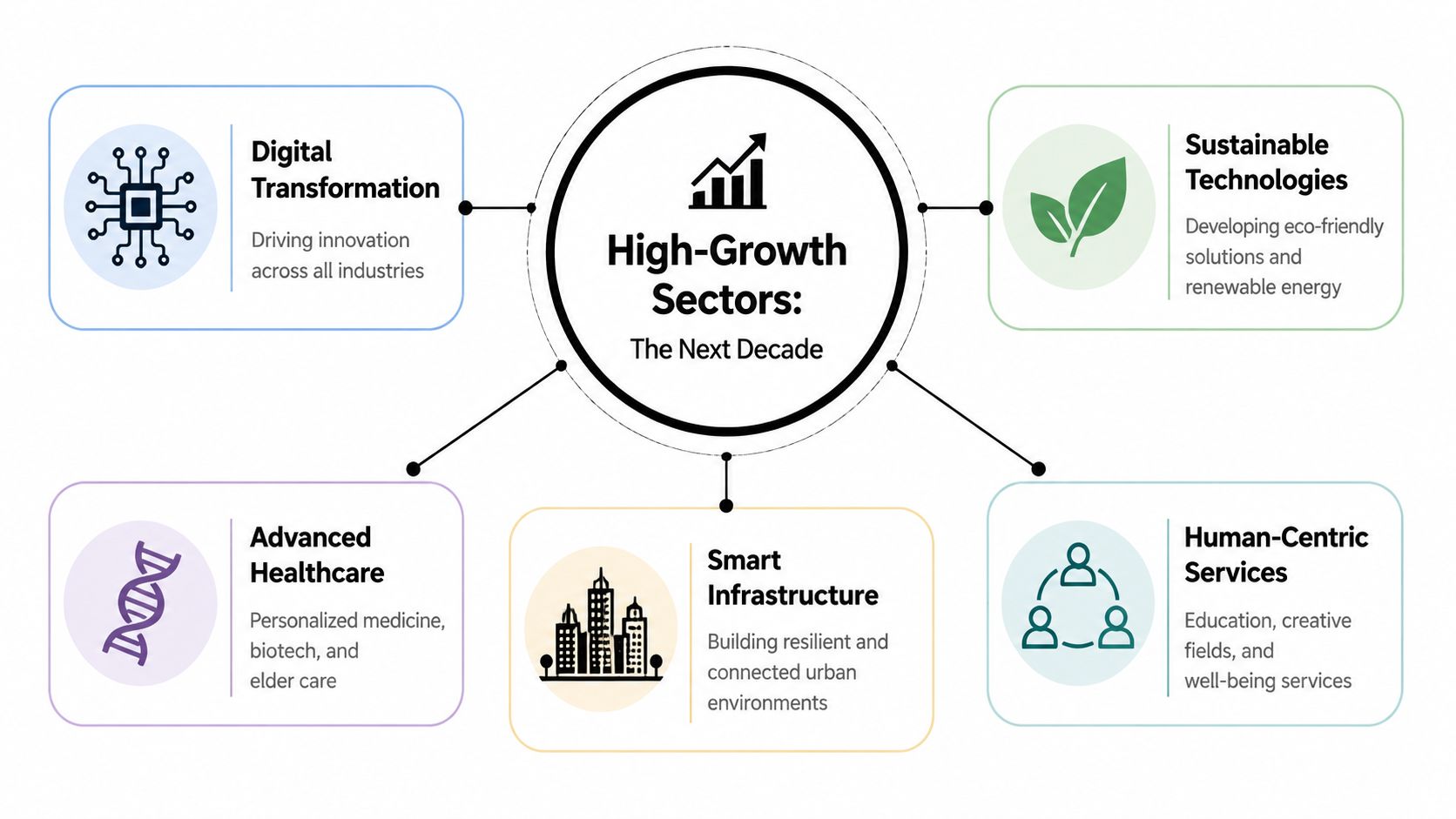
Labour demand over the next decade will be concentrated in a set of interconnected systems: digital infrastructure, clean energy, health and care, resilient built environments, and human services. For governments, the policy question is larger than which occupations will grow fastest. It is how to build training, procurement, regulation, and regional investment around sectors that reinforce national resilience and productivity at the same time.
Five pillars matter most
A practical policy map starts with five pillars that combine scale, strategic relevance, and strong spillover effects across the wider economy.
| Pillar | Why it matters | Flagship roles |
|---|---|---|
| Digital transformation | Digital capability shapes productivity, security, and service delivery across nearly every sector | AI specialists, data analysts, MLOps engineers, cybersecurity analysts |
| Sustainable technologies | Net-zero strategies require deployment capacity, grid upgrades, permitting, finance, and supply-chain coordination | Wind technicians, grid planners, ESG specialists, carbon policy analysts |
| Advanced healthcare | Ageing populations, workforce shortages, and digital care models are changing both demand and service design | Advanced practitioners, digital health analysts, mental health support roles |
| Smart infrastructure | Economic resilience depends on low-carbon, connected, and secure transport, energy, water, and building systems | Infrastructure planners, systems integrators, energy optimisation specialists |
| Human-centric services | Education, care, and public services remain major sources of employment where trust, judgement, and local presence matter | Teachers, therapists, care coordinators, public service managers |
These pillars should not be read as isolated sectors. They operate as linked labour ecosystems. A grid modernisation programme needs electrical engineers, software capability, planners, procurement specialists, and local construction capacity. A health system digitisation effort requires clinicians, data governance staff, cybersecurity expertise, and service redesign teams. The fastest-growing job clusters often sit between ministerial portfolios, which is one reason many workforce plans underperform.
Two implications stand out.
First, the strongest employment growth is likely to come from sector convergence rather than from a single headline industry. Energy plus digital creates demand for predictive maintenance, grid analytics, and systems monitoring. Health plus data creates roles in digital operations, care pathway design, and clinical informatics. Trade plus sustainability creates demand for compliance, traceability, and supply-chain reporting capabilities. The broader challenge of building inclusive digital labour markets therefore sits inside industrial policy, not outside it.
Second, job quality and access depend on the width of the occupational ladder. High-growth sectors need elite technical roles, but they also need technicians, operators, project managers, inspectors, trainers, and support staff. That matters for social cohesion. Economies that create only a narrow band of specialist winners will struggle to sustain political support for transition strategies, especially in regions shifting away from legacy industries.
What policymakers should infer
The most important conclusion is institutional. Ministries still organise funding and regulation around legacy categories such as manufacturing, services, and public administration. Future growth cuts across those categories. If training systems, industrial subsidies, infrastructure planning, and migration policy remain disconnected, governments will finance expansion while constraining the labour supply needed to deliver it.
A second conclusion concerns timing. Labour shortages typically appear late in the policy cycle, after capital has been committed and delivery timetables are already fixed. By that stage, delays become expensive and politically visible. Workforce planning therefore belongs upstream, at the stage where governments set industrial priorities, issue procurement frameworks, and negotiate regional development plans.
A third conclusion is geographic. High-growth sectors can widen regional inequality or reduce it, depending on where training capacity, transport links, and public investment are placed. The countries that perform best will do more than identify promising sectors. They will connect those sectors to place-based institutions that can turn national strategy into local employment pathways.
The AI Revolution and Digital Economy Roles
Artificial intelligence is no longer just another technology segment. It is becoming a foundational capability inside healthcare, defence, finance, education, and public administration. That changes the workforce question. Governments do not merely need more digital workers. They need institutions that can absorb AI safely, productively, and at scale.
AI is becoming a foundational capability
The strongest evidence sits at the specialist end of the market. AI and Machine Learning Specialists in the UK are projected to see employment growth of 25% to 30% by 2030. Roles requiring expertise in fine-tuning large language models are expected to create over 40,000 new openings, with median salaries of £85,000 to £120,000, according to the UK AI Council, Prospects UK LMI, and the WEF Future of Jobs UK supplement.
Those figures matter, but the deeper policy point is broader. AI demand is not contained within AI firms. It is being pulled by public services, regulated industries, and large enterprises trying to embed automation and decision support into existing workflows. That is why MLOps, model evaluation, domain adaptation, and deployment governance matter so much. The workforce challenge is shifting from “Can the country produce coders?” to “Can the country operationalise AI in real institutions?”
This is also why the digital economy should be viewed as a layer that reshapes all other growth sectors, not as a standalone vertical. The ministries responsible for health, energy, finance, and security are now all, in practice, talent ministries for digital capability.
Cybersecurity and AI governance are now core labour-market issues
The second labour-market effect is defensive. As more critical systems become digitally integrated, cybersecurity shifts from a support function to a strategic occupation class. In the UK, cybersecurity analyst vacancies are projected to exceed 100,000 by 2026, with ONS projections indicating 15.4% occupational growth to 2034, according to the Robert Half research reference cited in the verified data. This is not solely a tech-sector issue. Energy grids, health records, financial rails, and procurement systems all rely on secure operation.
That creates a new policy synthesis. AI specialists build capability. Cybersecurity analysts protect capability. Governance professionals legitimise capability. The three roles increasingly travel together.
A wider institutional implication follows from debates on secure and inclusive adoption. Governments that want to avoid a two-track economy, where only elite firms can harness AI safely, need public investment in shared standards, training pathways, and diffusion capacity, a challenge reflected in discussions on bridging the AI divide for inclusive growth and job quality.
A short explainer is useful here:
Policy test: If a country can procure AI tools but can't train model auditors, cyber defenders, procurement specialists, and regulators, it hasn't built an AI workforce. It has built dependency.
Jobs in the Green Transition and Resilient Infrastructure
The popular image of the green economy is still too narrow. It focuses on visible technical roles such as wind technicians, retrofit installers, and engineers. Those jobs matter. But the green transition functions as an employment ecosystem, and some of its most strategic roles are policy-adjacent.

The green transition is a workforce system, not a single sector
A national net-zero pathway requires project finance, planning consent, local procurement, environmental reporting, infrastructure operations, and trade management. That is why the labour market extends far beyond the turbine or the solar array.
The UK evidence is instructive. Thirty per cent of the projected 500,000 green jobs by 2030 will be in planning, ESG compliance, and international supply chain management. The ONS also noted a 22% undersupply of skills in sustainable trade policy in early 2026, for roles attracting average salaries of £65,000, according to the BEIS and ONS Labour Market Overview reference in the verified data.
This matters for policy because it breaks a persistent misconception: green jobs are not only STEM jobs. Many are governance, legal, commercial, and administrative jobs that enable infrastructure to move from announcement to delivery.
The overlooked non-engineering roles
A minister trying to accelerate resilient infrastructure should think in terms of a project chain. Each stage creates distinct labour demand.
- Planning and permitting: professionals who can manage land use, consultation, and environmental approvals.
- ESG and compliance: specialists who translate regulation into reporting, supplier standards, and risk controls.
- Trade and supply chains: analysts who understand critical inputs, border measures, and procurement resilience.
- Programme delivery: managers who can coordinate contractors, public agencies, financiers, and communities.
The implication is practical. If governments concentrate funding on technical training alone, they will underbuild the institutional occupations that make physical deployment possible. The stronger model is a workforce strategy linked to capital mobilisation, regional development, and infrastructure sequencing, which is also central to debates on mobilising investment for sustainable infrastructure amid global crises.
Green labour policy works best when it treats infrastructure delivery as a chain of occupations. A shortage in permitting or trade compliance can delay investment as surely as a shortage in engineering.
For ministers of labour and industry, that opens a wider pool of good future jobs. Workers with backgrounds in law, logistics, accounting, procurement, and public policy can enter the transition through credible reskilling routes. That makes the green economy not only cleaner, but politically broader and more durable.
The Cross-Cutting Competencies for a Future-Ready Workforce
The most resilient worker of the next decade may not be the person with the narrowest technical specialism. It may be the person who can learn new tools quickly, reason across systems, and operate in regulated environments where technology, public trust, and institutional judgement meet.
That is not an argument against technical skills. It is an argument against designing labour systems around technical skills alone.
Why portable skills now matter more than narrow specialism
Across sectors, employers increasingly need people who can interpret evidence, collaborate across functions, manage ambiguity, and translate specialist knowledge into operational decisions. In practical terms, that means competencies such as:
- Systems thinking: understanding how policy, technology, finance, and service delivery affect one another.
- Analytical judgement: using data without mistaking data for decision-making.
- Digital collaboration: working with AI tools, workflow software, and distributed teams.
- Adaptive communication: explaining technical or regulatory issues to non-specialists.
These skills travel well. A systems thinker can move from health operations to climate adaptation planning. A strong analytical communicator can work in public procurement, AI assurance, or ESG reporting. That is why durable employability increasingly comes from combinations of knowledge, not isolated expertise.
The governance capability gap
One of the clearest examples sits outside the classic tech workforce. The UK's AI Opportunities Action Plan projects 200,000 AI-related jobs by 2030, with 40% in regulatory and compliance functions, yet ONS data shows only 12% of UK civil service roles currently require AI ethics training, according to the UK Centre for Data Ethics and Innovation and ONS reference in the verified data.
This is a major policy signal. The labour-market bottleneck may not be in building AI systems. It may be in governing them. Countries can produce talented developers and still fall short if regulators, procurement officials, auditors, inspectors, and policy advisers cannot evaluate AI use in public life.
Institutional lesson: An AI-ready workforce includes philosophers, lawyers, behavioural scientists, public managers, and ethicists, provided they can work fluently with digital systems and regulatory evidence.
That conclusion should reshape curriculum design. STEM investment remains essential, but it isn't sufficient. Governments also need to fund interdisciplinary training that links computation with law, public administration, ethics, and sector expertise. For many states, that will be the difference between adopting technology and governing it well.
Key Policy Levers for an Equitable Workforce Transition
Public spending on skills is rising across many economies, yet delivery systems still lag behind labour-market change. The policy problem is no longer whether governments recognise the transition. It is whether education, employment, and industrial institutions can act in concert, at sufficient speed, and with clear distributional goals.
Three levers matter most: education and credential reform, transition support that reduces switching risk, and sector-based reskilling compacts linked to actual investment pipelines. Used separately, each has limited effect. Used together, they can widen access to high-growth work while reducing regional and social inequality.
Reform education and credentialing
Conventional degree pathways still matter, but they are poorly matched to mid-career transitions and occupations evolving faster than formal curricula. Governments should expand modular credentials, occupational conversion routes, and stackable learning that recognises prior experience rather than forcing workers to restart from the beginning.
Healthcare illustrates the institutional challenge. As noted earlier, workforce demand is set to rise sharply, and public systems are already planning role expansion across clinical and support functions. That scale of hiring will not be met through traditional education pipelines alone. It requires supervised practice models, faster accreditation decisions, and clearer progression routes from entry-level roles into licensed occupations.
The wider lesson is administrative, not only educational. Credential systems often fail because ministries fund training without updating licensing rules, quality assurance, or employer recognition. A future-ready workforce policy therefore has to align curricula, regulation, and hiring standards.
Modernise transition support
Workers assess retraining through the lens of household risk. A displaced technician or care worker is not weighing abstract productivity gains. They are weighing lost wages, childcare costs, commuting time, and the possibility that a new credential will not lead to stable employment.
That is why social protection has to support movement as well as income security.
A stronger model includes portable benefits, temporary income support during retraining, and public guidance systems that steer workers toward credible vacancies in expanding sectors. Where these mechanisms are weak, take-up falls even when governments subsidise courses.
A practical policy checklist includes:
- Tie support to verified labour demand: direct subsidies toward sectors with persistent hiring need and published vacancy signals.
- Reduce the cost of switching: cover short-course fees, certification costs, transport, and care responsibilities that block participation.
- Use employment services as transition brokers: match workers to adjacent occupations where existing skills retain value, rather than focusing only on like-for-like replacement.
- Track outcomes, not enrolments: judge programmes by job entry, earnings progression, and retention, not by training completion alone.
Build sector-based reskilling compacts
The third lever is coordination capacity. National strategies often fail at the point where ministries, employers, training providers, local authorities, and worker representatives need to make binding decisions on standards, financing, and hiring commitments. Sector-based compacts address that gap when they are tied to procurement, infrastructure pipelines, energy plans, or public-service reform.
The design principle is straightforward. Training should be linked to where investment will occur, which occupations will expand, and what standards employers will use to recruit.
This is also where equity is won or lost. Generic training markets tend to reward workers who already have better information, stronger networks, and more financial slack. Training linked to local employer demand, transparent occupational standards, and place-based support reaches a broader share of the workforce, including workers in regions exposed to industrial decline.
For G20 governments, the implication is clear. Labour policy, industrial policy, and social policy should be designed as a single implementation agenda. Countries that integrate those systems will fill strategic vacancies faster, spread opportunity more evenly, and convert headline investment into actual employment capacity.
A Call to Action for Global Leaders and Institutions
Good future jobs are often discussed as if they were the spontaneous by-product of innovation. They aren't. They are produced by institutions that align capital, capability, and legitimacy. That is the core governance challenge facing G7 and G20 leaders.
Three conclusions follow. First, workforce strategy must move closer to the centre of macroeconomic and industrial decision-making. Second, governments need to widen their definition of strategic talent beyond narrow technical elites. Third, multilateral cooperation should focus less on abstract declarations and more on common standards for training quality, AI governance, portable credentials, and worker protections.
For international institutions, this opens a concrete agenda. Development banks can tie financing to workforce readiness plans. Standard-setting bodies can support interoperable credentials and governance benchmarks. Labour and education ministries can share models for rapid occupational transition into health, digital security, and green infrastructure.
The prize is larger than employment statistics. A successful transition would strengthen public trust, reduce regional divergence, and make strategic investments more executable. Failure would produce the opposite: announced strategies without delivery capacity, technological adoption without legitimacy, and growth without social consent.
That is why the competition for good future jobs should not be treated as a zero-sum race. Countries will gain more from coordinated standards and shared learning than from fragmented national improvisation. The labour market of the next decade will be shaped by climate commitments, demographic change, and digital governance choices that no major economy can manage alone.
The social contract is being rewritten through labour-market design. Governments that act early can make that rewrite inclusive, productive, and stable.
Global Governance Media brings policymakers, analysts, and institutional leaders into one conversation on the choices shaping labour markets, AI governance, climate transition, and global resilience. If you're working on the policy architecture behind good future jobs, explore more analysis and briefings at Global Governance Media.