

By Dr Alex Mercer
The most useful way to understand the rise of robots is not as a labour market story, but as a governance story. In the UK alone, the operational stock of industrial robots reached 25,000 in 2023, with preliminary data indicating it exceeded 27,000 by 2024, according to the International Federation of Robotics on global robot demand in factories. That trajectory matters less because it confirms technological progress, and more because it signals a structural shift in how states will organise production, logistics, health systems, and strategic resilience.
For G7 and G20 leaders, that changes the policy question. The issue is no longer whether automation will spread. It is whether governments can shape the spread of robotics before fragmented standards, weak safety enforcement, and uneven workforce adjustment turn a productivity opportunity into a source of political strain. The current debate is still too narrow. It often treats robots as a private-sector efficiency tool, when in practice they are becoming part of industrial policy, supply chain security, and public service reform.
What follows is a policy brief in article form. It argues that robotics now sits at the intersection of economic competitiveness and international rule-setting. The core challenge for summit diplomacy is straightforward: countries need enough coordination to make robotic adoption safe, interoperable, and socially legitimate, while still leaving room for national industrial strategy. That balance will define whether the rise of robots strengthens multilateral cooperation or exposes how thin it has become.
Table of Contents
- Introduction The Unstoppable Automation Wave
- Mapping the Drivers of Robotic Adoption
- Sectoral Shifts and Geopolitical Consequences
- Assessing Core Risks and Societal Strains
- Reviewing Current Governance and Policy Responses
- A Strategic Framework for G7 and G20 Action
- Conclusion A Mandate for Proactive Governance
Introduction The Unstoppable Automation Wave
The starting point is scale. The global average reached 162 industrial robots per 10,000 employees in manufacturing in 2023, according to the International Federation of Robotics World Robotics 2024 report. By comparison, the UK stood at 11 robots per 10,000 employees in 2023, a rise from 10 in 2022, as reported in the IFR update on UK robot installations. Low penetration should not reassure policymakers. It often signals pent-up adjustment rather than insulation from disruption.
That distinction matters for G7 and G20 leaders. Countries below the technological frontier can still face sharp labour-market and regulatory shocks if adoption accelerates in a short period, particularly where firms are automating under cost pressure, workforce scarcity, and strategic pressure to secure supply.
Robotics has therefore moved beyond industrial modernisation. It now sits inside three policy domains that governments usually treat separately, even though they increasingly interact.
- Economic policy: automation can raise productivity, stabilise output, and reduce exposure to labour shortages.
- Social policy: the gains are uneven unless retraining, wage insurance, and regional adjustment tools are in place.
- Security policy: robotic capacity in manufacturing, logistics, and health systems affects national resilience during crisis and conflict.
The policy risk is fragmentation. If ministries pursue industrial incentives without labour-market protections, governments can accelerate deployment while weakening public consent. If they regulate safety without addressing competitiveness, production may shift to jurisdictions with weaker oversight. If they treat robotics as a domestic labour issue alone, they miss its growing role in supply-chain security, dual-use capability, and geopolitical dependence on foreign hardware and software stacks.
Robotics is becoming a test of whether advanced economies can raise productive capacity without widening social strain or strategic vulnerability.
This is why the rise of robots belongs on the G7 and G20 agenda. The central question is no longer whether automation will spread. It is whether major economies can coordinate standards, workforce transition, investment screening, and resilience planning before adoption outpaces governance.
Mapping the Drivers of Robotic Adoption

Why adoption is accelerating now
Robotic adoption is being driven by a shift in firm incentives, not by technological novelty alone. Across advanced economies, executives increasingly treat automation as a response to persistent operating risk: hard-to-fill vacancies, volatile labour supply, tighter service expectations, and repeated supply-chain disruption. That combination changes the investment case. Robotics moves from a discretionary capital project into core capacity planning.
The World Economic Forum has highlighted this convergence of labour pressure and technical progress in its analysis of autonomous robotics, including evidence on manufacturing vacancies, post-Brexit workforce shortages in the UK, lower deployment costs tied to ROS2 and private 5G integration, and improved precision from simulation-to-reality transfer in industrial settings. Taken together, those indicators point to a simple conclusion. Firms are adopting robots because the relative cost of inaction has risen.
That distinction matters for G7 and G20 leaders. Adoption driven by labour scarcity behaves differently from adoption driven by wage arbitrage. In the first case, companies use robotics to preserve output, meet delivery commitments, and reduce exposure to workforce instability. In the second, the political debate centers mainly on substitution. Policy design should reflect the difference.
A second driver is resilience.
Pandemic disruption exposed how vulnerable manually intensive operations can be when absenteeism rises, border movements slow, or supplier timetables break down. Robots do not remove those risks, but they can reduce sensitivity to them by making throughput more consistent and by allowing production systems to run with fewer bottlenecks. For governments shaping investment and industrial strategy for emerging technologies, that makes robotics a resilience asset as well as a productivity tool.
The technical stack has matured
Adoption is also accelerating because several technical constraints are easing at the same time. Interoperable software environments, lower-cost connectivity, better digital simulation, and clearer safety rules have reduced the practical barriers that once confined robotics to a small set of frontier firms.
The pattern is cumulative. A manufacturer is more likely to invest when deployment is cheaper, testing is more reliable, and compliance in shared workspaces is easier to manage. Mid-sized firms, which often delayed automation because failed pilots were too costly, now face a different calculation.
| Driver | Why it matters for adoption |
|---|---|
| ROS2 integration | Improves interoperability across robotic systems and software environments |
| Private 5G networks | Supports low-latency coordination on industrial sites |
| Simulation-to-reality transfer | Reduces deployment risk before live production use |
| ISO/TS 15066 safety standards | Supports wider use of collaborative robots in shared workspaces |
The strategic implication is easy to miss. Falling deployment frictions do more than increase robot sales. They widen the set of adopters from large manufacturers to second-tier suppliers, warehouse operators, food processors, hospitals, and utilities. Once diffusion reaches that stage, robotics stops being a narrow industrial modernization story and becomes a cross-sector governance issue.
This is the point at which national policy alone becomes insufficient. If G7 and G20 economies subsidize adoption without coordinating standards, skills policy, cyber safeguards, and supply-chain screening, they will speed deployment while increasing fragmentation across markets. If they coordinate those levers, they can shape adoption in ways that protect competitiveness, labour-market stability, and strategic resilience at the same time.
Sectoral Shifts and Geopolitical Consequences
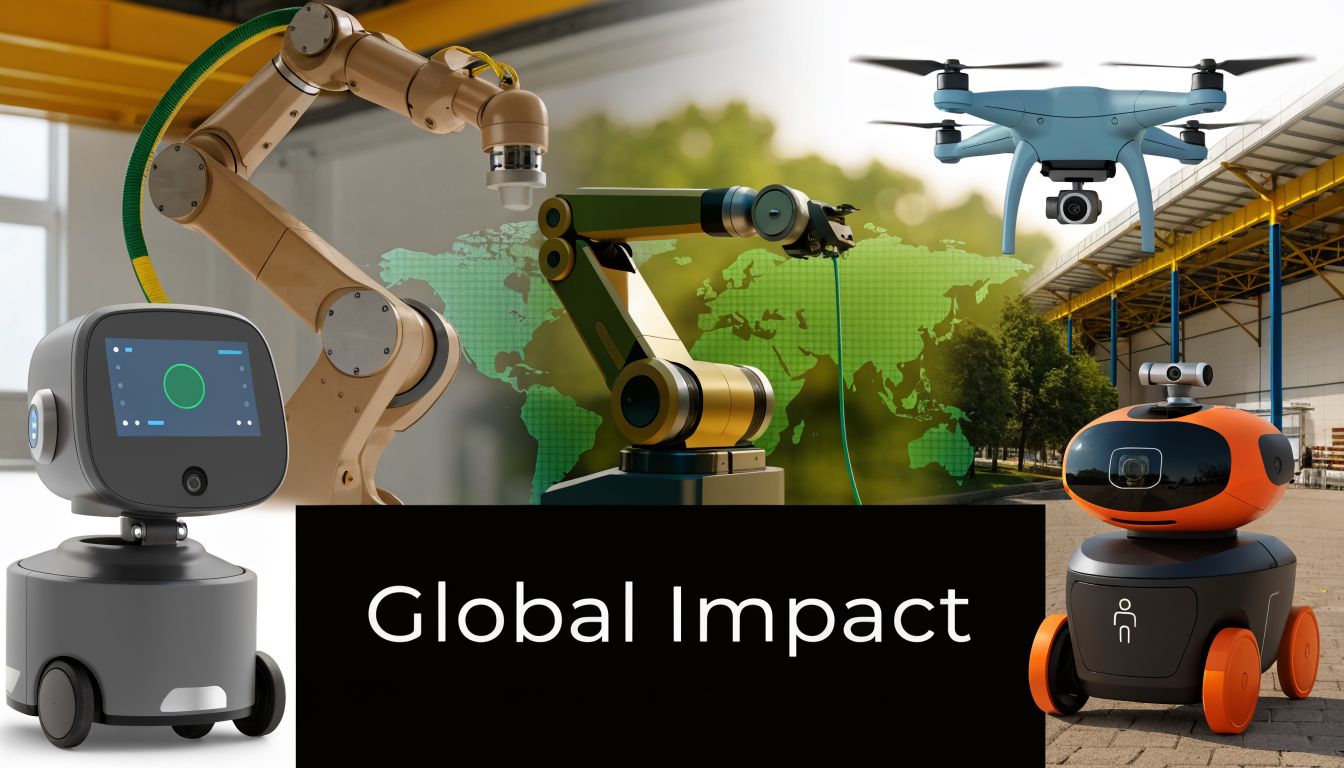
The rise of robots is already changing where economic power sits within sectors. It is also changing which sectors matter most to national strategy. Manufacturing remains central, but logistics and healthcare are becoming equally significant because they connect automation directly to public expectations around reliability, speed, and essential service delivery.
Logistics has become a frontline sector
The most visible sectoral shift is in warehousing. In the UK, autonomous mobile robot deployments grew 28% year over year to over 15,000 units by 2025, according to the UK warehouse automation account referenced here. The same source states that these systems use SLAM algorithms processing 100,000+ point clouds per second, helping reduce order fulfilment time by 35% and labour costs by 20%.
Those figures reveal something broader than operational efficiency. Warehousing is becoming software-defined infrastructure. Once fulfilment speed depends on robotic navigation, fleet orchestration, and predictive maintenance, logistics ceases to be a low-tech support function. It becomes part of national competitiveness.
A practical consequence follows. Countries that underinvest in warehouse and port automation may find that their domestic firms face hidden trade disadvantages even when tariff policy is stable. Delays, error rates, and throughput variability become strategic weaknesses.
This short explainer gives a visual sense of the wider shift in industrial automation and strategic adoption:
Why this now matters for strategic competition
The geopolitical implications are larger than the sectoral ones. Robotics changes the geography of advantage in at least three ways.
- It supports partial reconfiguration of supply chains. Countries that automate more effectively can absorb some cost pressures associated with local or regional production.
- It shifts competitive advantage toward standards-setters. The countries that define safety, interoperability, and liability frameworks shape market access.
- It creates new dependencies. Hardware, sensors, software layers, telecoms infrastructure, and cloud or edge environments can each become points of strategic vulnerability.
The automation race is not only about who builds more robots. It is about who governs the interfaces between robots, workers, data, and trade.
For G7 and G20 governments, this means industrial strategy can’t be separated from technical governance. A state may subsidise adoption, but if its domestic standards diverge too far from partner markets, firms will face friction in exports, procurement, and cross-border integration. Equally, if safety regimes are too weak, public trust will erode just as deployment scales.
The hidden geopolitical consequence is this: robotics is becoming a rule-making contest disguised as an innovation contest.
Assessing Core Risks and Societal Strains

The common policy mistake is to reduce robotic risk to one question: how many jobs might disappear. That matters, but it is too narrow to guide serious governance. The sharper risk is uneven transition. Gains arrive quickly for firms that can deploy capital, integrate software, and redesign workflows. Protections for workers, patients, and smaller suppliers often arrive later.
The real risk is uneven transition
Risk appears in several layers at once.
- Workforce stratification: High-skill workers who can operate, maintain, or integrate robotic systems gain an advantage. Routine roles face uncertainty unless retraining is organised early.
- Operational concentration: Highly automated systems can improve efficiency while increasing dependence on a limited set of vendors, platforms, or cyber-physical architectures.
- Institutional lag: Public regulators often inherit responsibilities for systems they didn’t help design.
That is why workforce policy has to be more than a promise of future reskilling. It needs to be connected to actual deployment pathways, employer obligations, and regional labour market realities. The debate on preparing for jobs of tomorrow is relevant here because robotics doesn’t only alter job counts. It changes bargaining power, training demand, and the timing of labour market shocks.
A further risk is political legitimacy. If communities experience automation first as service disruption, opaque decision-making, or weaker accountability after an incident, trust in both technology and government can fall quickly.
Healthcare shows the governance gap clearly
Healthcare demonstrates the promise and the strain in one setting. A 2026 King’s Fund analysis projects £2.1 billion in savings by 2030 from robotic aides in the UK NHS reducing nurse burnout, while warning of £450 million in upfront costs, according to the published discussion of robotic aides and health system implications. The same source notes a 12% nurse vacancy rate and reports that trials showed 28% faster response times.
That is an attractive efficiency case, but the same evidence points to unresolved governance questions, including liability in robot-assisted errors and the absence of settled national protocols. This is the critical point. The difficult issue isn’t whether robotic support can improve response times. It is whether institutions know who is accountable when robotic systems fail within complex human workflows.
| Risk area | Why it matters in healthcare |
|---|---|
| Liability | Errors can involve clinicians, providers, software vendors, and procurement bodies |
| Ethics | Patient dignity, consent, and human oversight become operational rather than abstract concerns |
| Finance | Upfront investment can strain already pressured public budgets |
| Trust | Public acceptance depends on visible safeguards, not just efficiency gains |
Faster response is valuable. In public services, legitimacy depends on whether responsibility remains clear when outcomes go wrong.
Healthcare therefore offers a warning for every other sector. Once robots operate inside socially sensitive systems, governance quality becomes as important as technical performance.
Reviewing Current Governance and Policy Responses
National strategies are more developed than enforcement systems. That gap is now the central weakness in robotics governance. Governments have announced innovation plans, productivity programmes, and AI ambitions. But deployment is moving faster than the institutions needed to supervise safety, accountability, and interoperability in practice.
Ambition is outpacing enforcement
The UK illustrates the problem clearly. A January 2026 House of Lords report highlighted insufficient enforcement mechanisms for robot safety standards, with only 15% of firms compliant with proposed ISO robotics standards as of Q1 2026, according to the reported analysis of UK robotics governance gaps. The same source says robot density in UK manufacturing rose 22% year over year in 2025, outpacing EU averages and increasing liability risks in human-robot collaboration.
This is the pattern G7 and G20 delegates should worry about. Policy ambition looks strong on paper. Compliance capacity on the ground remains thin. That creates a familiar but dangerous sequence: governments promote adoption, firms deploy quickly, incidents or near misses emerge, and regulators then try to retrofit control into an already scaled environment.
A more credible approach would link industrial incentives directly to auditable compliance milestones. Public support for adoption should not be detached from demonstrable safety readiness.
Multilateral frameworks remain too general
Existing multilateral initiatives have helped establish principles, but principles alone don’t resolve operational frictions. The issue is no longer whether governments endorse trustworthy AI in the abstract. The issue is whether countries can align around practical rules for robotic systems in shared economic space.
Three governance gaps stand out:
- Standards translation: International principles often don’t convert smoothly into factory, warehouse, or hospital compliance.
- Liability allocation: Cross-border supply chains complicate responsibility when hardware, software, and operators sit in different jurisdictions.
- Inspection capability: Many states lack specialised institutional capacity to evaluate robotic deployments in real operating environments.
For policymakers following debates on governing AI in Society 5.0, robotics should be treated as the practical frontier where broad AI principles either become enforceable or remain aspirational.
If enforcement is weak, even good standards become signalling devices rather than governing tools.
The governance lesson is not that current efforts have failed. It is that they remain incomplete in the one area that matters most to public trust: implementation.
A Strategic Framework for G7 and G20 Action
Industrial robot deployment has expanded sharply over the past decade, as noted earlier. The policy implication is larger than factory automation. Once robotics reaches scale across production, logistics, healthcare, and public services, it becomes a question of economic governance, labour market adjustment, supply chain resilience, and security coordination. G7 and G20 leaders should treat it accordingly.
National strategies alone will not be enough. Firms build, train, certify, finance, and deploy robotic systems across borders. If major economies set conflicting rules on safety, liability, data handling, and technical standards, they will raise compliance costs, slow diffusion in legitimate use cases, and increase the advantage of jurisdictions willing to cut corners. A multilateral response is therefore not a diplomatic add-on. It is part of the operating environment for the technology itself.
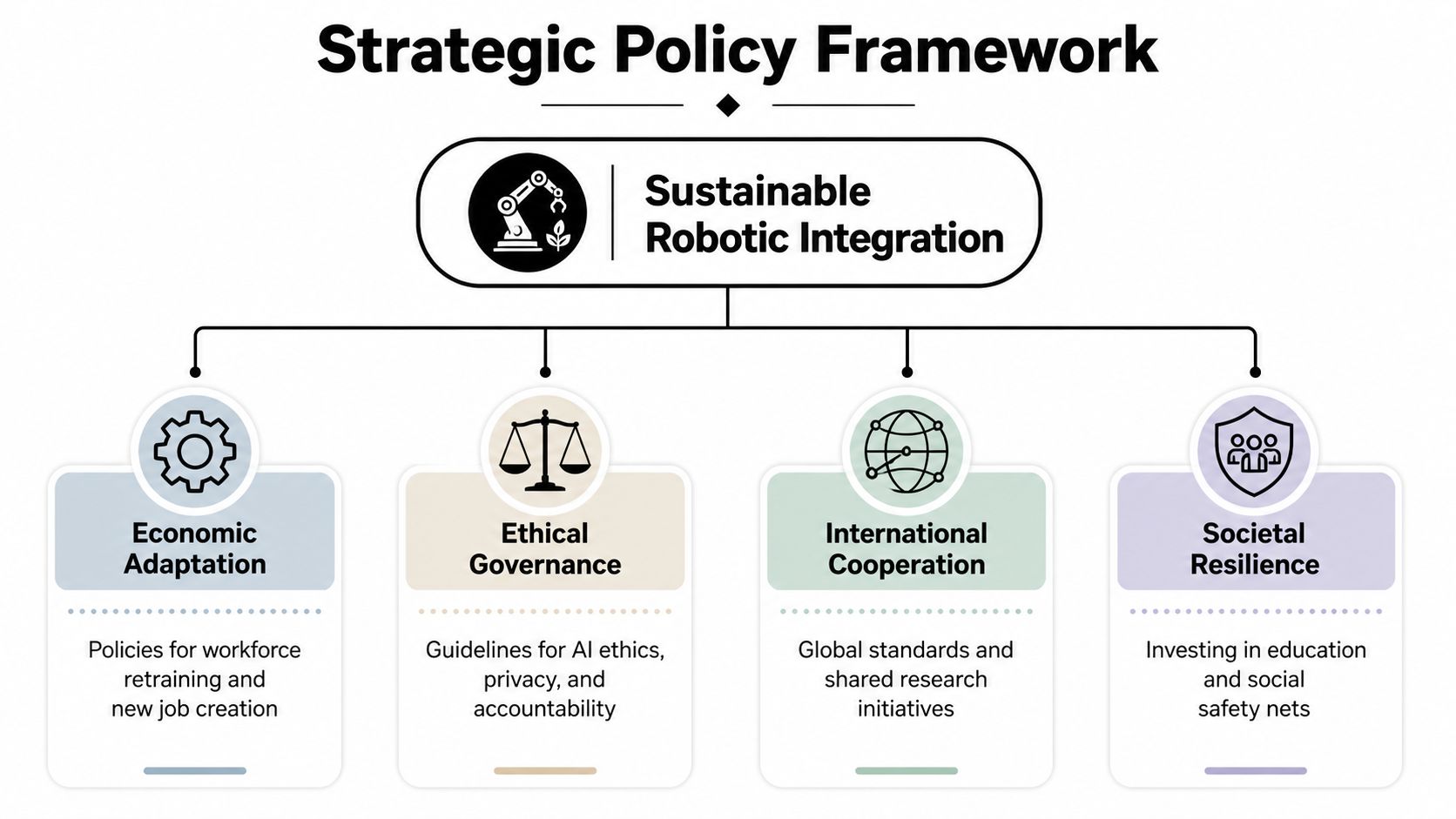
Four pillars for coordinated action
A credible framework should combine domestic policy flexibility with a common G7/G20 baseline in four areas.
Economic adaptation
Automation policy should link productivity gains to labour adjustment from the start. Governments can do that through tax credits, accelerated depreciation, public procurement, and innovation grants that require firms to submit workforce transition plans. Those plans should include retraining budgets, internal mobility pathways, and time-bound reporting on redeployment outcomes. Without that link, states absorb the social consequences while firms keep most of the upside.
This is also a fiscal issue. If governments subsidise capital adoption but underinvest in reskilling, they increase the medium-term burden on unemployment systems, regional support funds, and political trust.
Ethical governance
General principles need to become operating rules. For robotics, that means sector-specific requirements for human supervision, fail-safe design, incident disclosure, audit logging, and clear allocation of responsibility among manufacturers, software providers, integrators, and end users. Sensitive settings should face stricter thresholds, especially healthcare, elder care, transport, and critical infrastructure.
A practical rule is straightforward. The higher the potential harm from physical error or system failure, the stronger the ex ante certification and post-deployment monitoring should be.
International cooperation
Interoperability has become an economic and strategic asset. G7 and G20 countries should align around core technical standards, conformity assessment methods, cybersecurity baselines, and trusted testing protocols. Partial alignment would still matter. It would lower trade friction, improve procurement confidence, and reduce incentives for regulatory arbitrage across major markets.
There is also a security rationale. Networked robots can create new attack surfaces in ports, warehouses, energy systems, hospitals, and defence-adjacent supply chains. That makes cyber-physical assurance a shared resilience concern, not just a commercial compliance issue.
Societal resilience
Public acceptance will depend less on abstract support for innovation than on whether people see credible protections in practice. Education systems, mid-career training, local adjustment funds, portable benefits, and transparent communication strategies all affect whether adoption is politically sustainable. Regions with high exposure to routine-task automation will need targeted support rather than uniform national messaging.
The distribution of disruption matters as much as the aggregate productivity gain.
What leaders should do next
Summit communiques should translate into a short list of implementable commitments.
- Establish a G7/G20 robotics coordination track. Its mandate should cover safety certification, interoperability, cyber-physical risk management, and common reporting terminology across industrial and service robotics.
- Condition public support on workforce transition plans. Firms receiving tax relief, grants, or procurement preference for robotic deployment should meet minimum standards on retraining, redeployment, and worker consultation.
- Create joint regulatory testbeds. Shared pilot environments would allow governments to compare inspection methods, safety thresholds, and human oversight models before codifying them.
- Adopt baseline principles for cross-border liability. Common reference rules would reduce uncertainty where hardware, software, maintenance, and operation span multiple jurisdictions.
- Prioritise public-service deployments. Healthcare, social care, and municipal services should receive dedicated multilateral attention because failures in these sectors carry high trust and legitimacy costs.
- Integrate robotics into economic security planning. Supply chain concentration in key components, industrial software, sensors, and advanced semiconductors should be assessed as part of broader resilience and strategic dependency reviews.
The central policy conclusion is clear. Robotics should be governed as a strategic production system with cross-border spillovers, not as an isolated labour market trend. That framing gives G7 and G20 leaders a more usable playbook. Coordinate standards where fragmentation is costly, preserve national flexibility where conditions differ, and tie public support to measurable social obligations.
Conclusion A Mandate for Proactive Governance
The rise of robots is often described as inevitable. That is only half true. Adoption may be difficult to stop, but its social and geopolitical consequences are still open to political choice. Governments will decide whether robotics deepens inequality or supports broader resilience. They will decide whether standards become shared tools of trust or fragmented instruments of competitive blocking. They will also decide whether public services adopt robots under clear accountability or under improvised rules after failures occur.
That is why the core challenge for the G7 and G20 is not speed alone. It is coordination with legitimacy. Countries need to move quickly enough to remain competitive, but carefully enough to preserve trust among workers, patients, firms, and citizens. The strategic mistake would be to frame those goals as opposites. In practice, they are interdependent. Weak governance slows adoption over time because it invites backlash, legal uncertainty, and institutional confusion.
The strongest conclusion is also the simplest. Robotics is now a test of whether multilateralism can still solve real operating problems. If G7 and G20 leaders can align standards, workforce transition, and accountability around the rise of robots, they will have done more than manage a technology shift. They will have shown that international cooperation still has practical value in the systems that shape daily life and long-term prosperity.
For more analysis like this, explore Global Governance Media, where policymakers, researchers and practitioners can follow data-led coverage on AI governance, inclusive growth, public health, trade resilience and the G7/G20 agenda.