

By Daniel Mercer
The most useful number in this debate isn't a futuristic projection. It's the fact that the UK still operated around 5.9 GW of nuclear capacity in 2024, and nuclear generated roughly 13% of UK electricity in 2023, which means fission remains part of today's energy-security architecture, not yesterday's UK nuclear capacity and generation context. For G7 and G20 leaders, that changes the frame.
Nuclear fission and fusion aren't two versions of the same technology. They are two different strategic assets with different timelines, industrial requirements, and governance burdens. One already underpins electricity systems and industrial capability in multiple advanced economies. The other has reached a genuine scientific milestone, but still sits on the far side of commercial deployment.
That distinction matters because the policy error is now obvious. Governments often discuss fission as a legacy issue and fusion as a visionary one. In practice, the dilemma is sequencing. Leaders must decide how to preserve reliable low-carbon power in the near term while building the research, regulation, and supply chains that fusion would need over the long term.
Table of Contents
- The Clean Energy Imperative for Global Governance
- Understanding Nuclear Fission The Power That Is
- Exploring Nuclear Fusion The Promise That Could Be
- A Comparative Analysis for Strategic Decision Making
- The Global State of Play Fission Fleets and Fusion Labs
- Policy and Governance for the Nuclear Age
- A Multilateral Roadmap for a Nuclear Future
The Clean Energy Imperative for Global Governance
For heads of government, nuclear strategy is no longer a niche technical file. It sits at the intersection of energy security, industrial policy, climate delivery, and strategic autonomy. That's why nuclear fission and fusion should be treated as governance questions first and science questions second.
Fission and fusion solve different problems on different clocks. Fission offers dispatchable low-carbon electricity with an established operating history. Fusion offers the possibility of a more abundant and potentially different nuclear future, but only after major scientific and industrial hurdles are cleared. Treating them as substitutes today produces bad planning.
Why the dilemma is political, not just technical
The core issue for the G7 and G20 is allocation. Public capital, regulatory attention, engineering talent, and supply-chain capacity are finite. Every government has to decide how much to spend on extending or replacing current fission assets, and how much to devote to pre-commercial fusion systems that may define the next era of clean power.
Strategic test: If a technology can support grid reliability today, it belongs in energy-security planning. If it can't, it belongs in research, industrial preparation, and long-range diplomacy.
That doesn't diminish fusion. It disciplines the way governments should talk about it. Fusion deserves serious support precisely because it remains uncertain, difficult, and strategically valuable. Fission deserves equal seriousness because it is already embedded in national power systems, workforces, and fuel-cycle decisions.
What multilateral leaders should recognise now
Three conclusions follow.
- Fission is current-state policy: It affects reliability, replacement schedules, labour markets, and sovereign industrial capability now.
- Fusion is future-state policy: It demands patient public investment, test facilities, licensing models, and materials development before commercial roll-out is plausible.
- Governance must split into two tracks: Trying to regulate, finance, or politically justify both through one nuclear narrative confuses investors and the public.
The strategic question isn't whether the world prefers nuclear fission or fusion. It's whether governments can manage both without weakening either.
Understanding Nuclear Fission The Power That Is
Nuclear fission is the splitting of a heavy atom into smaller parts. The practical image for policymakers is a line of carefully spaced dominoes. One neutron strikes a heavy atomic nucleus, the nucleus splits, energy is released, and more neutrons are produced. If engineers control that sequence inside a reactor, the result is steady heat. That heat boils water, drives turbines, and generates electricity.
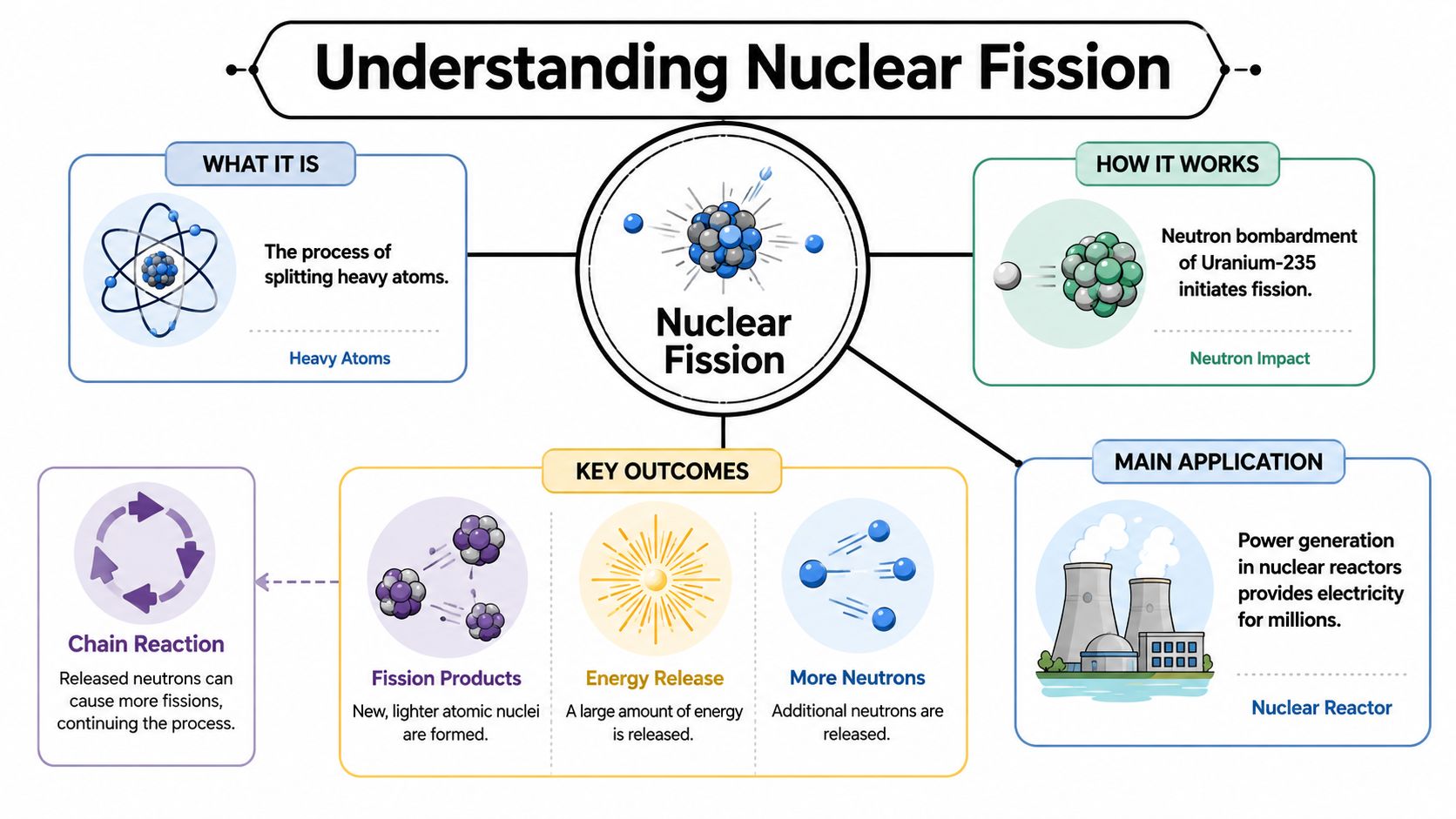
Fission is not theoretical; instead, it is a system technology with operators, safety protocols, supply chains, fuel handling, maintenance cycles, and regulatory institutions. Governments don't evaluate it as a physics experiment. They evaluate it as national infrastructure.
From laboratory discovery to state capability
The scientific roots of fission run directly through the UK. James Chadwick discovered the neutron in England in 1932, a breakthrough that helped make controlled fission physics possible. The first controlled nuclear chain reaction followed on 2 December 1942 at the University of Chicago, and the first electricity from atomic fission was generated on 20 December 1951 at EBR-I historical sequence of nuclear fission.
That sequence matters for policy because it shows how quickly nuclear knowledge became state capability. Once the science moved from identifying fission experimentally in December 1938 and introducing the term in 1939 into engineered chain reactions and power generation by the mid-1940s, nuclear energy stopped being a laboratory curiosity. It became part of national strategy.
For the UK and other advanced industrial states, fission shaped debates about sovereignty as much as electricity. Reactor design, fuel cycles, skills pipelines, waste institutions, and strategic alliances all grew from that scientific base. That's why any serious assessment of the power of nuclear has to start with fission as a governing reality, not an abstract legacy technology.
Why fission remains a policy instrument
Fission's strategic value comes from its maturity. Leaders know its main categories of risk, cost, delay, and regulation. They also know what it can do. It can anchor baseload-style generation, support industrial demand, and provide continuity while variable renewable systems expand.
Fission's advantage isn't perfection. It's that ministers can legislate for it, regulators can license it, engineers can build it, and grids can use it.
That doesn't eliminate the contested issues. Waste management, public confidence, accident risk, and long construction timelines remain politically decisive. But these are known governance problems. Governments can assign responsibility, structure oversight, and negotiate trade-offs around them.
That is a major distinction from fusion. Fission asks leaders whether they are willing to manage a difficult but available technology. Fusion asks whether they are willing to prepare for a technology that doesn't yet exist at commercial scale.
Exploring Nuclear Fusion The Promise That Could Be
Fusion is the opposite physical process. Instead of splitting a heavy atom, it combines light atoms under extreme heat and pressure. The easiest policy analogy is that scientists are trying to bottle the conditions that power a star, then hold them long enough and efficiently enough to turn that reaction into usable electricity.
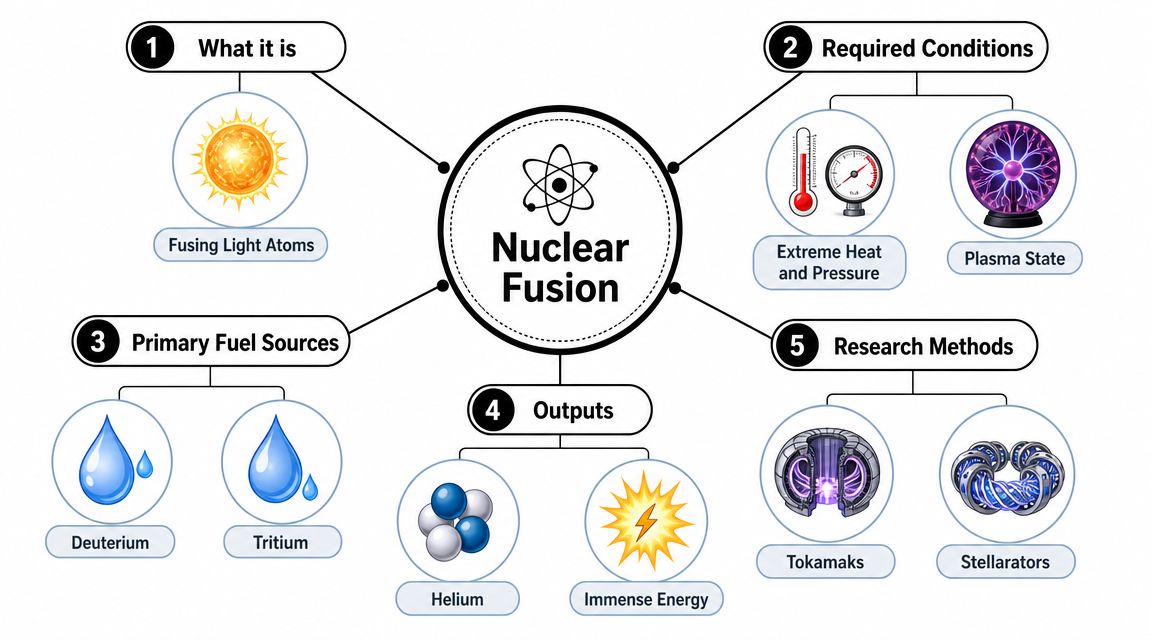
For governments, fusion is compelling because it suggests a different long-term nuclear proposition. It points toward fuel pathways that look different from conventional fission systems, operating characteristics that many policymakers view as potentially safer, and waste questions that may be more manageable in some respects. But none of those advantages can be banked politically until the engineering works outside specialised facilities.
Why fusion attracts strategic attention
Fusion draws sustained government interest because it is not merely an energy technology. It is also a strategic research platform. It touches materials science, advanced manufacturing, superconducting systems, robotics, plasma control, fuel-cycle management, and national prestige.
That makes fusion a classic G20 issue. No single government can fully ignore it, because the countries that shape the standards, components, and licensing assumptions early may also shape the eventual industrial base. The debate is already moving beyond abstract claims about clean energy and into practical questions such as tritium handling, blanket materials, remote maintenance, and future plant regulation. Those questions have direct analogies to other strategic sectors where supply chains matter as much as end products.
A useful parallel sits outside nuclear policy itself. Energy systems only become bankable when storage, transport, and safety rules mature alongside generation technologies. The same logic appears in adjacent clean-energy sectors, including technical work on safely storing hydrogen, where commercial viability depends on handling standards and infrastructure, not just scientific promise.
Later in the policy cycle, this becomes an institutional challenge rather than a scientific one.
What the 2022 breakthrough did and did not change
The most important recent benchmark came on 5 December 2022, when scientists at Lawrence Livermore National Laboratory announced the first fusion ignition, meaning the reaction produced more energy than the laser energy used to start it fusion ignition milestone. That was a real scientific milestone.
It was not, however, a commercial turning point. Fusion is still not a grid-scale power source. For policymakers, that distinction should govern everything from subsidy design to public messaging. If leaders oversell fusion as imminent electricity supply, they will damage credibility when deployment remains slow. If they undersell it as distant science, they may miss the chance to build early industrial leadership.
For countries considering long-term decarbonisation, that means net zero through clean fusion should be approached as a disciplined strategic programme. It needs patient funding, clear milestones, and realistic public language. Fusion has moved out of the realm of pure speculation. It hasn't moved into routine power planning.
A Comparative Analysis for Strategic Decision Making
Leaders don't need a winner-takes-all answer. They need a decision framework. Nuclear fission and fusion should be compared against the criteria that drive public policy: maturity, fuel assumptions, safety profile, waste burden, proliferation concern, and implementation complexity.
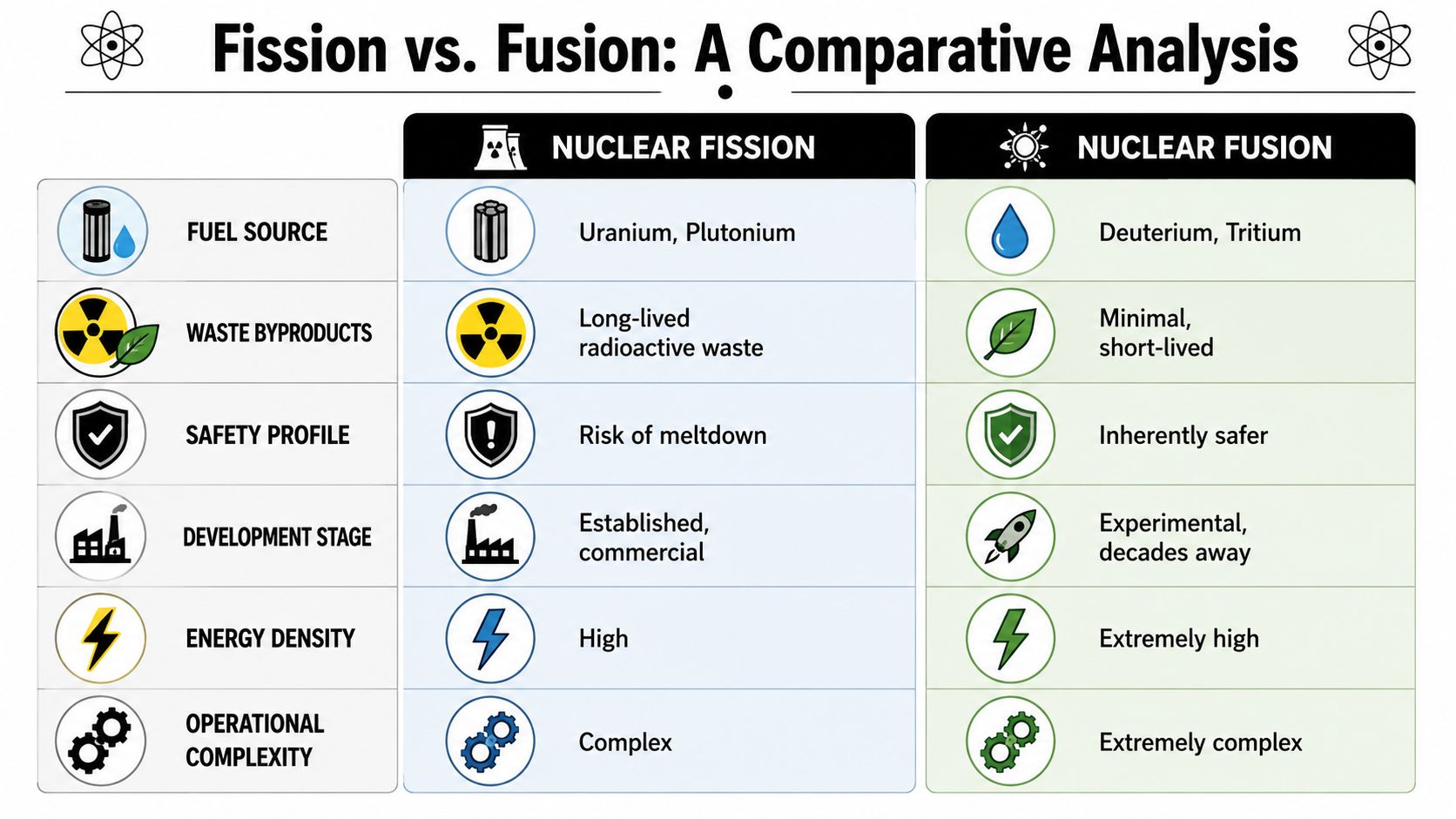
Policy comparison table
| Criterion | Nuclear Fission (Current) | Nuclear Fusion (Projected) |
|---|---|---|
| Fuel source | Uses established nuclear fuel systems and fuel-cycle institutions | Relies on fuel pathways and handling systems that remain pre-commercial |
| Waste byproducts | Produces radioactive waste that requires long-term governance | Often presented as producing less problematic waste, but classification and handling still need regulatory clarity |
| Safety profile | Operates within mature safety regimes, with known accident concerns that regulators must manage | Doesn't present the same type of runaway chain reaction challenge, but poses different engineering and materials risks |
| Development stage | Commercial and operating in national electricity systems | Advanced research and prototype-focused, not yet a commercial grid technology |
| Energy density | High | Potentially extremely high if sustained commercial operation becomes viable |
| Operational complexity | Complex, but institutionally familiar | Extremely complex, with unresolved scientific, engineering, and maintenance barriers |
| Proliferation concern | Embedded in longstanding safeguards and geopolitical sensitivity | Raises a different set of materials and governance questions, which still require international rules |
What leaders should compare first
The first comparison is not physics. It is time horizon.
Fission belongs to current system planning. It can be counted in capacity replacement decisions, workforce planning, and electricity-market design. Fusion belongs to strategic preparation. It should be measured through demonstration milestones, licensing readiness, component manufacturing, and international collaboration.
Decision rule: Use fission to solve near-term reliability and industrial continuity. Use fusion to build long-term optionality.
The second comparison is institutional readiness. Fission already has regulators, operators, insurers, and public procedures, even if they differ by country. Fusion is moving into that zone, but isn't there yet. That means governments must fund not just reactors and labs, but legal architecture.
The third comparison is political tolerance for uncertainty. Fission carries known controversy. Fusion carries unknown timelines. Policymakers often prefer the rhetoric of future breakthroughs to the burden of present trade-offs. That instinct is understandable, but it is strategically weak. Climate and security planning require technologies to be sorted by function, not by narrative appeal.
The most important conclusion is that these technologies are complementary only if governments assign them different jobs. If leaders expect fusion to fill a near-term supply gap, they will underinvest in reliable capacity. If they dismiss fusion because it isn't ready today, they may surrender future industrial advantage.
The Global State of Play Fission Fleets and Fusion Labs
Nuclear power still supplies a meaningful share of electricity in several advanced economies, while commercial fusion supplies none. That single fact should shape how G7 and G20 leaders allocate capital, regulatory attention, and diplomatic effort.
Fission and fusion now sit in different parts of the state. Fission is embedded in power systems, industrial supply chains, labour markets, and energy-security planning. Fusion is concentrated in laboratories, pilot facilities, public research programmes, and cross-border scientific partnerships. Treating them as if they occupy the same policy category leads to poor decisions on timelines, procurement, and governance.
Fission is operating infrastructure
The UK illustrates the point clearly. Nuclear remains part of the country's present electricity mix and therefore part of its present security calculus, as shown in official UK reporting on civil nuclear generation and capacity. The strategic question is not whether fission belongs to history. It is whether governments will preserve enough firm low-carbon capacity while grids add variable renewables, electrified heat, and new industrial demand.
That question extends well beyond the UK. Ageing reactor fleets in Europe, North America, and parts of Asia create a common G20 problem. Every retirement has second-order effects. System operators lose dispatchable supply. Manufacturers lose specialised orders. Training pipelines weaken. Communities that host plants face economic disruption. Replacing the electricity is only one part of the task.
This is why fission policy is now inseparable from industrial policy. Countries that maintain fleets keep engineering capability, fuel-cycle expertise, safety culture, and bargaining power in supply chains for heavy components and enriched fuel. Countries that allow unmanaged decline give up those assets and become more exposed to external suppliers.
Fusion is organised ambition
Fusion sits in a different strategic category. Its value today lies less in electricity output than in the capability race around materials, magnets, tritium handling, advanced manufacturing, and future rule-setting. The countries that build early competence in those areas may shape the commercial terms of the market if fusion reaches deployment at scale.
The UK's programme reflects that logic. It treats fusion as a long-range national capability project built through research infrastructure, demonstration planning, and international cooperation, including the STEP fusion programme. That approach is more credible than presenting fusion as an imminent answer to current power shortages.
For G20 leaders, the implication is straightforward. Fusion spending should be judged against milestones that matter for future industrial position: test facilities, supply-chain qualification, component manufacturing, licensing frameworks, and talent formation. The relevant competition is not only scientific prestige. It is control over standards, intellectual property, and high-value production networks.
The geopolitical dimension is easy to miss. A state that hosts serious fusion programmes gains influence in the wider debate on nuclear governance, including how future facilities are licensed, monitored, and integrated into non-proliferation frameworks. That makes fusion part of a broader strategic discussion about security and restraint, not just innovation, as debates over a world without nuclear weapons continue alongside civil nuclear expansion.
Some countries can sustain both tracks. Those states are likely to hold an advantage. They can use fission to support current system reliability while using fusion programmes to secure future technological position. For the rest, the policy dilemma is sharper. Underinvest in fission and they weaken near-term energy resilience. Ignore fusion and they risk dependence on standards, components, and intellectual property set elsewhere.
Policy and Governance for the Nuclear Age
The largest policy mistake would be to force fission and fusion into one regulatory category and assume the rest will follow. They need related but distinct governance models.

Two regulatory logics are required
For fission, the central governance tasks are familiar. Governments need credible licensing, predictable project oversight, waste institutions, safeguards, and long-term political discipline. The challenge isn't lack of categories. It's that many states still move too slowly, regulate inconsistently across borders, or fail to maintain public legitimacy over long project cycles.
For fusion, the challenge is almost the reverse. The categories themselves are still being formed. Policymakers have to decide what a commercial fusion facility would be regulated as, how its fuel systems would be monitored, how waste streams would be classified, and how to prepare inspectors and emergency frameworks before there is a mature market.
The supply chain question is now central
Governance therefore becomes industrial policy. Commercial fusion will require a dedicated supply chain and regulatory system centred on tritium breeding, advanced materials, and waste classification, and the UK's STEP programme is targeting a prototype plant in the early 2040s, which underlines the long-term nature of the task fusion regulation and STEP context. That timeline should focus ministers' attention. If industrial and regulatory preparation starts late, commercial readiness slips further.
Three governance implications follow.
- For fission, harmonisation matters: If countries want faster deployment of advanced reactor designs, they need licensing cooperation and more consistent standards between jurisdictions.
- For fusion, pre-regulation matters: Governments should build legal definitions and materials rules before the first wave of commercial developers arrives.
- For both, trust matters: Public legitimacy depends on transparent oversight, not on slogans about clean energy.
One additional file should stay connected to this agenda. Nuclear governance doesn't sit apart from non-proliferation and international security. Public acceptance of civil nuclear systems is shaped partly by whether states can show serious commitment to restraint, safeguards, and the broader goal of a world without nuclear weapons.
States that separate nuclear energy policy from nuclear governance strategy will struggle to sustain either.
A Multilateral Roadmap for a Nuclear Future
The G7 and G20 don't need a single nuclear doctrine. They need a practical division of labour backed by cooperation. A critical opportunity is to build a dual-track framework in which fission supports present energy resilience while fusion remains a disciplined strategic bet.
Four actions for the G7 and G20
First, governments should create joint public-private financing platforms that distinguish clearly between deployable fission assets and experimental fusion programmes. These shouldn't be blended into one pool with one set of expectations. Fission finance should target replacement, extension, and new-build where national systems choose it. Fusion finance should target prototypes, enabling technologies, and manufacturing capability.
Second, leaders should launch a standards effort for nuclear components and regulatory data exchange. The purpose is simple: reduce unnecessary duplication where safety goals are shared, while preserving national authority. For fusion, an early standards process would help prevent a fragmented market from emerging before one even exists.
Third, G20 members should cooperate on supply-chain readiness. On fission, that means fuel services, skilled labour, specialist manufacturing, and waste institutions. On fusion, it means moving now on tritium, advanced materials, remote handling, and plant classification. Delaying these preparatory functions would be a policy choice to delay deployment later.
Fourth, governments should invest in public communication that is factual rather than promotional. Citizens can handle complexity. What weakens trust is oversimplification. Fission should be described as difficult but available. Fusion should be described as promising but pre-commercial. Policy durability depends on that honesty.
There is also a role for information platforms that help decision-makers track summit commitments, energy policy debates, and cross-border governance choices. In that context, Global Governance Media provides policy coverage focused on G7 and G20 agendas, including energy and international cooperation, which makes it useful as one venue for following how nuclear choices are being framed in multilateral settings.
The central conclusion is straightforward. Governments shouldn't ask whether nuclear fission and fusion compete. They should ask how to govern each according to its real maturity, risk, and strategic function. Fission is part of the current transition. Fusion is part of the next one. Serious leaders will plan for both, but they won't confuse them.
Global Governance Media helps policymakers, executives, and analysts follow the choices shaping international energy and climate strategy. If you want sharper briefings on nuclear policy, G7 and G20 negotiations, and the governance decisions behind the clean-energy transition, visit Global Governance Media.