

By Alex Morgan
When policymakers, donors, or NGO researchers search for The Stars Foundation, are they talking about a dissolved London-based international charity, or an active UK social enterprise funding youth grants through textile recycling? That ambiguity isn't a minor branding issue. It affects due diligence, partnership decisions, historical attribution, and even how people interpret funding models in the wider development sector.
The confusion is understandable because public references to “the stars foundation” point to more than one entity with distinct missions, legal histories, and operating logics. One record describes a foundation with a global mandate and an awards-based approach to strengthening NGOs. Another points to a UK charity built around a social enterprise model that turns commercial recycling activity into local grantmaking. If those models are collapsed into one narrative, the result is bad analysis.
That matters for international development professionals. A grantmaker assessing organisational precedent needs to know whether an impact award originated in a global philanthropy architecture or in a domestic social enterprise. A local authority exploring alternative revenue mechanisms needs to separate legacy reputation from present operational reality. Even the language of “impact” shifts meaning depending on which foundation is under discussion.
One reason the confusion persists is that development discourse often privileges mission statements over institutional form. Yet form shapes accountability, sustainability, and scale. The organisation referenced in a global health initiatives analysis frame may look relevant to health and child outcomes, but that doesn't mean it is the same body as a UK grantmaker supporting children in sports and the arts.
Publicly available grant material adds another layer. A listing for the UK-based Stars Foundation states that it launched its second annual Stars Impacts Awards in 2024, requiring NGOs to show quantifiable evidence of improved child mortality outcomes and project effectiveness across Health, Education, Protection, and WASH (funding criteria for Stars Impact Awards). Read in isolation, that sounds like a conventional international NGO funder. Read alongside charity and company records, it raises a more important question: which institutional lineage is being invoked?
This article treats that ambiguity as the main subject, not as a footnote. It separates the historical Stars Foundation associated with global humanitarian investment from the active STAR Foundation in the UK, then draws out what their divergence means for governance, funding design, and policy judgement.
Table of Contents
- Introduction Clarifying a Common Point of Confusion
- The Global Legacy of The Stars Foundation 2001-2021
- The STAR Foundation UK A Social Enterprise Model
- Comparing the Two Foundations A Side-by-Side Analysis
- Policy Implications and Lessons for the Sector
- Engaging with the STAR Foundation and Its Model
Introduction Clarifying a Common Point of Confusion
The central problem isn't that the names are similar. It's that the names can lead professionals to attach the wrong theory of change to the wrong institution.
In one strand of the record, The Stars Foundation appears as a global-facing charity associated with NGO assessment, impact awards, and child-centred development outcomes. In another, STAR Foundation appears as an active UK social enterprise supporting underprivileged young people through grants shaped by a revenue-generating recycling operation. Those aren't variations on a theme. They are different organisational types.
Why the name confusion matters
For policymakers, a shared name can distort institutional memory. Officials may assume continuity where there is none, or overlook the difference between a philanthropic intermediary and a self-financing local grantmaker. That can produce weak benchmarking. It can also lead to poor comparisons when ministries or local authorities explore blended finance, circular economy funding, or small-scale youth grant programmes.
For funders, the risk is practical. Due diligence often starts with basic web searches and public profiles. If those profiles collapse multiple entities into one composite image, a potential partner may misunderstand governance arrangements, beneficiary scope, or operating status.
Analytical rule: When two charities share a near-identical public name, the first step isn't mission analysis. It's entity verification.
What the records actually suggest
The available evidence points to a split story. One organisation carried a clearly international development orientation and became associated with an awards model focused on organisational quality and measurable outcomes. Another operates in the UK with a distinctly local remit and a business-linked funding base.
That distinction changes the policy reading. The first belongs to a period when large philanthropic actors often used recognition, competition, and institutional strengthening to influence front-line delivery. The second is more interesting for debates about financial resilience, place-based grantmaking, and whether social enterprise can provide steadier support for community benefit.
A serious reading of the stars foundation therefore requires disambiguation before evaluation. Otherwise, the sector risks drawing broad conclusions from a blurred institutional picture.
The Global Legacy of The Stars Foundation 2001-2021
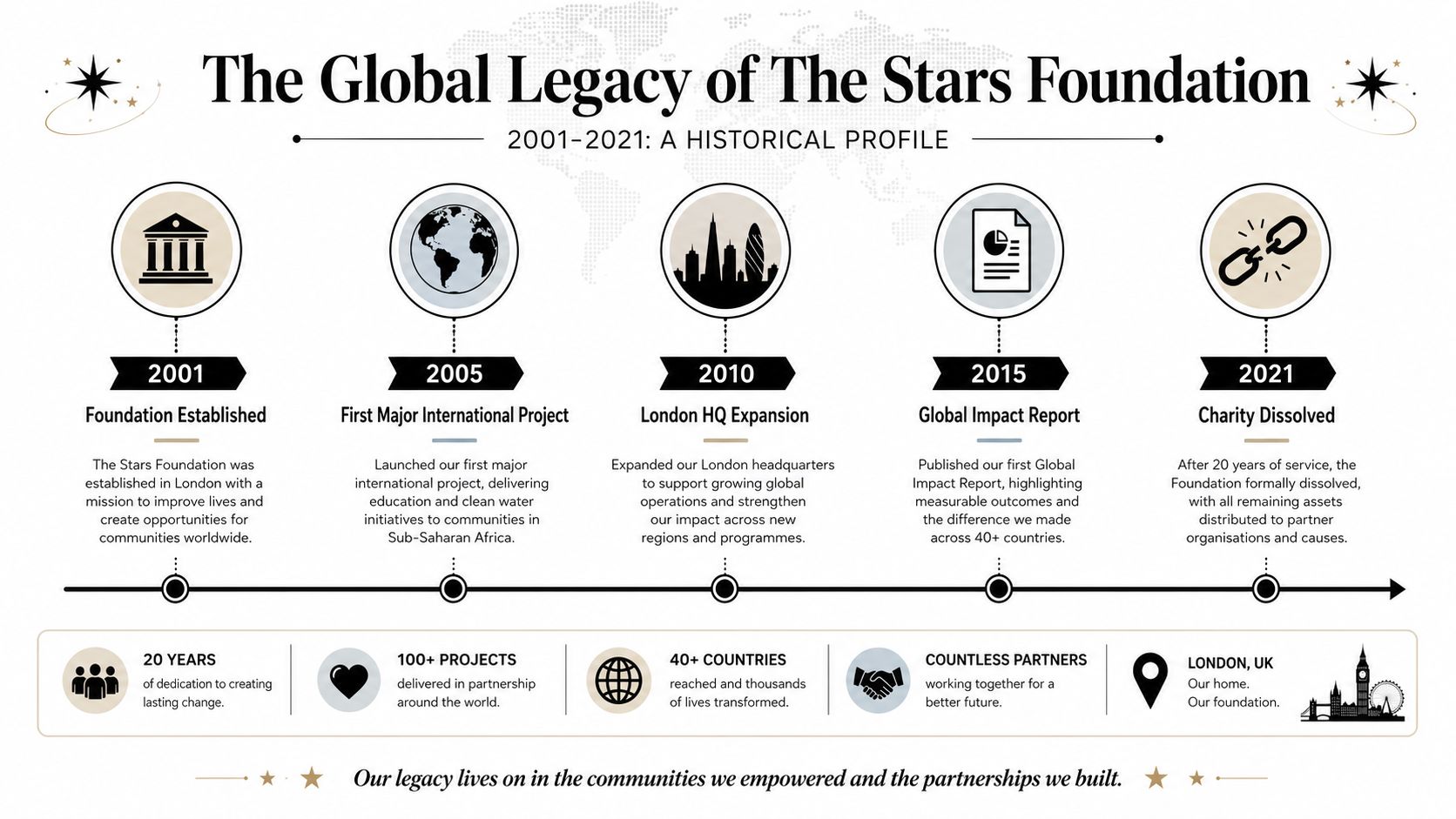
The historical Stars Foundation occupied a recognisable place in early twenty-first century philanthropy. It was incorporated on 11 July 2001 and dissolved on 24 August 2021, operated as an independent charity based in London, and was originally founded by Al-Dabbagh Group. Its public profile also included a high-level ambition to reach 20 million people globally by 2020 (historical profile of The Stars Foundation).
That combination of traits matters. It positioned the organisation less as a direct service provider and more as a strategic backer within the global development ecosystem.
A model rooted in intermediation
The historical foundation's mission centred on investing in organisations and ideas that could transform the lives of disadvantaged children, young people, and their communities globally. That wording signals a classic intermediary logic. Rather than treating delivery as the core institutional function, the organisation appears to have focused on selecting, supporting, and elevating front-line actors.
For development professionals, this is familiar territory. Foundations of that era often tried to improve outcomes indirectly by improving which organisations got visibility, legitimacy, and financial support. Awards programmes were part of that toolkit because they did more than transfer funds. They also shaped reputational hierarchies.
Why its impact goal matters
The aspiration to reach 20 million people globally by 2020 is more than a headline. It reflects the language of scale that dominated philanthropy and international development in that period. Institutions frequently signalled seriousness through large reach ambitions, transnational scope, and a preference for high-visibility frameworks that could connect donors, NGOs, and public recognition.
A target like that also reveals a governance style. It assumes that a foundation can influence systems by identifying exemplars and amplifying them across networks. That is different from a place-based model built around repeat local engagement.
The historical Stars Foundation should be read as part of a wider philanthropic moment in which recognition mechanisms were used to steer attention, credibility, and resources towards selected NGOs.
What dissolution changes
Its dissolution in 2021 doesn't erase its importance. It changes how that importance should be interpreted. Analysts should treat it as a completed institutional chapter, not as an active operational partner.
That distinction is significant because legacy can outlive legal existence. Old references remain online. Awards retain reputational residue. Former beneficiaries and observers may still cite the foundation as if it were current. For policy work, however, dissolution means the institution now belongs to historical analysis, not contemporary funding mapping.
The table below helps fix the essential record.
| Attribute | Historical Stars Foundation |
|---|---|
| Organisational status | Dissolved |
| Base | London |
| Founding context | Founded by Al-Dabbagh Group |
| Operating posture | Independent charity |
| Strategic ambition | Reach 20 million people globally by 2020 |
Its lasting sector influence
The more durable legacy lies in method. The foundation helped normalise a style of philanthropy that rewards organisational effectiveness and front-line legitimacy through competitive recognition. That approach still shows up in international development, especially where funders want evidence of impact and management quality without becoming direct implementers themselves.
Its history also reminds policymakers that philanthropic visibility can create enduring brand memory, even after an institution closes. That makes archival clarity and institutional naming more important than many funders assume.
The STAR Foundation UK A Social Enterprise Model
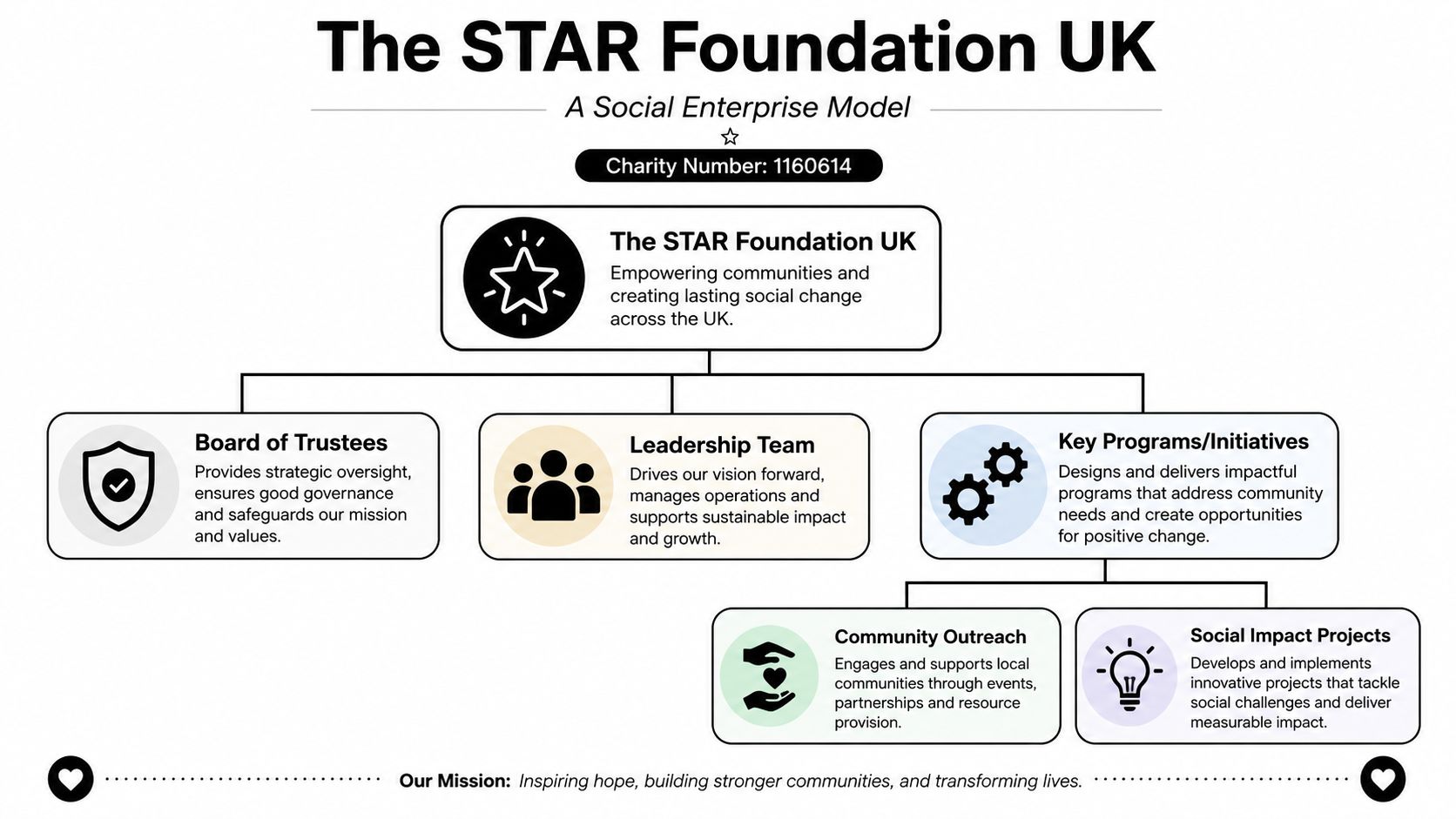
The active STAR Foundation is analytically distinct from the historical global charity. It is a UK-based social enterprise with Charity Number 1160614, and its model links commercial activity directly to grantmaking. In the 2023-24 period, it recorded annual income exceeding £999,000 and distributed exactly £240,660 in charitable activities supporting underprivileged youth in sports, arts, and creative fields (STAR Foundation UK profile and grant data).
That record immediately puts the organisation in a different policy category. This isn't an ordinary grantmaking charity. It is a charity whose funding mechanism is embedded in a trading model.
How the model works
The foundation operates a textile recycling programme called Rags2Riches. The significance of that programme isn't only financial. It shows a direct connection between a circular-economy activity and charitable output.
For policymakers, that creates an important distinction. Traditional foundations usually depend on endowment income, donor contributions, or corporate giving. The STAR Foundation's model instead links operational revenue generation to community grant distribution. That creates a tighter relationship between enterprise activity and social purpose.
What the grants are designed to do
The organisation targets individuals aged 16 and under in underprivileged areas across the UK, with grants between £100 and £300 for eligible applicants who show potential and determination. That level of grantmaking is modest by institutional standards, but that's the point. It is designed for small, direct interventions in young people's lives, especially where access to sports, arts, or creative opportunity may otherwise be thin.
This is not international development in the conventional sense. It is localised social investment. Yet the model is highly relevant to broader development debates because it addresses a recurring problem: how to create predictable charitable capacity without relying solely on external donors.
Practical lesson: Small grants can be strategically important when they are fast, targeted, and tied to a funding mechanism that the organisation can influence directly.
Why this matters beyond the UK
The STAR Foundation's value as a case study lies in institutional design. It suggests that revenue-generating activity can coexist with a charitable mission without collapsing into mission drift, provided the linkage remains clear and the beneficiary focus stays disciplined.
A few features stand out:
- Revenue clarity means observers can see how the recycling operation underwrites the grant programme.
- Beneficiary precision keeps the mission narrow enough to remain legible.
- Local focus reduces the complexity that often weakens accountability in broad multi-country portfolios.
Its operational details reinforce that grounded character. The foundation was founded by Pete Tryner, lists its registered address at Derby Road, Burton-on-Trent, Staffordshire, DE14 1RS, and uses a contact-based application system rather than an impersonal portal-heavy process, as noted in the same public profile.
A different theory of institutional resilience
This model deserves attention because it doesn't treat sustainability as an abstract aspiration. It builds sustainability into organisational architecture. That doesn't make it automatically superior to philanthropic grantmaking. It does mean the source of resilience is different.
Where larger international charities often depend on donor cycles, branded campaigns, or major institutional relationships, the STAR Foundation's structure points towards a more local, operationally rooted form of continuity. For public agencies exploring civic finance, community wealth building, or circular social investment, that's more than a niche example. It is a usable design logic.
Comparing the Two Foundations A Side-by-Side Analysis
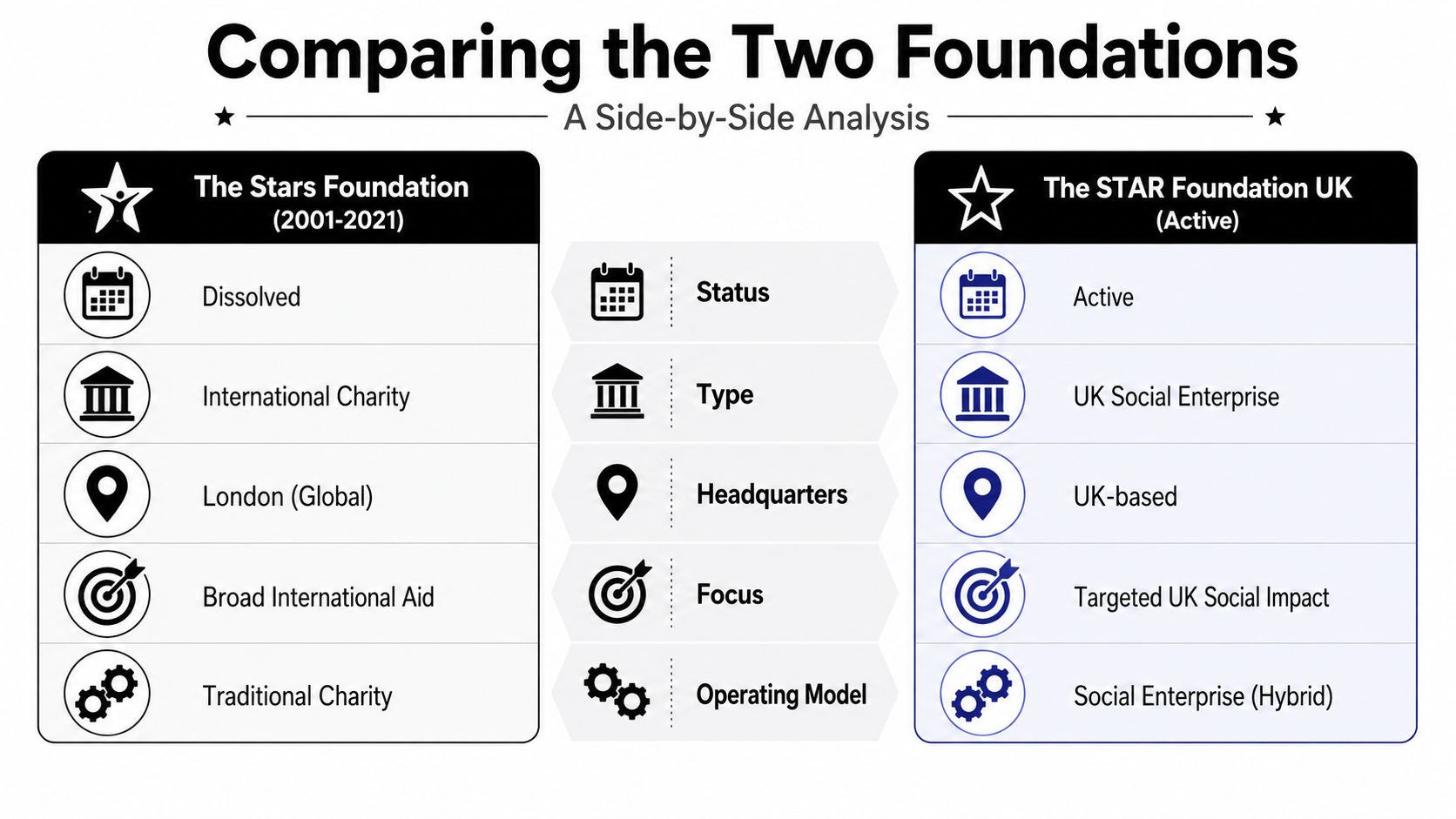
The easiest way to misunderstand the stars foundation is to compare names instead of structures. Once the comparison starts with legal status, scope, and operating model, the distinctions become much clearer.
Status and institutional time horizon
The historical Stars Foundation belongs to the past tense. It operated for two decades and then dissolved. The STAR Foundation UK is active and operational.
That difference changes what each organisation can be used for analytically. The former is a source of historical lessons about philanthropy and NGO recognition. The latter is a live case for policy experimentation around enterprise-backed grantmaking.
Geographic scope and governing logic
One foundation was outward-facing and global in ambition. The other is domestic in remit and UK-based in operational identity.
This isn't merely a question of map coverage. Global scope often requires looser chains of accountability, broader partner assessment, and more complex claims about impact. Local scope permits tighter alignment between revenue source, beneficiary group, and decision-making context.
Beneficiary architecture
The historical foundation appears to have worked through organisations and ideas aimed at transforming the lives of disadvantaged children and communities globally. The active STAR Foundation supports underprivileged young people in the UK directly through small grants for sports, arts, and creative development.
That means the comparison is intermediary versus proximate grantmaker.
| Dimension | Historical Stars Foundation | STAR Foundation UK |
|---|---|---|
| Current status | No longer operating | Active |
| Primary orientation | International | UK-based |
| Core mechanism | Philanthropic investment and awards | Social enterprise-funded grantmaking |
| Beneficiary route | Through NGOs and wider development actors | Direct support for young people |
| Analytical use | Historical precedent | Contemporary policy case |
Funding model
This is the most consequential divide.
The historical organisation fits a recognisable charitable model in which a foundation allocates resources to organisations judged capable of producing significant social gains. The STAR Foundation UK, by contrast, creates charitable capacity through a commercial recycling activity. That means its social spending is linked to enterprise performance rather than solely to donor appetite or institutional fundraising.
If a policymaker is looking for lessons on philanthropic intermediation, the historical foundation is the relevant case. If the question is how a charity can generate its own grantmaking base, the STAR Foundation UK is the more useful reference point.
Brand overlap and analytical risk
The shared naming creates a specific hazard for the sector. Observers may attribute the achievements, assumptions, or reputation of one model to the other. That can lead to weak procurement decisions, inaccurate citations, or confused policy analogies.
A practical discipline helps avoid that problem:
- Check legal status first.
- Identify the geographic remit.
- Ask how money is generated.
- Determine whether the organisation funds intermediaries or end beneficiaries.
Those four questions separate the two foundations quickly and reliably. They also offer a wider template for analysing similarly named charities whose public identities outlast institutional changes.
Policy Implications and Lessons for the Sector

Taken together, the two foundations tell a larger story about how the social sector has changed. The contrast isn't only between global and local. It is between two different answers to a persistent governance question: where does social purpose get its staying power?
Funding resilience is a design choice
The historical model relied on philanthropic authority, NGO selection, and a logic of catalytic influence. That made sense in an era when foundations often sought to shape systems by backing front-line exemplars. The risk in that model is that continuity may depend heavily on founder commitment, institutional sponsorship, or the durability of philanthropic strategy.
The UK social enterprise model offers a different answer. It ties mission delivery to an operating activity. That doesn't remove risk, but it changes the risk profile. Revenue volatility becomes an operational issue rather than solely a fundraising one. For local policymakers, that may be a more manageable problem.
A related governance point is compliance. When charities or nonprofits engage with partners, staff, or screening processes across jurisdictions, procedural discipline becomes more important, not less. For organisations assessing hiring and background-check obligations in regulated environments, this overview of FCRA compliance for nonprofits is a useful operational reference.
Impact measurement has become more exacting
The historical and contemporary records also point to a shift in what counts as credible evidence. In earlier philanthropic practice, broad ambitions and high-level reach goals carried substantial signalling power. Today, funders often expect clearer lines between intervention, evidence, and outcome.
That is especially visible in the impact-award style criteria associated with Stars-branded funding, where applicants are expected to show documented effective practice, positive impact on disadvantaged children's lives, and strong management systems. The move is from aspiration towards verification.
Stronger evidence requirements don't just filter applicants. They reshape organisational behaviour, often pushing NGOs to formalise governance, reporting, and internal systems.
This wider trend aligns with the evolution of philanthropic strategy discussed in analysis of philanthropy's changing role in global health. The policy implication is clear. Funding architecture now matters as much as mission rhetoric.
Brand governance needs more attention
Nonprofit leaders often underestimate the policy cost of ambiguous naming. Yet when a dissolved global charity and an active domestic social enterprise share similar names, confusion doesn't remain a communications issue. It becomes a governance issue.
Three lessons follow:
- Entity clarity should be explicit. Public-facing materials should make legal status, geography, and operating model easy to distinguish.
- Archive management matters. Historical impact claims should remain accessible but clearly dated.
- Partner due diligence must go beyond brand recognition. Shared names are poor substitutes for institutional identification.
What policymakers should take away
The two foundations show that form shapes strategic possibility. A recognition-based international charity can influence a field by conferring legitimacy and resources. A trading-backed local charity can create a tighter loop between enterprise and grantmaking.
Neither model is universally superior. Each fits different political economies, different scales, and different accountability expectations. A key lesson is that institutional design should be assessed as seriously as programme ambition. That's where many policy mistakes begin.
Engaging with the STAR Foundation and Its Model
For practitioners who want to act rather than classify, the active STAR Foundation is the more relevant entry point. Its model offers something tangible: a live example of how charitable support for children can be linked to a revenue-generating social enterprise rather than depending entirely on periodic donations or one-off grants.
For applicants and local partners
The foundation focuses on underprivileged young people in the UK, particularly those with potential in sports, arts, and creative fields. Its application process is direct and personal rather than heavily automated. Interested applicants are asked to contact the foundation by email at info@starfoundation.org.uk or by telephone on 07779096467, according to the public foundation listing.
That contact-based approach is easy to overlook, but it tells you something important about the organisation. It suggests a model that remains relationship-led, accessible, and relatively close to its beneficiary community.
For policymakers and institutional leaders
The larger opportunity is analytical. The STAR Foundation should be studied as a practical model for localised funding resilience. Its use of a textile recycling programme to generate charitable income makes it relevant to debates about circular economy policy, youth opportunity, and community wealth building.
Officials working on social infrastructure should ask a harder question than whether the model is replicable in identical form. They should ask which elements are adaptable:
- Could local authorities support enterprise-linked grantmaking ecosystems?
- Could waste, reuse, or recycling flows be structured to produce community benefit?
- Could small grants for young people be funded through more durable local revenue channels?
The strongest reason to engage with the STAR Foundation isn't that it offers a universal template. It's that it demonstrates a credible institutional logic linking commerce, place, and youth opportunity.
That logic also connects to wider questions in social and digital infrastructure, especially where foundations act as bridges between service systems and community needs. For readers thinking along those lines, this piece on why foundations matter in digital health offers a useful adjacent lens.
The policy case for engagement is straightforward. Don't treat the STAR Foundation merely as a local charity. Treat it as a working example of how an organisation can convert routine economic activity into sustained social value, then ask what your own institution could learn from that design.
Global Governance Media tracks the institutions, funding models, and governance choices that shape international cooperation. If you want more analysis that turns complex organizational environments into practical policy insight, explore Global Governance Media.