


By Dr Eleanor Hart
160 million credit-underserved Indians remain largely outside the channels through which monetary easing is supposed to work, even while the Average Annual Percentage Rate in microfinance often remains around 33% according to Reuters on India's rate cuts and credit access. That single contrast reframes the debate on the interest rate in India. The policy rate matters, but the distribution of its effects matters more.
For G20 finance ministers, India's rate environment is not a narrow domestic variable. It is a test case in how a major emerging economy manages disinflation, credit allocation, financial inclusion and external credibility at the same time. The headline rate is only the top layer. Beneath it sits a more consequential question: when the Reserve Bank of India adjusts policy, who feels the change?
Table of Contents
- India's Monetary Stance in a Global Context
- Decoding the RBI's Monetary Policy Toolkit
- Economic Drivers of Indian Interest Rates
- Historical Trends and Future Projections
- The Monetary Policy Transmission Mechanism
- Macroeconomic and Sectoral Impacts
- Policy Implications for Global Stakeholders
India's Monetary Stance in a Global Context
As of June 5, 2026, the Reserve Bank of India's key policy repo rate under the Liquidity Adjustment Facility stood at 5.25%, unchanged since the 25 basis point cut in December 2025, according to India's interest rate decision calendar. For a G20 audience, that level signals neither panic easing nor punitive tightening. It signals controlled calibration.
India's monetary stance sits at the intersection of domestic stabilisation and global spillovers. When the RBI holds or cuts, it influences not only domestic borrowing conditions but also investor expectations about the rupee, sovereign financing conditions and cross-border capital allocation. In large emerging markets, rate policy is never just about inflation management. It is also about preserving policy autonomy when capital can move faster than institutions can adapt.
A second point deserves more attention. India's role in global governance means its monetary choices carry demonstration effects for other middle-income economies facing similar trade-offs. Policymakers watching the interaction between domestic priorities and external constraints will find useful parallels in broader debates on China's currency policy and the limits of G7 action.
Core insight: The interest rate in India should be read less as a single price of money and more as a policy signal about credibility, sequencing and the state's capacity to transmit relief through formal finance.
That is why the surface reading of the repo rate is insufficient. The operative question is whether the policy stance can reach households and firms in a segmented credit system, where formal banking, sovereign debt markets and microfinance often move at different speeds.
Decoding the RBI's Monetary Policy Toolkit
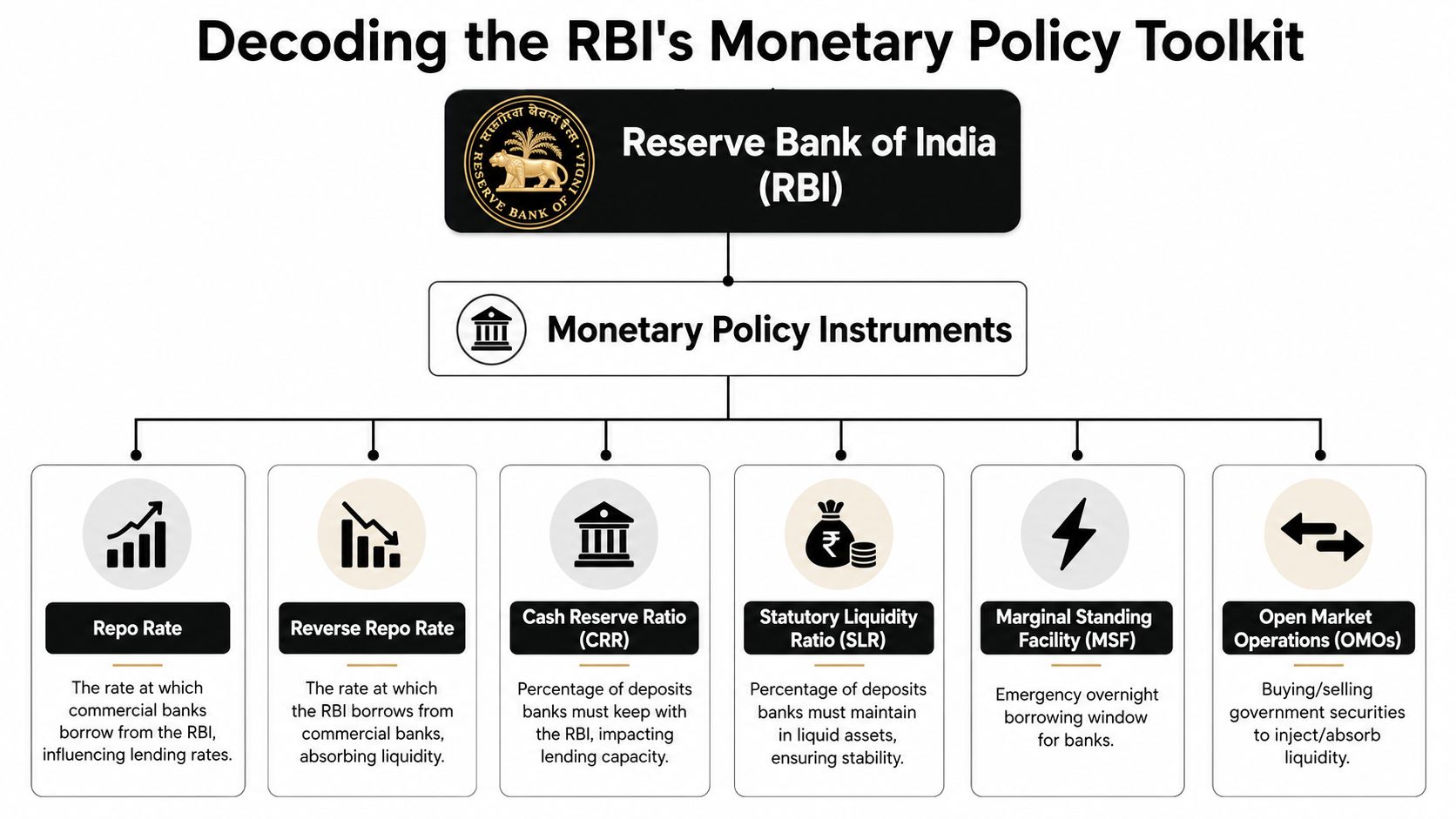
The RBI's toolkit works like a plumbing system. One valve sets the headline direction, others regulate pressure, and the corridor around the policy rate keeps liquidity from swinging too far in either direction. Officials who focus only on the repo rate miss the architecture that gives the stance operational force.
The corridor matters more than the headline
The repo rate is the rate at which commercial banks borrow from the RBI against eligible collateral. It is the central signal rate and the principal benchmark for short-term monetary policy in India.
The Standing Deposit Facility, or SDF, is the lower side of the corridor. It gives banks a place to park excess liquidity with the central bank. The Marginal Standing Facility, or MSF, is the upper side of the corridor and operates as an emergency overnight window for banks. The Bank Rate sits alongside this upper threshold as a key reference in the broader framework.
According to the RBI's policy framework, the SDF rate is 6.25%, while the MSF rate and Bank Rate are both 6.75%, creating a corridor around the 5.25% repo rate to manage overnight liquidity, as set out in the RBI's official policy rates table. Functionally, that corridor matters because it shapes the cost of short-term liquidity stress and the return on short-term surplus funds.
The reverse repo rate, CRR, SLR and open market operations also matter in practice, but it's analytically significant that they are not interchangeable. Some tools signal stance. Others absorb or inject liquidity. Others constrain bank balance-sheet behaviour. Analysts following central bank governance in other systems may find it useful to compare these functions with the Central Bank of the Russian Federation policy framework.
Current RBI policy interest rates
| Policy Rate | Current Rate (p.a.) | Primary Function |
|---|---|---|
| Repo Rate | 5.25% | Main policy signal and collateralised borrowing rate for banks |
| Standing Deposit Facility | 6.25% | Floor-side liquidity absorption tool for surplus funds |
| Marginal Standing Facility | 6.75% | Emergency overnight borrowing window for banks |
| Bank Rate | 6.75% | Reference rate linked to the upper side of the policy framework |
A practical reading of the toolkit yields three conclusions:
- The repo rate sets direction. It tells markets whether the RBI wants tighter or looser financial conditions.
- The corridor sets discipline. It limits disorder in overnight funding conditions.
- The operating framework sets credibility. If short-term money market conditions don't align with the signal, the headline rate loses force.
In India, the toolkit is best understood as an operating system, not a glossary.
Economic Drivers of Indian Interest Rates
No central bank sets rates in a vacuum. The interest rate in India reflects a balancing act among inflation pressures, growth conditions, exchange-rate concerns and the global monetary backdrop. The difficult part is that these drivers often point in different directions at the same time.
Inflation, growth and the exchange rate constraint
Inflation remains the classic driver of policy tightening. When price pressures broaden, central banks typically lean against demand and expectations through tighter financial conditions. In India, that impulse is complicated by the composition of inflation pressure, especially when food or imported energy shocks weaken the usefulness of blunt rate moves.
Growth creates the opposite pressure. When domestic activity softens, policymakers face demands to lower funding costs and support credit expansion. Yet a large economy cannot pursue growth support without considering second-round effects. A rate cut that assists demand may also alter capital flows, currency expectations and imported price pressures.
The exchange rate adds a third layer. A wide interest differential versus major economies can shape foreign portfolio behaviour and influence domestic financial conditions through the currency. For India, this means the RBI's choices are partly domestic and partly comparative. The relevant policy question is not merely whether inflation is easing, but whether easing can occur without creating instability elsewhere in the system.
Why the RBI's reaction function stays complex
The most useful way to think about the RBI is not as an inflation-only institution and not as a growth-only institution. It behaves as a sequencer. It tries to decide which problem is most costly to underreact to at a given moment.
That produces several persistent tensions:
- Inflation versus supply shocks. Rate increases can cool demand, but they can't produce better harvests or lower imported fuel costs.
- Growth versus financial discipline. Lower rates can support activity, but cheap money can also delay balance-sheet repair and misprice risk.
- Currency stability versus domestic autonomy. Policymakers may want looser settings at home while external conditions argue for caution.
Practical rule: Don't interpret any single RBI move in isolation. The stance only makes sense when read alongside external financing conditions, domestic price formation and credit distribution.
For G20 ministries, that has an institutional implication. India's monetary decisions should be assessed together with financial-sector depth and transmission capacity. A central bank can set the right price at the centre and still obtain uneven outcomes if the transmission chain is segmented downstream.
Historical Trends and Future Projections
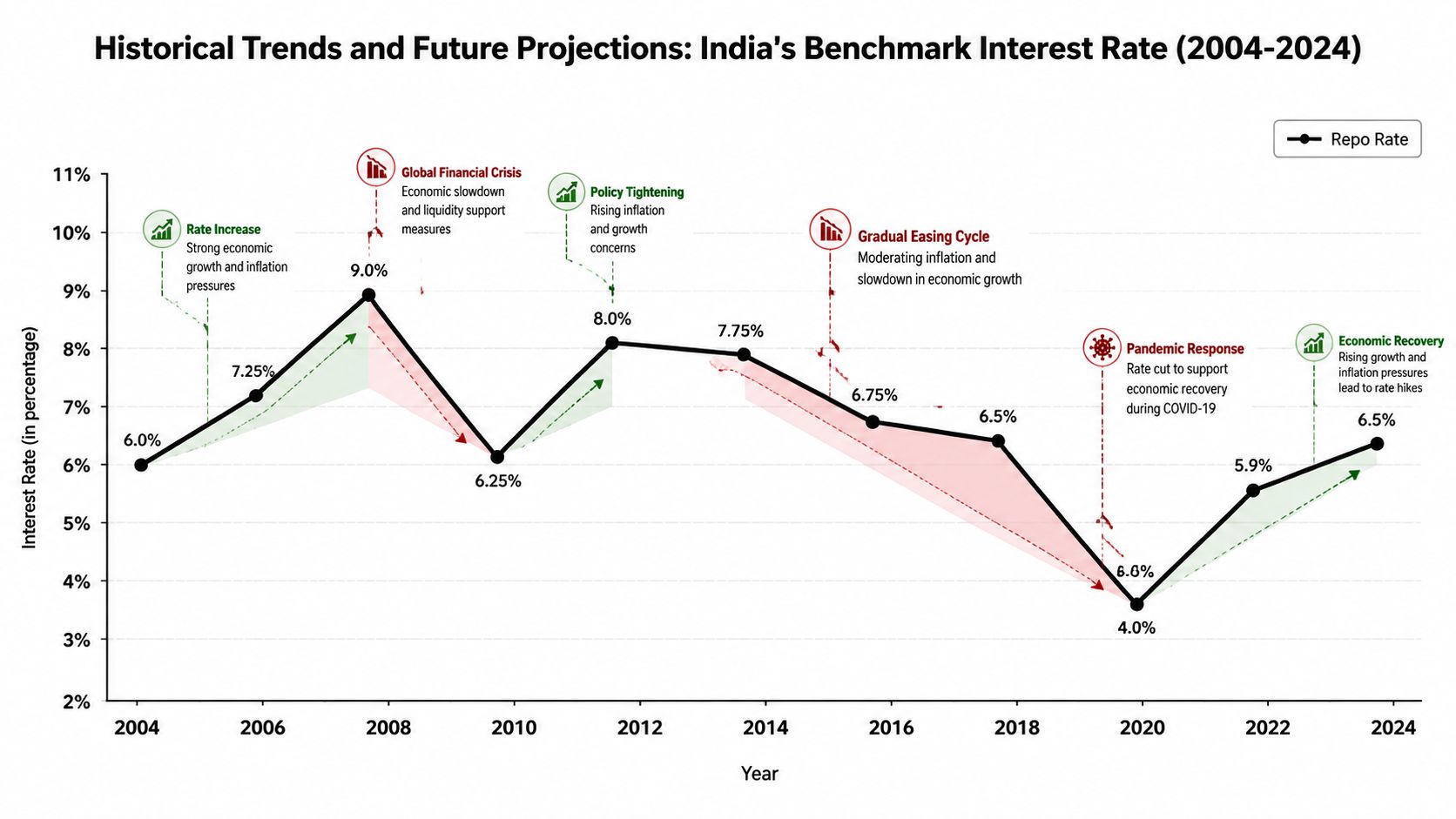
History places the current policy stance in proportion. India has not operated within a narrow rate regime. It has moved across a very wide range in response to external shocks, domestic inflation dynamics and financial stress.
What the long run says about policy flexibility
India's benchmark interest rate averaged 6.33% from 2000 to 2026, reached an all-time high of 14.50% in August 2000, and fell to a record low of 4.00% in May 2020, according to Moneycontrol's long-run India interest rate series. That range tells us something important. The RBI has shown a willingness to move forcefully when macroeconomic conditions justify it.
The current level therefore shouldn't be read as historically extreme. It sits within a broader pattern of cyclical adjustment. What matters is less the absolute level than the combination of policy intent and market reception. A moderate policy rate can still feel tight if liquidity is patchy and risk pricing is conservative. A lower rate can still feel ineffective if financial intermediation remains segmented.
A separate source projects India's policy rate to trend around 5.00% in 2027, while also reporting the 10-year Government Securities Yield at 6.78% in January 2026, up from 6.66% in the previous month, and the State Bank of India base rate at 7.25% p.a. effective April 1, 2026, as noted by Trading Economics on India's rate environment. Those data points suggest that policy easing at the centre doesn't collapse the broader term structure or erase retail pricing frictions.
What to infer from the current yield structure
Long-term borrowing conditions deserve separate attention because they reveal how markets price future inflation, fiscal supply and duration risk. India's long-term interest rate was 6.84% in March 2026, up from 6.77% in February 2026 and 6.68% in March 2025, while remaining below the long-term average of 7.28%, according to YCharts data on India's long-term interest rates. That rise in longer-dated yields alongside a lower short-term policy rate signals a familiar divergence.
Three implications follow:
- Short-term easing doesn't guarantee easier long-term finance. Sovereign and corporate borrowers at the long end can still face firmer pricing.
- The market may be differentiating between liquidity relief and structural disinflation. That distinction matters for investment planning.
- India's monetary story is increasingly about the slope, not just the level, of rates. The spread between policy rates, bank lending rates and bond yields shapes economic outcomes.
This is why historical averages alone can mislead. The policy signal itself lies in how today's stance interacts with current credit channels and market expectations.
The Monetary Policy Transmission Mechanism
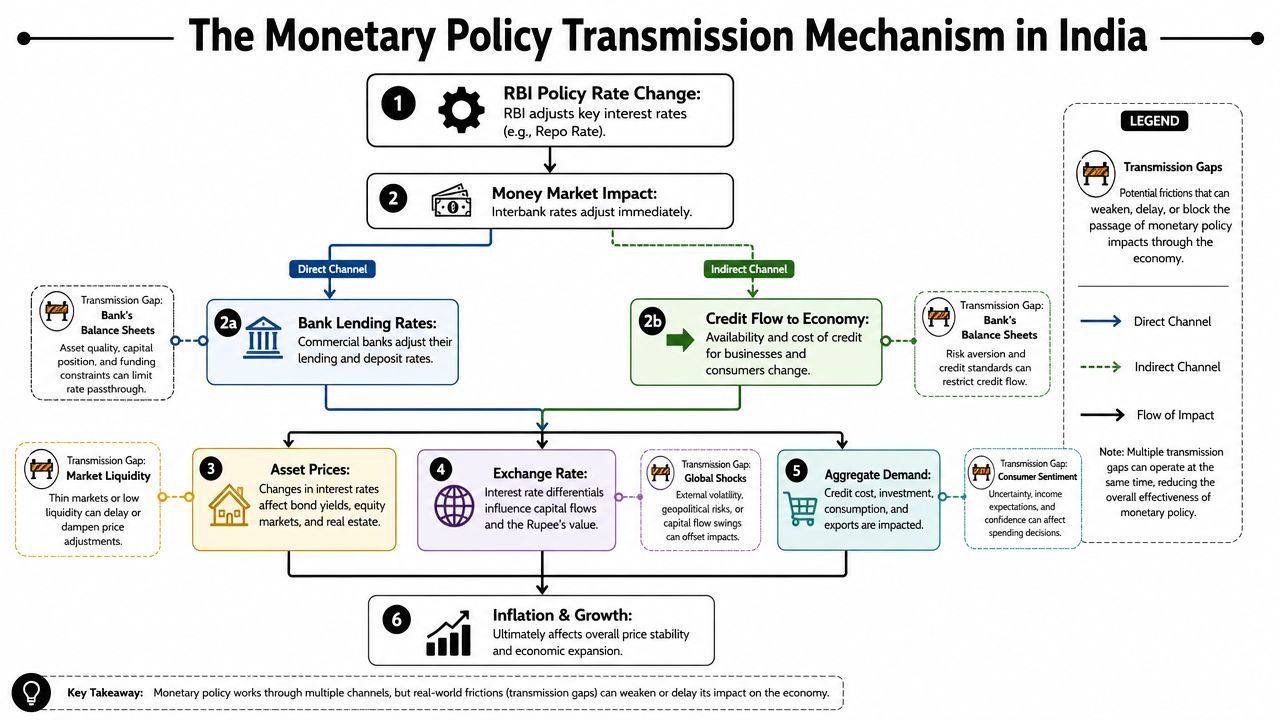
Policy transmission in India is best understood as a widening spread between benchmark rates and the rates many borrowers face. The repo rate can move quickly. The cost of credit for households and small firms often does not.
Where transmission works
Transmission is strongest where pricing is transparent, refinancing is feasible, and balance sheets are visible to lenders. Money markets reprice first because banks, mutual funds, and other liquidity-sensitive institutions respond immediately to changes in funding costs. Government securities and top-tier corporate debt usually adjust soon after, although term premia and fiscal supply can dilute the signal.
Banks then pass changes through unevenly. Institutions with a larger share of market-linked liabilities or stronger competition in their loan books tend to reprice faster than banks funded primarily through stickier deposits. For large corporates, highly rated issuers, and prime urban households, this matters. They sit closest to formal transmission channels and are more likely to benefit from lower borrowing costs, better refinancing terms, or both.
That is why headline commentary can overstate the reach of monetary easing. The borrowers most visible in aggregate banking and bond data are also the borrowers most likely to receive the policy impulse.
Where transmission thins out
The transmission problem becomes more serious as lending shifts from formal, collateral-backed credit toward small-ticket, high-touch, information-intensive finance. As noted earlier, a large credit-underserved population remains far from the rates implied by RBI easing. The issue is not only exclusion from bank balance sheets. It is also the persistence of high origination, servicing, and collection costs in segments where lenders operate with thin information and limited scale.
This weak pass-through is structural. Lower policy rates can reduce banks' marginal funding costs without materially changing the final price paid by borrowers whose loans are expensive to administer, difficult to underwrite, or too small to serve profitably through conventional channels. In that setting, the repo rate influences the core of the financial system more than its periphery.
The result is a segmented credit market. One tier reprices off policy and market benchmarks. Another tier reprices off operating costs, risk assumptions, and local market power.
That distinction has macroeconomic consequences.
Why the gap persists
Three frictions explain much of the shortfall in pass-through.
- Liability structure limits speed. Banks cannot cut lending rates aggressively if their funding base reprices slowly or remains locked into higher deposit costs.
- Credit intermediation costs remain high. Small loans require screening, monitoring, and recovery processes that absorb a large share of the interest margin.
- Market access is uneven. Borrowers outside formal documentation systems or established credit histories cannot easily switch lenders when policy rates fall.
These constraints point to a broader institutional issue, not just a monetary one. The quality of transmission depends partly on how far India advances in payment rails, credit data, collateral frameworks, and capital markets development in emerging financial systems. Without that infrastructure, rate cuts improve liquidity conditions more reliably than they improve borrowing conditions for underserved households and enterprises.
Why this matters for public policy
For macroeconomic management, the implication is straightforward. The effective stimulus from easing is smaller than the headline policy move suggests when a large share of borrowers remains outside efficient transmission channels. Consumption responds less, informal firms invest less, and household balance-sheet relief arrives with delay or not at all.
This also changes how international stakeholders should read India's monetary stance. A policy cut can support sovereign financing conditions, formal credit creation, and market sentiment while leaving a substantial part of domestic demand constrained by high end-user borrowing costs. Analysts who focus only on the policy rate, or even on bank lending averages, risk overstating the reach of accommodation.
Several policy conclusions follow:
- Monetary easing and financial inclusion are complements, not substitutes. One lowers the benchmark price of money. The other determines who can access it.
- Transmission analysis should be distribution-sensitive. Pass-through to listed firms and mortgage borrowers does not capture pass-through to rural households, microenterprises, or informal workers.
- Credit architecture matters for macro efficiency. Better data, enforcement, and lender competition can raise the growth impact of a given rate cut without changing the policy rate itself.
For G20 finance ministers, this is the blind spot that deserves more attention. India's monetary policy should be assessed not only by the direction of the repo rate, but by the distance between that rate and the borrowing conditions faced by the credit-underserved.
Macroeconomic and Sectoral Impacts
Interest-rate changes always create a map of uneven effects. Some actors receive relief quickly, some with delay, and some almost not at all. In India, those differences are amplified by the coexistence of deep formal markets and persistent credit exclusion.

The macro effects are uneven by design
At the macro level, lower policy rates aim to support consumption, encourage business borrowing and soften debt-service pressure. But the strength of those effects depends on who holds debt, who can refinance and who remains outside the transmission chain.
Formal firms with bank access can benefit through reduced working-capital costs and improved confidence about future financing. Households with floating-rate loans may see repayment burdens ease over time. Sovereign borrowing conditions can also improve at the margin when policy signals reinforce credibility and liquidity conditions.
Yet those channels don't move the economy uniformly. Small enterprises dependent on non-bank or informal borrowing may experience little direct relief. Households facing high food, transport or healthcare costs may remain cautious even when benchmark rates fall. The result is a familiar asymmetry: policy can improve financial conditions before it improves broad-based demand.
Sectoral winners, laggards and policy friction
The banking sector sits closest to the decision point. Rate shifts alter funding costs, deposit competition and lending incentives. For banks with strong transmission capacity, a lower policy rate can support credit growth, though margin dynamics depend on repricing speed on both sides of the balance sheet.
Real estate is usually one of the first sectors analysts watch because mortgage pricing transmits visible changes to monthly repayment expectations. But property markets also depend on land regulation, household confidence and developer balance sheets. A rate cut helps, though it doesn't resolve structural supply constraints.
The automotive sector is similarly rate-sensitive because consumer financing shapes purchase decisions. Here again, the impact is strongest where formal retail credit is already well developed.
For small businesses and informal retail, the picture is more mixed. If borrowing still occurs through expensive channels, changes in the repo rate may influence sentiment more than actual financing cost. That is where the transmission gap returns as a macroeconomic issue, not merely a social one.
A useful way to organise the sectoral picture is this:
- Fast transmission sectors include commercial banking, listed debt and top-tier corporate finance.
- Medium transmission sectors include housing and consumer durables financed through formal lenders.
- Weak transmission sectors include micro-enterprises and households dependent on high-cost non-bank credit.
Readers assessing broader market architecture may want to connect this monetary story to the larger question of capital markets development in emerging economies. India's sectoral outcomes increasingly depend on whether firms can diversify beyond bank finance and whether households can move into lower-cost formal credit channels.
A lower policy rate can improve the economy's average financing conditions while leaving its most vulnerable borrowers almost untouched.
That's why aggregate easing can coexist with persistent stress in local markets. The average improves. The margin remains expensive.
Policy Implications for Global Stakeholders
For global stakeholders, the policy debate should move beyond whether the RBI is dovish or hawkish. The sharper question is whether India can align monetary flexibility with deeper transmission and broader financial inclusion. That is the variable that will shape the quality, not just the appearance, of macro stability.
What G20 counterparts should watch
Three indicators deserve close attention in future RBI cycles.
First, watch the relationship between the policy rate and longer-dated yields. If long-term financing costs remain firm while the policy rate stays moderate, that suggests markets still require compensation for inflation uncertainty, fiscal duration or term risk.
Second, watch the gap between formal lending conditions and marginal borrower realities. A central bank can deliver clean signalling while weaker borrowers remain trapped in expensive credit channels. For external partners, that means top-down easing shouldn't be mistaken for broad-based monetary relief.
Third, watch the institutional side of transmission. Progress in digital finance, underwriting quality, competitive local credit delivery and borrower protection will often matter more for inclusion than another incremental rate adjustment.
A more strategic reading of the interest rate in India
The strategic conclusion is that India's monetary policy has entered a phase where distributional effectiveness is becoming as important as directional accuracy. Setting the right rate is necessary. It isn't sufficient.
For finance ministers and multilateral institutions, that has several implications:
- Treat monetary policy and financial inclusion as linked agendas. They are often discussed separately, but in India they determine one another's effectiveness.
- Avoid overreading the repo rate as a complete measure of credit conditions. The operative cost of money differs sharply across segments.
- Support reforms that improve pass-through. Better transmission raises the return on prudent monetary policy.
- Read India as a systems case for emerging markets. The same pattern appears elsewhere: strong central frameworks, uneven last-mile finance.
India's current stance is credible, but credibility at the centre must be matched by access at the edge. If that happens, policy easing can support demand without losing anchor. If it doesn't, the country will continue to display a split financial geography in which macro policy improves averages while leaving many borrowers outside the circle of relief.
The most important forward-looking conclusion is this. International partners should stop asking only where the RBI will set the next rate. They should also ask how many borrowers can borrow at anything close to it. That is the measure that will determine whether India's monetary policy translates into inclusive growth, stronger domestic demand and a more resilient contribution to G20 stability.
For deeper, policy-focused analysis on India's monetary strategy, G20 economic coordination and the wider architecture of global finance, explore Global Governance Media. The platform brings together decision-makers, researchers and practitioners who need concise, evidence-led perspectives on the choices shaping international economic governance.