


By Eleanor Whitmore
You may be reading this while preparing a summit note, reviewing a cross-border data-sharing proposal, or trying to understand why one ministry can't use information that another already holds. In those moments, data governance frameworks often appear as an administrative detail. They aren't.
When a supply chain disruption spreads across borders, when public health authorities need interoperable data under time pressure, or when governments face an AI-enabled disinformation campaign, the decisive question isn't only who has the data. It's who may use it, under what authority, with what safeguards, and for which public purpose. That is the terrain of governance.
For G7 and G20 delegates, this has become a strategic policy issue. It sits alongside trade, cyber security, industrial policy, and democratic resilience. The states that organise data well can coordinate faster, regulate more credibly, and negotiate internationally from a position of strength.
Table of Contents
- The New Frontier of Statecraft
- What Is a Data Governance Framework
- Mapping the Three Governance Models
- The Four Pillars of a National Framework
- Governance in Action Global Policy Case Studies
- Driving Accountability Beyond the Rulebook
- A Policymaker's Implementation Checklist
The New Frontier of Statecraft
A state can possess advanced digital infrastructure and still fail strategically if its institutions can't govern data coherently. In practice, that failure appears as delayed crisis response, contradictory reporting across agencies, legal hesitation over legitimate sharing, and weak assurance for allies considering cross-border cooperation.
That is why data governance frameworks should be treated as instruments of statecraft. They shape whether countries can support trusted digital trade, protect sensitive information, and coordinate action across ministries and borders. They also determine whether a government can convert data into public value without undermining rights or public trust.
The economic signal is already clear. The UK data governance market is projected to grow from USD 160.48 million to USD 651.68 million by 2035, with a 15.04% CAGR, driven by compliance pressures and the strategic need for structured frameworks, according to UK data governance market projections. That projection matters not only as a commercial indicator, but as evidence that governance capacity is becoming part of national competitiveness.
Why this has moved beyond compliance
A narrow compliance lens misses the wider strategic function of governance. Policymakers need frameworks because they do three things at once:
- They reduce friction inside government: Agencies can share and use data with clearer authority and fewer avoidable disputes.
- They support trusted international exchange: Partners are more willing to cooperate when roles, controls, and accountability are explicit.
- They strengthen resilience: Crisis management depends on reliable access, classification, and decision rights.
Practical rule: If a state can't explain who is accountable for a dataset, it probably can't use that dataset effectively in a crisis.
There's also a diplomatic dimension. Governments increasingly negotiate standards, adequacy, interoperability, and secure flows as part of broader economic and security relationships. A country without mature governance enters those negotiations defensively. A country with mature governance can shape them.
For readers tracking the policy consequences of emerging technologies, technology and public-interest governance debates show why digital systems are now inseparable from wider questions of legitimacy and institutional trust.
What Is a Data Governance Framework
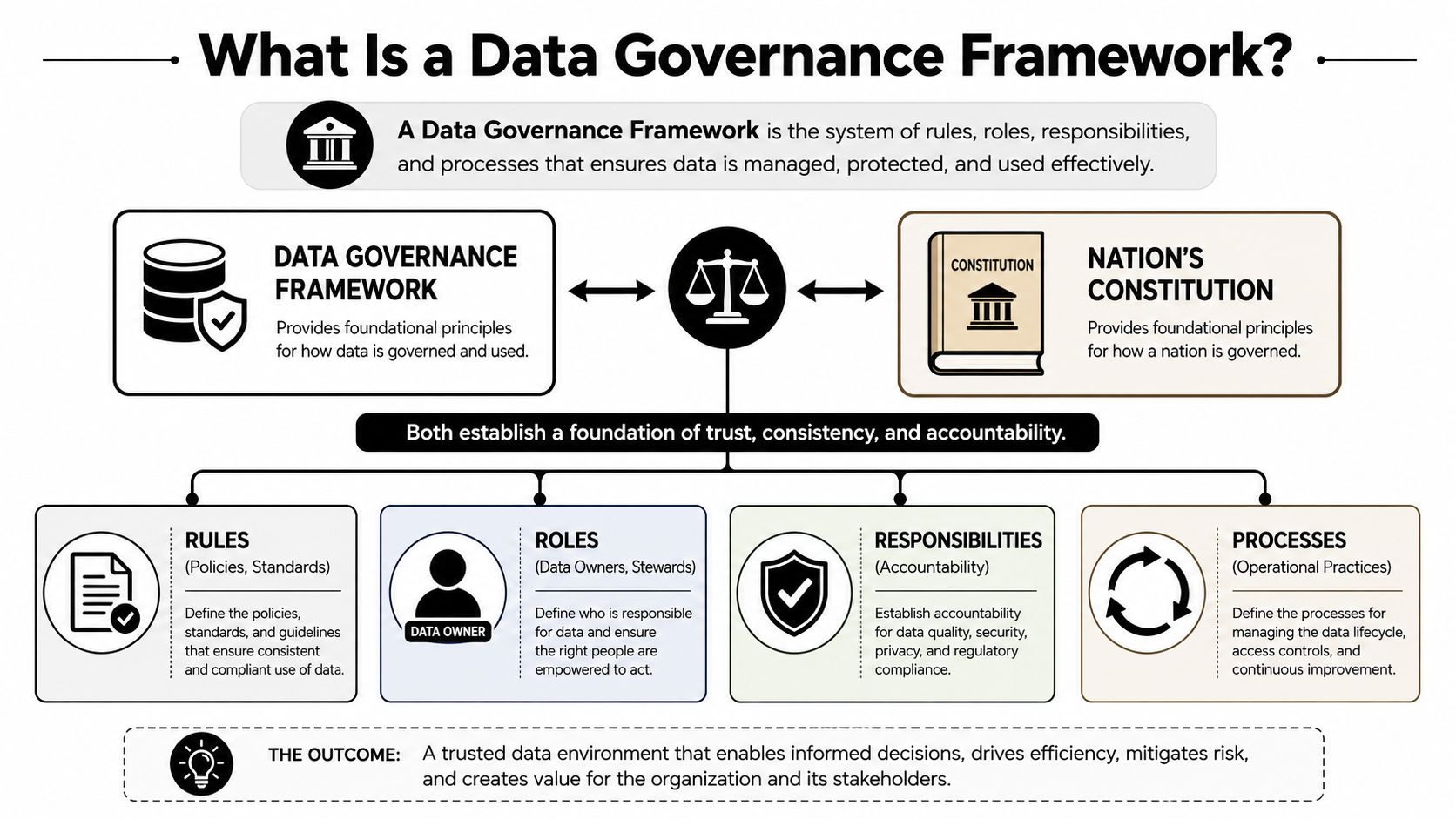
A data governance framework is best understood as the constitutional order for data. It sets the rules, assigns powers, defines responsibilities, and establishes the processes through which data is used, protected, and shared.
That comparison matters because constitutions don't manage every daily transaction. They establish the authority under which those transactions occur. Data governance works the same way. It determines what good stewardship looks like before any technical team builds a workflow or any agency launches a programme.
A constitution for data
A strong framework usually includes four foundational elements.
| Element | Policy meaning | Strategic value |
|---|---|---|
| Rules | Policies, standards, classifications | Creates consistency across institutions |
| Roles | Owners, stewards, custodians, committees | Makes accountability visible |
| Responsibilities | Duties tied to quality, access, protection | Prevents gaps and overlap |
| Processes | Lifecycle, approvals, access controls, review | Turns principle into repeatable action |
This structure is what allows governments to treat data as a strategic asset rather than a by-product of administration. In public health, fiscal planning, border management, and national security, the same principle holds. Data only becomes usable at scale when institutions agree on who governs it.
Readers who need a quick grounding in the object being governed may find it helpful to revisit a plain-language explanation of what a dataset is. Policy debates often become abstract because participants use the same term for raw records, analytical products, and shared registries.
Governance and management are not the same
Governance and management are often blended together, but they serve different purposes.
- Governance decides authority: Who may approve access, set standards, and arbitrate conflicts.
- Management executes operations: How data is stored, catalogued, cleaned, moved, and monitored.
- Governance defines acceptable use: It answers the question of legitimacy before the question of efficiency.
- Management delivers implementation: It answers the question of execution once authority is clear.
That distinction has become more important with AI, synthetic media, and platform risk. Many institutions have tools, but not enough agreed rules for how those tools should be used. In adjacent fields such as platform integrity, a useful reference point is this modern trust and safety guide, which helps explain why governance must cover human harms and institutional accountability, not only technical controls.
Governance sets the public terms of use. Management carries them out.
For G7 and G20 policymakers, this is the central insight. A data governance framework isn't an IT manual. It's a policy regime for the lawful, secure, and purposeful use of national information assets.
Mapping the Three Governance Models
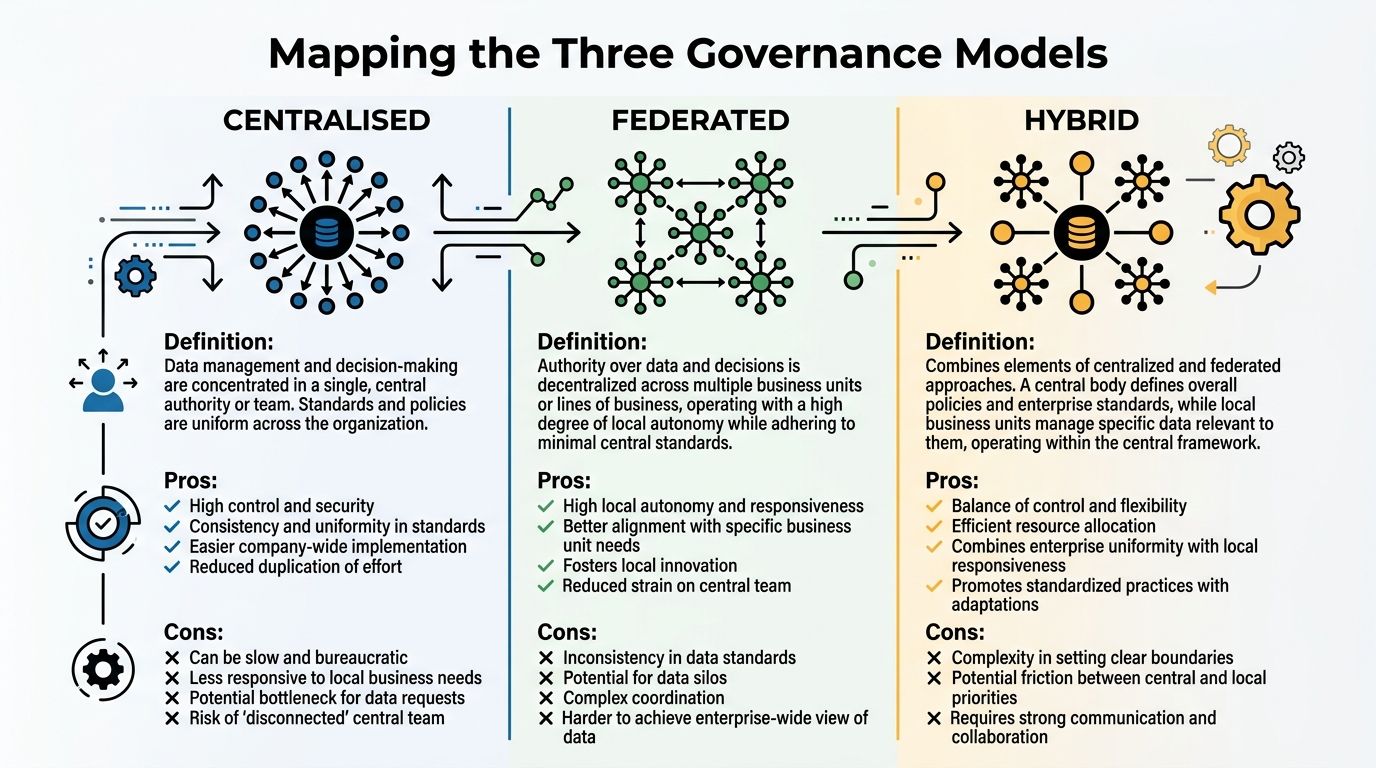
Institutional design choices in data governance frameworks resemble constitutional choices in government. Some systems centralise authority. Others distribute it. Most durable arrangements combine both.
The practical question isn't which model is universally best. It's which model best fits a country's administrative culture, risk profile, and strategic objectives.
Centralised
A centralised model resembles a unitary state. One authority sets standards, approves decisions, and often retains strong control over access and quality rules across departments.
This model works best where sensitivity is high and tolerance for divergence is low. Defence, intelligence, and certain revenue functions often favour it because uniformity matters more than local discretion.
Its weakness is political as much as technical. Ministries and agencies may comply formally while bypassing the centre in practice if governance is too slow or detached from operational realities.
Federated
A federated model resembles a federal system. Ministries, agencies, or domains retain significant local authority, but operate within shared principles and common standards.
That structure is often better suited to complex public sectors, especially where health, local government, science, and sector regulators need room to adapt governance to context. The strongest evidence in the material available points in this direction. The techUK Six Principles for Future UK Data Governance show that UK organisations adopting federated governance playbooks achieved 41% faster data monetization and 27% higher data quality scores compared to centralized models, according to analysis of UK federated governance performance.
For policymakers, the strategic implication is larger than operational performance. Federated systems can support innovation while preserving national standards. That matters in countries trying to combine economic dynamism with credible safeguards.
Hybrid
A hybrid model blends central authority with distributed execution. Core rules, classifications, and assurance mechanisms sit at the centre. Operational stewardship and domain-specific decisions sit closer to the ministries or agencies that know the data best.
This is often the most realistic design for modern states. It acknowledges that central government needs visibility and coherence, but also that no single office can govern every dataset effectively from the top.
The most durable governance model is often the one that accepts political reality rather than chasing administrative perfection.
Choosing among them
The decision can be framed through three policy tests:
- Security test: If a breach or misuse would have serious national consequences, stronger central control is usually justified.
- Innovation test: If ministries need to experiment or respond to local conditions, federated authority may deliver better results.
- Coordination test: If the state struggles with fragmentation, a hybrid arrangement can create common rules without paralysing delivery.
What this means for G7 and G20 cooperation is straightforward. Countries don't need identical internal models. They do need governance systems that make cross-border trust possible. Partners can work with different structures, but not with unclear accountability.
The Four Pillars of a National Framework
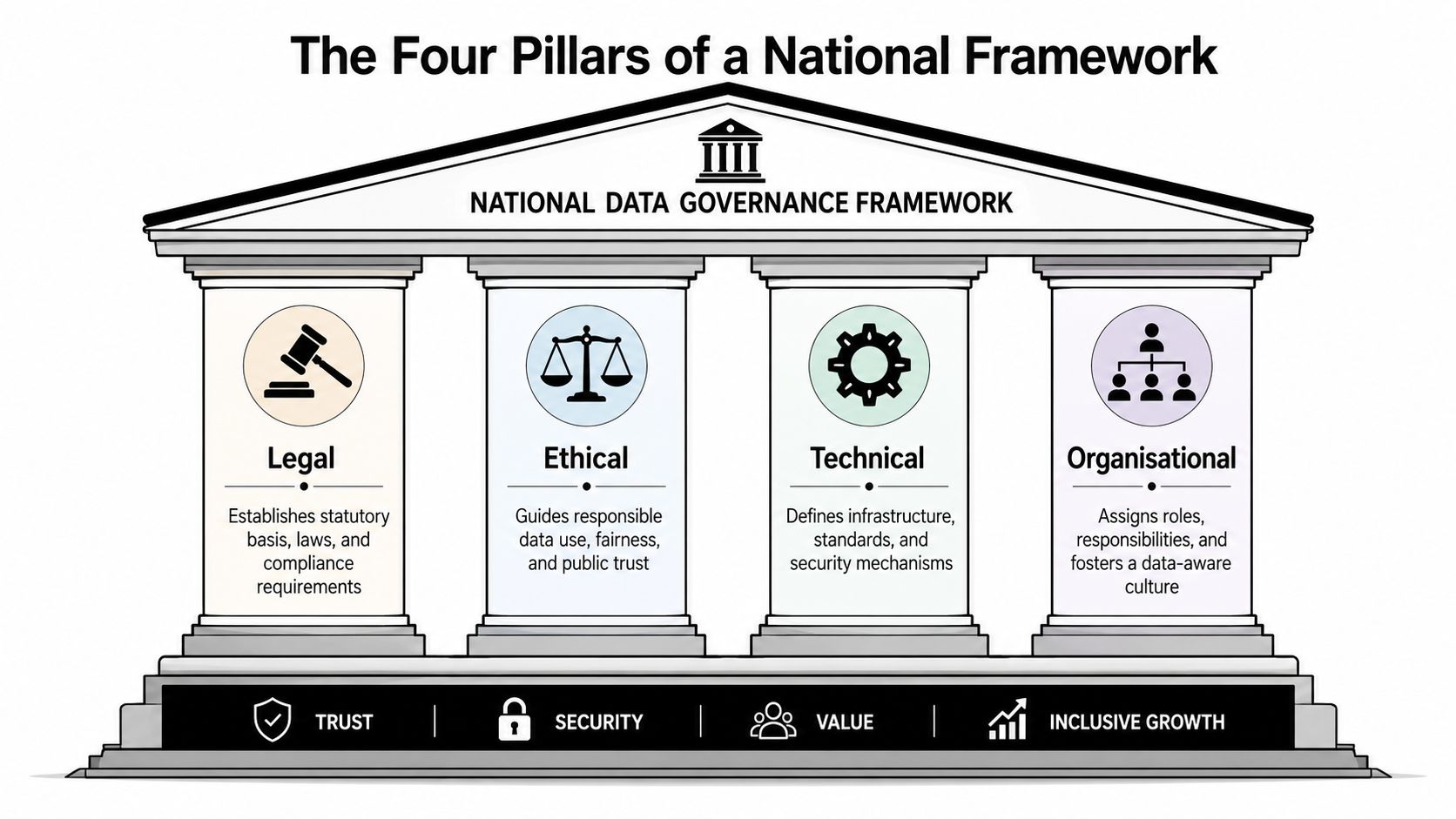
National data governance frameworks only endure when they rest on more than legal compliance. A credible system combines law, institutions, infrastructure, and ethics. If any one pillar is weak, the others absorb the strain.
Legal authority
The legal pillar gives the framework its public legitimacy. It defines the statutory basis for collection, use, retention, access, and sharing. It also establishes the conditions under which public bodies can cooperate without drifting into either unlawful disclosure or excessive caution.
The UK offers a strategically important principle here. Under the UK Data Sharing Governance Framework, organisations must implement a flexible data risk assessment model that avoids overestimating risk while explicitly recognising the societal impact of failing to share data, and it seeks to streamline access by repealing obsolete legal gateways, as set out in the UK Data Sharing Governance Framework.
That point deserves attention in international policy. Many governments know how to regulate against misuse. Fewer know how to govern against the public harm caused by unnecessary non-sharing. Mature governance has to do both.
Organisational accountability
Laws don't govern data on their own. People do. The organisational pillar assigns authority to named roles and bodies so that accountability survives beyond policy documents.
In practice, this means clear mandates for leadership, stewardship, and adjudication. It means committees that can resolve cross-departmental disputes. It means operating rhythms that keep governance alive after launch.
Typical elements include:
- Senior oversight: Cabinet-level sponsorship or an equivalent mandate that gives the framework political force.
- Named stewardship roles: Data owners, stewards, and custodians with explicit duties.
- Decision forums: Committees that bring together legal, policy, operational, and security functions.
- Review mechanisms: Regular audit, revision, and escalation routes.
Technical architecture
The technical pillar gives effect to policy intent. It covers interoperability, access control, classification, metadata, auditability, and security mechanisms. For policymakers, the strategic issue isn't software selection. It's whether the technical estate can support the rules the state has chosen to adopt.
A framework that promises controlled sharing but lacks interoperable standards won't deliver. A framework that mandates accountability but lacks traceability won't sustain confidence.
A governance rule that cannot be operationalised becomes an exception process, and exception processes eventually become the real system.
Ethical legitimacy
The ethical pillar is what keeps governance aligned with democratic purpose. It addresses fairness, public trust, proportionality, and the responsible use of data in high-impact settings such as welfare, policing, health, and AI deployment.
This pillar matters internationally because states increasingly judge one another not only by legal formality, but by whether governance regimes produce outcomes that citizens and partners can regard as legitimate. Ethical weakness travels quickly across borders. It can affect trade talks, regulatory cooperation, and trust in shared innovation initiatives.
Taken together, these four pillars reveal a broader truth. National governance isn't merely about securing data. It's about structuring power over information in a way that remains effective, lawful, and acceptable under domestic and international scrutiny.
Governance in Action Global Policy Case Studies
The most useful way to judge data governance frameworks is to watch where they appear in real policy arenas. They are now embedded in regional regulation, national administrative reform, and multilateral discussions on trusted cross-border flows.
Regional rules and national systems
The European approach has shown how governance can be embedded in a wider regulatory order. In that model, data protection, market rules, and digital sovereignty questions are treated as connected. The result is a governance environment in which legal certainty is part of geopolitical positioning.
National systems then adapt those principles to domestic institutions. The UK's Data Sharing Governance Framework is a key national standard, mirroring structures used in the Ministry of Defence and the NHS, with clear roles such as data stewards and custodians aligned to Cabinet Office sensitivity procedures, as outlined in the UK data-sharing governance guidance.
That example matters beyond the UK. It shows how a national framework can translate broad principles into operational accountability in high-stakes sectors. Defence, health, and central government do not govern identical datasets, but they can operate within a common logic of stewardship and classification.
Why multilateral forums keep returning to data
The G7, G20, and other multilateral bodies return repeatedly to data because the issue sits at the intersection of economic openness, regulatory trust, and national security. Countries want cross-border flows for trade, research, supply chains, and innovation. They also want control, assurance, and democratic legitimacy.
That tension is why slogans alone don't settle the matter. Shared political language must be backed by national systems that can execute what leaders endorse. When governments discuss trusted data flows, AI cooperation, or digital public infrastructure, they are really discussing whether their governance frameworks are compatible enough to support practical collaboration.
A useful way to read current diplomacy is this: states are not only negotiating data access. They are negotiating confidence in one another's institutional competence.
Driving Accountability Beyond the Rulebook
Governments often assume that if the legal text is sound, the framework will work. That assumption doesn't survive contact with implementation.
The more common failure point is organisational. Legal teams, security teams, operational leads, and product or service owners often approach the same data issue with different definitions of risk, speed, and acceptable use. If they don't align early, governance stalls.
The operational failure point
The strongest evidence in the material available is stark. Survey data from UK public sector bodies shows that 68% of data governance failures in 2024–2025 stemmed from misaligned cross-functional teams who failed to agree on outcomes upfront, rather than legal gaps in policy, according to UK public sector findings on governance failure.
That changes the policy diagnosis. The question isn't only whether the rules are adequate. It's whether the state has designed a working operating model around those rules.
A useful way to think about this is to ask who convenes disagreement. If nobody has the authority to force clarity across legal, technical, and operational functions, every difficult case becomes a delay.
Why accountability has to be designed
Strong frameworks usually depend on visible institutional roles. A Chief Data Officer or equivalent senior official can anchor authority. Data stewards can translate policy into domain practice. Cross-functional committees can arbitrate difficult cases before they become crises.
The cultural side matters just as much. Teams need a shared language for risk, consent, classification, and public value. Where emerging modalities are involved, such as wearable or first-person data collection, consent and privacy questions become even more complex. That's why resources such as Truelabel on egocentric dataset consent are useful to policymakers who need to understand how governance challenges evolve as data forms change.
For public institutions trying to turn policy into consistent practice, practical examples of using data to improve compliance help show that accountability has to be operational, not merely declaratory.
Publish the framework by all means. Then decide who will settle disputes, train staff, review exceptions, and own outcomes. That's where governance either lives or fails.
A Policymaker's Implementation Checklist
Policymakers don't need another abstract endorsement of good governance. They need a sequence of moves that can survive bureaucracy, electoral cycles, and interdepartmental friction.
The following checklist is most useful when treated as a statecraft exercise rather than an IT programme.
A visual summary can help anchor that sequence for ministerial teams and senior officials.
Eight moves that create traction
Secure a cabinet-level mandate
Governance fails when it is treated as optional coordination. Senior political authority signals that ministries must participate.Assess the current state
Map where critical datasets sit, which legal gateways exist, and where responsibility is unclear.Define strategic goals
Decide whether the immediate purpose is secure sharing, economic use, AI assurance, public service reform, or crisis coordination.Choose the operating model
Select centralised, federated, or hybrid governance based on institutional reality, not management fashion.Assign named roles
Designate owners, stewards, custodians, and decision forums before launching reform.Pilot in high-value ministries
Start where governance can solve a visible problem. Health, customs, treasury, or social policy are common proving grounds.
A short explainer can also support internal workshops and leadership briefings.
Build capability, not only controls
Training, guidance, and review routines matter as much as policy text. Teams need to know how to exercise judgement.Monitor and revise
Governance frameworks should be reviewed as policy instruments. If legal gateways are obsolete, retire them. If operational bottlenecks persist, redesign them. For teams that want a structured visual reference when sequencing implementation and assurance work, this downloadable security roadmap is a useful companion for internal planning discussions.
The strategic lesson for G7 and G20 delegates is simple. Data governance frameworks are no longer supporting instruments. They are part of how states govern complexity, cooperate internationally, and defend legitimacy in the digital age.
For policymakers, analysts, and institutional leaders working across the G7 and G20 agenda, Global Governance Media offers timely analysis, summit-focused commentary, and practical insight on the policy choices shaping international cooperation. Follow its coverage to stay ahead of the governance questions that will define economic resilience, security, and public trust.