

By Eleanor Hart, Senior Policy Analyst
At the end of 2024, UK solar photovoltaic capacity reached 17.0 GW and generation reached 14.4 TWh, according to the referenced market material drawing on official UK statistics in the SEIA Solar Market Insight Q2 2025 material. For G20 delegates, that figure does more than describe one national market. It signals that solar has moved beyond demonstration status in advanced economies and into the realm of system planning, industrial strategy, and geopolitical bargaining.
That shift changes how policymakers should view the Solar Energy Industries Association (SEIA). It isn't just a domestic trade body speaking for one industry segment. It operates as a non-state actor in energy governance, shaping the language of market maturity, the standards used to judge project quality, and the policy framing that ministers, regulators, lenders, and multilateral institutions increasingly inherit. In practical terms, understanding SEIA means understanding how commercial coalitions influence the global rules of decarbonisation.
Table of Contents
- The Solar Industry's Primary Voice in Global Policy
- Understanding SEIA's Structure and Mission
- Core Policy Positions and Advocacy Priorities
- Gauging SEIA's Influence on Market Growth and Policy
- Tensions Criticisms and Geopolitical Realities
- Engagement Pathways for Policymakers
- Policy Takeaways for the Global Energy Transition
The Solar Industry's Primary Voice in Global Policy
The strongest way to understand SEIA is to stop treating it as a narrow lobby group. In global energy diplomacy, trade associations often function as translation mechanisms between markets and states. They convert technical bottlenecks into policy demands, commercial risks into legislative priorities, and deployment experience into narratives that can travel across borders.
That gives SEIA relevance well beyond Washington. When solar becomes a material part of the power mix in advanced economies, every debate changes. Grid design changes. Procurement rules change. Finance ministries ask different questions. Trade ministries become more sensitive to supply-chain exposure. Development banks reassess what counts as bankable infrastructure.
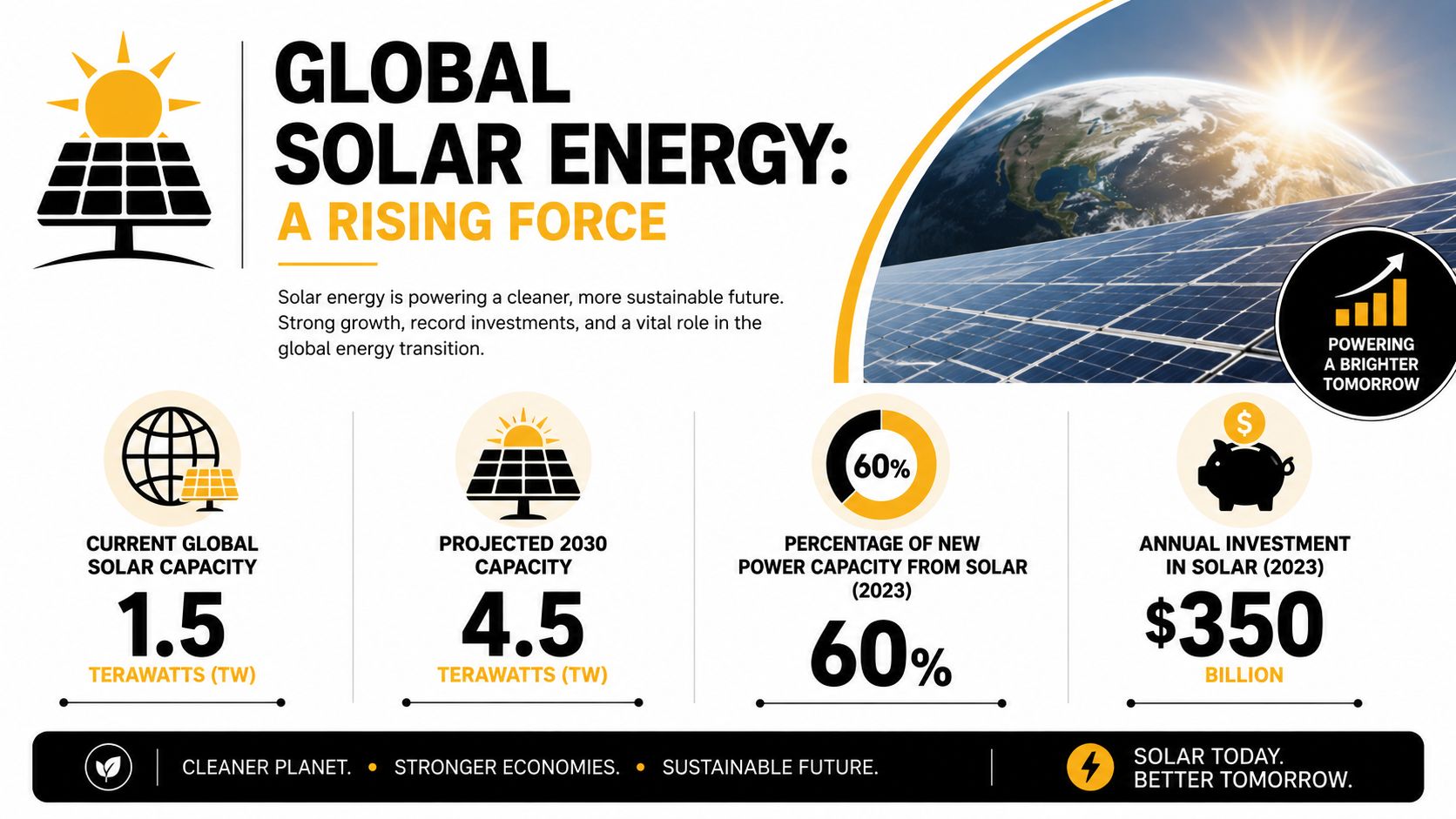
Why SEIA matters to G7 and G20 delegates
SEIA's significance lies in three forms of influence.
- Agenda influence: It helps define which barriers are seen as urgent, especially where deployment is slowed by permitting, interconnection, system standards, and investment risk.
- Market signalling: Its positions can shape how investors, utilities, and equipment suppliers interpret policy durability.
- Norm diffusion: Ideas first advanced within one major solar market can migrate into wider G7 and G20 discussions on resilience, industrial policy, and clean energy security.
A delegate reading SEIA only as a US-sector voice will miss the wider point. Industry bodies become powerful when their framing is portable. SEIA's framing often is.
Strategic implication: The most influential trade associations don't merely ask for supportive policy. They help define what “practical” policy means.
For multilateral officials, that matters because solar governance is no longer only about technology cost. It is about institutional capacity, infrastructure timing, and whether regulatory design can keep up with deployment.
Policymakers following broader summit debates on energy coordination should also consider how solar trade bodies fit into the wider architecture of advanced economy cooperation, particularly in G7 and G20 energy governance discussions.
A non-state actor with state-level consequences
SEIA's practical importance comes from where its advocacy lands. It sits at the intersection of:
| Domain | Why it matters for governments |
|---|---|
| Industrial policy | Solar deployment increasingly overlaps with manufacturing strategy and trade competitiveness |
| Energy security | Import dependence, component standards, and grid readiness affect resilience |
| Climate delivery | Solar is central to national decarbonisation pathways |
| Financial governance | Bankability standards influence project pipelines and capital allocation |
The key analytical point is simple. SEIA helps shape the operating environment in which public climate commitments are either delivered or delayed. That makes it relevant to any government trying to convert net zero ambition into functioning infrastructure.
Understanding SEIA's Structure and Mission
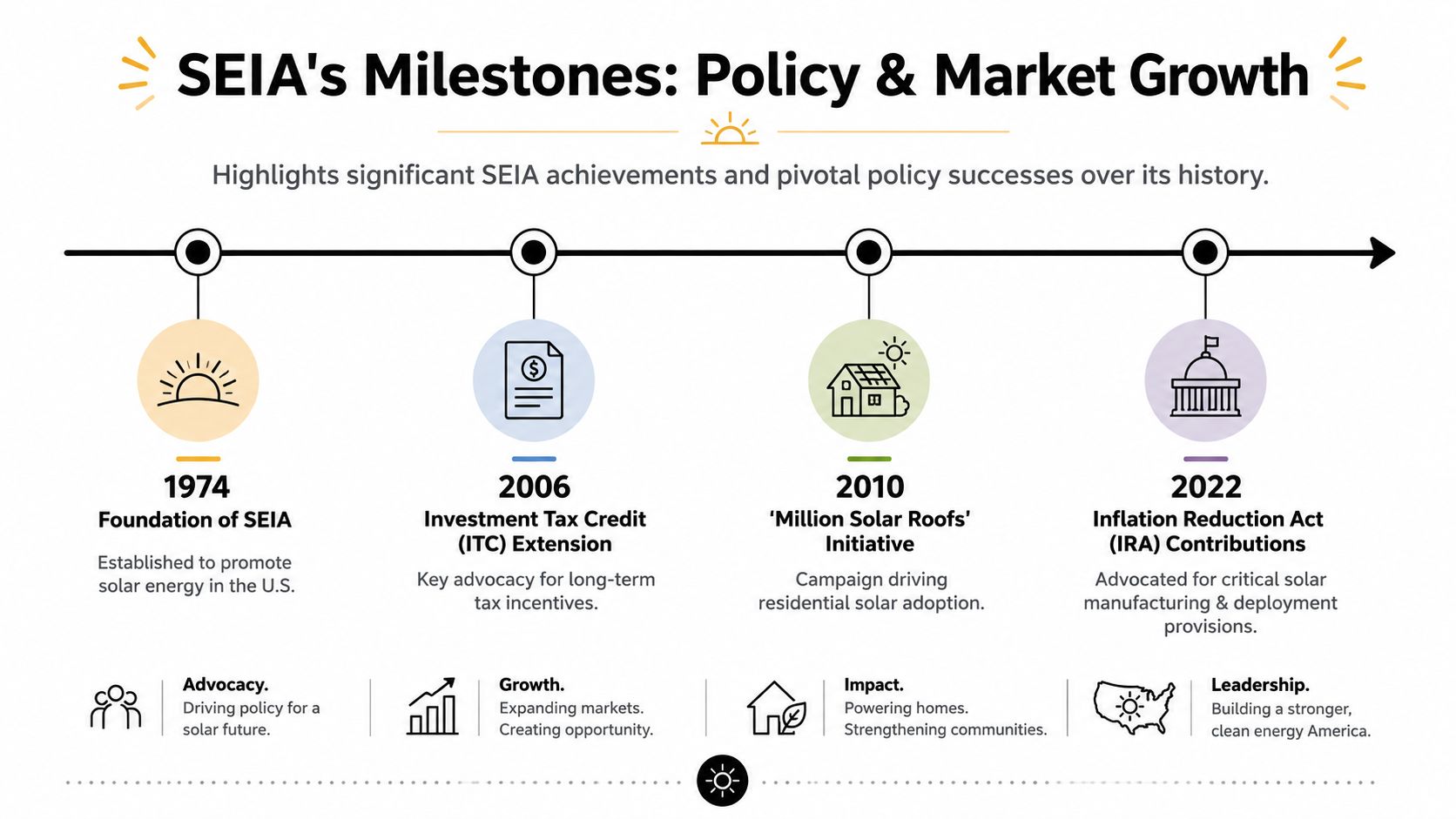
Founded in 1974, SEIA has outlasted several distinct phases of solar politics in the United States, from subsidy-led market formation to trade disputes, grid-integration debates, and the current push for industrial strategy. That institutional continuity matters because organizations that persist across policy cycles accumulate procedural knowledge, regulator relationships, and credibility with capital markets. In practice, SEIA brings more than sector advocacy. It carries historical memory about which policy designs scale deployment and which ones stall in implementation.
That helps explain why its relevance extends beyond Washington. International officials should read SEIA as a non-state actor that translates domestic industry priorities into policy signals watched by investors, manufacturers, standards bodies, and governments well outside the United States. For G7 and G20 members assessing clean-energy delivery risk, that gives SEIA a wider role in global energy governance than the label "US trade association" suggests.
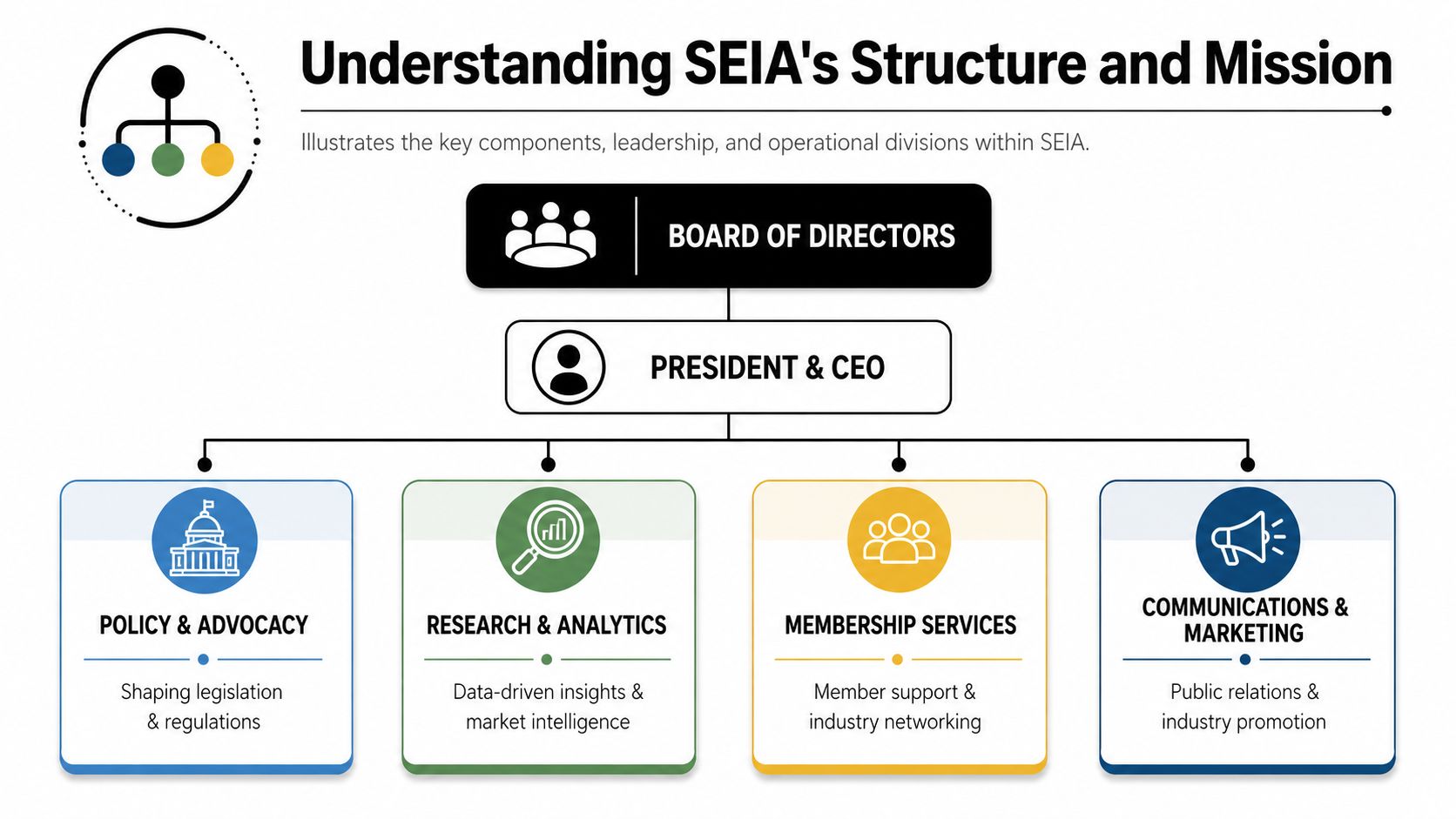
How to read a trade association structurally
SEIA is best understood as a coalition mechanism. It aggregates the preferences of manufacturers, utility-scale developers, residential installers, storage companies, financiers, and service firms that share an interest in solar expansion but often diverge on tariffs, domestic-content rules, procurement design, and which part of the value chain should receive policy protection.
For policymakers, four organizational functions are especially important:
Representation
SEIA converts a fragmented industry into a smaller set of public demands that officials can negotiate with.Coordination
It gives competing firms a forum to align around common positions before engaging regulators, legislatures, and executive agencies.Legitimation
It frames commercial preferences in public-interest terms, often through standards work, market analysis, and system-reliability arguments.Interface management
It serves as a repeat interlocutor for government, media, and foreign observers seeking a single point of contact for a complex sector.
This structure creates influence, but it also shapes the limits of that influence. A coalition can speak forcefully only where internal interests can be reconciled. Where they cannot, silence, ambiguity, or selective emphasis often reveal as much as formal policy statements.
Mission as market governance
SEIA's mission is broader than increasing solar installations. Its policy role is to narrow the gap between political ambition and projects that can be financed, permitted, interconnected, insured, and operated at scale.
That is a governance function as much as an industry function. Fast deployment alone does not produce a stable energy transition if grid rules lag, contractor quality varies widely, or compliance systems become too weak to maintain investor confidence. Associations with staying power therefore concentrate on the operating conditions around market growth, including standards, permitting, workforce practice, and transaction certainty.
For G20 delegates, the strategic implication is clear. Engagement with SEIA is not merely consultation with a commercial lobby. It is engagement with an actor that helps define what counts as executable clean-energy policy in one of the world's most important power markets.
What this means for international policymakers
Governments dealing with SEIA should approach it with three working assumptions.
- Its public positions are negotiated coalition outputs, not neutral technical judgments.
- Its most persuasive interventions usually sit where investor certainty and public policy objectives overlap.
- Its weakest areas are likely to involve distributional questions, trade-offs across regions or income groups, and governance issues that market expansion does not solve on its own.
That combination makes SEIA unusually relevant in cross-border policy discussions. It does not just advocate for firms. It helps shape the institutional terms under which solar is incorporated into national power systems, industrial strategies, and climate-delivery plans.
Core Policy Positions and Advocacy Priorities
SEIA's policy agenda is best understood through the barriers it treats as decisive. Its most consequential advocacy doesn't focus on symbolism. It focuses on the rules that determine whether projects can move from planning to operation without losing bankability, regulatory certainty, or technical credibility.
One verified example illustrates the pattern clearly. For larger projects, grid-connection and system-design constraints matter more than simple module supply. SEIA-linked technical material states that projects above 250 kW typically require more rigorous design, installation, quality-control, and inspection processes, and that procurement should be specified at the system level, including inverter topology, battery interoperability, and commissioning criteria, as outlined in the SEIA 251 draft standard.
The real policy signal in SEIA's advocacy
It reveals how the association frames deployment risk. It is not saying that more panels alone solve the problem. It is saying that modern solar policy must account for the full architecture of the project.
That has three immediate implications for governments:
- Procurement policy must mature: Officials can't evaluate projects by panel wattage alone if inverters, storage design, and commissioning quality determine performance.
- Grid policy becomes solar policy: Interconnection delays and system integration constraints move from the edge of the debate to the centre.
- Standards shape finance: Lenders and insurers care whether the project has been designed and commissioned as a functioning system.
SEIA's core policy pillars
| Policy Pillar | Objective | Key Advocacy Actions |
|---|---|---|
| Grid integration | Reduce deployment friction | Push for faster interconnection processes, stronger system design rules, and planning that treats solar as grid infrastructure rather than an add-on |
| Technical standards | Improve bankability and performance | Promote system-level procurement criteria covering inverters, storage compatibility, commissioning, and inspection |
| Market certainty | Lower investment risk | Support stable policy frameworks that allow developers, manufacturers, and financiers to plan across multiple years |
| Supply-chain operability | Keep projects moving | Press for policy settings that reduce avoidable disruption in component availability and project delivery |
| Sector credibility | Protect long-term expansion | Encourage quality control and contractor qualification so rapid growth doesn't undermine trust in delivered assets |
Why this agenda travels internationally
What makes SEIA strategically important is that these priorities are portable. Any government scaling solar eventually encounters the same questions. How should storage be integrated? Which standards matter most for inspection? When should regulators tighten quality requirements? How should procurement evolve as projects get larger and more complex?
Those questions are not uniquely American. They are common to advanced and emerging markets alike.
Policy test: If an industry demand improves both deployment speed and asset quality, governments should examine it closely. If it improves one while weakening the other, caution is warranted.
The broader lesson is that SEIA often intervenes where public institutions are under pressure to catch up with market growth. That gives the association an advantage. It can offer practical knowledge that governments need. But it can also shape regulatory design in ways that favour larger, better-capitalised actors who can manage more complex compliance regimes.
For G20 delegates, the strategic reading is this: SEIA's agenda is less about abstract support for renewable energy than about controlling the conditions under which solar becomes a reliable investment class. That is why its technical positions often matter as much as its political ones.
Gauging SEIA's Influence on Market Growth and Policy
Influence is easiest to misread when observers focus only on formal lobbying. SEIA's deeper impact lies in how it helps convert solar from a policy aspiration into a mainstream category of infrastructure. Trade associations become influential when policymakers, investors, and regulators begin using their framing as the default language of sector development.
A useful benchmark comes from outside the United States. In the UK, solar PV accounted for around 4.8% of electricity generation in 2024, up from 4.3% in 2023, according to the referenced SEIA Solar Market Insight Q3 2025 material. That change matters because it shows how quickly solar can move from niche status to a visible share of a national power system. Once that transition happens, industry associations gain standing because governments can no longer treat the sector as marginal.
Influence works through policy framing
SEIA's influence can be assessed through three channels.
First, it helps frame policy bottlenecks. If interconnection, standards, or commissioning quality become accepted as core constraints, then ministries and regulators will organise around those problems.
Second, it helps define what maturity looks like. A market is no longer judged only by installed capacity. It is judged by whether projects can integrate storage, connect efficiently, and satisfy lender expectations.
Third, it helps discipline the discourse. Once a trade body's categories become common reference points, other actors must either work within them or explicitly challenge them.
What G20 policymakers should infer
The strategic implication isn't that SEIA controls policy outcomes. It's that it often shapes the terms of decision-making before formal decisions are made. That is a quieter form of power, but in infrastructure policy it is often the more durable one.
Consider the practical crossover into adjacent policy domains. Large solar assets raise questions about site safety, system integrity, and emergency response capacity. Officials looking at those operational dimensions may find it useful to explore our fire safety resources, especially where battery integration and asset protection planning intersect with broader project governance.
A trade association becomes powerful when governments begin asking the questions it has already prepared answers for.
Why this matters internationally
For G7 and G20 governments, SEIA's significance lies in replication. Once one major association has successfully framed solar as an issue of standards, interconnection, and industrial competitiveness, similar arguments often surface across allied and partner markets.
That creates both opportunity and risk.
- Opportunity: Policymakers can learn quickly from mature-market experience.
- Risk: Governments may import industry-preferred solutions without sufficient adjustment for local grid conditions, social equity concerns, or institutional capacity.
The most important conclusion is that SEIA's influence should be measured less by visibility and more by policy uptake. If its categories of analysis become embedded in official planning, regulatory design, and market expectations, then its role in global solar governance is already substantial.
Tensions Criticisms and Geopolitical Realities
Trade associations matter most when their strengths and limitations are analysed together. SEIA is effective because it translates industry needs into credible policy language. It is contested because that translation can leave out constituencies, risks, and distributive questions that matter to governments.
Equity claims meet delivery constraints
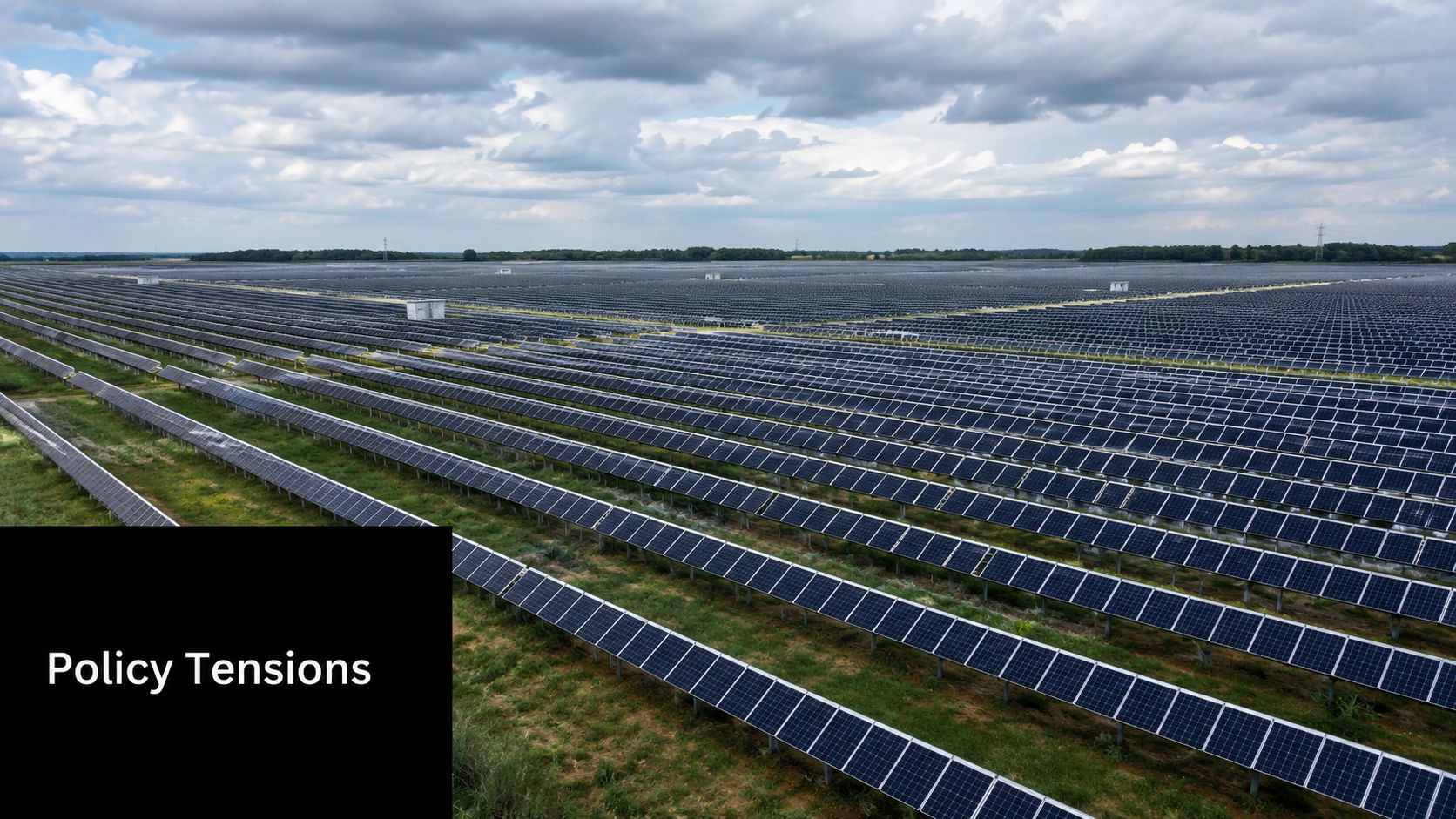
One of the clearest criticisms concerns access. Verified background on the UK-relevant equity question notes that solar benefits are often constrained by split incentives between landlords and tenants, landlord-tenant barriers, and grid connection delays, raising a more difficult question than whether solar works. It asks which households can realistically capture the savings, as discussed in the US Department of Energy primer cited in the brief.
This is a significant policy challenge because industry rhetoric often assumes that deployment growth naturally broadens access. In practice, that doesn't always follow. Owner-occupiers with suitable property can move faster than renters. Households in harder-to-treat homes face different constraints from those in newer housing stock. Areas with weaker grid readiness face a slower route to benefit.
Representation is never neutral
SEIA also faces a structural challenge common to broad trade associations. The larger and more commercially diverse the coalition, the more likely it is that internal power skews toward actors with greater capital, regulatory capacity, and influence over supply chains.
That can create a mismatch between public messaging and market reality.
- Large project developers often benefit from system-wide regulatory reform and clearer bankability standards.
- Smaller firms may support those same reforms but struggle with the compliance burden they create.
- Public-interest groups may welcome deployment yet object when access, affordability, or community voice remain secondary.
The central tension isn't whether SEIA supports solar expansion. It's whose version of expansion gets institutional backing.
A second lens is geopolitical. Solar is embedded in trade dependence, industrial policy competition, and supply-chain scrutiny. Any major association operating in this space must address tensions between speed of deployment, domestic industry aims, and ethical sourcing concerns. Those tensions don't disappear when an association speaks the language of climate urgency. They become sharper.
For delegates who want a concise visual briefing on how those strategic tensions play out in practice, this video is a useful prompt for policy reflection.
The policy lesson from criticism
Governments should resist two simplistic readings. One is to assume trade associations are merely self-interested and therefore ignorable. The other is to assume their technical knowledge makes them quasi-neutral partners. Neither is right.
SEIA is most valuable when policymakers treat it as a high-capacity but partial source of insight. It can identify bottlenecks with precision. It can't, on its own, resolve fairness, representation, or geopolitical trade-offs.
Engagement Pathways for Policymakers
The practical question for G20 officials isn't whether to engage SEIA. It's how to engage without being captured by the assumptions built into its advocacy. Effective engagement requires method, sequencing, and institutional discipline.
Use SEIA for market intelligence, not final judgement
Trade associations can provide early signals on where implementation is likely to stall. That makes them useful in agenda setting, especially when ministries need to understand technical friction points quickly.
But policymakers should separate problem identification from policy validation. A strong consultation process asks SEIA what is blocking deployment, then tests those claims against grid operators, consumer bodies, local authorities, financiers, and independent technical experts.
A disciplined engagement model often works best:
Map the issue narrowly
Define whether the problem is interconnection, standards, procurement, financing, or access.Invite evidence in structured form
Ask for specific operational barriers and the policy mechanisms SEIA believes would address them.Stress-test the proposal
Compare SEIA's preferred solution with alternatives that may better protect competition, access, or public value.
Build consultation architecture that avoids overreliance
Governments often drift into dependence on the best-organised stakeholder. That's understandable, but risky. The answer isn't exclusion. It's balanced design.
A resilient consultation process should include:
- Utilities and system operators, because grid readiness and network realities shape deployment pace.
- Consumer and housing stakeholders, because equity barriers often sit outside the technology itself.
- Independent engineering voices, because technical standards need scrutiny beyond commercial convenience.
- Subnational authorities, because local implementation often reveals what national strategy misses.
Operational rule: Engage SEIA early enough to hear market reality, but late enough that government has already framed the public-interest questions.
Anticipate where SEIA will be persuasive
Officials should expect SEIA to be strongest where its arguments connect commercial viability with broader public goals. Those include project quality, interconnection efficiency, and system integration. It will usually be less complete on questions where public value depends on intervention outside the market, such as renter access or regional distributional fairness.
That's why engagement should be paired with investment strategy. Governments planning wider capital mobilisation for the transition may benefit from reviewing approaches to growing the pipeline of energy transition investments, especially where public-private alignment is central.
Four practical modes of engagement
| Mode | Best use | Main caution |
|---|---|---|
| Technical consultation | Clarifying design and implementation barriers | May privilege incumbent market actors |
| Strategic dialogue | Understanding sector direction and investment signals | Can blur advocacy and neutral analysis |
| Formal hearings | Building transparent records for regulatory decisions | Often rewards the most prepared organisations |
| Multilateral exchange | Comparing policy lessons across countries | Imported solutions may not fit local institutions |
The strongest policymakers won't ask whether SEIA is “for” or “against” the public interest. They'll ask where its expertise is indispensable, where its incentives narrow its field of vision, and how to structure engagement accordingly.
Policy Takeaways for the Global Energy Transition
Energy transition policy is now shaped through a wider governing coalition than national ministries alone. Industry associations, capital providers, grid operators, standards bodies, and regulators all influence which technologies scale, which business models attract investment, and which reforms become politically feasible. In that setting, SEIA matters not only as a US trade association, but as a non-state actor whose positions can travel into G7 and G20 debates on industrial strategy, supply chains, grid modernisation, and climate delivery.
Three policy implications stand out.
First, engage industry associations as governance actors
SEIA should be treated as part of the operating system of energy transition governance. It helps define implementation bottlenecks, frames investor expectations, and translates commercial constraints into policy demands. For governments, the strategic task is disciplined engagement. Use SEIA's market intelligence where it improves policy design, but test its claims against independent system modelling, consumer evidence, and wider public-interest objectives.
Second, distinguish deployment gains from system-wide public value
Solar expansion advances decarbonisation, but deployment volumes alone do not resolve network congestion, energy poverty, housing access, or regional equity. Those issues require separate policy design and, in many cases, public intervention beyond what project markets will deliver on their own. In distributed energy policy, that broader system view is visible in debates over aggregation, orchestration, and demand-side flexibility, including this primer on Connect VPP, which shows that renewable integration increasingly depends on coordination across the whole power system.
Third, treat solar policy as a cross-sector governance question
A clearer lesson from SEIA's policy relevance is that solar no longer sits inside a narrow technology silo. Its policy footprint now extends into interconnection, storage, trade, manufacturing, permitting, resilience, quality standards, and social inclusion. That is why solar discussions increasingly intersect with broader pathways toward the power of solar in taking us closer to net zero.
Governments get better outcomes when they use industry expertise aggressively, verify it independently, and legislate for constituencies the market does not automatically serve.
For G20 delegates, the practical conclusion is direct. Treat the Solar Energy Industries Association as a consequential non-state actor in global energy governance. Engage it systematically, not episodically. Draw on its market knowledge, scrutinise its assumptions, and place its input alongside labour, consumer, grid, and development perspectives.
That same discipline should shape how policymakers use external analysis. For sharper coverage of the actors, incentives, and policy trade-offs shaping international cooperation, follow Global Governance Media. Its reporting helps decision-makers convert summit language into implementable strategy across climate, energy, and the wider G7 and G20 agenda.