

By Elias Maren
As of early 2026, Apple's market capitalisation exceeds the annual GDP of G20 members like Canada and Russia, placing the company in the category of actors whose decisions carry macroeconomic and geopolitical consequences, not just commercial ones, according to IMF comparative economic data. That single fact changes how serious observers should approach an Apple SWOT analysis.
A conventional corporate review asks whether Apple can defend market share, sustain margins, or launch the next category-defining device. Those questions matter, but they're too narrow for the current policy environment. Apple now sits at the intersection of industrial policy, data governance, digital competition law, public health infrastructure, and strategic supply chain resilience. Its product roadmap affects labour markets. Its privacy architecture shapes regulatory norms. Its manufacturing geography intersects with great-power rivalry.
For G20 leaders, multilateral institutions, and ministries responsible for trade, health, innovation, or competition policy, Apple is no longer just a listed company. It is a private governance system with global reach. Its standards influence how software ecosystems are organised, how personal data are processed, how app markets are governed, and how advanced manufacturing networks are distributed across jurisdictions.
That's why this Apple SWOT analysis treats the company as a systemic actor. Strengths are not just commercial advantages. They are sources of institutional power. Weaknesses are not just balance-sheet concerns. They are fault lines that states, regulators, and rivals can exploit. Opportunities are not merely growth vectors. They are entry points into sectors that governments already regulate heavily. Threats are no longer confined to competitors selling better devices. They increasingly come from sovereign states, legal regimes, and fragmented geopolitical blocs.
Table of Contents
- Introduction The Systemic Importance of Apple Inc
- A Strategic Framework for a Global Titan
- Core Strengths A Fortress of Brand and Capital
- Inherent Weaknesses The Paradox of Concentration
- Strategic Opportunities Frontiers in AI Health and Climate
- Global Threats Geopolitics Regulation and Supply Chains
- Implications for Global Governance and Strategy
Introduction The Systemic Importance of Apple Inc
Apple's scale gives it a form of influence once associated almost exclusively with states. It commands capital, controls standards, shapes consumer behaviour across borders, and affects strategic sectors that governments increasingly classify as sensitive. An Apple product launch can alter supply priorities. A software policy change can provoke antitrust scrutiny across jurisdictions. A hardware sourcing decision can redirect investment flows between countries.
The company operates in domains that are no longer politically neutral. Smartphones aren't just consumer electronics. They are gateways to payments, identity, health tracking, cloud services, and AI-enabled personal assistance. Wearables aren't just lifestyle products. They're increasingly adjacent to preventive medicine and population-level health monitoring. App distribution isn't merely a commercial channel. It's part of the infrastructure through which digital markets are organised and governed.
Why Apple belongs in policy analysis
A serious Apple SWOT analysis has to account for the company's role in shaping the practical boundaries between public authority and private infrastructure. In many economies, policymakers are trying to preserve open competition, secure supply chains, promote domestic innovation, protect personal data, and accelerate green transitions at the same time. Apple touches each of those objectives, sometimes as a partner, sometimes as a constraint.
Apple's strategic choices now ripple far beyond shareholders. They affect national resilience, regulatory credibility, and the balance between innovation and public oversight.
That's also why Apple often appears in policy debates that seem, at first glance, unrelated. Competition authorities focus on platform rules. Health officials examine data interoperability. Trade ministries assess exposure to geopolitical shocks. Climate officials consider product lifecycles and materials recovery. Each sees only one slice. The deeper insight is that these slices are increasingly connected.
A different use of SWOT
In that context, SWOT is useful not as a classroom template but as a strategic map. It helps identify where Apple's internal advantages translate into external influence, where its dependencies create pressure points, and where governments should expect corporate strategy to collide with public interest questions. For ministers and multilateral bodies, that framing is more valuable than a narrow investor note because it reveals where private power may outpace existing governance tools.
A Strategic Framework for a Global Titan
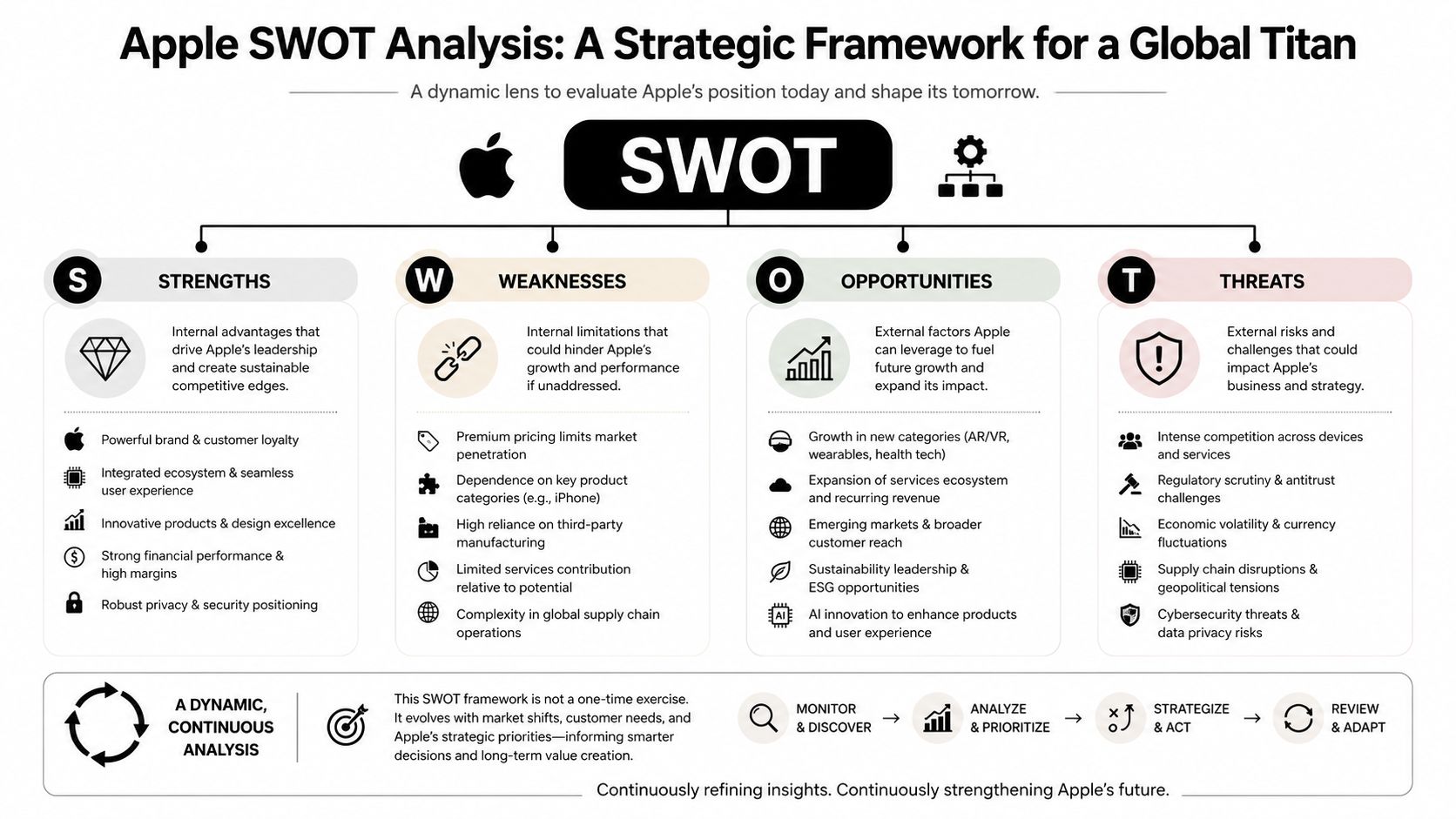
Most SWOT analyses freeze a company in place. That doesn't work for Apple. Its strengths produce some of its weaknesses. Its opportunities create new regulatory exposure. Its threats often emerge precisely because its strategic position is so strong. For a company operating at Apple's scale, the four quadrants are interdependent.
SWOT as strategic foresight
A policymaker reading Apple through this lens should ask four practical questions.
- Strengths: Which assets give Apple rule-setting power in markets before formal regulation catches up?
- Weaknesses: Which internal dependencies could turn into systemic vulnerabilities under geopolitical stress?
- Opportunities: Which adjacent sectors allow Apple to extend influence into areas with public-interest consequences?
- Threats: Which governments, legal regimes, or external shocks can constrain Apple's room for manoeuvre?
This method matters because Apple isn't operating in a stable liberalisation cycle any more. It's operating in a world of technological fragmentation, industrial policy competition, and regulatory divergence. The company must adapt not only to demand signals, but to competing national priorities.
Why the framework matters for G20 actors
For G20 governments, the value of this framework is that it converts a familiar business tool into a governance instrument. It helps officials distinguish between ordinary commercial risk and strategic concentration risk. It also shows where a private firm's success can create dependencies that are uncomfortable for states.
Practical rule: When a company combines market-shaping scale, consumer lock-in, and cross-border infrastructure relevance, its SWOT profile becomes a public policy concern.
An investor might look at Apple and ask whether its ecosystem remains defensible. A government should ask a harder question. If that ecosystem becomes integral to communications, payments, health, and AI interfaces, what happens when regulation, security concerns, or geopolitical conflict interrupts it? That's the threshold at which Apple becomes not only a corporate giant, but a governance challenge.
Core Strengths A Fortress of Brand and Capital
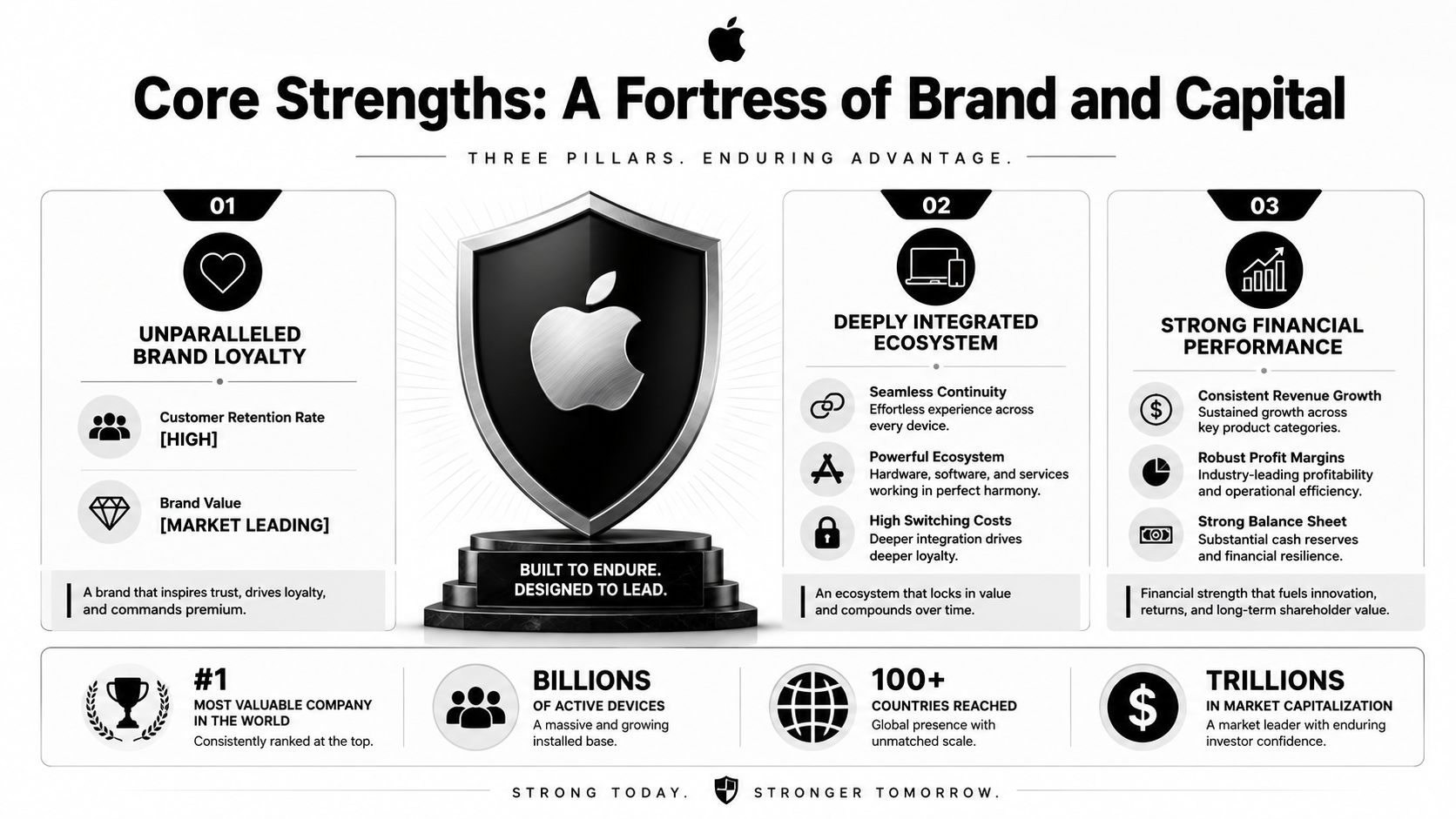
Apple's primary strength isn't a single device. It's the combination of brand authority, technological integration, and capital allocation discipline. Taken together, these create a strategic moat that few corporations can replicate and few states can ignore.
A headline figure captures part of that power. Apple's brand was valued at over $516 billion in 2026, and its R&D spending consistently surpasses $30 billion annually, according to Forbes brand rankings. Those two facts matter more in combination than in isolation. Brand value lowers friction when Apple enters adjacent markets. Research spending gives it the means to build those entries on proprietary foundations.
The result is a company that can fund long-cycle innovation while preserving the premium identity that makes consumers accept high switching costs. That isn't merely a marketing edge. It's a strategic resource.
Brand power as strategic insulation
Apple's brand gives it unusual resilience in moments when other technology firms would face rapid reputational erosion. Consumers don't buy only a handset or a laptop. They buy into an architecture of trust, status, continuity, and expected usability across devices like the iPhone, Mac, iPad, Apple Watch, and AirPods.
That trust produces strategic insulation in three ways:
- Pricing authority: Apple can defend premium positioning more easily than rivals whose products compete primarily on specifications.
- Policy credibility: Its longstanding emphasis on privacy gives it a stronger public-interest narrative than companies seen chiefly as advertising intermediaries.
- Category extension: When Apple moves into new domains, many users grant it a presumption of reliability before the product is fully proven.
Standard investor commentary often overlooks a pivotal issue. Brand strength at Apple's level doesn't only support sales. It supports governance influence. When Apple takes a position on encryption, app distribution, health tracking, or on-device processing, regulators must respond to a company whose user base often perceives its design choices as legitimate by default.
A closer look at Apple's strategic posture is useful here:
Research spending and ecosystem control
Research intensity matters because Apple's ecosystem only works as a moat if the company continues to control the interfaces that make the ecosystem coherent. Hardware, operating systems, chips, developer frameworks, and services all need to reinforce one another. Sustained R&D is what allows that coherence.
Apple's annual spending above the $30 billion threshold supports more than product iteration. It supports strategic autonomy. It lets the company pursue custom silicon, health sensing, privacy-preserving machine learning, and vertical integration without relying excessively on outside platforms. In policy terms, this reduces vulnerability to upstream dependency while increasing downstream influence over users and developers.
Apple's strongest asset may be its ability to convert technical integration into a form of private standard-setting.
That's why Apple can often move ahead of formal rulemaking. It can embed privacy defaults in software architecture, define accessory compatibility through its platform choices, and establish practical norms around app permissions, payments, and interoperability. In a fragmented global digital order, those capabilities resemble the powers of a standards-setting institution.
Inherent Weaknesses The Paradox of Concentration
Apple's strengths have produced an opposing reality. The company is highly concentrated around a narrow set of strategic assumptions. That concentration made sense in an era defined by efficiency, premium consumer demand, and globalised production. It's less comfortable in an era defined by regulatory contestation, political risk, and technological transition.
The most obvious weakness is product concentration. The iPhone continues to account for over 50% of Apple's total revenue, creating a significant single-product dependency that exposes the company to market shifts and targeted competitive or regulatory pressure, according to Apple event and newsroom materials. For a company often praised for diversification across devices and services, that's a critical reminder that the centre of gravity remains unusually narrow.
The iPhone dependency problem
The iPhone is more than a profitable product line. It is the anchor that pulls users into Apple's wider ecosystem. That makes it commercially powerful, but strategically brittle. If regulators constrain app economics, if a rival changes the terms of smartphone competition, or if consumer replacement cycles weaken, Apple doesn't just face a sales problem. It faces stress across the entire ecosystem built around the iPhone's centrality.
The weakness isn't just revenue exposure. It's organisational dependency. Apple's software policies, accessory strategy, services architecture, and upgrade logic all assume that the iPhone remains the default personal computing hub for a large share of its users. That creates path dependence.
Three consequences follow:
- Innovation pressure rises. Apple must keep making the iPhone feel indispensable, even as smartphone markets mature.
- Regulatory power increases. Authorities can apply pressure where the ecosystem is most commercially concentrated.
- Competitive asymmetry grows. Rivals don't need to displace Apple across all categories. They only need to weaken the centre.
Operational rigidity in a fragmented world
The second weakness is less visible to consumers but more relevant to governments. Apple's operating model has been built for precision and scale. That delivers consistency. It can also reduce flexibility when political conditions shift quickly.
A tightly choreographed global manufacturing system performs well under stable rules. It becomes harder to defend when states start prioritising redundancy, localisation, and strategic resilience over pure efficiency. Apple's deep integration means that production, logistics, and market access aren't fully separable from politics any more.
A company optimised for seamlessness can struggle when the world rewards redundancy.
This doesn't mean Apple lacks adaptation capacity. It means adaptation carries costs. Any significant move away from concentrated production, tightly controlled platform structures, or signature product dependence risks undermining some of the efficiencies that made Apple formidable in the first place. That's the paradox at the centre of this Apple SWOT analysis. The company's greatest source of control may also be the main source of its exposure.
Strategic Opportunities Frontiers in AI Health and Climate
Apple's most consequential opportunities sit in sectors where commercial growth and public regulation increasingly overlap. AI, digital health, and climate-linked product strategy each offer expansion potential. Beyond mere expansion potential, each offers Apple a chance to deepen its role in systems that governments already regard as strategic.
AI as a governance strategy
Apple's opportunity in AI isn't only to match rivals feature for feature. Its stronger opening lies in positioning AI as a trusted, device-centred layer built around privacy, security, and user control. If it can make on-device intelligence feel safer and more practical than cloud-heavy alternatives, it can turn a technical race into a governance advantage.
That possibility matters for states. Many governments want AI adoption without surrendering sensitive personal data to opaque cross-border systems. Apple is well placed to argue that its hardware-software integration allows a different model. Readers interested in the broader policy challenge can examine building an AI economy that works for all, which frames the institutional choices required when AI becomes economic infrastructure.
Apple's challenge is that AI credibility now depends on execution, not brand confidence alone. Still, if the company succeeds, it could become a preferred platform for regulated consumer AI in markets where privacy and data sovereignty are politically salient.
Health platforms and regulated expansion
The clearest quantified opportunity lies in health. The global digital health market is projected to grow to over $780 billion by 2030, and Apple is positioning its Watch and Health platforms to capture a significant share of this preventative and monitoring-focused segment, according to Grand View Research's digital health market outlook. That projection matters because digital health is not a discretionary software niche. It is increasingly tied to ageing societies, chronic disease management, remote monitoring, and preventive care models.
For Apple, the strategic attraction is obvious. Devices like Apple Watch sit close to the body, generate continuous data, and can integrate with broader digital ecosystems. If Apple translates those capabilities into trusted health interfaces, it gains not only revenue opportunities but institutional relevance in a domain historically governed by public agencies, hospitals, insurers, and regulated medical providers.
That creates a policy dilemma. Apple can help widen access to monitoring and preventive tools. Yet the more central its platforms become, the more urgent questions arise around data portability, clinical validation, interoperability, and accountability.
Climate strategy beyond reputation
Climate is often treated as a reputational layer in technology strategy. That's too shallow. For Apple, climate-related opportunity sits at the intersection of product design, materials policy, energy sourcing, and circularity. Governments want lower-carbon supply chains, less waste, and more resilient resource use. Apple wants to preserve premium design while responding to those demands before regulation hardens further.
One practical frontier is product lifecycle management, including repair, refurbishment, and reducing electronic waste. That topic matters because climate credibility in consumer technology won't rest only on renewable energy claims. It will increasingly depend on whether firms help extend device life, recover materials, and limit disposal burdens.
- For Apple: climate strategy can reinforce brand trust if sustainability becomes visible in products, packaging, and recovery systems.
- For regulators: the company can serve as a useful test case for how circular economy rules affect premium electronics.
- For multilateral bodies: Apple's scale means its procurement and design standards can influence broader industry practice.
Apple's opportunity takes on a geopolitical dimension. If it helps define acceptable norms for AI privacy, personal health interfaces, and sustainable hardware design, it won't just enter new markets. It will shape the terms on which those markets are governed.
Global Threats Geopolitics Regulation and Supply Chains
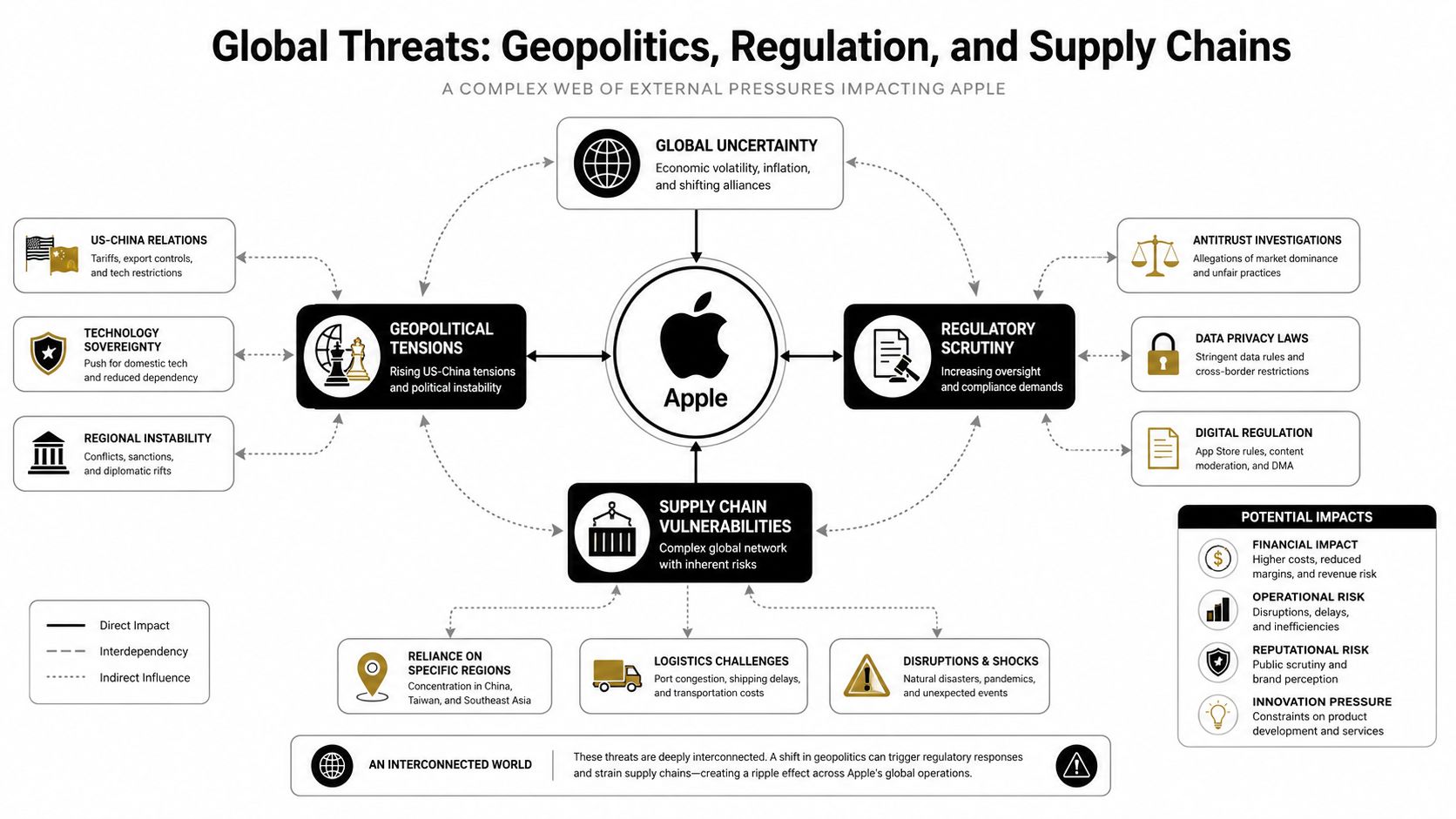
Apple's external threat environment is now broader than normal competitive rivalry. The main pressures come from geopolitical fragmentation, assertive regulation, and supply chain exposure to state action. These threats interact. A regulatory dispute can alter business model economics. A geopolitical crisis can disrupt production and market access at once. A supply chain shock can quickly become a strategic policy issue.
Where external pressure is intensifying
The first threat is the deterioration of the policy environment around global technology. The United States, the European Union, China, and other major jurisdictions increasingly view digital platforms through the lens of sovereignty, competition, security, and industrial strategy. Apple's integrated model is efficient, but it is also exactly the kind of concentrated private power that many regulators now want to discipline.
The second threat is supply chain fragility under geopolitical stress. Apple depends on a highly coordinated production system that doesn't sit outside politics. Export controls, trade restrictions, market retaliation, and localisation requirements can all raise the cost of strategic coherence. For a company built around precision manufacturing and timed product cycles, that's a structural risk rather than a temporary inconvenience. The wider logic of this issue is reflected in debates over the future of the global value chain.
The central threat to Apple is no longer that another firm builds a better phone. It's that states redraw the operating conditions under which the phone business works.
The third threat is cumulative legal pressure. Apple faces scrutiny not only because it is large, but because its model bundles devices, software, distribution, and services in ways that many authorities see as market-shaping. Even where rules differ by jurisdiction, the direction of travel is similar. Regulators want more openness, more contestability, and less unilateral control over gatekeeping functions.
Global Regulatory Pressures on Apple 2026
| Jurisdiction | Regulatory Focus | Primary Legislation / Action | Implication for Apple |
|---|---|---|---|
| European Union | Digital market contestability | Digital competition and platform rules | Pressure to relax platform control and justify ecosystem restrictions |
| United States | Antitrust and platform power | Competition enforcement and litigation | Greater scrutiny of integrated hardware, software, and app distribution practices |
| China | Technology sovereignty and market control | Administrative and industrial policy instruments | Exposure to shifting compliance expectations and strategic market access risk |
| Other major economies | Data governance and consumer protection | National privacy, competition, and product rules | Rising compliance complexity across fragmented legal regimes |
This table matters because the threat isn't any single legal proceeding. It's the accumulation of pressures from multiple jurisdictions pursuing different goals with overlapping consequences. Apple can adapt to one rulebook. It's harder to optimise for several at once when they pull in different directions.
For policymakers, that creates an additional challenge. If jurisdictions regulate in isolation, Apple may comply tactically while preserving broader structural power. If they coordinate more effectively, they can shape clearer expectations around platform fairness, resilience, and user rights. That's why Apple belongs in discussions of global governance, not only corporate strategy.
Implications for Global Governance and Strategy
The core conclusion of this Apple SWOT analysis is straightforward. Apple is strong enough to influence markets like a sovereign actor, but not autonomous enough to escape the strategic return of the state. Its future will be determined not just by product quality or brand loyalty, but by how well it manages an era in which governments are reclaiming authority over technology systems.
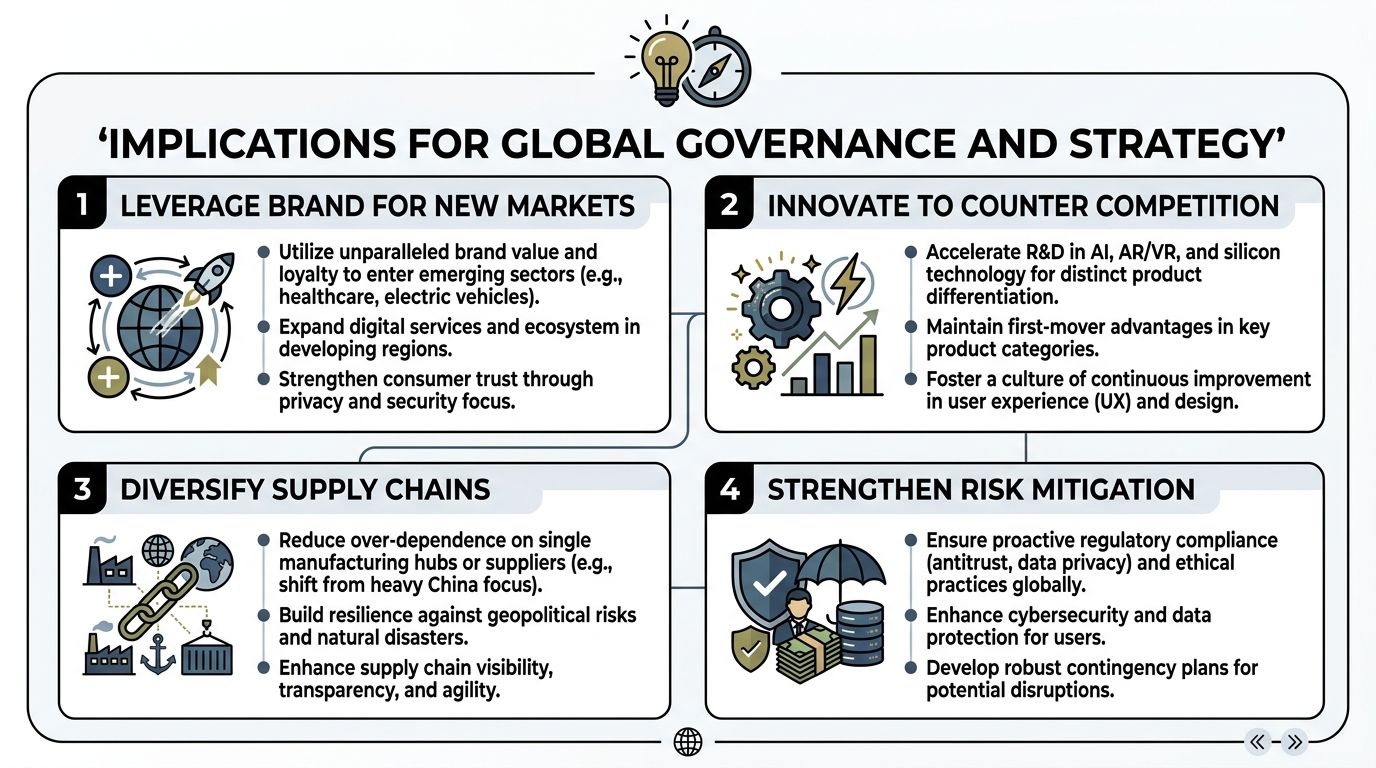
What policymakers should do now
Governments should avoid two mistakes. The first is treating Apple as just another successful multinational. The second is treating regulation as an exercise in punishment rather than system design. Apple's scale means that poorly designed rules can create spillovers for developers, health systems, suppliers, and consumers. But weak oversight leaves critical digital functions under concentrated private control.
A more effective policy agenda would include:
- Competition with interoperability in mind: regulators should focus on opening bottlenecks without destroying legitimate product integration.
- Supply chain resilience standards: governments should identify where concentrated manufacturing exposure creates national vulnerability and encourage diversification through predictable incentives.
- Health governance readiness: health ministries and regulators should prepare for a world in which consumer platforms sit closer to public health systems.
- Data protection coherence: jurisdictions should align expectations where possible, especially on sensitive personal data. The broader architecture of data protection regulations matters here because fragmented compliance regimes can weaken both enforcement and innovation.
Policy priority: regulate corporate power where it becomes infrastructural, not only where it becomes unpopular.
There is also a multilateral case for action. Standards on digital health interoperability, responsible AI deployment, e-waste reduction, and cross-border data governance shouldn't be left to fragmented national responses alone. Apple is influential enough that coordinated public frameworks can shape its conduct. Uncoordinated action often can't.
What boardrooms and investors should monitor
Corporate leaders should read Apple less as a singular success story and more as an advanced warning. The age of frictionless global scaling is over. Companies that depend on concentrated supply chains, integrated platforms, and permissive regulation face a harder operating environment. Apple's response will offer lessons for firms across semiconductors, software, health technology, and consumer electronics.
Institutional investors also need a broader lens. Traditional valuation approaches often underweight political and governance variables until they become acute. For Apple, long-term resilience will depend on whether it can convert strength into legitimacy. Capital depth and brand power still matter, but so do regulatory adaptability, geopolitical optionality, and trust in adjacent sectors like AI and health.
Three strategic judgments follow.
- Apple remains unusually powerful because its brand, capital base, and integration reinforce one another.
- Its principal vulnerabilities arise from concentration, not weakness in the ordinary sense.
- Its next phase of growth will unfold in sectors where public authority is stronger and tolerance for unilateral platform control is lower.
The policy implication is clear. Governments shouldn't wait for crisis moments to decide how to govern firms with Apple's reach. They should build the rules, standards, and coordination mechanisms now, while there is still room to shape outcomes rather than merely react to them.
For more policy-led analysis on technology power, digital regulation, trade resilience, health governance, and G7/G20 strategy, follow Global Governance Media. It brings decision-makers and analysts into the same conversation, with practical insight for leaders who need to govern markets shaped by companies as consequential as Apple.