

By Senior Foreign Policy Analyst
The surprising fact about the allies of the United States isn't how many states Washington works with. It's that public debate often confuses strategic intimacy with legal obligation. The United States has 51 treaty allies but also maintains quasi-allies that receive support without a defence commitment, a distinction that is frequently blurred in political rhetoric and media shorthand, as explained by Defense Priorities on what ally status means in law and practice.
That distinction matters more now because alliance politics no longer turns only on deterrence abroad. It also turns on domestic credibility at home. Voters, legislatures, armed forces, treasury officials and industrial planners all shape whether alliances remain operational in a crisis. For G7 and G20 policymakers, the central question isn't merely who stands with Washington. It's which relationships are treaty-bound, which are politically contingent, and which can absorb political stress without strategic drift.
Table of Contents
- The Enduring Relevance of Alliances in a Fractured World
- The Alliance Spectrum Treaty Allies and Strategic Partners
- The Transatlantic Core NATO and European Security
- The Indo-Pacific Pivot Alliances in an Era of Competition
- Navigating Complex Partnerships in the Middle East and Americas
- Alliance Resilience Domestic Politics and Burden Sharing
- Recommendations for Revitalising Multilateral Cooperation
The Enduring Relevance of Alliances in a Fractured World
The United States still sits at the centre of the most consequential alliance network in the international system, but that network can't be understood through sentiment alone. The core issue is institutional design. Treaty commitments, consensus procedures, interoperability, intelligence ties and political signalling all determine whether a relationship can shape events under pressure.
That is why alliances matter even more in a fragmented geopolitical environment. Formal alliances reduce uncertainty among partners, but they also create expectations that can be politically costly when domestic priorities shift. For finance ministries, alliance commitments influence spending choices. For trade officials, they affect supply chain strategy. For defence planners, they shape basing, procurement and escalation options.
A serious reading of the allies United States framework also changes how policymakers interpret risk. States that appear close to Washington may not have mutual-defence guarantees. Others that attract less public attention may be firmly embedded in treaty structures with immediate operational consequences. The result is a hierarchy of relationships, not a flat list.
For readers tracking the wider strategic context, international relations current events analysis offers a useful companion lens because alliance management now overlaps with technology controls, sanctions policy, industrial resilience and maritime security.
Alliances don't just aggregate military power. They organise political expectation before a crisis begins.
Three policy questions follow from that reality:
- Legal scope: Which states are covered by treaty commitments, and what exactly is promised?
- Operational depth: Which relationships produce real planning, intelligence and force integration?
- Political durability: Which alliances can survive electoral pressure, fiscal constraint and burden-sharing disputes?
Those questions separate durable alliances from merely close partnerships. They also explain why today's debate shouldn't revolve around who is America's "best friend". It should revolve around which commitments are formal, which are flexible, and which are strong enough to sustain deterrence when domestic politics becomes adversarial.
The Alliance Spectrum Treaty Allies and Strategic Partners
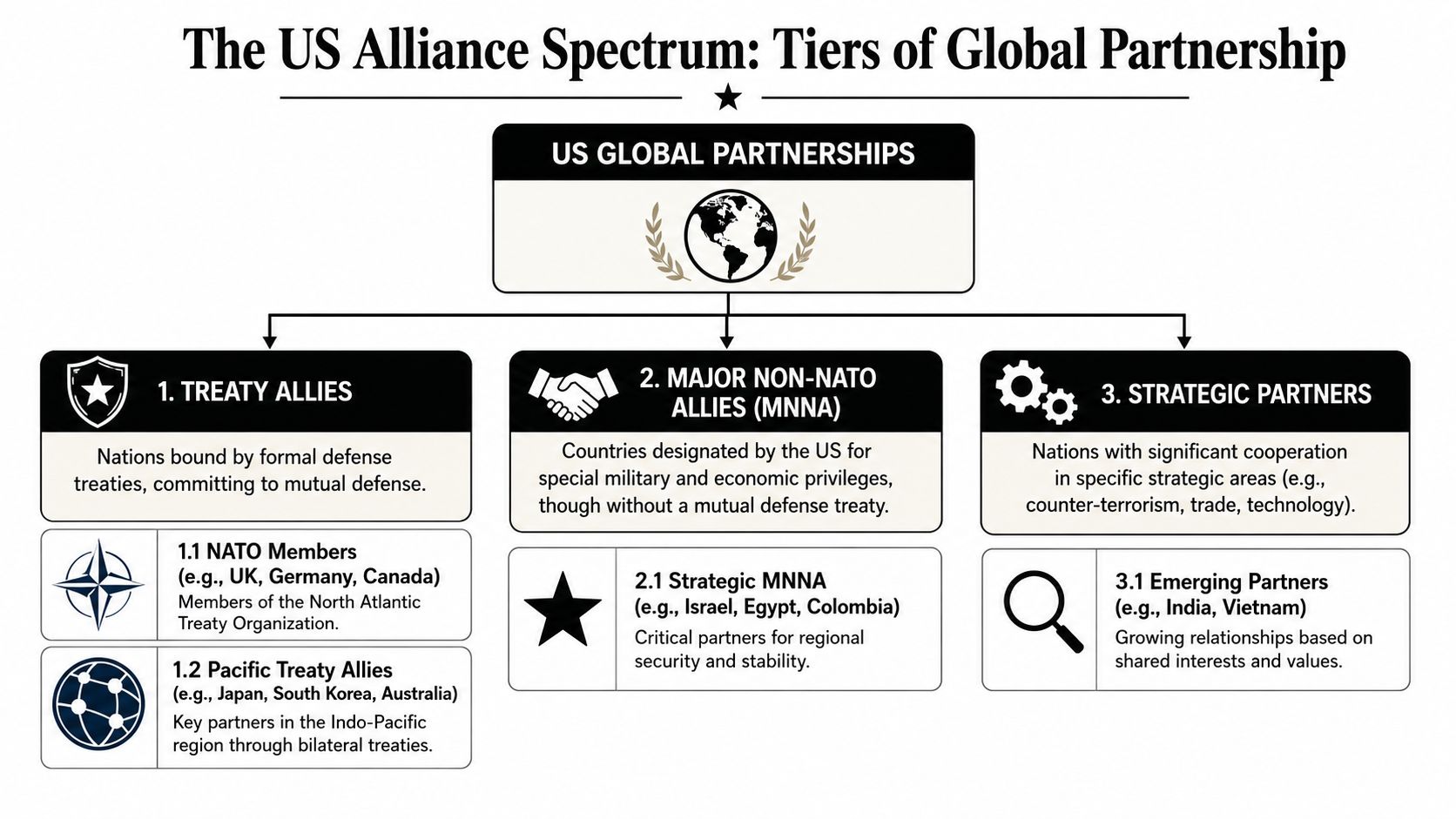
America's alliance network is less a fixed club than a hierarchy of legal commitments, operational arrangements and political expectations. Treating every close relationship as an "ally" obscures the central policy question: which governments can reasonably expect U.S. military support in a crisis, and which are cooperating partners whose value lies in access, alignment or regional influence rather than treaty-backed defence.
Why the legal distinction matters
A formal defence commitment does more than signal goodwill. It shapes contingency planning, force posture, intelligence sharing and deterrence calculations in ways that looser partnerships usually do not. It also raises the domestic political cost of inaction. Leaders may still debate how to respond, but treaty language narrows the range of credible options once a conflict begins.
That distinction matters because public debate often conflates familiarity with obligation. The United Kingdom may be viewed in Washington as an especially close partner, yet its importance rests on more than sentiment. What gives the relationship strategic weight is its place inside treaty-based institutions and interoperable military structures. Similar confusion appears in debates over Asian security and even in assessments of U.S.-Russia strategic competition and crisis risk, where rhetorical alignment and legally binding commitments are often treated as if they were interchangeable.
Classification of US Global Partnerships
| Classification | Core Obligation | Example Countries |
|---|---|---|
| Treaty allies | Formal mutual-defence commitment through treaty architecture | UK, Germany, Canada, Japan, South Korea, Australia |
| Major Non-NATO Allies | Preferential security cooperation without a mutual-defence treaty | Israel, Egypt, Colombia |
| Strategic partners | Cooperation in selected strategic areas without treaty defence obligations | India, Vietnam |
These categories are not semantic. They distribute risk differently across Washington's global portfolio.
Treaty allies tie the United States to specific security outcomes. Major Non-NATO Ally status offers access to defence cooperation and procurement benefits, but it does not create an automatic war obligation. Strategic partnerships can still be highly consequential, especially where the United States wants flexibility, deniability or issue-specific cooperation, yet ambiguity is part of their design rather than a flaw in need of correction.
Perception versus obligation
The gap between perceived closeness and legal obligation is where alliance management becomes politically difficult. Some of Washington's most publicly celebrated relationships are also the ones most exposed to domestic electoral change, budget pressure and disputes over burden sharing. By contrast, less visible treaty arrangements may prove more durable because expectations are codified and military bureaucracies are built around them.
This has a practical implication for policymakers. They should reserve the term "ally" for relationships that carry identifiable defence obligations, or explain clearly what support is promised. Precision reduces the risk of deterrence failure, allied overconfidence and adversary miscalculation.
Institutions outside foreign policy confront a similar problem. Commitment depends on rules, incentives and defined responsibilities, not on rhetoric alone. Even in membership-based organisations, structure determines whether affinity becomes organised action, which is why the association ambassador playbook offers a useful parallel.
For analysts, the more revealing question is not which state appears closest to Washington. It is which relationships can survive a crisis when legal commitments, operational readiness and domestic political consent are tested at the same time.
The Transatlantic Core NATO and European Security
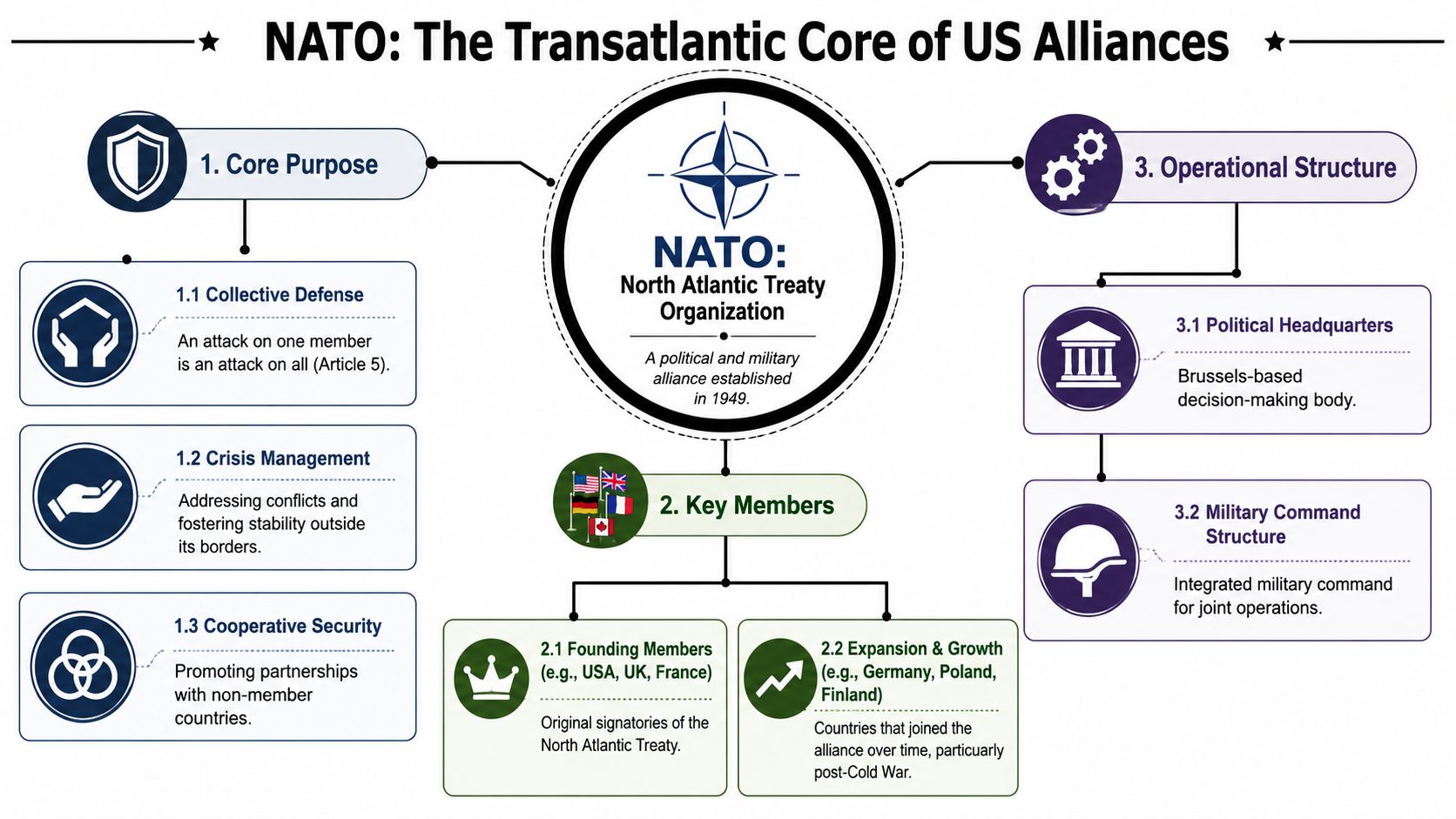
NATO remains the United States' most consequential alliance because it converts political affinity into standing military obligations, common procedures and an established chain of consultation. That distinction matters. Public rhetoric often treats the closest allies as interchangeable, but European security still depends on which relationships are embedded in institutions that can function under pressure.
Why NATO remains the core alliance mechanism
NATO's significance lies in process as much as promise. The alliance ties deterrence to defence planning, force integration, intelligence coordination and regular political consultation. Those habits reduce uncertainty in a crisis. They also impose discipline on the United States and its European allies by forcing strategic disagreements into a formal setting rather than leaving them to ad hoc bilateral bargaining.
The United Kingdom holds a particular place in that system. Its value is not only cultural proximity to Washington. It sits inside the alliance as a founding member with high-end military capabilities, intelligence links and a long record of operational interoperability with US forces. In practical terms, Britain often matters because it can shape alliance decisions from within NATO's machinery, not because it is perceived as Washington's closest European friend.
That institutional logic has become more important as Russia's war against Ukraine has forced European governments to reconsider deterrence, stockpiles, industrial capacity and readiness. The strategic backdrop is clearer when placed alongside broader analysis of US and Russia relations.
The institutional value of wartime memory
Historical memory still matters, but mainly because it was translated into durable institutions. The Anglo-American wartime partnership created habits of strategic coordination that later informed the Atlantic alliance. The relevant lesson is not sentimentality about a shared past. It is that repeated military cooperation, once formalised, can outlast changes in leadership and shifts in public mood.
That helps explain NATO's persistence through periods of serious disagreement over Iraq, Afghanistan, defence spending and relations with Moscow. Alliances survive friction when procedures are established, command relationships are practised and the costs of defection are high. Wartime memory can legitimise that structure domestically, but institutions carry the heavier burden.
A short explainer is useful here:
Why numbers alone don't capture alliance depth
NATO's scale matters less than its capacity to make commitments credible. More members broaden political legitimacy and military reach, but they also make consensus harder and expose the alliance to domestic volatility across multiple capitals. Elections in the United States, coalition shifts in Europe, fiscal constraints and public fatigue with defence spending all affect how quickly common policy can be formed.
This is the central transatlantic trade-off. A larger alliance can deter more effectively because an attack carries wider consequences. The same breadth can slow decision-making and magnify internal disputes over risk, burden sharing and escalation.
Mature alliances survive because institutions make disagreement manageable.
For G7 and G20 policymakers, the core question is not whether the transatlantic relationship remains symbolically strong. It is whether NATO's members can sustain the domestic consent, defence investment and political coordination required to keep treaty obligations credible when the costs of deterrence rise.
The Indo-Pacific Pivot Alliances in an Era of Competition
The Indo-Pacific presents a different alliance logic. In Europe, the United States works through a multilateral treaty institution with standing procedures. In Asia, the architecture is more often described as a hub-and-spokes model, built around bilateral treaty relationships and reinforced by issue-specific coalitions.
Why the Indo-Pacific model looks different
The region's strategic environment demands flexibility. Maritime geography, industrial interdependence, contested sea lanes, technology competition and coercive economic practices all require more than a traditional defence lens. Washington's alliances with Japan, South Korea and Australia, alongside ties with the Philippines and Thailand, therefore serve multiple purposes at once. They deter military aggression, but they also support logistics, technology standards, industrial planning and supply chain resilience.
That functional breadth is why Indo-Pacific alliances often look less institutionally uniform than NATO. They are not weaker for that reason. They are adapted to a theatre where states face overlapping security and economic pressures, and where many governments want strong cooperation with Washington without replicating a European-style bloc structure.
Strategic trade-offs in the region
The policy challenge is that deterrence and flexibility don't always align. Bilateral alliances can move faster than large consensus-based organisations, but they can also produce fragmentation. Regional actors may support security coordination while resisting formal bloc logic in trade, technology or diplomacy. That creates a persistent calibration problem for Washington and its partners.
Three trade-offs stand out:
- Deterrence versus autonomy: Allies want credible U.S. backing, but many also want room to manage economic relations independently.
- Security versus integration: Military coordination can deepen quickly, while economic alignment often moves more cautiously.
- Speed versus legitimacy: Small coalitions can act quickly, but broader regional support is harder to consolidate.
Beyond military containment
The most serious analytical mistake is to treat Indo-Pacific alliances as a simple anti-China instrument. That framing is too narrow. These relationships are also about governing strategic interdependence. Semiconductor exposure, maritime insurance risk, critical minerals, cyber resilience and technology regulation all sit within the same policy conversation.
That is why newer arrangements, including minilateral formats and technology-focused partnerships, matter. They show that the U.S. alliance system is adapting from a model centred on territorial defence alone to one that increasingly addresses economic security. In practical terms, the Indo-Pacific is where Washington is testing whether its alliance system can remain credible in an era when coercion is often commercial, digital or infrastructural rather than overtly military.
Navigating Complex Partnerships in the Middle East and Americas
Outside Europe and much of East Asia, U.S. statecraft relies more heavily on partnership management than on formal alliance architecture. That doesn't make these relationships peripheral. In many cases, they are central to regional order, but they operate with looser legal commitments and greater political ambiguity.
The Middle East's transactional density
In the Middle East, Washington works through relationships that vary sharply in purpose and expectation. Israel occupies a singular place as a close security partner. Gulf relationships are also strategically significant, especially in defence cooperation, regional deterrence and energy security, yet they don't map neatly onto treaty-ally language.
That ambiguity gives policymakers room to manoeuvre, but it also creates recurring expectation gaps. Partners may assume political support will imply military backing. U.S. officials may seek influence without open-ended commitment. In a crisis, those assumptions can diverge quickly.
A comparison with treaty systems is revealing:
| Region | Typical relationship form | Policy consequence |
|---|---|---|
| Europe | Institutionalised treaty alliance | Higher predictability, slower consensus |
| Indo-Pacific | Bilateral treaty network plus minilateral formats | Greater flexibility, uneven regional structure |
| Middle East | Strategic partnerships and security cooperation | More discretion, less legal clarity |
The Americas and the logic of proximity
In the Americas, proximity changes the equation. Canada and Mexico matter not only as neighbours but as states integrally embedded in U.S. economic and security planning. The relationship is less about abstract solidarity than about practical interdependence across trade, migration, border management and industrial supply chains.
Elsewhere in the hemisphere, Washington uses a different toolkit. Colombia is often discussed as a strategically important partner rather than a formal treaty ally. That distinction is not semantic. It affects what can be promised, what can be expected and how support is justified domestically in Washington.
The United States often exerts more influence through layered partnerships than through formal treaty expansion.
What this means for policy
For G20 officials, the lesson is that much of U.S. power operates through relationships that are neither casual nor treaty-bound. These arrangements can be effective because they are adaptable. They can also be brittle because they depend heavily on executive choice, regional conditions and short-cycle political incentives.
That makes them useful instruments for crisis management, sanctions coordination and selective security cooperation. It also means they are less reliable than treaty alliances when deterrence depends on automaticity or legal clarity. Policymakers should therefore resist the temptation to call every close partner an ally. Doing so obscures the actual menu of commitments available in a crisis.
Alliance Resilience Domestic Politics and Burden Sharing
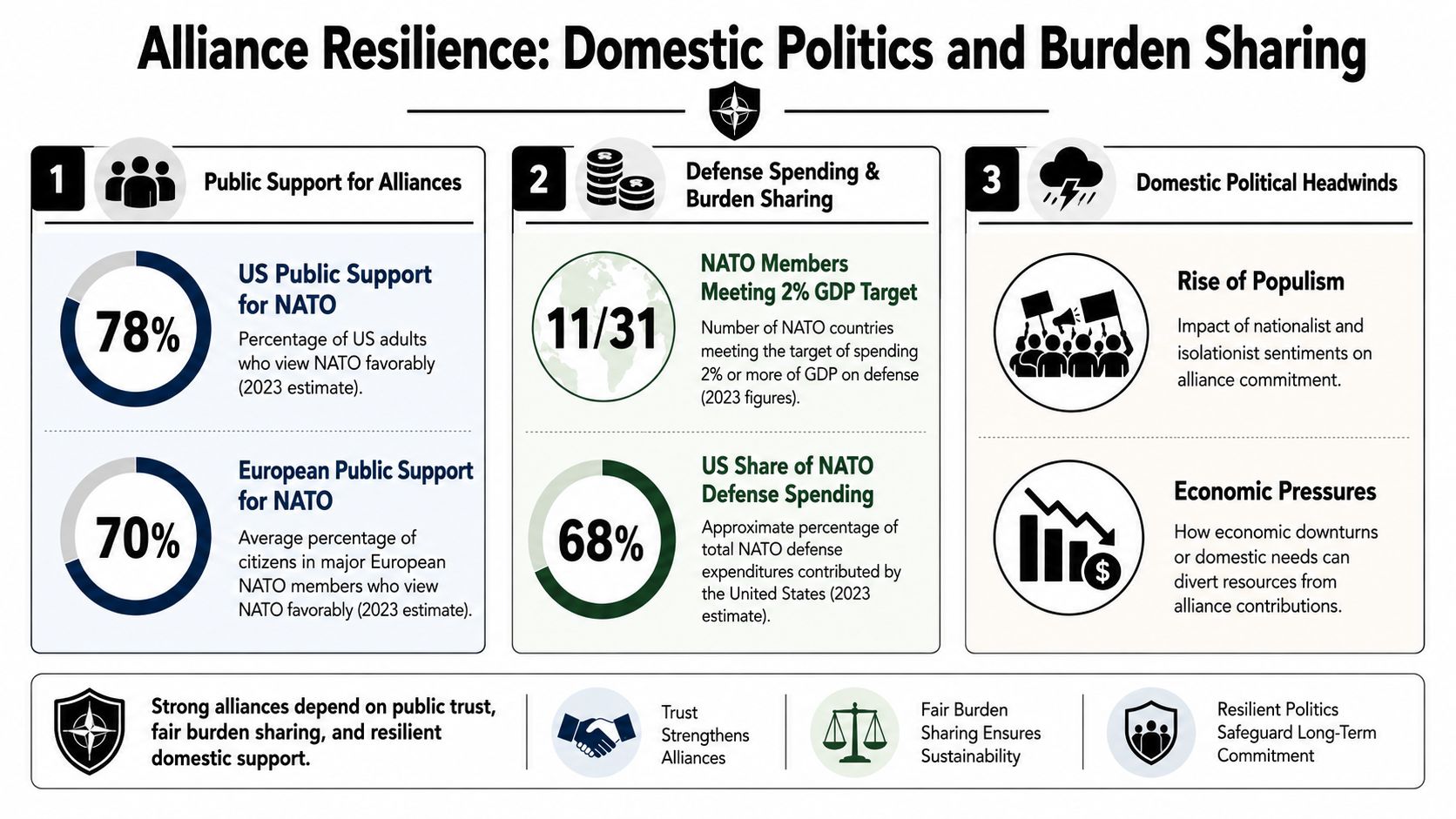
The strongest challenge to the U.S. alliance system doesn't come only from rivals. It also comes from the political systems of the allies themselves. Fiscal pressure, industrial policy disputes, polarised electorates and burden-sharing arguments all test whether alliance commitments remain credible when they become domestically expensive.
Public support is stronger than elite rhetoric suggests
Political commentary often implies that alliance support is collapsing. The evidence cited here points in a more complicated direction. U.S. public support for alliances is at an all-time high, with majorities favouring security alliances in Europe at 68% and in Asia at 72%, according to Chicago Council reporting via Global Affairs on U.S. support for alliances.
That doesn't mean alliance politics is settled. It means policymakers can't assume sceptical rhetoric reflects majority opinion. There is still political space to defend alliances, but leaders have to explain them in terms voters recognise: deterrence, industrial resilience, intelligence protection and reduced crisis risk.
Alignment is real, but resilience isn't automatic
The United Kingdom is among the most highly aligned U.S. treaty allies, ranking in the top five globally in a CNA assessment of alliance alignment and interoperability, according to CNA's data-science study of U.S. alliances and partnerships. That is strategically significant. It suggests some alliances are not merely symbolic or historical. They are closely integrated at the policy and operational level.
But high alignment doesn't remove political stress. It can even intensify it, because highly integrated allies are more exposed to one another's elections, procurement choices, sanctions decisions and strategic re-prioritisations.
The real burden-sharing debate
The burden-sharing debate is often framed too narrowly as a matter of who spends more. The more important question is who contributes what to collective outcomes. Some allies provide geography, others intelligence access, others niche capabilities, legitimacy, basing or diplomatic reach. A narrow financial framing can therefore distort strategic reality.
For ministers and planners, three tests matter most:
- Can the alliance still take decisions under domestic pressure?
- Can governments justify commitments in language their public accepts?
- Can allies adapt burden-sharing to new domains such as cyber, technology and supply chains?
If the answer to those questions is yes, alliances remain durable even during noisy political cycles. If not, legal commitments may survive on paper while practical credibility erodes.
Recommendations for Revitalising Multilateral Cooperation
Alliance policy shouldn't be treated as separate from multilateral governance. For G7 and G20 leaders, the U.S. alliance network is most valuable when it becomes a platform for solving problems that no state can manage alone.
Build coalition capacity beyond defence
Allied frameworks should be used more systematically for pandemic preparedness, resilient supply chains and energy transition planning. Defence ministries already know how to coordinate contingency operations. Civilian agencies should borrow that discipline for health security, critical infrastructure protection and industrial mapping.
Treat technology governance as an alliance issue
Emerging technologies are now part of strategic competition. That means allies need common approaches to export controls, trusted research partnerships, cyber resilience and AI governance. Fragmentation among allies creates openings for coercion and regulatory arbitrage.
A practical starting point is to use established multilateral venues more effectively. The task isn't to build new institutions for every challenge. It is to align existing forums, legal commitments and policy communities around shared implementation. Readers focused on institutional effectiveness can explore making multilateral institutions work for a broader governance perspective.
Redefine burden sharing for a wider strategic era
The next burden-sharing debate shouldn't be fought with old metrics alone. Policymakers should recognise contributions in logistics, technology standards, sanctions enforcement, maritime awareness, industrial resilience and crisis diplomacy. That would produce a fairer account of who carries strategic weight and would make alliance politics easier to defend domestically.
Strong alliances are not relics of the postwar order. They are the operating system for collective action in a more contested century.
The policy conclusion is straightforward. The United States' alliances remain a decisive strategic asset, but only if leaders stop confusing affinity with obligation and stop treating domestic politics as a secondary variable. The future of alliance credibility will be decided as much in parliaments, budgets and public debate as in treaty texts.
For more policy analysis, summit-focused commentary and evidence-led reporting on international cooperation, visit Global Governance Media.