


Embedding particular catalysts can boost G20 compliance on macroeconomic commitments, which can help play a vital role at this time of crisis
Global cooperation on macroeconomic policy is vital amid the ongoing COVID-19 pandemic and its devastating economic impact. The G20 can play a particularly significant role in such cooperation. Macroeconomic policy cooperation has been at the core of the G20’s agenda since the summit’s start. Since 2008, its macroeconomic policy deliberation and decision-making have been strong and stable. Its delivery of commitments has been outstanding. Leaders can further improve that delivery by embedding compliance-increasing catalysts in the commitments they make at their Rome Summit.
Deliberation
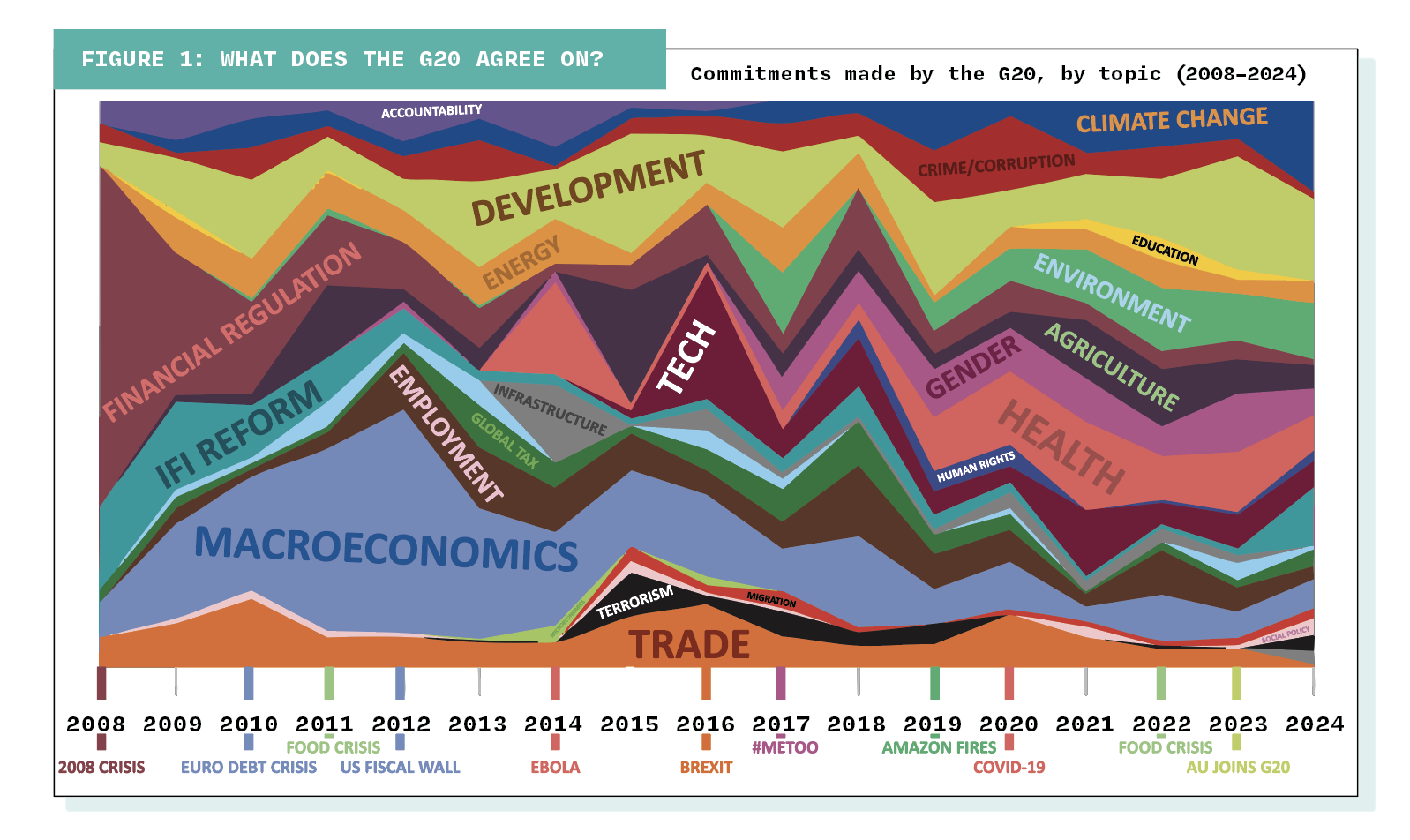
Since 2008, G20 leaders have dedicated more than 4,800 words, or about 34% of the total, to macroeconomic policy per summit.
The first phase of increasing deliberation from 2008 to 2013 began at Washington in 2008 with 651 words (18%). That number increased to a peak at St Petersburg in 2013 with 12,000 words (42%), the most ever.
The second, short phase of relatively stable and high deliberation from 2014 to 2016 started at Brisbane in 2014 with 4,939 words, for a high 54%. Hangzhou in 2016 had 10,600 words (29%).
A third phase of decreasing deliberation from 2017 to 2020 started at Hamburg in 2017 with 7,964 words (23%), dropping to 673 words (10%) at Osaka in 2019, but rising at Riyadh in 2020 to 3,384 words, for an all-time high of 60%, to counter the recession caused by COVID-19 that year.
Decisions
G20 decision-making has been strong but has recently declined. Since 2008, the G20 has made 484 macroeconomic policy commitments, for 17% of the total, putting this subject first.
The first phase of increasing decision-making from 2008 to 2011 started with six commitments (6%) in 2008, then increased to a peak of 91 commitments (32%) at Cannes in 2011.
The second phase of decreasing decision-making started in 2012 and reached nine commitments at both Osaka 2019 and Riyadh 2020, for 6% and 8%, respectively.
Delivery
On the 30 macroeconomic policy commitments assessed by the G20 Research Group, members’ compliance averaged 82%, well above the G20’s all-subject average of 71%.
This strong compliance has been somewhat stable. It started with commitments made at Washington in 2008 at 88%, dropped to 68% with London in April 2009, then climbed above 85% with Pittsburgh in September 2009, 87% with Toronto in 2010 and 85% with Seoul in 2010. Compliance dropped to 72% with the 2011 Cannes Summit, rose to 88% with 2012 Los Cabos and 80% with 2013 St Petersburg. It dropped again to 70% with 2014 Brisbane, rose to 85% with 2015 Antalya, dropped to 69% with 2016 Hangzhou, and then soared to 90% with 2017 Hamburg. It remained high at 85% with 2018 Buenos Aires and 89% with 2019 Osaka. Halfway between the 2020 Riyadh and 2020 Rome summits, compliance was stronger still, at 91%.
The top compliers were Canada with 97%, Germany with 94% and the European Union with 92%.
Causes of compliance
Compliance on macroeconomic commitments is strongest when particular catalysts are embedded in their text. Commitments with a multi-year timetable averaged 92% compliance, compared with 80% for those without one. Those with a one-year timetable averaged 90%, compared with 80% for the others. Those that referred to a past summit averaged 85%, compared with 81% for those that did not.
Corrections
At the Rome Summit, G20 leaders can raise their deliberation and decision-making on macroeconomic policy, including by building on the momentum of the Riyadh Summit. They should embed a multi-year or one-year timetable in their commitments and refer to a past summit to help maintain their high compliance levels. This matters, because countering the ongoing COVID-19 pandemic calls for strong leadership from the G20.