

By Eleanor Ashcroft, Senior Trade Policy Adviser
Most policymakers still describe the japan external trade organization as if it were a conventional export promotion agency. That reading is outdated. The stronger interpretation, backed by JETRO’s institutional evolution and its operational footprint, is that Japan uses JETRO as a practical instrument of economic statecraft. It links trade promotion, market access, regulatory interpretation, investment attraction and commercial intelligence in a single policy platform.
That matters for G7 and G20 governments because trade policy no longer sits in a narrow commercial silo. It now intersects with supply chain resilience, regulatory alignment, technology governance and strategic competition. Japan’s model deserves close study not because it is rhetorically ambitious, but because it is administratively organised to turn national priorities into repeatable commercial outcomes. For governments reconsidering how to join domestic industrial policy with outward economic engagement, JETRO is a useful benchmark. A related debate about the broader strategic turn in trade policy has been captured well in this analysis of a key moment for trade.
Table of Contents
- Introduction Why JETRO Matters for Global Governance
- From Export Engine to Investment Magnet JETROs Evolution
- Inside JETRO Organisational Structure and Governance
- JETROs Core Programmes Unpacked
- Engaging with JETRO A Guide for Firms and Governments
- JETROs Role in a Shifting Global Order
- Conclusion The Future of Trade Facilitation and Strategic Implications
Introduction Why JETRO Matters for Global Governance
JETRO matters because it sits in the space where governments increasingly need institutional competence. It does more than advertise opportunities. It helps translate policy, regulation and market conditions into executable commercial decisions. That is a different function from classic export marketing, and it places JETRO much closer to the core of Japan’s external economic strategy.
For G7 officials, the important point isn’t just that Japan has a trade body. Many states do. The important point is that Japan has maintained and adapted a body able to work across inward investment, bilateral commercial facilitation, smaller firm engagement and information dissemination. According to JETRO’s institutional history, its remit broadened over time from export promotion to include investment attraction, import promotion, liaison services between small and medium-sized Japanese businesses and overseas counterparts, and extensive data dissemination. That is the architecture of a strategic platform, not a single-function bureau.
Why this matters beyond Japan
A government that can align trade services with regulatory explanation and investment promotion has an advantage in periods of fragmentation. Businesses don’t need abstract support. They need clear pathways into markets, interpretation of changing standards, and credible interlocutors who can connect official policy with operational practice.
Practical rule: When a trade institution can reduce uncertainty, it increases a country’s strategic attractiveness even before tariffs or subsidies enter the discussion.
That has implications well beyond bilateral trade with Japan. In a world of contested standards, de-risking strategies and industrial policy revival, institutions like JETRO become part of how states compete for trust. They also become part of how allies coordinate. A body that can convene firms, explain regulatory shifts and lower entry friction is relevant to digital trade, food systems, advanced manufacturing and green transition policy.
A more useful policy lens
The conventional lens asks whether JETRO promotes Japanese commerce. Of course it does. The more revealing question is what sort of state capacity JETRO represents. The answer is a form of economic governance that is outward-facing, technically literate and operationally patient.
That’s why policymakers shouldn’t treat the japan external trade organization as administrative background. They should treat it as evidence of how Japan organises geoeconomic influence.
From Export Engine to Investment Magnet JETROs Evolution

JETRO’s evolution tracks Japan’s shift from catch-up industrialisation to strategic market shaping. That makes it more than an administrative story. It is a case study in how an advanced economy repurposes a trade institution once export promotion alone no longer fits national needs.
A postwar institution built for a different Japan
JETRO was established in the early postwar period, when Japan’s overriding external objective was to rebuild productive capacity, earn foreign exchange, and secure access to overseas markets. In that context, a specialised export promotion body was a rational policy choice. It helped reduce information gaps for firms, create commercial contacts abroad, and support the outward push of Japanese industry.
That original model matched the structure of the Japanese economy at the time. It does not explain JETRO’s current relevance.
By the time Japan had become a mature surplus economy with globally established firms, the policy problem had changed. The state no longer needed an institution focused mainly on getting Japanese goods into foreign markets. It needed an organisation that could also attract investment, interpret overseas regulatory conditions, support smaller firms with less international reach, and maintain commercial ties in sectors where market access depends as much on standards and trust as on price.
The legal reorganisation in the early 2000s should be read through that lens. The change in status was not a bureaucratic tidying exercise. It reflected a broader recalibration in Japanese economic policy, away from a narrow export-first model and toward a wider form of external economic management.
Why the 2003 redesign mattered
The most important consequence of the redesign was strategic breadth. JETRO’s mandate expanded in ways that mirrored the concerns of other advanced economies: inward investment, partner-country engagement, SME internationalisation, and policy-relevant market intelligence. Those functions matter more in an era defined by supply chain concentration, regulatory fragmentation, and industrial policy competition.
For G7 governments, the lesson is straightforward. Trade promotion agencies that remain tied to a twentieth-century export script will miss where competitive advantage now sits. Advanced economies compete through four channels at once:
- Market intelligence: giving firms usable information on regulation, demand, and entry barriers.
- Investment attraction: drawing in capital, technology, and business functions that strengthen domestic production networks.
- SME internationalisation: helping smaller firms participate in cross-border commerce that would otherwise be dominated by large incumbents.
- Economic diplomacy: sustaining trust with counterpart governments and firms when trade relationships are shaped by strategic risk as well as commercial opportunity.
JETRO moved in that direction earlier than many external observers recognised. Its evolution suggests that Japan understood a broader point. In mature economies, trade institutions create value by lowering uncertainty across the full investment and market-entry cycle, not only by promoting exports at the border.
This is also why JETRO deserves attention in debates on allied coordination. An institution designed to connect firms, explain foreign business conditions, and attract overseas investment can support de-risking without defaulting to decoupling. It can also help align commercial policy with industrial resilience. That places JETRO closer to the logic of economic statecraft than to the narrower tradition of trade fair promotion.
A related perspective on how states build outward-facing commercial infrastructure appears in this analysis of business gateways around the world.
JETRO’s institutional shift shows how Japan adapted its external economic toolkit to a different stage of development. The organisation did not abandon trade promotion. It integrated trade promotion into a wider strategy for investment, information, and strategic commercial presence.
That has a wider implication for G20 and G7 policy. Agencies like JETRO matter because they sit at the intersection of trade, investment screening, industrial policy, and standards diplomacy. Japan’s experience shows that institutional adaptation can be a source of geoeconomic advantage, especially when governments need instruments that are operational, credible, and flexible enough to work across both cooperation and competition.
Inside JETRO Organisational Structure and Governance

JETRO matters because it gives Japan an institutional mechanism for turning economic strategy into repeatable action. For G7 governments, the key point is not limited to JETRO promoting trade. It sits in the space between ministerial direction and commercial execution, where state priorities are translated into services, relationships, and market presence.
Its governance design explains that role. As noted earlier, JETRO operates as an Independent Administrative Institution under a dedicated legal framework. That arrangement gives it a degree of operational continuity while keeping it closely aligned with national policy objectives. For foreign officials, this combination is significant. It means engagement with JETRO can offer a practical reading of Japanese priorities even when formal decisions remain with ministries.
This is a familiar feature of advanced economic statecraft. Governments rarely rely on ministries alone to shape external commercial outcomes. They also build specialised bodies that can maintain technical expertise, sustain business networks, and work across longer time horizons than electoral cycles usually allow. JETRO fits that model.
How to read JETRO as a policy actor
A useful way to assess JETRO is to focus on the functions that institutions of this type perform for the state.
| Function | What it means in practice | Why it matters |
|---|---|---|
| Policy translation | Explaining how national priorities affect firms, sectors, and foreign investors | Reduces uncertainty and signals where the government wants activity to occur |
| Network coordination | Connecting Japanese actors with overseas firms, agencies, and regional partners | Lowers transaction costs and speeds commercial matching |
| Implementation support | Converting broad policy goals into programmes, events, advisory services, and operational follow-through | Gives economic strategy institutional durability |
The analytical point is straightforward. A ministry can announce priorities. A body such as JETRO can operationalise them at scale, across sectors and across jurisdictions.
That distinction matters more in the current trade environment. Geoeconomic competition is no longer defined only by tariffs or market access disputes. It also turns on who can shape supply chain decisions, influence corporate site selection, and provide trusted channels for regulatory interpretation. JETRO contributes to all three. Its organisational form therefore has strategic weight beyond administrative design.
What foreign counterparts should infer
For G7 officials, trade promotion agencies, and corporate public affairs teams, three conclusions follow.
- Treat JETRO as an operational signal of Japanese intent. Where it allocates attention often indicates where Tokyo sees strategic commercial value.
- Use it for problem-solving, not protocol. Engagement is most productive when tied to specific sectoral, regulatory, investment, or standards questions.
- Expect policy boundaries to be porous. Trade, investment attraction, industrial resilience, and overseas commercial strategy are often handled as linked issues rather than separate files.
This has implications for allied coordination. Institutions like JETRO can support de-risking agendas, supply chain diversification, and inward investment screening dialogues without requiring governments to rely solely on formal diplomatic channels. They also create a competitive dynamic inside the G7. Partners cooperate on resilience and standards, but they also compete for capital, technology partnerships, and strategic industries. JETRO helps Japan do both with discipline.
The broader conclusion is that organisational architecture shapes state capacity. Japan’s external economic influence does not rest only on policy statements or summit diplomacy. It also rests on whether institutions such as JETRO can keep delivering credible engagement, market intelligence, and commercial follow-through over time.
JETROs Core Programmes Unpacked
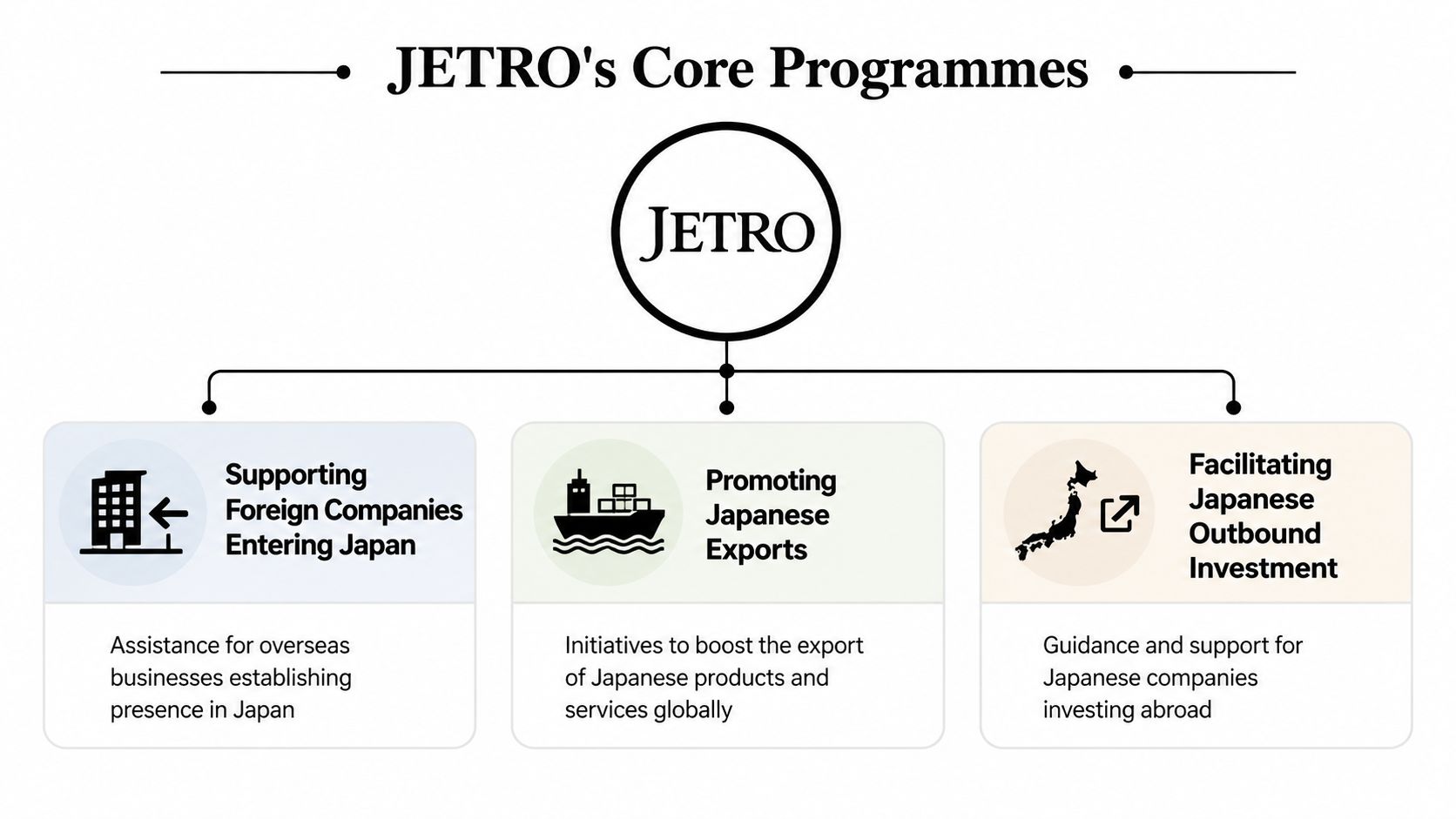
JETRO’s programme mix shows why it should be read as an instrument of economic statecraft, not only as a trade promotion agency. Its core activities connect firm-level problem solving with state-level objectives: attracting capital into Japan, supporting Japanese companies abroad, and shaping the regulatory conditions under which cross-border commerce takes place.
Three pillars matter.
The first is market entry support for foreign companies. This is the channel through which JETRO helps overseas firms assess Japanese demand, understand regulatory requirements, identify local partners, and sequence an entry plan. For G7 governments, that function matters because investment promotion is no longer separate from industrial strategy. The firms JETRO assists today may become part of Japan’s future supply chains in advanced manufacturing, food security, digital services, or energy transition sectors.
The second is support for Japanese outward commerce. This still includes classic export promotion, but the policy significance is broader than shipment volumes. JETRO helps Japanese companies locate buyers, evaluate overseas operating conditions, and reduce execution risk in foreign markets. In practice, that means supporting the international reach of Japanese firms in sectors that also sit at the centre of G7 competition over standards, technology adoption, and supply chain resilience.
The third is research and trade analysis. This function deserves more attention than it usually receives. Institutions that can interpret regulatory change, translate standards into commercial decisions, and circulate sector intelligence quickly tend to shape trade outcomes more effectively than institutions that only convene networking events. JETRO’s analytical role gives Japan an advantage in that respect.
A UK food and beverage case illustrates how these pillars work together. Publicly cited material on JETRO’s UK-facing activity reports trade missions for British exporters, contract generation for premium goods entering Japan, and a relatively high conversion rate from event leads into commercial outcomes. More important than the headline numbers, however, is the operating method behind them. JETRO paired business matching with guidance on amendments to Japan’s Food Sanitation Act and with practical support on certification and market access procedures, as noted earlier in the DigiComply profile of JETRO’s UK-facing activity.
That combination explains the policy value. Firms rarely need generic market descriptions. They need targeted regulatory interpretation that enables decisions on product adaptation, testing, certification, logistics, and partner selection. JETRO’s contribution lies in reducing uncertainty at precisely those pressure points.
The same historical reporting from late 2024 also pointed to shorter testing cycles under relevant recognition arrangements, certification issuance during that period, logistics cost savings through recommended port and cold-chain options, and stronger pricing outcomes for certain perishable exports. Read narrowly, those are operational improvements. Read strategically, they show how a trade institution can convert standards knowledge and infrastructure awareness into commercial advantage without changing tariff schedules.
That matters for G7 policymakers because it marks the intersection of cooperation and competition. Allies may share an interest in resilient supply chains and transparent rules, but they still compete for investor attention, trusted supplier status, and first-mover advantage in regulated sectors. JETRO helps Japan compete inside that cooperative framework.
A useful way to assess the programme logic is:
- Regulatory interpretation: JETRO translates rule changes into actions firms can take.
- Commercial matching: It connects firms with distributors, buyers, and local counterparts.
- Operational execution: It improves compliance timing, logistics choices, and route-to-market decisions.
- Strategic alignment: It links present market access to longer-term standards, sustainability, and digital trade objectives.
This is what gives the japan external trade organization strategic weight. JETRO does not only promote trade. It integrates market intelligence, administrative guidance, commercial brokerage, and forward standards positioning in a single operating platform. For partner governments, that makes it a useful counterpart. For competitors, it makes Japan harder to outmanoeuvre in contested sectors.
Engaging with JETRO A Guide for Firms and Governments

Engagement with JETRO should begin before a market decision is locked in. By the time a firm is facing a customs delay, a failed distributor search, or an unclear incorporation pathway, the cheapest strategic options have usually disappeared. For G7 firms and public agencies, the right question is not whether JETRO can solve a problem at the end of a transaction. It is whether early engagement can improve the design of the transaction itself.
That distinction matters because JETRO operates as more than a promotional contact point. In practice, it can shape how foreign firms interpret Japanese market conditions, how local authorities understand Japanese commercial priorities, and how allied governments identify areas for practical cooperation. The World Economic Forum’s organisational profile points to a wider problem. Public information on JETRO’s overseas operations, including aspects of its UK-facing activity and post-Brexit adaptation, remains limited, which makes direct institutional engagement more important for any actor treating Japan as a strategic commercial partner rather than a one-off export destination.
For firms entering Japan
Firms get better results when they approach JETRO with a decision agenda. A generic request for market information usually produces generic output. A focused brief produces something more useful, whether that is regulatory clarification, a shortlist of counterparties, or guidance on the sequence of market entry steps.
Three disciplines tend to matter most:
Define the commercial objective clearly
State whether the near-term goal is distributor appointment, entity formation, licensing, location selection, or investment assessment. JETRO is easier to use well when the requested support matches a specific business decision.
Separate market risk from regulatory risk
Firms often combine customer demand questions with compliance uncertainty. Those are different problems and they require different forms of engagement. A company selling food, life sciences products, advanced materials, or digital services should identify which issue is commercial and which is administrative before the first meeting.
Ask for structured access
Introductions have value, but they are rarely enough on their own. The better request is access to the relevant operating environment: legal and tax considerations, certification routes, potential partners, local ecosystem actors, and the practical constraints that shape market entry costs.
A firm that knows its next decision usually gets more from JETRO than a firm seeking broad reassurance.
A practical visual overview can help frame how external stakeholders think about engagement:
For governments seeking deeper links
Governments should approach JETRO as a channel for economic coordination, not only as a trade promotion counterpart. That is particularly relevant for subnational investment agencies, export ministries, innovation bodies, and sector regulators in G7 economies that want stronger links with Japanese capital, technology partnerships, or supply chain projects.
The practical starting point is alignment around sectors where Japanese firms are actively internationalising and where host governments can offer policy certainty. Advanced manufacturing, energy transition infrastructure, life sciences, digital services, and resilient supply chain activities are obvious candidates, but the principle matters more than the list. JETRO engagement works best where the foreign government can present a credible policy offer, not just a marketing pitch.
An effective public-sector approach usually includes:
- Sector selection tied to Japanese demand: choose industries where Japanese companies need stable overseas production, research, or market access partners.
- Regular institutional contact: maintain dialogue across the year instead of relying on conference meetings or trade missions alone.
- Problem-led cooperation: focus discussions on permitting, talent availability, standards recognition, procurement conditions, or co-investment barriers.
- Clear escalation routes: identify which issues can be handled by JETRO staff and which require ministry-level discussion.
This has a statecraft dimension. For allied governments, working with JETRO can support inward investment and supply chain diversification. It can also reveal where Japan is placing long-term strategic attention. Those signals matter. They help partner governments distinguish between sectors where cooperation with Japan is likely to deepen and sectors where competition for capital, technology, or standards influence will intensify.
For both firms and governments, the operative principle is straightforward. Engage while strategy is still adjustable, budgets are still flexible, and counterpart selection is still open. That is the point at which JETRO has the greatest strategic value.
JETROs Role in a Shifting Global Order
Trade institutions now operate inside a geopolitical environment shaped by strategic dependency, standards competition and selective openness. In that setting, JETRO’s significance expands. It becomes one of the mechanisms through which Japan can pursue economic openness without pretending that markets are detached from state interests.
Trade facilitation now serves strategic policy
JETRO’s broadened mandate already suggests this shift. An institution that covers investment attraction, import promotion, SME liaison and information dissemination is well suited to a world where governments need finer control over how cross-border economic relationships develop. That doesn’t make JETRO a coercive instrument. It makes it a coordinating instrument.
For G7 policymakers, that distinction matters. Economic statecraft isn’t always about sanctions, export controls or subsidy races. Sometimes it’s about who can make trusted commerce easier within politically aligned networks. Japan has long placed value on stable commercial relationships and rule-governed exchange. JETRO gives that preference institutional reach.
A useful comparison with some Western counterparts reveals an important difference in style. Many Western trade bodies split market promotion, investment attraction and regulatory support across separate agencies. Japan’s model appears more integrated. That can produce clearer signalling to firms because commercial support and strategic intent travel together.
What G7 partners should learn
The lesson isn’t that every country should copy Japan’s administrative form. Institutional transplants rarely work cleanly. The lesson is that fragmented external economic governance is now a liability.
Three implications follow.
- Integrated trade institutions are more strategic: they can connect market access, regulation and investment in a single conversation.
- Administrative continuity matters: firms respond to predictability, especially in sensitive sectors.
- Allied economic coordination needs operational vehicles: summit declarations won’t carry themselves into business decisions.
A broader discussion of Japan’s strategic positioning within global governance can be found in this analysis focused on counting on Japan.
When allies talk about resilience, they often mean diversification. But diversification only happens when institutions can help firms move from intent to execution.
That is where the japan external trade organization fits into the wider G7 and G20 picture. It helps Japan remain open, competitive and strategically legible at the same time. In the current global order, that combination is a major advantage.
Conclusion The Future of Trade Facilitation and Strategic Implications
The central point is clear. JETRO isn’t best understood as a legacy export office with a broader brochure. It is better understood as a state-backed platform that connects trade, investment, regulation and commercial intelligence in support of Japan’s wider external economic strategy.
Its institutional redesign in the early 2000s reflected Japan’s recognition that mature economies need more than export promotion alone. They need mechanisms that can manage bilateral economic relationships, attract investment, support smaller firms and distribute usable market knowledge. The UK trade example shows how that logic works in practice. Regulatory interpretation, trade missions, certification pathways, logistics advice and standards alignment can be organised as one coherent system.
For G7 governments, the most important takeaway isn’t admiration. It is adaptation. Many governments still treat trade promotion, investment attraction and standards engagement as adjacent but separate functions. That fragmentation makes it harder to convert strategic priorities into commercial outcomes. JETRO suggests a different model. It shows what happens when a government creates an institution that can operate across those boundaries with continuity and technical depth.
There is also a geopolitical implication. The next phase of globalisation won’t be defined by frictionless openness. It will be defined by managed openness among trusted partners, with greater attention to resilience, regulatory compatibility and strategic sectors. Institutions like the japan external trade organization are built for that environment.
Governments that want stronger supply chains, deeper allied coordination and more durable economic competitiveness should study JETRO closely. They don’t need to reproduce it exactly. But they do need to ask whether their own institutional machinery is capable of matching strategy with execution. In the current geoeconomic environment, that question is no longer administrative. It is strategic.
Global Governance Media convenes the policymakers, analysts and executives shaping the future of international cooperation. If you want more rigorous briefings on trade, investment, industrial policy and G7 governance, follow Global Governance Media and join the conversation on how institutions can turn global ambition into practical results.