


By Daniel Hart, Senior Energy Policy Analyst
The most useful way to think about solar cell windows isn’t as a futuristic novelty. It’s as a response to a basic urban constraint: cities have vast vertical surfaces, but limited roof area. That matters because the global solar power windows market is projected to grow from USD 653 million in 2023 to USD 4,086 million by 2033, a 22.6% CAGR according to Market.us.
For G7 and G20 governments, that growth signal should be read less as a niche market story and more as an infrastructure warning. If public policy continues to treat glazing only as a thermal and architectural component, countries will miss a category of building-integrated generation that can help decarbonise cities, improve resilience and reduce pressure on strained grids. Solar cell windows sit at the intersection of industrial policy, building regulation, electricity market design and urban planning. That makes them unusually hard to scale, but also unusually valuable when policy is aligned.
Table of Contents
- The Strategic Imperative for Solar Cell Windows
- How Solar Windows Turn Buildings into Power Plants
- Market Readiness and Key Performance Metrics
- Transforming Urban Environments and Energy Use
- Overcoming Regulatory and Standards Barriers
- Innovative Financing and Procurement Models
- A Policy Toolkit for G7 and G20 Action
The Strategic Imperative for Solar Cell Windows
The strategic case starts with capital flows. Global solar energy investment reached USD 380 billion in 2023, overtaking upstream oil for the first time, according to Market.us reporting on the solar power windows market. Solar cell windows should be understood within that wider reallocation of capital, not outside it.
That shift has direct consequences for urban policy. G7 and G20 economies are trying to decarbonise the built environment while managing electricity demand growth, industrial competitiveness and exposure to volatile fuel markets. Conventional rooftop solar remains central, but it doesn’t solve the geometry of dense cities where towers, public buildings and commercial districts have much more façade area than roof space.
Buildings are no longer just energy consumers
Solar cell windows alter the role of a building envelope. Instead of a passive boundary that merely insulates, shades and admits daylight, the façade starts to act as a distributed generation surface. That changes planning assumptions for commercial districts, airports, hospitals, schools and high-rise housing.
Three strategic implications follow:
- Urban resilience: On-site generation reduces dependence on external supply during periods of grid stress.
- Built environment decarbonisation: Ministers gain another route to cut operational emissions where roof space is constrained.
- Industrial opportunity: Countries that establish standards early can influence manufacturing, certification and export norms.
Solar cell windows are most valuable where land is scarce, electricity demand is concentrated and governments need every square metre of the built environment to work harder.
Why ministers should care now
The core policy mistake would be to wait for perfect efficiency before acting. The relevant question isn’t whether solar cell windows outperform standard rooftop modules. They won’t, and that’s not their purpose. The question is whether they can turn previously non-productive surface area into a useful energy asset while also improving building performance.
That’s why solar cell windows belong on the ministerial agenda. They’re not a substitute for utility-scale renewables or rooftop programmes. They’re an additional urban decarbonisation layer that becomes more important as cities electrify transport, cooling and building services.
How Solar Windows Turn Buildings into Power Plants
A useful analogy is smart sunglasses for buildings. The glass stays transparent enough for daylight and visibility, but specialised layers inside the glazing selectively capture parts of sunlight that occupants don’t need to see.
Selective light capture rather than opaque generation
Traditional solar panels work by capturing a broad portion of incoming light and converting it into electricity. Solar cell windows use a narrower and more selective approach. The photovoltaic material is embedded in or applied to the glazing so it can absorb non-visible wavelengths, particularly parts of the ultraviolet and infrared spectrum, while allowing visible light to pass through.
That’s what makes them viable as windows instead of wall panels. The window still performs as glass. It still admits daylight. But some of the incoming solar energy is intercepted and redirected into electrical generation.
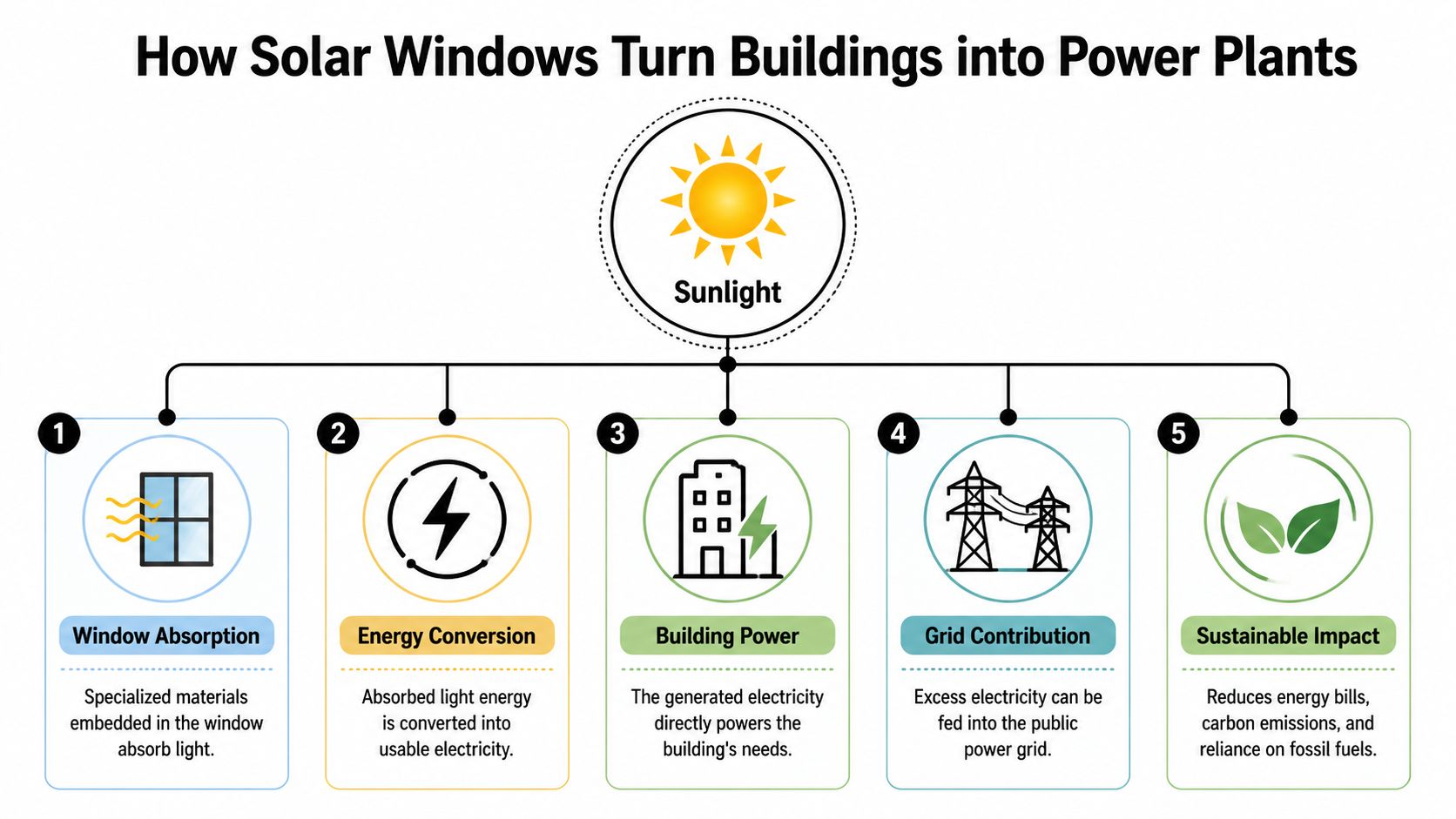
The technologies differ, but the basic logic is consistent:
- Light enters the glazing unit.
- The active layer absorbs selected wavelengths.
- The photovoltaic material converts absorbed energy into electrical current.
- Conductive elements route that electricity into the building system.
- The building consumes the power directly or exports surplus under local market rules.
In UK deployment discussions, Polysolar’s thin-film approach has attracted attention because it can generate electricity in diffuse and low-light conditions and operate in as little as 10% sunlight, according to Renewable Energy Hub’s overview of UK solar windows. That point matters for ministers in northern climates. Solar cell windows don’t depend on perfect, cloudless conditions to contribute value.
What the building does with the electricity
The generated electricity is most useful when matched to building loads that operate during the day. Ventilation systems, common area lighting, controls, lifts, sensors and cooling equipment are all candidates depending on building type and system design.
Practical rule: The strongest early use case isn’t total building self-sufficiency. It’s partial load offset in energy-intensive façades and commercial properties.
This is also where policy needs to move beyond the hardware. A solar window is only one component in a building-integrated energy system that includes inverters, controls, metering, storage decisions and export arrangements. Without those supporting rules, the technology stays trapped as an architectural demonstration rather than an energy asset.
For policymakers trying to situate solar cell windows within wider energy transition planning, this perspective on a solar-powered future is useful because it frames distributed generation as part of system design rather than a standalone product category.
Market Readiness and Key Performance Metrics
Solar cell windows are no longer defined only by laboratory curiosity. They’re now judged by the same questions investors ask of any energy asset. How much electricity do they generate, how long do they last, what do they cost, and can lenders rely on the performance claims?
What bankability now depends on
The most important recent benchmark is that semi-transparent organic photovoltaics reached a record light utilisation efficiency of 6.05 percent, while a University of Michigan design is projected to retain 80% efficiency after a 30-year operational life, as reported by Interesting Engineering’s summary of the underlying research. That combination matters because it addresses the two questions that have historically limited uptake: efficiency and durability.
Bankability improves when technology providers can show not just output, but credible long-term retention of output. In building products, durability often matters more than a headline laboratory result. Ministers should pay attention to that distinction because subsidy schemes and procurement criteria often overweight efficiency and underweight service life.
A second signal of readiness comes from commercial glazing specifications already entering policy discussion. In the UK market, clear BIPV window models have been cited at £250 per square metre, with output in the range of 20 to 50 W/m² under standard test conditions and lifespans of 25 to 30 years, according to Renewable Energy Hub’s review of solar windows in the UK. These figures don’t mean mass commoditisation has arrived. They do mean policymakers can no longer treat cost and longevity as unknowable.
Comparison of solar window technologies 2026 status
| Technology Type | Power Conversion Efficiency (PCE) | Visible Light Transmission (VLT) | Estimated Cost (£/m²) | Projected Lifespan |
|---|---|---|---|---|
| Semi-transparent organic photovoltaics | 6.05% | Qualitatively high enough for semi-transparent use | Qualitative, varies by design | Design from recent research is projected to maintain 80% efficiency after 30 years |
| Thin-film BIPV solar windows in UK commercial use | Clear models exceed prior variants qualitatively | Visible light transmission supports façade integration | £250/m² | 25 to 30 years |
| Transparent solar PV glazing in insulated glazing units | ~5 to 10% conversion benchmark | Transparent glazing for building envelope use | Qualitative, project-specific | Qualitative, aligned with conventional building product expectations |
The table highlights a point ministers often miss. There is no single solar window category. Different technologies trade off transparency, power output, cost and maturity in different ways. Procurement rules that treat all solar cell windows as interchangeable will distort the market.
The metrics that matter in policy design
When governments evaluate solar cell windows, four metrics deserve priority:
- Durability: Long-life performance supports financeability and public procurement.
- Thermal behaviour: The technology changes cooling demand as well as electricity supply.
- Integration cost: Building-level economics depend on glazing replacement cycles, wiring and controls, not just panel-like output.
- Aesthetic compatibility: In urban commercial markets, products that fit façade expectations face fewer adoption barriers.
The ministerial question isn’t whether the technology is mature in the abstract. It’s whether the policy framework distinguishes between pilots, early commercial use and standards-ready deployment.
That distinction is where many countries are still behind.
Transforming Urban Environments and Energy Use
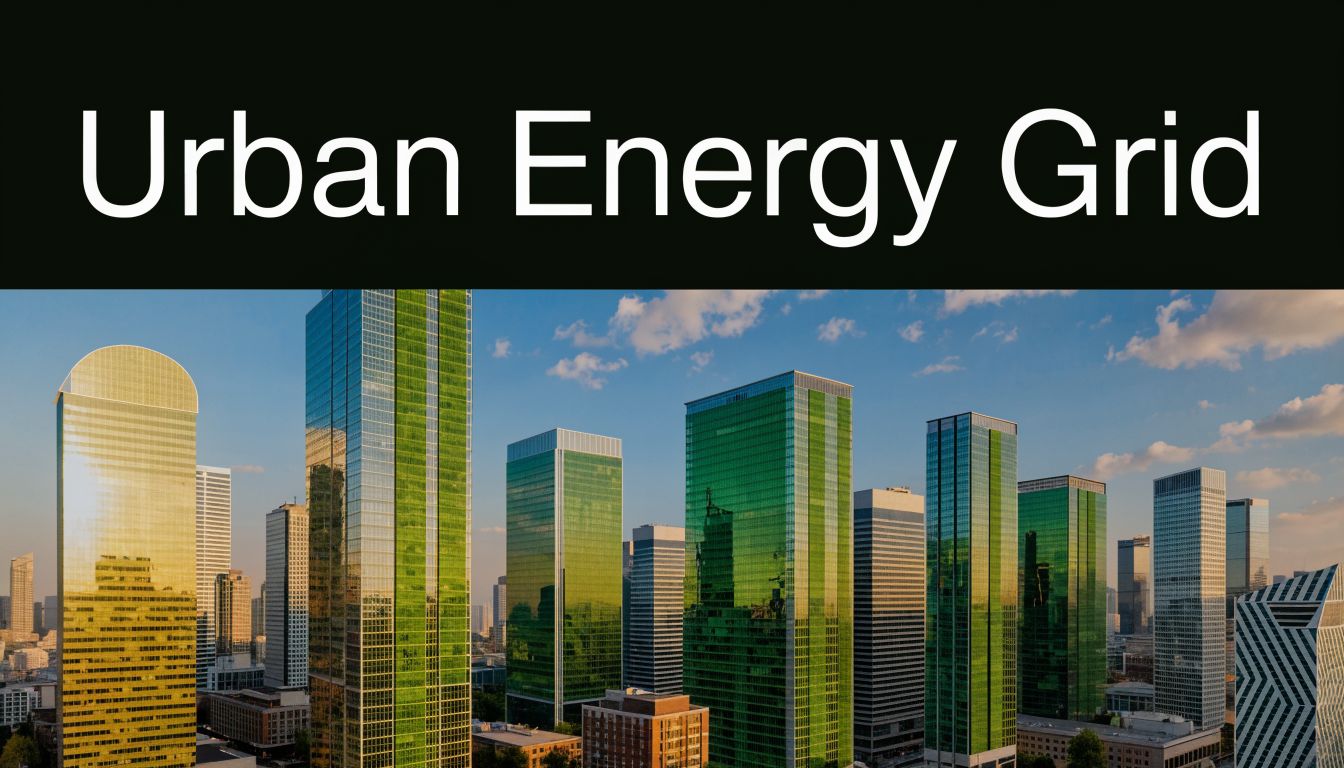
Cities don’t need solar cell windows only because they generate power. They need them because they can improve the thermal performance of buildings at the exact moment many urban centres are struggling with overheating, rising cooling loads and electrification stress.
The façade becomes an energy and cooling asset
UKGBC-endorsed transparent solar PV glazing can achieve U-values of ≤1 W/m²K and g-values of ~0.24 while blocking ~76% of solar heat, and field trials found air-conditioning energy reductions of 20% to 30% in south-facing commercial façades, according to UKGBC’s briefing on transparent solar photovoltaic glazing.
That evidence changes the policy conversation. Solar cell windows shouldn’t be assessed only as a generation technology. They’re also a cooling demand intervention. In dense commercial districts, reducing peak cooling demand can be as strategically important as generating electricity on-site.
Why cities should treat glazing as infrastructure
Urban planners usually separate three policy domains that should be connected: façade regulation, building energy codes and distributed energy strategy. Solar cell windows cut across all three.
Their system value in cities includes:
- Heat management: Lower solar heat gain can reduce overheating risks in highly glazed buildings.
- Grid support: Daytime generation aligns with commercial demand profiles in many offices and public buildings.
- Retrofit opportunity: Existing façades scheduled for refurbishment can become decarbonisation assets rather than simple replacements.
For city leaders thinking beyond individual buildings, this wider discussion of sustainable cities is relevant because it treats building systems, transport and energy as connected design problems rather than siloed sectors.
A conventional window is a sunk cost. A solar window can be a thermal control device, a power source and a compliance tool at the same time.
The deeper urban implication
The least obvious benefit is strategic. Solar cell windows help solve the mismatch between where electricity demand is concentrated and where conventional distributed generation can be installed. In high-rise business districts, roof space is scarce relative to floor area. Façade-integrated generation doesn’t eliminate that mismatch, but it narrows it.
That makes solar cell windows especially relevant for finance centres, public estates, airport zones and institutional campuses. In those settings, ministers aren’t choosing between rooftop solar and solar glazing. They’re choosing whether to leave a major class of urban surface passive or productive.
Overcoming Regulatory and Standards Barriers
Technology isn’t the main reason solar cell windows remain niche. Regulation is. In many jurisdictions, the product sits awkwardly between energy equipment, construction material, fire safety component and façade system.
The certification bottleneck is a policy choice
The clearest example comes from the UK, where building regulations classify BIPV as “new materials”, requiring bespoke BBA certification that can delay projects by 6 to 12 months and cost £50k to £100k per design, as described in ScienceAlert’s report citing UK regulatory barriers. For ministers, the implication is stark. Delay and certification cost can outweigh technical progress.
This is why the common policy narrative is too narrow. Officials often assume uptake is slow because efficiency is still improving. In practice, developers and manufacturers frequently confront approval uncertainty before they even reach a financing decision.
What ministers can change quickly
A serious reform agenda doesn’t need to start with subsidy. It should start with administrative clarity.
Governments can move faster by doing the following:
- Create standard approval pathways: Solar glazing shouldn’t require an improvised process in each project.
- Harmonise test protocols: Fire, impact, thermal and electrical assessments need interoperable rules across jurisdictions.
- Publish model guidance for local authorities: Planning officers and inspectors often lack confidence because guidance is fragmented.
- Separate pilot treatment from mainstream treatment: Demonstration projects can tolerate bespoke review. Commercial roll-out can’t.
The biggest near-term barrier isn’t scientific uncertainty. It’s that too many regulators still process solar cell windows as exceptions.
Why international coordination matters
G7 and G20 members have a specific advantage here. They can reduce market fragmentation by aligning standards discussions across trade, construction and energy ministries. If that doesn’t happen, manufacturers will continue redesigning products for each national approval context, slowing volume growth and keeping prices high.
There’s also a sequencing issue. Once standards are settled, finance becomes easier because insurers, lenders and procuring authorities can compare products on a common basis. Until then, each project carries more transaction cost than it should.
In short, regulatory reform is not a secondary issue to solve after technical maturity. It’s the condition for discovering where technical maturity already exists.
Innovative Financing and Procurement Models
Even where the technology is technically viable and legally approved, solar cell windows still face a financing problem. They sit in a difficult space between capital expenditure for building refurbishment and investment in energy assets. That ambiguity can stall otherwise sound projects.
Three models with different risk profiles
The first model is public procurement tied to building renewal cycles. When ministries or city authorities already plan to replace glazing in schools, hospitals, offices or transport hubs, adding solar cell windows can be assessed as an incremental investment within a broader refurbishment programme. This lowers decision friction because the counterfactual isn’t “build nothing”. It’s “install standard glazing instead”.
The second is the energy performance contract. In this model, a specialist provider or consortium installs the technology and is repaid through verified building performance outcomes. This can work well where owners want lower upfront exposure and where building operators have enough demand during daylight hours to monetise the output.
The third is green or transition finance linked to building-integrated photovoltaics. This route is useful for portfolios rather than single assets. Property groups, public development banks and urban regeneration agencies can package solar glazing within wider retrofit finance structures.
Why procurement matters as much as subsidy
Subsidy can stimulate a first wave of projects, but procurement shapes the market more durably. If governments write tenders that reward lowest upfront façade cost alone, solar cell windows will struggle. If tenders evaluate life-cycle energy value, cooling reduction, resilience and compliance with decarbonisation targets, the economics look different.
That is where policy design should focus:
- Bundled retrofit programmes can aggregate demand and reduce transaction costs.
- Standardised contract templates can make new projects easier for building owners and financiers to assess.
- Portfolio procurement can create predictable order books for manufacturers.
- Public building demonstrators can generate performance data that lenders recognise.
For a broader discussion of how governments can mobilise capital for complex transitions, this analysis of financing the green global economy offers a useful policy lens.
Finance follows clarity. When standards, procurement criteria and operating rules are coherent, capital usually arrives faster than policymakers expect.
The real de-risking tool
Ministers often ask which financial instrument is best. The better question is which risk needs to be reduced first. In solar cell windows, the most immediate risks are usually product approval risk, performance verification risk and integration risk at building level. Once those are reduced, conventional finance mechanisms become much more workable.
That’s why the best financing policy may not be a grant. It may be a procurement rule, a standard form contract or a government-backed demonstration pipeline.
A Policy Toolkit for G7 and G20 Action
The next phase of solar cell windows won’t be determined by laboratory progress alone. It will be determined by whether governments treat the technology as an energy system component, a construction product and an industrial opportunity at the same time.

A critical policy question concerns performance in lower-irradiance climates. Evidence cited in relation to a Swiss testbed in Edinburgh found 12.5% efficiency and generation of 25 kWh/m²/year, while also highlighting unresolved grid integration issues under frameworks such as the UK’s Future Homes Standard, according to the University of Michigan-linked discussion referenced here. That point deserves ministerial attention because it shifts the debate from “can it generate?” to “can systems absorb and value that generation properly?”
A practical agenda for ministers
Align building and energy regulation
Energy ministries, housing ministries and standards bodies should create joint pathways for building-integrated photovoltaics. If solar cell windows are left between departments, deployment will remain slow.Establish common performance categories
Governments should distinguish pilot products, early commercial products and standards-ready products. That would allow procurement and finance to match technology maturity instead of applying a single blunt rule.Use public estates as market makers
Ministries can accelerate learning by prioritising façades due for replacement in offices, schools, transport buildings and hospitals. Public demand can create reference projects that private capital trusts.Reform approval timelines
Bespoke certification should be the exception, not the default. Faster, predictable approval pathways will do more for market formation than broad rhetoric about innovation.Fund climate-specific deployment research
Conditions differ sharply across G20 countries. Cold, cloudy, humid and high-heat environments create different operational challenges. Governments should support applied testing for local building stock and climate conditions.Update electricity market rules for building-integrated generation
Small-scale façade generation needs metering, export and interconnection rules that are simple enough for commercial building owners to use without specialist negotiation each time.Incorporate thermal value into building codes and incentives
Solar cell windows shouldn’t be rewarded only for kilowatt-hours. In hot urban settings, reduced cooling demand can be equally important.Coordinate internationally on standards and trade
G7 and G20 forums can reduce duplication by promoting interoperable testing, safety criteria and certification language. That would lower costs and accelerate manufacturing scale.
If governments wait for solar cell windows to become simple, cheap and fully standardised before acting, they’ll delay the very policy steps that make those outcomes possible.
The strategic conclusion
Solar cell windows won’t replace conventional solar. They don’t need to. Their strategic role is to activate urban surfaces that standard energy planning still undervalues. For dense cities pursuing net zero, that’s a meaningful shift in how ministers should think about the built environment.
The strongest policy insight is that the technology challenge and the policy challenge are no longer separate. Efficiency gains, thermal performance, approval rules, procurement design and grid integration now move together. Countries that understand that interaction early won’t just deploy more solar cell windows. They’ll build a more flexible urban decarbonisation toolkit than their peers.
Global Governance Media tracks the policy choices that determine whether technologies like solar cell windows stay stuck in pilot mode or scale into mainstream infrastructure. Explore more analysis, expert commentary and summit-focused energy coverage at Global Governance Media.