

When G7 leaders meet in Évian on 15–17 June, they will be separated from the eastern border of Ukraine by about 2,600 kilometres of land. There, for the last 12 years, Ukrainians have held off Russian offensives – first from an incremental attack on the Donbas region and the annexation of Crimea, and later from a full-scale invasion of the country.
Deliberation
From its first mention in 1986 to 2025, G7 leaders devoted a total of 20,240 words in their communiqués to Ukraine, overwhelmingly on the topic of regional security. Within a year of Ukraine’s independence on 24 August 1991, at the 1992 summit, they began to pay continuous attention to Ukraine, with 583 words devoted to it in 1995 – the most until 2013.
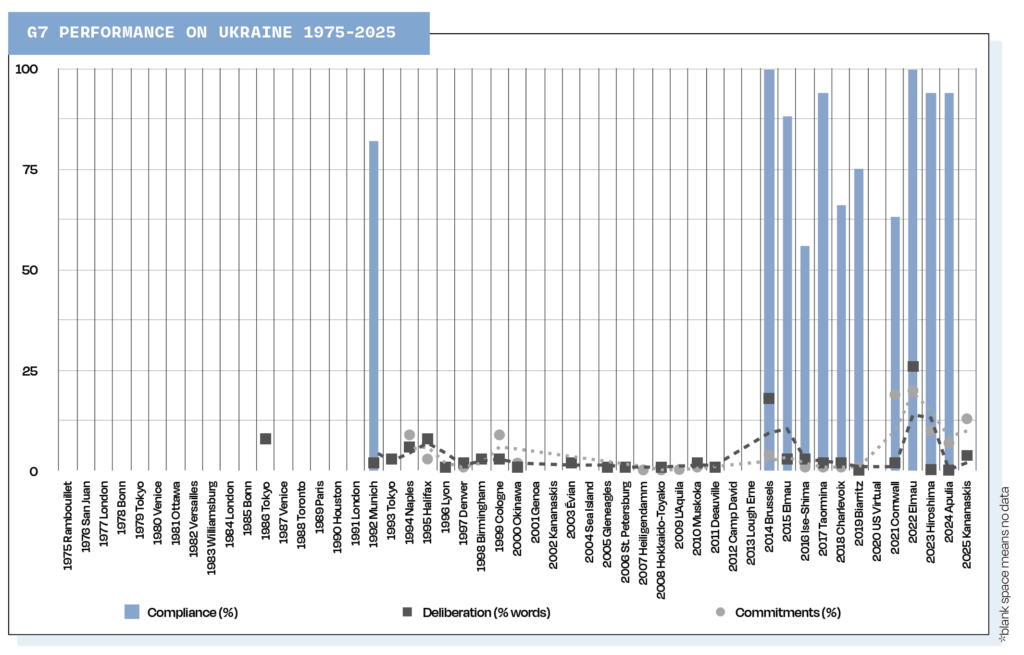
Over time, attention diminished, with no words on Ukraine in 2002, 2012 and 2013. However, after Russia’s invasion in 2014 and its suspension from the G8, attention resumed dramatically from 2014 to 2019, with a spike to 950 words in 2014. The second major wave from 2022 to 2024 peaked due to Russia’s full-scale invasion in 2022, with 2023 reaching an unprecedented 6,070 words. In proportional terms, attention to Ukraine peaked in 2022, when Ukraine accounted for 26% of all words produced across all six outcome documents produced at that summit. At the 2025 summit, the G7 members devoted 237 words to Ukraine.
Commitments
G7 leaders made 20 commitments on Ukraine from 1992 to 2013. Starting with six commitments in 2014 and 10 in 2015, they have since made 326 commitments to aid Ukraine in finance, energy and, most importantly, security. However, G7 action has been largely reactive to Russian actions.
At the 2014 summit, the G7 response to Russian aggression centred on verbal support for Ukrainian sovereignty and applying economic pressure on Russia through sanctions. In the following years, the focus shifted to diplomacy – the Normandy Format, the Trilateral Contact Group and the Minsk Agreements – as the front line largely froze, and G7 attention to Ukraine declined.
In 2022, after Russia’s invasion, G7 leaders made 107 commitments on Ukraine, responding with a decisiveness markedly different from prior years. Since then, their commitments have included stronger language: committing to support Ukraine militarily and in security terms “for as long as it takes.”
Compliance
G7 compliance with leaders’ commitments on regional security in Ukraine averaged 83%, based on the 19 commitments made between 1992 and 2024 assessed by the G7 Research Group.
For both 2014 and 2022, immediately after the shocks of the Russian invasions, all G7 members had 100% compliance. However, following the initial invasion, compliance declined to 88% for 2015 and dropped to the lowest ever at 56% for 2016. It increased to 94% for 2017, dipped again to 66% for 2018 and rose to 75% for 2019. No commitments were made on Ukraine in 2020, and compliance dropped again to 63% for 2021. The decline after 2022’s 100% was only to 94% for 2023 and 2024. By December 2025, compliance with the commitment assessed from the 2025 summit was 75%.
The European Union has achieved full compliance of 100% on all regional security commitments related to Ukraine, followed by the United Kingdom and the United States with 91% compliance each.
Recommendations
G7 compliance with the leaders’ commitments on Ukraine coincides with G7 foreign ministers’ activity. From 2014 to 2020, G7 foreign ministers met or issued statements an average of two times each year, with as many as six. G7 compliance with the leaders’ commitments on Ukraine for those years averaged 79%.
From 2021 to 2025, foreign ministers met or issued statements an average of 14 times, and never fewer than 11. Compliance with leaders’ commitments from 2021 to 2024 averaged 88%. To improve compliance, G7 leaders should have their foreign ministers continue to meet and issue statements frequently – at least monthly – as this is a relatively inexpensive measure directly under their control.
The Évian Summit is a crucial event for advocates of Ukraine, given the decline in military and financial support by the United States, the inconsistent rhetoric of the Trump administration and the rise of new wars in the Middle East.
Yet it is precisely this uncertainty that makes this year’s summit consequential: can G7 members reinvent themselves to consolidate their support for Ukraine?
The Évian Summit is a potential turning point. It presents an opportunity for G7 members to articulate a new vision of support for Ukraine – one that breaks the cycle of declining compliance beyond the immediate shock of crisis, moves towards more proactive rather than reactive engagement, and secures a more consistent and unified commitment among G7 members.