

By Dr. Alex Mercer
Germany's defence revival is often described as a budget story. More consequential, however, is that Berlin is trying to turn higher spending into a durable industrial system, in a country where defence procurement, export policy and capital allocation have historically pulled in different directions.
That matters well beyond Germany. In 2024, Germany's aerospace and defence revenues reached EUR 52 billion, while the UK remained the larger benchmark at GBP 100 billion, according to the US International Trade Administration's Germany aerospace, defence and security guide. The same source reports that roughly three quarters of German production was exported, and that revenues rose 13% year on year, crossing the EUR 50 billion threshold for the first time. The implication for allied planners is counterintuitive. Germany is no longer just a customer that needs equipment. It is increasingly a shaper of European supply, competition and production geography.
For G7 and NATO partners, the strategic question isn't whether the German defence industry is growing. It is whether Germany can convert political intent into reliable output, bankable production expansion and interoperable capability for allies. That challenge sits at the centre of wider debates about alliance burden-sharing, industrial sovereignty and the future of European deterrence. It also intersects with the wider discussion on global security and the G7's growing centrality, because Germany's industrial choices will now influence collective readiness, not merely national policy.
Table of Contents
- Introduction A New Era for German Defence
- The Scale and Structure of German Defence Production
- Navigating Procurement and Export Controls
- The Zeitenwende Industrial Strategy
- Technological Frontiers and Dual-Use Innovation
- Supply Chain Risks and Strategic Dependencies
- Actionable Recommendations for Multilateral Partners
Introduction A New Era for German Defence
The most important fact about Germany's defence turn isn't that it has spent more. It is that Berlin has started to define defence production as an instrument of national and allied security policy in its own right. That is a marked departure from the earlier pattern in which budgets, procurement, exports and industrial policy were often treated as separate political files.
Germany's post-2022 trajectory now has strategic weight because it combines rearmament with an explicit theory of industrial retention. That changes the policy conversation for partners. Allied governments can no longer look at Germany as a major European economy with underused defence potential. They have to assess it as an increasingly consequential producer whose choices will affect competition in aircraft, missiles, ammunition, digitalisation, AI and unmanned systems.
Germany's defence shift is best understood not as a temporary surge, but as an attempt to rebuild state confidence in long-cycle military production.
The resulting policy dilemma is straightforward. If Germany succeeds, Europe gains another deep industrial base able to support deterrence and sustainment. If Germany only partially succeeds, allies could face a more fragmented market, duplicated effort and persistent delivery bottlenecks despite larger aggregate budgets.
For summit-level audiences, that means the German defence industry should be read through three lenses at once. First, as an industrial scaling effort. Second, as a test of whether democratic states can restore munitions, shipbuilding and sovereign technology capacity under time pressure. Third, as a coordination problem for NATO and the G7, where national procurement choices can either reinforce or weaken collective resilience.
The Scale and Structure of German Defence Production
Germany is no longer only a demand-side story driven by higher budgets. It is becoming one of the few European states with the industrial breadth to influence alliance production capacity, export availability and technology choices at the same time.
That matters for NATO and G7 partners because German output sits at the intersection of three policy systems that rarely align perfectly: national procurement, European industrial cooperation and politically controlled arms exports. The result is an industrial base with real strategic mass, but also one whose contribution to collective defence depends on coordination rather than scale alone.
Scale matters less than composition
According to SIPRI's arms transfer database, Germany remains one of the world's leading arms exporters over the past five-year reporting periods. That position has strategic implications beyond headline ranking. Export experience gives German firms established channels into allied and partner markets, but it also means production planning is shaped by external demand, licensing timelines and multinational programme commitments.
For allied governments, the key point is structural. A producer with a large export footprint can support coalition rearmament, yet it can also transmit delays or policy restrictions across multiple partners at once. This is one reason German industrial policy now belongs in wider debates on G7 performance on governing arms control, not only in national budget discussions.
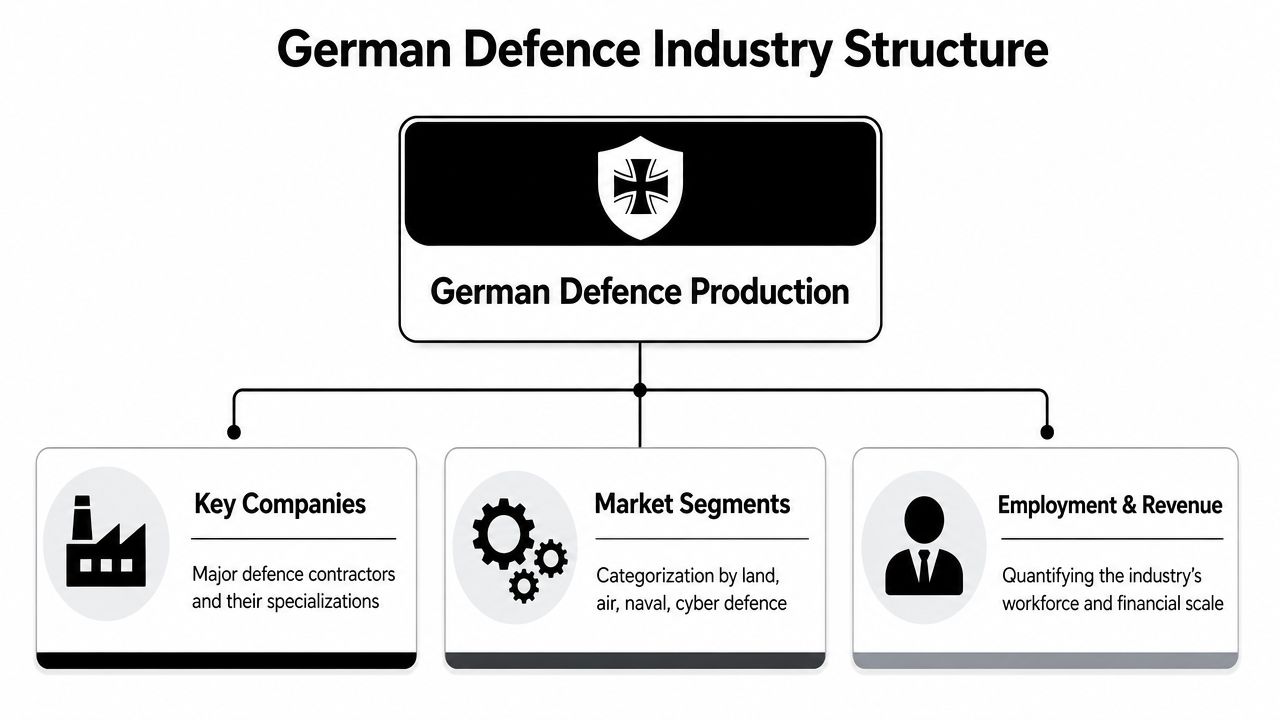
Industrial depth is equally important. The German Aerospace Industries Association reports employment and turnover data across the country's aerospace and security sectors that indicate a substantial engineering and manufacturing base rather than a narrow final-assembly model. For partners, this distinction matters. States that retain design, integration and supplier capabilities can expand output faster than states that rely mainly on imported subsystems or intermittent assembly work.
An industrial ecosystem with alliance relevance
The German defence industry is best understood as a distributed production system. Prime contractors are important, but delivery risk often sits further down the chain in propulsion, electronics, energetics, castings, software integration and specialist machining. That makes Germany more useful to partners than a simple firm-by-firm ranking suggests, because cooperation can occur at several layers of the value chain.
It also creates vulnerabilities. A broad industrial ecosystem can absorb shocks if orders are predictable and qualification processes are sequenced early. The same ecosystem can stall if ministries place large orders without synchronising testing capacity, skilled labour, component supply and export approvals. For NATO planners, this is the practical meaning of German scale. Capacity is real, but not automatically convertible into timely volume.
Leading German Defence Companies and Specialisations
| Company | Primary Specialisation | Key Products / Systems |
|---|---|---|
| Rheinmetall | Land systems, munitions, sensors | Armoured vehicles, ammunition, air defence-related systems |
| KNDS Deutschland | Land systems | Main battle tanks, tracked and wheeled armoured platforms |
| Thyssenkrupp Marine Systems | Naval shipbuilding | Submarines, naval vessels |
| Hensoldt | Sensors and electronics | Radar, optronics, electronic systems |
| Diehl Defence | Missiles and air defence | Missile systems, guided effectors |
| MBDA Deutschland | Missile systems | Missile and missile defence-related systems |
The distribution of these capabilities carries a non-obvious implication for partners. Germany's strategic value does not rest only on marquee platforms such as submarines, tanks or missile families. It rests on whether Berlin and its partners can preserve the supplier tiers, testing infrastructure and engineering teams that make repeat production possible over several procurement cycles.
Industrial implication: In Germany, sovereign capability often resides in design authority, subsystem integration and qualified suppliers, not only in final assembly.
For multilateral partners, the policy conclusion is straightforward. Working with Germany requires engagement below the prime-contractor level, especially in munitions, electronics, naval systems and air defence supply chains where bottlenecks are most likely to affect alliance readiness.
Navigating Procurement and Export Controls
Germany's procurement and export-control system is now a strategic filter on allied industrial cooperation, not an administrative detail. For G7, NATO and EU partners, the central question is no longer whether Berlin will spend more on defence. It is whether that spending can be translated into contracts, production runs and exportable programmes at alliance speed.
What international partners should assume about procurement
The practical obstacle is not a lack of political intent. It is the interaction between procurement law, parliamentary scrutiny, audit requirements and industrial policy. As noted earlier, Berlin is trying to create a longer demand horizon for industry. Yet foreign suppliers and partner governments should expect acquisition decisions to remain documentation-heavy, legally reviewable and closely tied to supply-security concerns.
That has three implications for international bidders and co-development partners.
- Treat timing as a strategic variable: German procurement often rewards firms that enter early, build a local compliance posture and prepare for long approval cycles.
- Design for auditability from the outset: Technical performance alone is rarely enough. Programmes also need traceable supply chains, credible through-life support and clear responsibility for sustainment.
- Assume industrial resilience will shape award decisions: If Berlin identifies a capability as sensitive for national or European security, procurement choices may favour retention of design authority, production know-how or key subcomponent access.
This creates a market with real scale potential, but also a higher threshold for entry than headline budget figures imply. For multinational consortia, that threshold can be met. It usually cannot be met late.
Export controls as a strategic variable
Export controls create the second filter, and in some cases the more consequential one. Germany's defence firms depend heavily on external markets, but export decisions remain politically sensitive, legally structured and vulnerable to coalition dynamics. Partners should therefore treat exportability as a programme design issue from the beginning, especially where German components could create downstream licensing dependencies for third-country sales.
The strategic effect reaches beyond individual licences. If a multinational system is assembled across several jurisdictions but one participant cannot provide predictable export approval, the commercial case for expanding production weakens. Capacity investments then stall, unit costs remain higher, and allied rearmament goals become harder to meet.
That wider policy context is already visible in debates over burden-sharing, transfer controls and alliance discipline, including broader analysis of G7 performance on governing arms control. The relevant lesson for partners is straightforward. Germany's export regime should be assessed as part of alliance capability planning, not treated as a national afterthought.
Joint programmes with Germany work best when partners align early on three questions: who buys, who controls key components, and where exports are politically acceptable.
For multilateral policymakers, the implication is clear. Procurement reform without greater export predictability will limit the strategic return on Germany's industrial expansion. The opportunity for allies is to address both together through earlier licensing coordination, shared programme governance and clearer rules for component control across joint production lines.
The Zeitenwende Industrial Strategy
Germany's industrial turn is now a coalition management issue for NATO and the G7, not just a national budget story. Berlin is building a defence industrial base with clearer strategic priorities, and partners will feel the effects through joint programmes, supply planning, technology cooperation and force posture decisions.
From exceptional funding to structural demand
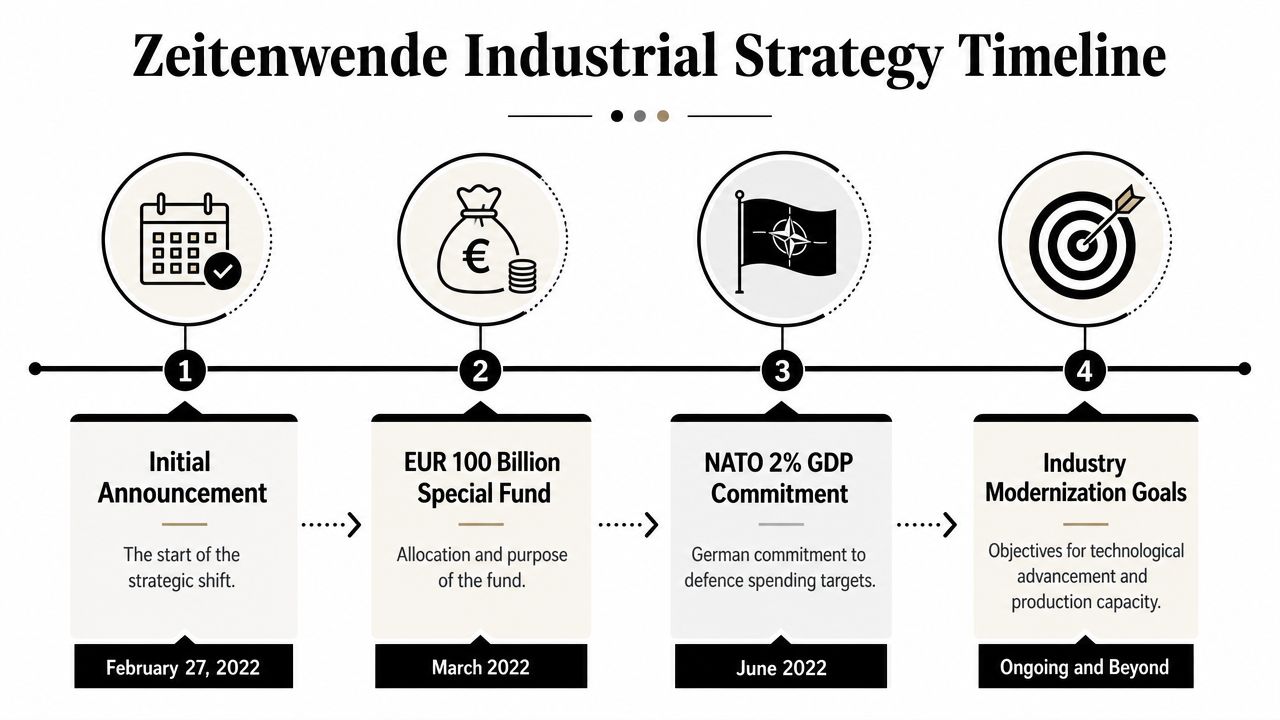
The fiscal shift began with Chancellor Olaf Scholz's 2022 decision to create a EUR 100 billion special fund for Bundeswehr modernisation and to push German defence spending above 2% of GDP. According to NATO's defence expenditure data, Germany reached the alliance benchmark in 2024 after decades below it. That matters because industry responds less to headline pledges than to the credibility of repeat orders, longer production runs and clearer procurement signals.
The policy question for allies is therefore narrower and more practical than the rhetoric around Zeitenwende often suggests. Can Germany convert temporary financial acceleration into stable demand for the parts of the industrial base that matter most to European deterrence?
Why the key-technologies list matters
The more consequential step is Berlin's decision to define industrial priorities explicitly in the Federal Government's National Security and Defence Industry Strategy. The strategy identifies military and security-relevant IT and communications, AI, naval shipbuilding, protected and armoured vehicles, sensor technology, protection systems and electromagnetic warfare as core national technologies. It also classifies quantum technologies, missiles and missile defence, space technologies, ammunition and unmanned systems as strategically important for supply security.
This is a hierarchy of sovereignty, not a neutral catalogue. Berlin is signaling which capabilities it wants to retain, where foreign dependence is politically harder to accept, and which production segments are likely to receive stronger state attention.
That creates several implications for partners.
First, Germany is becoming more selective about where industrial autonomy matters most. Naval systems, protected mobility, sensors and electronic effects are likely to carry greater weight in future programme choices than a simple spending total would suggest.
Second, the supply-security categories deserve as much attention as the headline technology list. Ammunition, missiles, space assets and uncrewed systems are precisely the areas where allied stockpiles, production capacity and operational demand remain under strain. If Germany expands output in those segments, the strategic value extends well beyond the Bundeswehr.
Third, industrial cooperation with Germany will increasingly require alignment on regulation as well as capability. Firms working across civil and military markets must manage export controls, investment screening and technology transfer rules while complying with dual-use rules. For multinational partners, that makes early governance design part of industrial strategy rather than a legal afterthought.
The broader political constraints behind this shift are examined in this analysis of the challenge of the Zeitenwende. The industrial conclusion is straightforward. Germany is trying to convert fiscal credibility into technological staying power, and allied governments should treat that effort as a platform for coordinated production planning, not as a purely domestic rearmament programme.
Technological Frontiers and Dual-Use Innovation
Germany's strategic technology agenda is now broad enough to cut across classic defence manufacturing and the wider innovation economy. That creates opportunities for allied collaboration, but it also introduces governance friction that Germany has not fully resolved.

Where Germany is concentrating strategic attention
The official technology categories already show where pressure will build. AI, military-relevant IT and communications, space technologies, unmanned systems and sensor-heavy capabilities all sit close to the dual-use boundary. They draw talent, capital and supply chains from civilian sectors, yet their military utility can rise quickly once integrated into operational concepts.
That has two consequences for NATO and G7 cooperation. First, the most important industrial partnerships may no longer look like traditional platform programmes. They may revolve around software layers, autonomy stacks, sensor fusion, electronic protection or manufacturing processes for energetics and specialised materials. Second, collaboration timelines may accelerate in some technology areas while procurement timelines remain slow. That mismatch can frustrate both ministries and firms.
The fastest-moving part of the German defence industry may not be heavy manufacturing. It may be the interface between software, sensors and autonomy.
The dual-use governance problem
Germany's caution becomes most visible where civilian innovation begins to acquire military relevance. Export control systems built around conventional categories can struggle when the same enabling technology can serve industrial automation, satellite applications or battlefield decision support.
For companies and public officials working across borders, operational literacy on compliance is becoming part of industrial strategy. Teams handling advanced electronics, AI-enabled systems or research collaborations increasingly need a working understanding of complying with dual-use rules, because product design, data-sharing and licensing questions often emerge long before a final procurement decision.
A second challenge is organisational. Civilian technology firms often move on venture timelines and expect fast iteration. Defence customers require certification, security controls and sustainment assurances. Germany's policy success will depend in part on whether it can bridge those cultures without losing either speed or accountability.
A useful illustration of the wider innovation environment is below.
For allies, the strategic implication is clear. The next phase of cooperation with Germany shouldn't be confined to platforms. It should include the rules, test environments and procurement pathways that allow dual-use innovation to reach deployable military form.
Supply Chain Risks and Strategic Dependencies
The prevailing narrative suggests that once political will and budgets align, industrial output will follow. Germany's experience points to a harder truth. The bottlenecks that matter most often sit outside headline procurement debates.
The financing constraint is now central
A key underexamined issue is capital formation. The Atlantic Council argues that Germany is building a military-industrial complex “from scratch” and experimenting with public money, commercial banking and private capital, as discussed in its analysis of Germany's defence build-up. The strategic question isn't just whether factories can be expanded. It is whether firms and investors believe future demand is credible enough to justify long-cycle commitments.
That distinction matters. Governments can announce programmes faster than suppliers can finance tooling, workforce growth, inventory buffers and production lines. If procurement certainty remains uneven, firms will rationally protect balance sheets rather than over-expand.
Decision test: If a supplier can't see stable orders, it won't invest at the speed ministers want, regardless of the urgency of public rhetoric.
Production scale depends on industrial inputs, not rhetoric
Germany's formal strategy places heavy emphasis on technologies where throughput constraints are severe. Ammunition, missile-related production, sensors, protected vehicles and naval work all rely on specialised components, testing capacity and qualified labour. Those aren't problems that disappear through declarations of intent.
For policymakers, this has two practical implications.
- Supply-chain resilience should be treated as programme design: Multinational projects need mapping of critical subcomponents and qualification dependencies from the outset.
- Advanced manufacturing capability deserves more attention: Tools that accelerate materials discovery and process optimisation may matter upstream. Work on AI in materials science is a useful example of the kind of enabling knowledge base relevant to defence manufacturing bottlenecks.
The deeper conclusion is uncomfortable but important. Germany may have enough industrial talent and demand to grow substantially, yet still fall short of allied expectations if financing, supplier qualification and key inputs remain misaligned.
Actionable Recommendations for Multilateral Partners
Germany's defence-industrial expansion will shape allied force generation well beyond its national market. For G7, NATO and EU partners, the policy question is no longer whether Germany matters more. It is how to convert German scale into collective capacity without creating new bottlenecks in procurement, export policy or supply chains.
As noted earlier, Berlin's higher spending trajectory is now large enough to affect production priorities, subcontracting patterns and competitive dynamics across Europe. Left to national procurement cycles alone, that shift could fragment demand and intensify rivalry for skilled labour, components and test capacity. Managed well, it could do the opposite. It could anchor a more interoperable and resilient transatlantic industrial base.
Four practical priorities
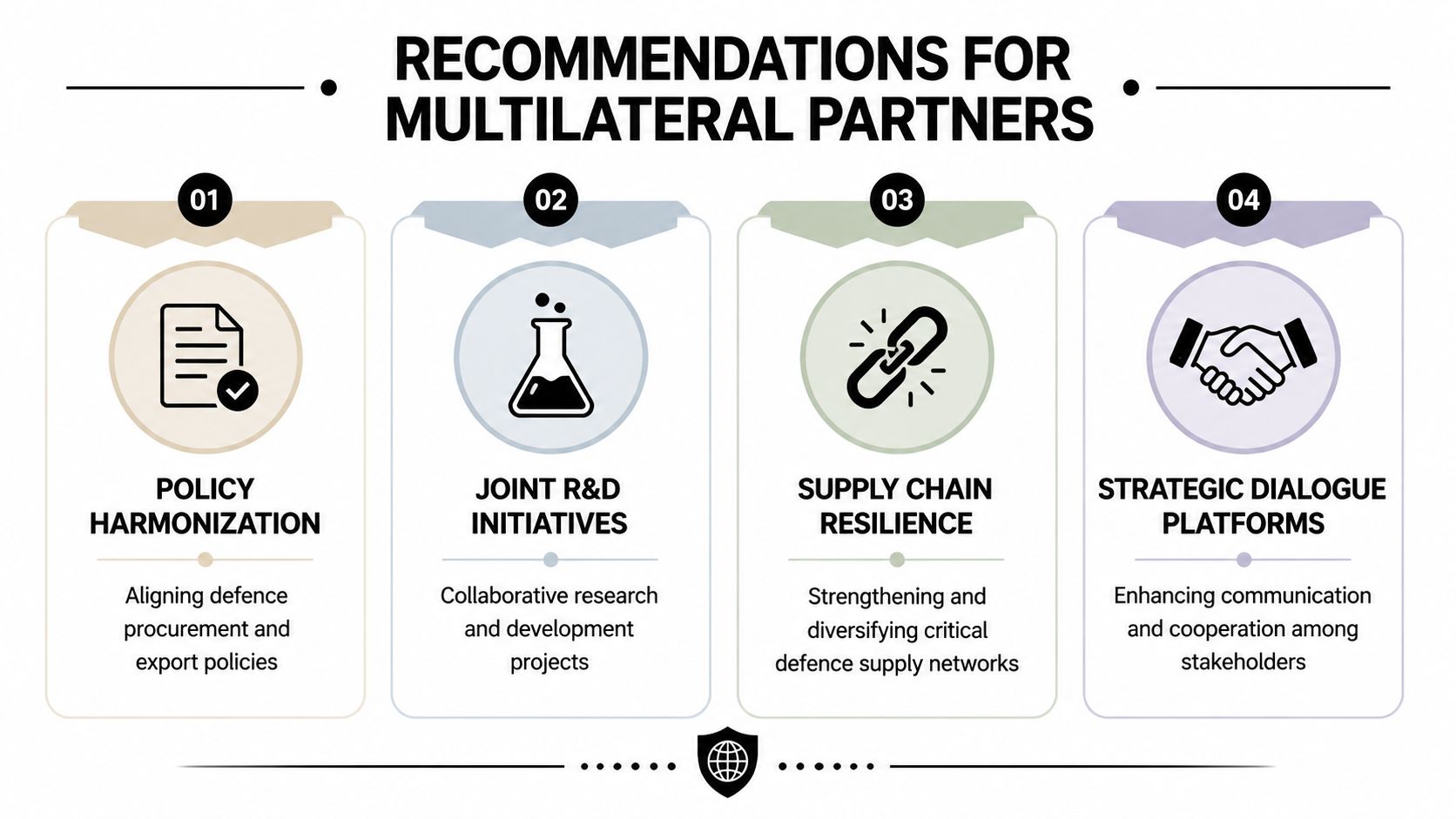
First, partners should align procurement planning with export-control policy at the start of multinational programmes. Too many cooperative projects still treat exportability, re-export permissions and sustainment access as downstream legal questions. They are strategic design variables. If governments do not reconcile them early, joint production will continue to produce political friction precisely when surge demand is highest.
Second, allies should use joint R&D, prototyping and test infrastructure more selectively. The strongest gains are likely to come in areas where software integration, mission systems, sensors, autonomy and subsystem certification determine programme speed more than final assembly does. That points to a division of labour in which German industry is integrated as part of a wider allied innovation chain, rather than treated only as a prime contractor base.
Third, NATO and G7 governments need a shared method for classifying industrial dependencies. Some German capabilities should be distributed across allied production networks to reduce concentration risk. Others will remain nationally protected or politically sensitive, which means partners need parallel sourcing plans and pre-agreed contingency arrangements. The strategic error would be to assume that all interdependence is either efficient or safe. Some of it will be productive. Some of it will be a vulnerability.
Fourth, strategic dialogue should include industry, commercial lenders and institutional investors, not only defence ministries and procurement agencies. If firms face uncertain order books, slow contracting and uneven financing conditions, production targets will remain aspirational. Security planning therefore needs a capital-market dimension. Multilateral coordination on demand signals, contract duration and co-financing structures would do more to raise output than another round of declaratory ambition.
The broader implication is strategic. Germany is becoming a central variable in Western industrial security, moving beyond being a large national buyer with important neighbours. Partners that adapt first will treat German industrial growth as a coordination problem to solve collectively. That is how a national rearmament effort becomes allied military advantage.
For more policy analysis like this, explore Global Governance Media, where summit-focused coverage connects defence, industrial policy and multilateral strategy for decision-makers across the G7, G20 and allied institutions.