


By Eleanor Hart
The most consequential digital identity systems often become politically visible only after they've already been embedded in critical infrastructure. That's why IdentityMind Global deserves closer scrutiny. In the financial sector, its patented eDNA™ technology has been cited in an Oracle compliance case study as reducing client onboarding fraud by up to 35% and transaction fraud by 28% in UK-regulated financial institutions through real-time, risk-based authentication and dynamic scoring across transactions such as onboarding, money transfers, and online payments (Oracle compliance case study). The counterintuitive part is this: a tool associated with private-sector fraud controls may have equally important implications for public sector integrity, especially where governments struggle to verify who is accessing funds, services, or regulated research pathways.
That matters because digital identity is no longer a narrow technical issue. It sits at the intersection of state capacity, market trust, sanctions enforcement, anti-money laundering controls, and the legitimacy of cross-border governance. When identity verification fails, public institutions don't just lose efficiency. They lose their ability to distinguish legitimate participation from organised abuse.
Table of Contents
- The New Frontier of Global Trust
- The Evolution of a Digital Identity Gatekeeper
- How eDNA Technology Maps Digital Identities
- Real-World Impact Across Regulated Sectors
- Navigating Global Regulatory and Governance Hurdles
- Unseen Risks and Untapped Public Sector Potential
- Actionable Recommendations for Multilateral Actors
The New Frontier of Global Trust
Digital identity has become a hidden layer of global order. Banks, payment processors, online platforms, and public agencies all depend on the same basic judgement call: can this person, entity, or transaction be trusted enough to proceed?
That judgement now shapes more than customer onboarding. It affects sanctions compliance, financial stability, public procurement integrity, humanitarian disbursement safeguards, and the credibility of international data-sharing arrangements. In practice, systems like IdentityMind Global form part of the private infrastructure through which states and firms police access to economic participation.
A useful way to understand the shift is to stop treating identity as a document problem. It's increasingly a relationship problem. What matters isn't only whether a passport image looks authentic. It's whether a pattern of behaviour, linked data points, and transactional context together suggest legitimacy or manipulation. That's one reason debates about trusted digital ecosystems now sit close to broader discussions about trust-based societies.
Trust now operates as infrastructure
The strategic significance of IdentityMind Global lies in the fact that it doesn't merely verify a claimant at a single moment. It sits inside a wider architecture of risk management and compliance automation. That changes the policy lens. Governments can't assess such tools only as vendor products. They have to assess them as components of governance capacity.
Practical rule: When a private identity platform influences access to payments, services, or regulated activity, public officials should treat it as governance infrastructure, not just as software procurement.
The international affairs dimension takes on greater significance. Cross-border commerce and cross-border crime both depend on digital intermediaries. The same capability that helps a regulated institution screen risk during onboarding can also shape how states think about fraud prevention in welfare systems, procurement chains, and health research administration.
Identity systems are becoming policy objects
Policymakers often discuss digital identity as if national ID schemes and border systems are the core issue. They're not the whole issue. Commercial compliance tools increasingly mediate who gets trusted in the first place, especially in sectors where regulators demand evidence of ongoing due diligence.
IdentityMind Global therefore offers a revealing case study. It shows how a private compliance platform can become relevant to questions of public authority, even when its original market logic was commercial.
The Evolution of a Digital Identity Gatekeeper
IdentityMind Global did not emerge as a public policy institution. It emerged as a market response to rising compliance pressure, online fraud, and the need for platforms to make fast, defensible risk decisions.
From startup to compliance infrastructure
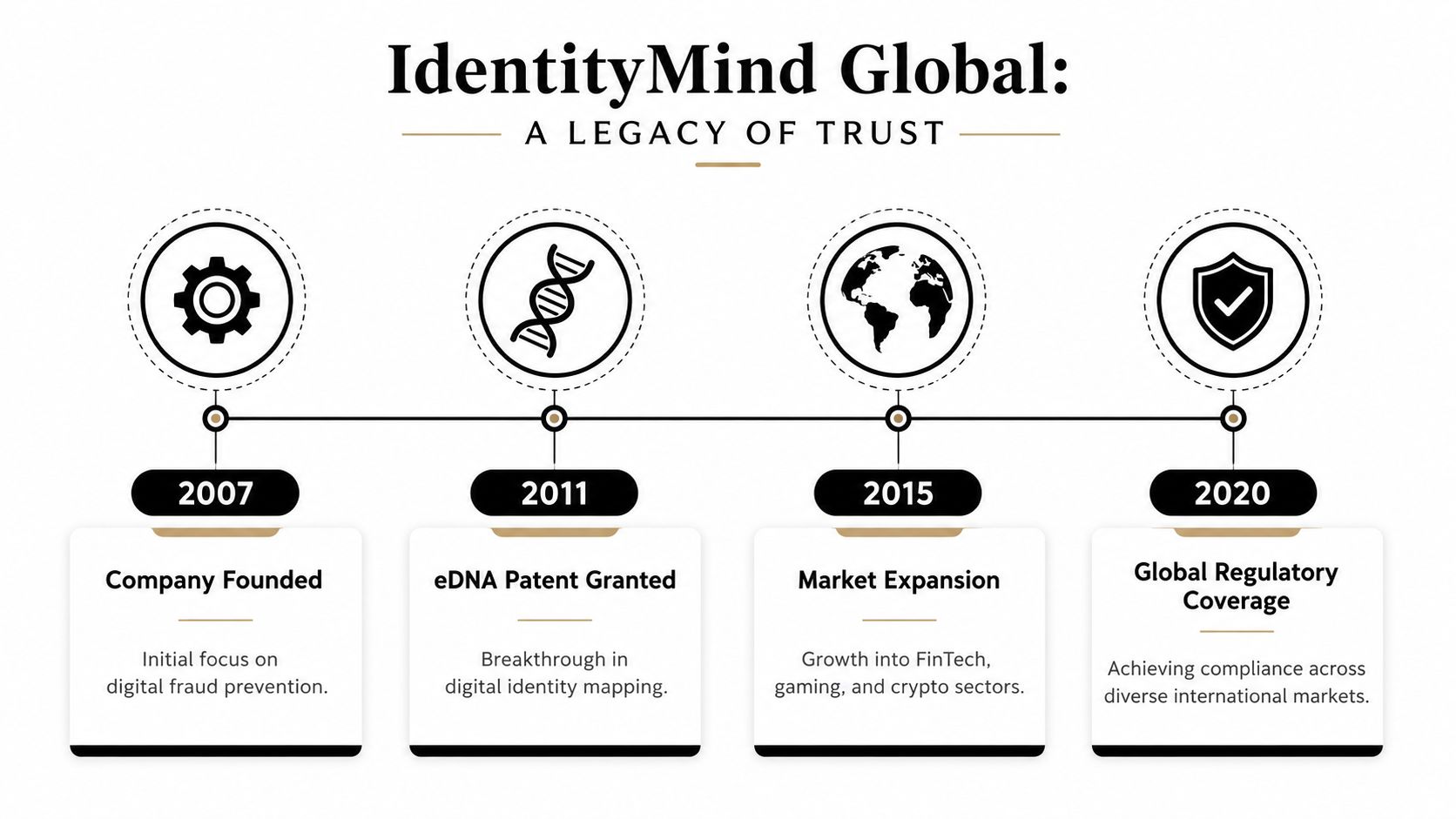
The company was founded in 2013 and raised $21.5 million across three funding rounds before its acquisition by Acuant, a milestone that positioned it as a significant player in online risk management and compliance automation (Finovate on the Acuant acquisition). Those details matter because they place IdentityMind Global inside the first mature wave of RegTech, when investors, regulators, and financial institutions all started looking for tools that could reduce fraud without paralysing user onboarding.
Its growth also reflected a structural change in compliance itself. Institutions no longer wanted identity checks that behaved like isolated checkpoints. They wanted systems capable of building continuity across fragmented interactions. That demand helped create a market for persistent digital identity analysis rather than one-off verification.
A related lesson appears in adjacent identity environments. Enterprise identity migrations, for example, often expose hidden dependencies and control failures, as outlined in Ollo's analysis of tenant migration risks exposed. The parallel is instructive. Whether the setting is enterprise access or customer risk, identity systems become strategically important when organisations discover how much trust depends on data continuity and governance design.
Why that trajectory matters for policymakers
IdentityMind's corporate evolution also mirrors a larger concentration trend. Specialist firms that build trust and compliance infrastructure often begin as niche vendors. They later become embedded in larger identity and verification ecosystems through acquisition, partnership, or platform consolidation.
That should interest officials tracking digital sovereignty. When compliance infrastructure concentrates, policy influence shifts. Governments and regulated entities may gain better tools, but they can also become more dependent on a smaller number of intermediaries for risk judgements that affect market access. That is one reason debates about digital public infrastructure in major economies, including India's digital public infrastructure and the G20, have become strategically relevant far beyond payments.
The politics of identity technology rarely start with ideology. They start with procurement, interoperability, and institutional dependency.
IdentityMind Global's rise tells decision-makers something important. Trust infrastructure doesn't stay private in its consequences, even when it starts private in its ownership.
How eDNA Technology Maps Digital Identities
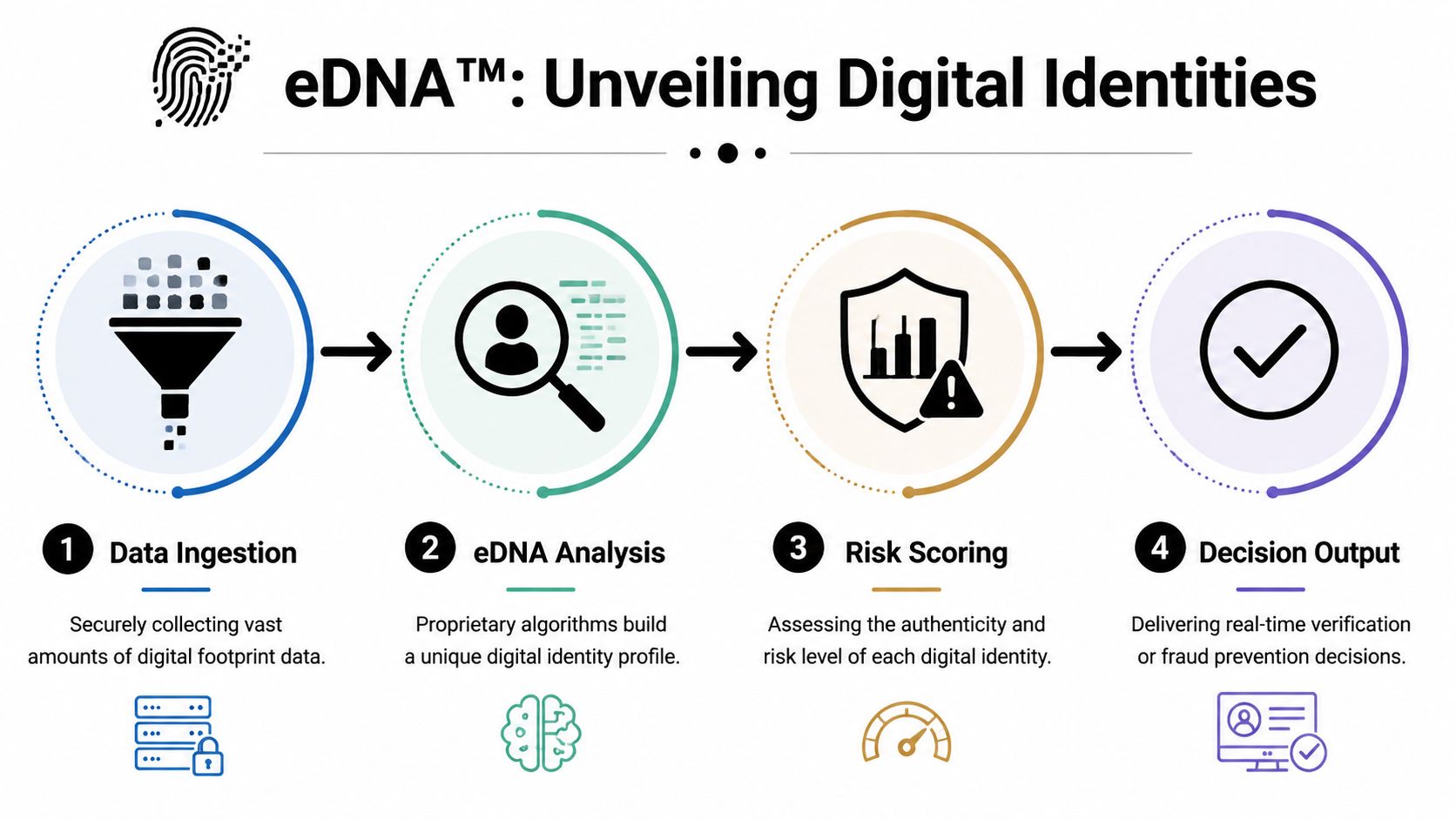
The central idea behind eDNA™ is easier to understand if you think of it as a live trust profile rather than a static ID check. Traditional verification asks whether submitted credentials appear valid at a specific moment. eDNA works more like a continuously updated risk model built from linked signals across digital activity.
A digital trust profile rather than a static ID check
IdentityMind Global has built a library of over 215 million digital identities, using machine learning and diverse algorithms to weave and analyse those identities for enterprise risk management and compliance automation (CIOReview company profile). That scale matters because digital identity systems become more useful when they can compare a new interaction against a large body of prior patterns.
In practical terms, the platform assembles a digital identity from multiple signals. The request brief points to examples such as email, phone, IP address, device information, and payment details. The policy significance lies in how those signals are synthesised. A single data point may prove very little. Their combination can reveal consistency, anomaly, reuse, or synthetic construction.
How the system produces a live risk view
A simplified version of the process looks like this:
- Signals enter the system from transactions or onboarding events.
- The platform links those signals to an existing profile or identifies a new pattern.
- Algorithms analyse the relationship between attributes, behaviours, and known risk indicators.
- A dynamic risk score is generated to support decisions on whether to allow, review, or reject an activity.
This architecture matters for regulators because it changes compliance from a paperwork exercise into a behavioural assessment model. It also changes the evidentiary basis of trust. Instead of asking, “Is this document acceptable?”, institutions ask, “Does this digital identity behave like a legitimate participant over time?”
A short comparison helps clarify the distinction:
| Approach | Primary question | Typical weakness | Governance implication |
|---|---|---|---|
| Static ID check | Is this credential valid now? | Can miss linked fraud patterns | Easier to audit, weaker against adaptive abuse |
| Dynamic risk scoring | Does this identity look trustworthy across interactions? | Harder to explain in simple terms | Stronger prevention, higher accountability burden |
That's why systems like this matter in border, migration, and transnational enforcement debates, including concerns explored in work on biometrics and data ensuring the safety of transnational borders. The issue isn't only data collection. It's the institutional power created when many weak signals are combined into a strong judgement.
A dynamic identity score can improve screening, but it also creates a new policy question. Who gets to define what suspicious behaviour looks like?
For decision-makers, that's the core tension. eDNA can reduce uncertainty at speed. It can also move consequential decisions into an analytical layer that citizens, auditors, and even frontline officials may struggle to inspect.
Real-World Impact Across Regulated Sectors
Identity risk scoring is no longer a banking tool with limited policy relevance. It is becoming part of the operational backbone for any regulated system that must decide, quickly and repeatedly, which actors, transactions, and claims deserve trust under legal scrutiny.
What the UK financial evidence shows
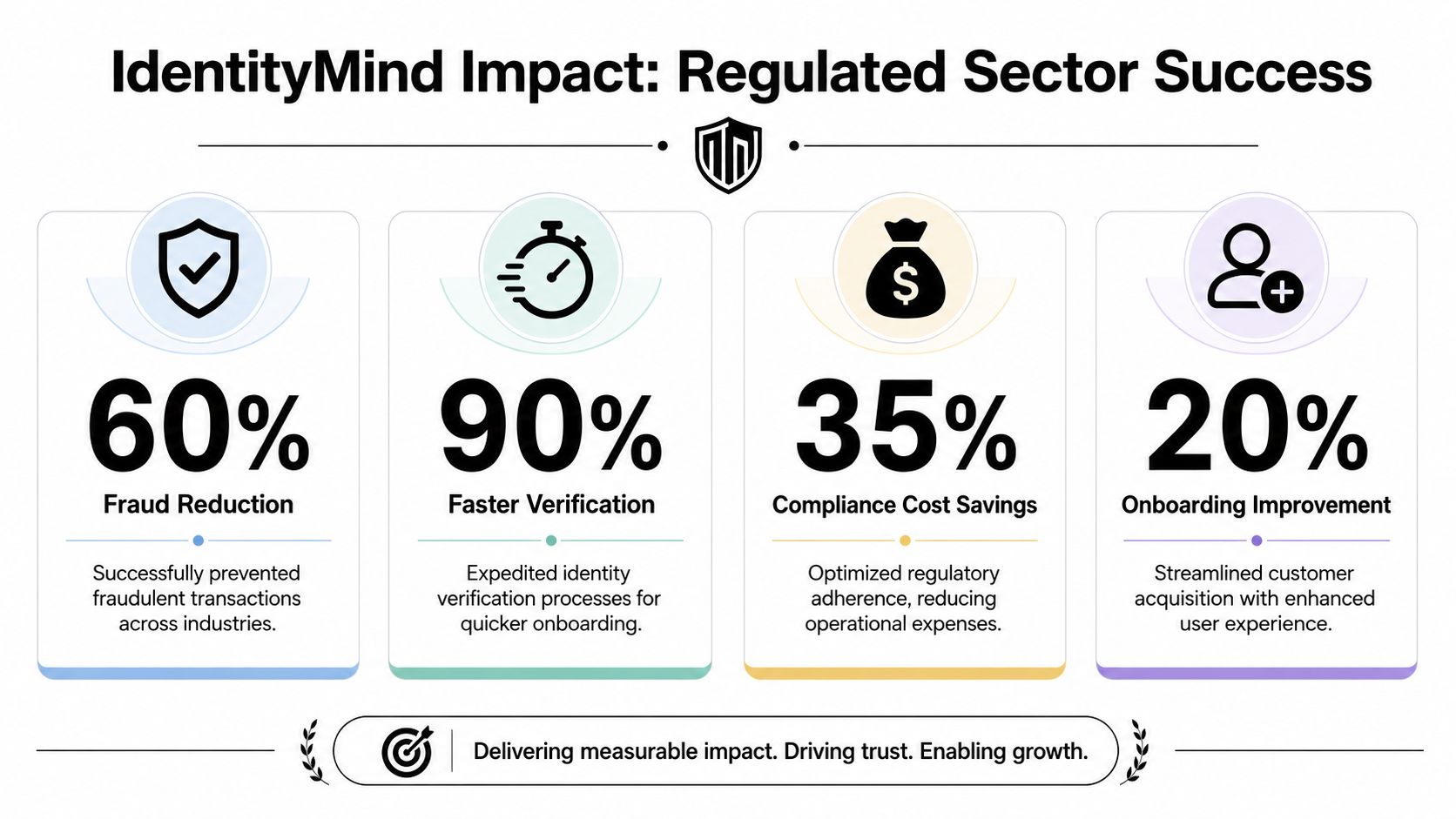
The clearest UK-linked evidence in the source set comes from the Oracle case study cited earlier. It reports that IdentityMind Global's eDNA technology supports real-time, risk-based authentication across onboarding, money transfers, and online payments, with measurable reductions in both onboarding fraud and transaction fraud in UK-regulated financial institutions.
The strategic point is narrower, and more useful, than typical vendor claims suggest. The evidence does not establish that dynamic identity analytics remove fraud from a system. It indicates that embedding risk scoring into live operational workflows can improve control performance in sectors where compliance decisions must be documented, reviewed, and defended. For supervisors and regulated entities, that distinction matters because the value lies not only in lower losses, but in better traceability around why a case was escalated, paused, or cleared.
That has direct relevance beyond finance.
Where the model travels well
Public discussion of IdentityMind often stops at payments fraud. A more consequential application may sit in public sector integrity functions that face similar verification problems but receive less analytical attention.
Public health financing is one example. Ministries, insurers, and donor-funded programmes must screen providers, intermediaries, and claims across fragmented databases, cross-border payments, and recurring transactions. A dynamic identity risk score could help flag suspicious provider behaviour, repeated anomalies across reimbursement channels, or linked entities that appear legitimate in isolation but form a higher-risk pattern when viewed together.
Clinical trial compliance presents a second case. Trial sponsors, contract research organisations, and regulators need to verify investigators, sites, vendors, and payment flows across jurisdictions. In that setting, identity analytics could support checks on site legitimacy, detect unusual coordination between actors, and strengthen oversight of participant compensation or procurement relationships that may otherwise escape notice until after a compliance breach.
These are not theoretical edge cases. They are governance environments with high documentation burdens, repeated interactions, and serious consequences when weak controls distort public outcomes.
Why some regulated sectors gain more than others
Adoption tends to produce stronger results where three conditions are present. First, institutions already operate under formal review and audit requirements. Second, they manage repeat interactions rather than one-time checks. Third, they face meaningful harm from concealed relationships across entities, accounts, or transactions.
| Sector condition | Why eDNA-style scoring matters |
|---|---|
| Ongoing KYC and AML obligations | Supports continuous review instead of one-off verification |
| High-volume remote onboarding | Helps compliance teams prioritise cases quickly |
| Multi-step transaction journeys | Connects events that may look low-risk when viewed separately |
| Public reimbursement or grant disbursement | Can expose linked anomalies across providers, beneficiaries, and intermediaries |
| Cross-border research and procurement networks | Can surface integrity risks that span multiple legal entities and jurisdictions |
A hospital payment scheme, a research consortium, and a digital bank do not share the same mission. They do share an operational problem. Each must judge trust across incomplete records, multiple counterparties, and time-sensitive decisions.
Better identity controls change how institutions allocate scrutiny, justify intervention, and define acceptable uncertainty.
For policymakers, that is the main cross-sector implication. The strongest near-term use case for identity risk scoring may not be another marginal improvement in retail banking controls. It may be the extension of these methods into public systems where fraud, collusion, and compliance failure undermine health spending, research credibility, and administrative legitimacy at much larger social cost.
Navigating Global Regulatory and Governance Hurdles
The usual assumption is that stronger identity analytics automatically produce better governance. They don't. They produce trade-offs. Each gain in visibility, continuity, and risk detection raises a corresponding question about lawful use, accountability, and jurisdiction.

Security needs and sovereignty claims
Cross-border identity systems rely on data flows, analytical consistency, and shared risk language. But governments often insist on local legal control over personal data, compliance records, and automated decision pathways. That tension doesn't disappear when a vendor performs well. It becomes sharper.
For a platform like IdentityMind Global, the governance challenge sits in the overlap between private compliance logic and public law. One jurisdiction may prioritise anti-fraud monitoring. Another may focus on privacy, data minimisation, or procedural rights. A multinational institution using the same identity stack across markets has to reconcile those differences in operational terms, not just legal theory.
That is why digital identity governance has become an international relations issue. States aren't merely regulating tools. They're contesting how trust should be produced, who may hold the data, and what degree of machine-assisted inference is acceptable.
Governance questions that procurement teams miss
Public agencies and regulated firms often focus procurement on capability. They ask whether a platform can detect fraud, support screening, and integrate into workflows. They ask less often whether the institution can govern the consequences of those functions.
The harder questions include:
- Auditability. Can officials explain why a person or transaction was flagged?
- Appeal routes. If an identity score shapes access to services or funds, what recourse exists?
- Data lineage. Which inputs influenced a judgement, and can they be independently reviewed?
- Jurisdictional control. Where are sensitive records processed, retained, and challenged?
Security without procedural legitimacy creates a governance deficit, not a governance solution.
There is also an asymmetry worth noting. Large institutions can usually negotiate controls, oversight clauses, and integration standards. Smaller agencies often can't. That means governance quality may depend less on the technology itself than on the buyer's institutional maturity. For international organisations and ministries, the policy task isn't only to adopt better identity tools. It's to build the legal and administrative capacity to supervise them.
Unseen Risks and Untapped Public Sector Potential
Identity risk scoring may matter more for state integrity than for consumer finance. The strategic significance of IdentityMind Global becomes clearest where weak verification distorts public spending, undermines research governance, and erodes confidence in health institutions.
Public debate still treats these systems mainly as anti-fraud infrastructure for banks and payment firms. That framing is too narrow. In ministries of health, donor-funded procurement programs, and clinical research networks, the core problem is not only financial loss. It is whether public authorities can verify who is receiving funds, submitting claims, enrolling in studies, or interacting with regulated systems without creating new forms of opaque exclusion.
Public health and research compliance are the overlooked stress test
Health financing and clinical trial administration expose a harder governance problem than retail fraud does. They combine sensitive personal data, fragmented institutional workflows, cross-border actors, and high political stakes. A false negative can let manipulation pass unnoticed. A false positive can delay treatment, interrupt reimbursement, or cast doubt on valid research activity.
That makes digital identity scoring attractive to public administrators. A tool such as eDNA can connect dispersed signals across accounts, devices, transactions, and interactions, then flag anomalies for closer review. In public health financing, that logic could help identify duplicate claims, synthetic provider identities, or payment patterns that warrant audit. In clinical research, it could support checks on participant identity continuity, site-level irregularities, and suspicious changes in submission behavior across compliance systems.
The policy opportunity is real. So is the institutional risk.
For readers assessing adjacent control models, Suby on payment fraud prevention offers a useful comparison point. Its payment-focused analysis shows how detection logic built for transactional risk can migrate into much broader trust decisions once public institutions adopt it.
The main risk is administrative drift
The more pressing question is whether public authorities can confine identity scoring to narrow integrity functions, or whether it will gradually shape broader judgements about eligibility, credibility, and access. That shift often happens through routine administration rather than explicit political decision.
Three risks deserve particular attention:
- Function expansion. A system procured to detect fraud in reimbursements or grant flows can begin influencing decisions about enrolment, access, or institutional eligibility.
- Context loss. Risk scores built from fragmented digital traces may miss the operational realities of hospitals, trial sites, local intermediaries, or low-capacity service environments.
- Privatised judgement. Vendors may end up setting de facto thresholds for suspicion inside public programs, even when legal accountability remains with the state.
These concerns are sharper in health than in banking because the consequences extend beyond account security. They affect public expenditure, patient access, scientific credibility, and trust in regulatory oversight.
The underappreciated implication is that public administration may become the decisive arena for judging this technology's legitimacy. Finance served as the testing ground. Public health financing and clinical trial compliance are where governments will discover whether identity analytics can support integrity without weakening due process or democratic control.
Actionable Recommendations for Multilateral Actors
G7, G20, and multilateral institutions shouldn't treat platforms like IdentityMind Global as niche compliance products. They should treat them as part of the emerging architecture of transnational trust.
Three actions follow from that judgement.
First, develop common governance standards for risk-scored digital identity systems. Those standards should cover auditability, redress, procurement transparency, and minimum documentation for machine-assisted decisions. Without shared baselines, states will import private-sector tools into public systems with uneven safeguards.
Second, separate legitimate public-interest use from unchecked expansion. Multilateral guidance should distinguish narrowly focused fraud prevention functions from broader behavioural profiling. That line matters most in high-sensitivity sectors such as health, migration, and social protection.
Third, build public-sector capability, not just vendor dependence. Ministries and international organisations need in-house legal, technical, and oversight expertise to evaluate identity scoring systems before adoption and during operation. Procurement alone won't solve governance problems.
A final principle should guide all three. Public trust can't be outsourced. Private platforms may support enforcement, screening, and compliance, but elected governments and accountable institutions remain responsible for the rules under which those tools operate.
The choice facing policymakers isn't whether digital identity analytics will shape global governance. They already do. The real question is whether multilateral actors will define the terms early enough to preserve legitimacy while still capturing the gains in security and integrity.
Global Governance Media helps decision-makers turn complex questions like digital identity, public integrity, and cross-border governance into practical policy choices. Explore Global Governance Media for analysis, interviews, and data-led reporting that support more resilient and accountable international cooperation.