


By Dr Eleanor Marsh
The most important fact in the current debate over the income of middle class households is how little movement there has been where it matters most. In the UK, middle-class real median incomes rose by only 0.7% annually between 2007/08 and 2022/23, while the top decile saw 2.1% annual growth, according to the Office for National Statistics on household disposable income and inequality. That is not a routine distributional shift. It is a warning that the social contract underpinning advanced economies is weakening.
For G7 and G20 leaders, this matters well beyond household welfare. A broad and stable middle class supports consumption, tax capacity, social mobility, and trust in institutions. When that group fragments, economic policy starts producing weaker political consent. The result isn't only slower growth. It is also sharper territorial divides, more volatile electoral behaviour, and less room for governments to manage the green and digital transitions.
Table of Contents
- The Middle Class at a Crossroads
- Defining and Measuring the Global Middle Class
- Global Trends of a Squeezed Middle
- Analysing the Drivers of Income Stagnation
- Evaluating G20 Policy Levers for Inclusive Growth
- The Next Frontier AI and the Fracturing Middle Class
- A New Compact for the Middle Class G20 Recommendations
The Middle Class at a Crossroads
Across the G7, headline income growth has too often masked a harder regional reality. In several major economies, households near the middle still sit above poverty thresholds and below top-income gains, yet many no longer convert work into security with the consistency that defined the post-war middle class.
The policy implication is larger than household finance. Middle-income households anchor consumption, tax capacity, skills formation, and political trust. When their position weakens, governments face slower domestic demand, lower mobility, and sharper pressure on fiscal transfers to cover costs that labour income no longer meets. That places the income of middle class households at the centre of debates on resilience, productivity, and social cohesion across the G7 and G20, including wider concerns about progress on the Sustainable Development Goals.
The UK illustrates the broader pattern already noted earlier in this article. Median households saw much weaker income progress than top earners over the period after the global financial crisis. This pattern indicates more than a cyclical slowdown. It points to a structural failure to convert aggregate growth into broad-based middle-income security.
Why this is now a governance issue
National averages are an increasingly poor guide for policy design.
A household does not experience the economy as a national median. It lives in a specific region, faces a local housing market, relies on local public services, and works in an occupation exposed to different forms of automation. A middle-income family in a high-cost metropolitan area can face pressures that look closer to economic insecurity than to stability, even when national statistics suggest relative resilience.
This divergence is widening as AI changes the composition of middle-income work. The main risk is not uniform job loss. It is job polarisation within the middle itself. Workers in routine professional, administrative, and clerical roles face a different outlook from households whose earnings are supported by scarce technical skills, bargaining power, or assets. Blanket tax relief or economy-wide transfer measures therefore miss a growing share of the problem because they are not calibrated to place, sector, or task exposure.
Practical rule: If a middle-class strategy is not spatially targeted and labour-market specific, it will miss many of the households now under the greatest pressure.
That is why current frameworks are falling behind. They were built around a more uniform middle class and a simpler distinction between poverty and prosperity. The emerging policy challenge is internal fragmentation within the middle, across regions, sectors, and occupations. For G7 and G20 leaders, the test is no longer whether average incomes rise. It is whether policy can prevent AI, housing costs, and uneven regional growth from producing a permanently squeezed and politically volatile new middle class.
Defining and Measuring the Global Middle Class
Any serious discussion of the income of middle class households starts with measurement. Policymakers often use the term loosely, but different definitions produce very different policy conclusions.

Why definitions differ
In advanced economies, institutions commonly use a relative income approach. That means identifying middle-income households as those clustered around a national median, then adjusting for household size to reflect different living needs. This method is useful because it captures social position inside a given country. It tells ministers whether families can participate in the standard of living considered normal in their own society.
A second approach is absolute purchasing power. That is more common in development analysis because it allows cross-country comparison of living standards. Its strength is comparability. Its weakness is that it can obscure status pressure within richer economies, where households may clear an absolute threshold yet still struggle with housing, childcare, transport, or digital access.
Both methods matter. Relative metrics help governments assess social cohesion. Absolute metrics help multilateral institutions compare welfare across borders.
What policymakers should compare
The strongest framework uses several lenses at once:
- Relative disposable income: Best for tracking inclusion within a national economy.
- Household-size adjustment: Essential because a single adult and a family of four can't be compared on raw income alone.
- Regional cost differences: Vital in countries where housing and transport costs vary sharply by place.
- Labour market exposure: Necessary because two households on similar incomes may face very different future risks if one depends on routine work and the other on high-skill digital sectors.
That final point is often neglected. Income categories are static, but labour-market risk is dynamic. Governments need both.
For global institutions, the practical task is to standardise comparison without flattening real differences. A useful benchmark can anchor international dialogue, but it shouldn't replace national and sub-national diagnostics. That is especially true when governments assess progress against wider development goals such as those discussed in Global Governance Media's analysis of sustainable development goals progress.
A middle class that looks stable in national tables may already be under strain once housing costs, geography, and job composition are brought into view.
A better measurement agenda for the G20 would combine income thresholds with regional affordability and occupational vulnerability. Without that, leaders risk designing support for a statistical average rather than for real households.
Global Trends of a Squeezed Middle
The broad trend across advanced economies is familiar. The lived reality is more fragmented.
What matters for policy is not only whether middle-class households still exist in aggregate. It is whether they can sustain a predictable standard of living in the places where they live. On that point, national medians can conceal more than they reveal.
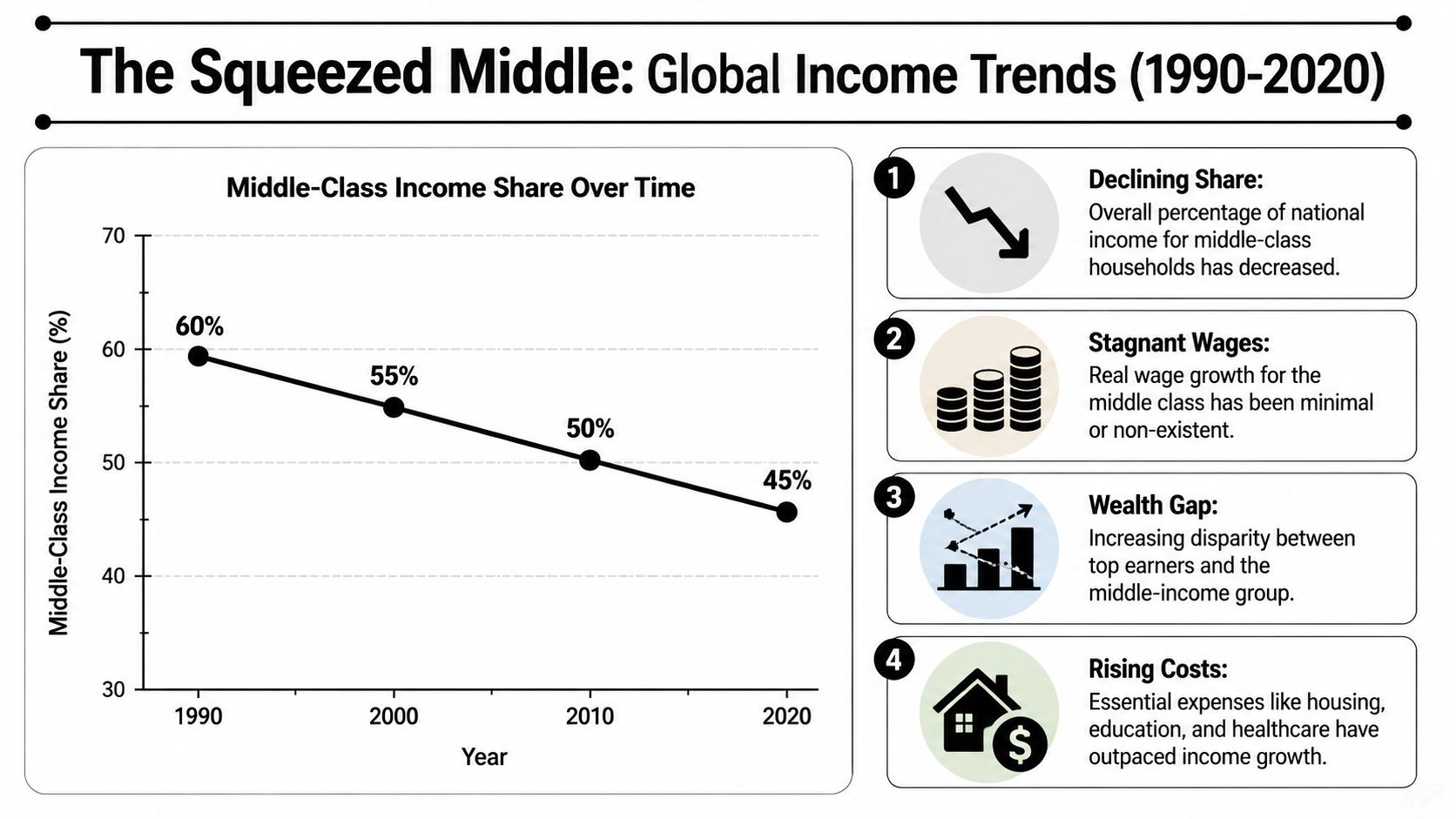
National medians hide local pressure
In the UK, national middle-class thresholds are roughly £23,400 to £70,000 for a typical household, but the range in London rises to £45,000 to £135,000 because of higher living costs, according to the Resolution Foundation's Living Standards Outlook 2024. The same source notes that a quarter of households in London are squeezed out of middle-class status compared with 15% nationally.
That single comparison changes the policy conversation. It shows that the income of middle class households isn't just about earnings. It is about the relationship between earnings and location-specific costs.
A government can announce broad tax relief or a national wage initiative and still fail to reach households whose principal pressure comes from metropolitan housing and transport costs. Equally, it can over-target struggling regions while underestimating the pressure on families in prosperous cities who are income-rich on paper and cost-burdened in practice.
Why blanket policy misses the target
Regional divergence creates at least three policy failures.
| Policy problem | Why it happens | Why it matters |
|---|---|---|
| National thresholds overstate security | Median-based measures ignore local costs | Households appear stable while disposable capacity erodes |
| Uniform labour policies miss sector clusters | Job risk is concentrated in particular local economies | Some towns absorb repeated middle-skill shocks |
| Central transfers arrive too late | Fiscal systems often react after household decline | Families cut training, mobility, and savings before support appears |
This is one reason leaders should be wary of saying "the middle class" as if it were a single constituency. It increasingly contains two distinct groups: households maintaining status through high-skill service earnings and asset support, and households remaining nominally middle income while losing resilience.
- The secure segment tends to be concentrated in sectors and regions that benefit from high-skill demand.
- The exposed segment often works in routine or semi-routine roles, with less bargaining power and weaker insulation against shocks.
- The squeezed segment may not show up as poor in headline data, yet faces repeated cost pressure that narrows room for saving and mobility.
The central policy error is to diagnose a national median problem when the real issue is a territorial and occupational mismatch.
For G7 and G20 governments, that means middle-class policy must move closer to place. Local labour-market intelligence, regional affordability metrics, and targeted retraining are no longer optional refinements. They are the difference between effective support and expensive underperformance.
Analysing the Drivers of Income Stagnation
The pressure on middle-income households didn't come from a single shock. It emerged from the interaction of trade exposure, financial openness, technological change, and labour-market restructuring. Those forces did not hit all middle earners equally, which is why aggregate responses have often disappointed.
Trade and finance didn't affect all middle earners equally
Evidence from the UK links widening middle-class inequality to trade globalisation. The Institute for Fiscal Studies inequality analysis notes that post-2004 EU enlargement exposed semi-skilled sectors to wage competition, reducing middle-quartile wages by 4% to 6%, while financial openness channelled investment toward high-skill services and boosted upper-middle pay.
That matters because the same national economy produced diverging outcomes inside the middle. Workers in tradable, semi-skilled sectors faced downward wage pressure. Workers in internationally connected high-skill services gained from expanded capital and market access. Both groups may still be classified as middle class, but they occupy very different trajectories.
A useful way to think about this is through distributional channels rather than broad averages:
- Trade channel: Compression in exposed semi-skilled wages.
- Finance channel: Gains concentrated where skills, networks, and capital access are strongest.
- Geographic channel: Benefits clustering in major service hubs, while losses spread through former industrial or administrative centres.
Technology amplified an existing divide
Automation didn't remove jobs in isolation. It increased the premium on non-routine work and weakened the bargaining position of workers in roles that could be standardised, codified, or relocated.
That has two implications for policy. First, technology often reinforces existing exposure created by trade. Second, labour-market institutions determine how those gains and losses are shared. Countries with stronger wage-setting systems, more active training institutions, or more generous transition support can cushion the impact. Countries with weaker coordination tend to pass more of the adjustment cost to households.
Analytical implication: The middle-class squeeze is best understood as a sorting process. Exposure to trade and technology lowers returns in routine work, while finance and digitalisation raise returns in high-skill service ecosystems.
This is why leaders shouldn't ask whether globalisation or technology was good or bad in the abstract. The right question is narrower and more useful: which households captured the gains, which absorbed the adjustment costs, and which institutions mediated the outcome?
The answer points to policy influence. Better transition systems, stronger local training ecosystems, and more deliberate tax-transfer design can alter distribution even when governments cannot or should not reverse openness itself.
Evaluating G20 Policy Levers for Inclusive Growth
The practical question isn't whether governments should act. It is which policy mix can restore middle-income security without suppressing innovation or fiscal credibility.
Three broad families of tools dominate the debate: taxation, social protection, and labour-market intervention. None works well in isolation.
Three policy families and their limits
Tax policy can recapture gains that accrue unevenly from globalisation and technological change. Done well, it funds public investment and household support without distorting productive activity excessively. Done poorly, it becomes a narrow redistribution exercise detached from growth.
Social protection stabilises households through shocks. It prevents temporary setbacks from becoming long-term exclusion. But passive support alone doesn't rebuild earnings power, especially where local labour demand has shifted permanently.
Labour-market policy shapes wage floors, bargaining conditions, and access to retraining. It is closest to the problem because the income of middle class households still depends primarily on earnings rather than transfers. Yet labour policy can underperform if macro, tax, and industrial settings pull in the opposite direction.
What an effective package looks like
The most credible benchmark remains the Nordic approach identified in earlier analysis. Policymakers can look to systems where progressive taxation recaptures about 15% of globalisation-related rents for transfers supporting middle-class households, a model highlighted in the IFS discussion of inequality and redistribution. The transferable lesson isn't institutional imitation. It is policy coherence.
A stronger package for G20 economies would combine:
- Progressive but broad-based tax design that captures part of windfall gains linked to openness and market concentration.
- Portable social insurance that follows workers across employment forms and sectors.
- Active labour-market support tied to real employer demand and regional industrial structure.
- Place-based investment for localities where middle-skill erosion has become entrenched.
A short comparison makes the point clearer.
| Policy lever | What it does well | Where it falls short alone |
|---|---|---|
| Progressive taxation | Recycles uneven gains | Doesn't fix weak earnings capacity |
| Social protection | Stabilises households in transition | Can become reactive and residual |
| Wage and training policy | Supports labour income directly | Needs fiscal and industrial alignment |
The policy lesson for G20 leaders is simple. Governments don't need one flagship initiative. They need an integrated middle-class strategy that links tax, labour, and territorial policy around a common objective: preserving earning power in a changing economy.
The Next Frontier AI and the Fracturing Middle Class
The dominant public narrative says AI threatens the middle class as a whole. That is too blunt to guide policy.
The evidence now points to a more selective and more politically difficult reality. AI is creating a split inside the middle. Some workers are seeing gains from complementarity with new systems. Others are being pushed into weaker wage trajectories because their tasks are easier to automate, standardise, or monitor.

AI is sorting the middle, not replacing it wholesale
Recent analysis indicates that UK middle-income quintiles saw only 1.2% real growth since 2023, while AI-adopting sectors experienced 8% gains. At the same time, routine middle-class jobs lost 4% of real income, affecting 3.5 million workers, according to the OBR fiscal risks and sustainability report citing recent IFS analysis.
Those figures are striking not because they prove universal disruption, but because they show divergence inside the same middle-income band. Workers in tech-finance and adjacent skilled sectors can gain from AI through productivity, complementarity, and stronger market demand. Workers in administration or routine production face a different logic. AI can narrow their task set, weaken wage growth, and increase substitution risk even before outright job loss occurs.
That means the income of middle class households will depend increasingly on whether workers are AI-complementary or AI-exposed.
- AI-complementary roles: Workers use AI to raise output and command stronger pay.
- AI-exposed roles: Workers perform tasks that systems can replicate or simplify.
- Transition roles: Workers could move upward with short-cycle training, employer support, and certification pathways.
Why current safety nets are poorly designed for this shift
Most labour-market institutions were built around unemployment shocks. AI often produces a different pattern. Workers remain employed, but their role degrades, their bargaining power weakens, and their wage path flattens.
That is harder to detect and slower to remedy. It also means conventional unemployment insurance catches the problem late.
A useful framing for ministers is that AI disruption is becoming a quality-of-work issue, not just a jobs issue. Policy therefore needs earlier triggers and more targeted instruments. Mid-career training, employer co-investment, modular credentials, and regional transition hubs all fit this challenge better than generic retraining promises.
A related discussion on bridging the AI divide and ensuring inclusive growth and job quality captures why this isn't a technology file alone. It is now central to labour-market governance.
The policy debate also benefits from a broader public explainer:
If governments wait for AI displacement to appear as mass unemployment, they will intervene too late. The earlier signal is income divergence within the middle.
A New Compact for the Middle Class G20 Recommendations
The core problem is no longer just stagnation. It is segmentation. The middle class is splitting by region, by sector, and now by AI exposure. Policies built for a uniform middle won't reverse that trend.
G20 leaders should therefore treat middle-class renewal as a strategic programme spanning labour markets, fiscal design, digital governance, and regional development. The objective isn't to freeze economic change. It is to ensure that adjustment costs do not remain concentrated on the same households and places.
Five priorities for summit leaders
Adopt regional middle-class dashboards. National medians should be supplemented with place-based affordability and labour-risk indicators. Leaders need to know where middle-income status is being eroded before families fall into acute distress.
Shift from generic retraining to targeted transition systems. Skills policy should be tied to actual employer demand in sectors where workers can become AI-complementary rather than AI-exposed.
Rebuild earnings resilience, not only income support. Transfers matter, but durable middle-class security still comes from stable, rising labour income.
Align tax policy with structural change. Where globalisation and digitalisation produce concentrated gains, fiscal systems should recycle part of those gains into mobility, training, and household stability.
Embed inclusive growth into G20 surveillance. Finance ministers and sherpas should evaluate not just headline growth, but whether middle-income households in different regions are participating in that growth.
The real test of inclusive growth
The right question for leaders at the next summit is not whether they support the middle class. Most do rhetorically. A better test is whether they are willing to abandon blunt national averages and govern for the actual structure of middle-income risk.
That means recognising three facts. First, middle-class strain is increasingly regional. Second, it is increasingly linked to occupational exposure rather than income level alone. Third, AI is accelerating divergence inside groups that older policy frameworks still treat as broadly similar.
If governments keep using blanket measures, they will keep missing the new squeezed middle class. If they build a new compact around place, skills, and transition capacity, they can still restore the middle class as the anchor of democratic capitalism and broad-based growth.
Global Governance Media tracks the policy choices that will define whether middle-income households regain security or face deeper fragmentation. If you're working on G7 or G20 agendas, follow Global Governance Media for evidence-led analysis, summit-focused commentary, and practical insights on inclusive growth, AI governance, and the future of economic resilience.