



By Adrian Mercer
You may be reading this between ministerial briefings, with one eye on an energy disruption, another on a supply chain alert, and a third, figuratively, on a diplomatic calendar that won't slow down. In that environment, the decisive question isn't whether governments have data. They do. The central question is whether institutions can turn fragmented signals into decisions that are timely, trusted, and coordinated across borders.
That is where information business systems matter. Not as back-office software. Not as a procurement line item. As the operating infrastructure of modern governance.
When a cross-border health event unfolds, or when climate adaptation equipment must move through customs, ports, and finance channels without delay, ministers depend on systems that can process transactions, generate management insight, preserve institutional memory, and support judgement under pressure. The strategic challenge is no longer access to information alone. It is the design of systems that convert information into state capacity.
Table of Contents
- The Strategic Imperative of Information Systems
- Mapping the Architecture of Modern Governance
- The Policy Value Chain From Data to Decision
- Information Systems in Global Policy and Cooperation
- Governing the System Data, Risk, and Resilience
- A Roadmap for Decision-Makers
- Conclusion Building the Future of Global Governance
The Strategic Imperative of Information Systems
A minister coordinating a disaster response doesn't experience information systems as abstract architecture. They experience them as a live question: can customs data, transport records, hospital status updates, and local authority reporting be brought into one decision picture before the window for action closes?
That's why information business systems should be understood as the nervous system of governance. They connect administrative action to political intent. If they fail, governments don't merely suffer inconvenience. They lose visibility, coherence, and credibility.
In multilateral settings, the stakes rise further. G7 and G20 agendas increasingly depend on coordinated implementation across health, trade, climate, fiscal policy, and digital governance. Each area requires institutions to gather operational data, interpret it, and align action across agencies that often use different tools, standards, and reporting habits. A summit communiqué may set direction, but information systems determine whether that direction becomes executable policy.
Practical rule: If leaders can't see the same operational picture across institutions, they can't govern complex risks coherently.
This is also why debates around automation and data capability can't be separated from institutional design. The most useful discussion is not whether governments should modernise, but how they should build systems that strengthen accountability while improving speed. For readers thinking through that intersection, this perspective on AI for business transformation is useful because it frames digital change as an organisational redesign challenge rather than a narrow technology deployment.
Three strategic implications follow.
- First, capacity is cumulative. A ministry that integrates data collection, reporting, and decision support builds institutional memory that survives electoral cycles.
- Second, interoperability is geopolitical. Shared standards make international cooperation more practical, especially where policy depends on cross-border verification.
- Third, resilience starts upstream. Crisis management improves when systems are built for continuous use, not improvised under pressure.
Mapping the Architecture of Modern Governance
The easiest way to understand information business systems is to think of a city. A city doesn't function because one structure is impressive. It functions because roads, traffic signals, archives, utilities, public services, and feedback channels work together. Governance systems operate the same way.
A city is a better analogy than a server room
In UK-oriented business systems frameworks, eight core information system types are commonly identified as the backbone of organisational decision-making: TPS, MIS, DSS, ERP, CRM, KMS, Expert Systems, and Office Automation according to this overview of information system types. Policymakers don't need to master the jargon. They do need to understand the roles.
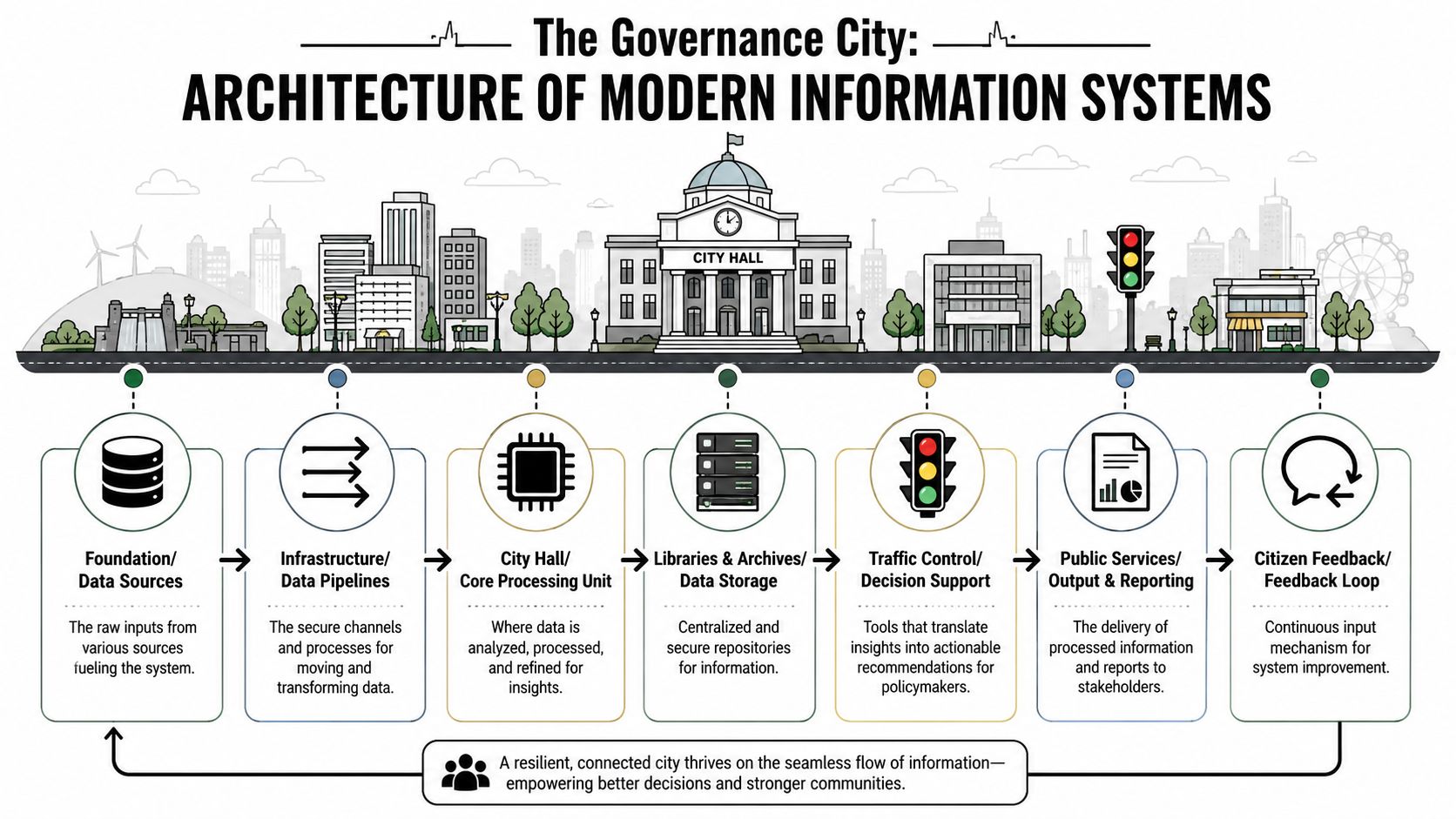
A practical translation looks like this:
- Transaction Processing Systems (TPS) are the roads. They carry routine activity such as billing, payroll, registration, and service transactions. The same framework notes a benchmark throughput of 10,000 transactions per minute for TPS in day-to-day operations, which underlines their role as high-volume operational infrastructure.
- Management Information Systems (MIS) are the traffic reports. They aggregate activity and show managers what is happening across the network.
- Decision Support Systems (DSS) are the traffic control centre. They help officials compare options when conditions change.
- ERP systems act like city utilities, joining finance, procurement, operations, and workflows into one administrative backbone.
- CRM and KMS tools provide the public-facing memory and internal institutional memory that prevent governments from repeatedly solving the same problem from scratch.
A country building digital public capability should think in layers, not products. That is one reason India's experience with interoperable state capacity has drawn attention in G20 discussions, particularly in debates around India's digital public infrastructure and the G20.
Where interdependence becomes a policy risk
The most important point is not that these systems exist. It is that they depend on one another. The same source states that a 15% increase in TPS transaction volume without corresponding ERP scaling leads to a 40% increase in MIS reporting latency, directly slowing management decision-making through degraded reporting flows.
That relationship matters politically. Ministers often inherit reporting delays as if they were analytical problems, when its underlying cause sits lower in the chain. A dashboard may look weak because the transaction layer and enterprise layer are out of balance.
The system that records activity shapes the system that explains activity.
This has two consequences for government.
| System layer | Governance question | Strategic consequence |
|---|---|---|
| Operational transactions | Can frontline activity be captured consistently? | Weak capture produces blind spots |
| Enterprise integration | Can agencies share and reconcile core records? | Poor integration fragments policy execution |
| Management reporting | Can leaders see reliable patterns quickly? | Delayed reporting slows coordination |
| Decision support | Can ministers compare options under uncertainty? | Weak support encourages reactive politics |
The architecture of information business systems is therefore not a technical map. It is a map of where states gain or lose command.
The Policy Value Chain From Data to Decision
Good systems don't stop at collection. They create a value chain in which raw inputs become policy action.
How one signal becomes a policy choice
Take a single operational signal. A local authority records a rise in service demand. On its own, that entry is just an event. Once aggregated with similar records from other localities, cleaned for consistency, stored securely, and compared against existing service obligations, it becomes a pattern. Once analysts interpret the pattern and present it in a form that decision-makers can use, it becomes a policy input. Once a minister acts on it, it becomes part of governance.
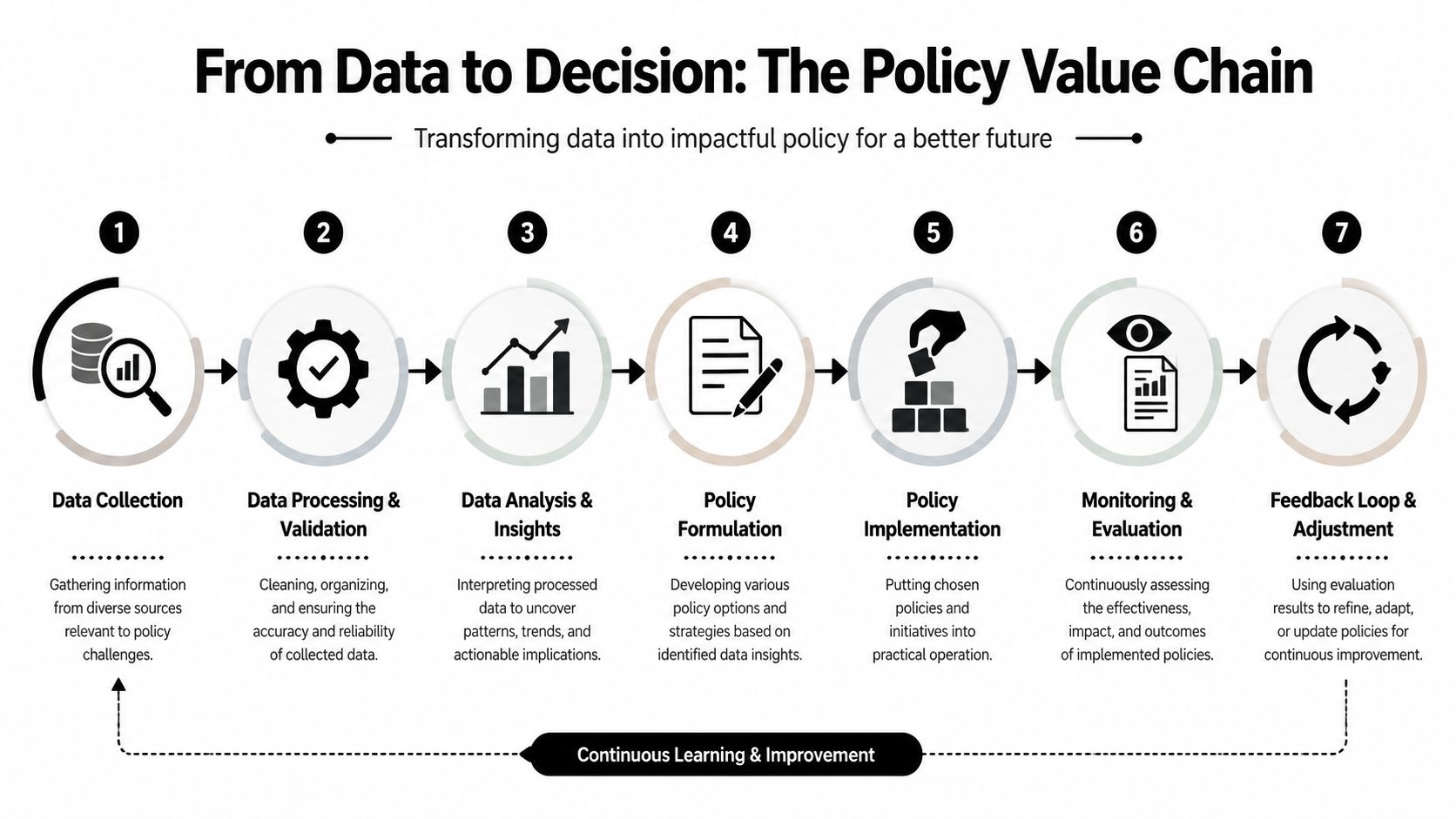
For non-technical leaders, the key discipline is to ask what value is being added at each stage. The concept of a dataset is simple, but its policy significance is often misunderstood. This primer on what is a dataset is useful because it clarifies that datasets are not neutral stockpiles. They are structured inputs whose design affects every downstream decision.
Where public value is gained or lost
The chain tends to break in predictable places.
- Collection failure. Agencies gather data in incompatible formats, or they exclude fields needed for later comparison.
- Validation failure. Institutions move quickly to analysis without checking reliability, producing speed without confidence.
- Interpretation failure. Analysts answer the wrong question because operational and policy teams never aligned on decision needs.
- Communication failure. Findings arrive as technical reporting, not as choices framed for ministers.
A strong value chain creates three kinds of public value.
- Administrative value. Routine operations become visible and governable.
- Strategic value. Leaders can compare trade-offs rather than govern by anecdote.
- Learning value. Outcomes can feed back into system design, improving future policy cycles.
Decision test: If a report cannot tell a minister what changed, why it matters, and what choice follows, the value chain is incomplete.
Many governments invest heavily in collection because it is tangible. Far fewer invest with equal seriousness in translation, which is where information becomes usable authority. That imbalance explains why some institutions are data-rich yet decision-poor.
Information Systems in Global Policy and Cooperation
When information business systems work well, they change the quality of international cooperation. They let states act on shared evidence rather than parallel assumptions.

From coordination to legitimacy
Consider three policy arenas where this matters.
In global health, governments need integrated systems that connect procurement records, inventory management, logistics updates, and local service delivery information. Without that chain, vaccine distribution or medical supply allocation becomes vulnerable to mismatch between central plans and frontline reality.
In climate policy, monitoring systems matter just as much as financing frameworks. States need mechanisms that combine administrative reporting, environmental observations, compliance records, and implementation feedback. Otherwise, international commitments remain declaratory.
In trade and supply resilience, customs records, transport information, and enterprise reporting need to align closely enough that governments can spot bottlenecks before they cascade into wider shortages. That is not merely an efficiency issue. It shapes confidence among allies, investors, and the public.
A short visual explainer helps make the point that system design is inseparable from collective action.
The equity gap inside the system
Yet there is a serious warning here. A system can be advanced and still be unjust.
The UK Government's Changing Futures guidance on ensuring equity for underserved groups states that bringing together qualitative and quantitative data from multiple sources is essential to understand “who are being underserved, and how”. That is a strategic insight, not a marginal social policy note. It means that a government relying only on formal administrative data may miss the very groups it most needs to reach.
Commercial system design often lags behind this requirement. Vendors may offer strong reporting modules for transactions and compliance, yet leave institutions without tools configured for the dual synthesis of lived experience and administrative measurement. The result is a familiar policy failure: aggregate progress masking unequal outcomes.
That matters for G7 and G20 agendas because multilateral initiatives increasingly promise inclusion, resilience, and fair transition. Those promises cannot be tested through quantitative reporting alone.
- For labour transitions, administrative records may show programme uptake while qualitative evidence reveals access barriers.
- For public health, service counts may appear stable while communities report mistrust or exclusion.
- For digital government, portal usage may rise while underserved groups remain functionally disconnected.
A modern information system should not only count service delivery. It should help governments detect who remains outside effective delivery.
The credibility of international cooperation now depends not just on execution, but on whether systems can see exclusion before it hardens into political grievance.
Governing the System Data, Risk, and Resilience
The strongest information business systems are not the most complex. They are the most governable. Ministers should treat governance as the condition that makes scale possible.
Reliability is a public service issue
In UK public sector digital care specifications, systems are required to achieve 99.9% availability with automated failover to ensure continuous data processing for patient records, according to the Hubble Project technical specification guidance. That requirement matters because it links system reliability directly to clinical decision-making.
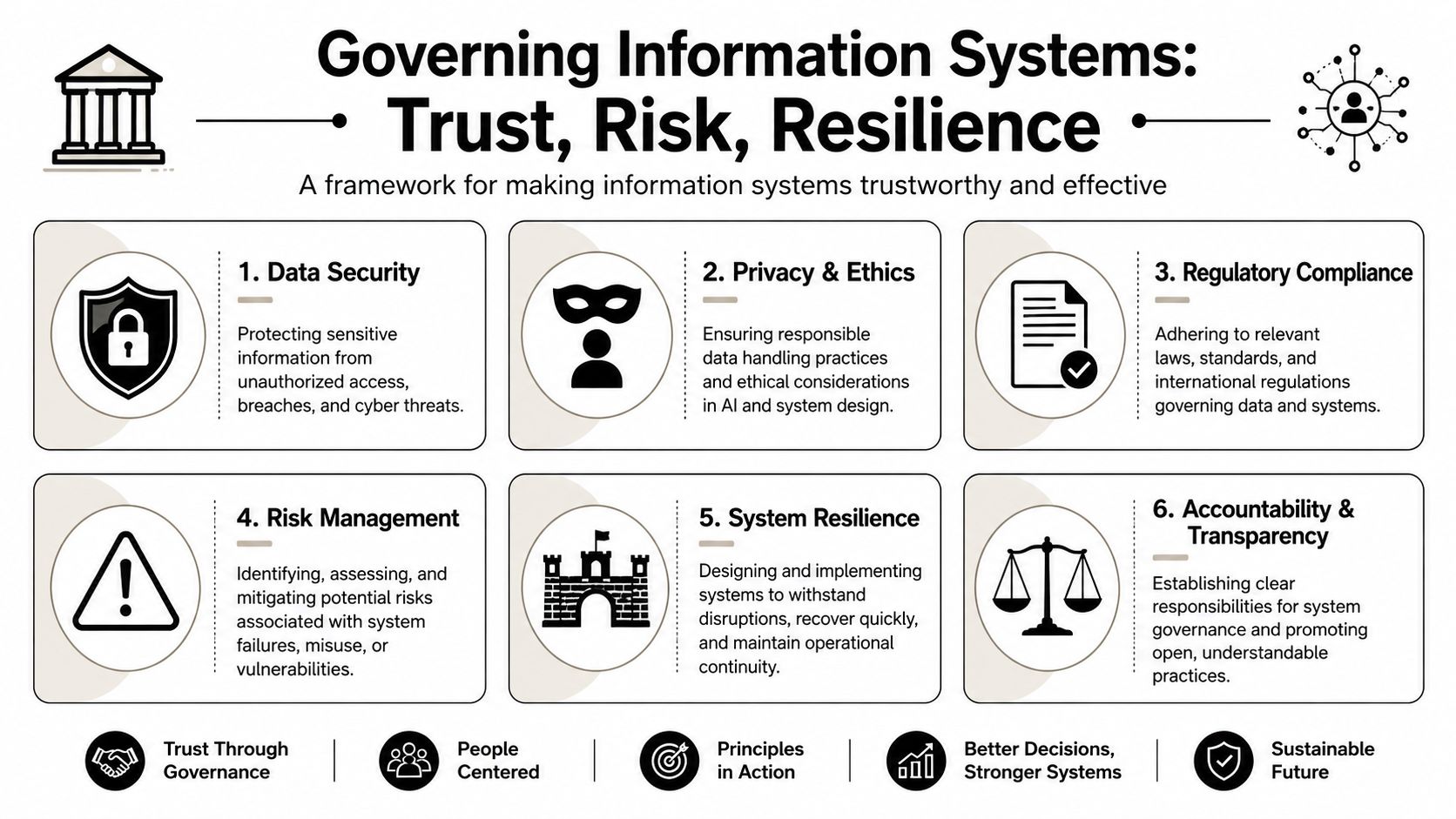
This is the correct policy frame. Uptime is not just an IT metric. It is a service delivery obligation. When information systems support health records, benefit administration, border processes, or emergency coordination, resilience becomes part of the public contract.
The same specification also requires a structured approach to performance requirements and testing programmes, with explicit links between system behaviour and service outcomes. That is a useful standard for ministers because it rejects a common procurement mistake: buying capability descriptions instead of enforceable operational expectations.
Governance disciplines that ministers should demand
A government serious about resilience should insist on at least four disciplines.
- Outcome-based specifications. Procurement documents should define what the system must enable in operational terms, not merely what software components it contains.
- Auditability. Institutions need clear records of who changed what, when, and under whose authority.
- Failure planning. Automated failover, contingency workflows, and remediation protocols should be designed before deployment, not after disruption.
- Decision accountability. Senior officials must know which outputs are advisory, which are authoritative, and where human review remains mandatory.
For ministries developing cross-agency capability, these principles align closely with broader thinking on data governance frameworks, especially where legal compliance and operational trust must be handled together.
Governance lesson: Trust doesn't come from digitisation alone. It comes from visible rules, tested controls, and systems that continue to function when conditions deteriorate.
There is also an international implication. If countries want interoperable systems across health security, trade monitoring, or climate implementation, they need compatible governance disciplines. Shared data without shared assurance creates friction, not cooperation.
A Roadmap for Decision-Makers
Leaders rarely need another slogan about digital transformation. They need a workable sequence for action.
Procurement should start with public outcomes
The first move is to define the policy outcome before selecting the platform. If a government wants better border coordination, stronger climate reporting, or improved social service targeting, procurement should begin with those outcomes and the decision moments attached to them. Otherwise, agencies buy tools that generate activity but not authority.
The second move is to organise sponsorship correctly. Information business systems fail when they are owned only by technology teams or only by policy units. They need joint stewardship across operations, finance, legal, frontline services, and ministerial leadership.
The third move is to treat adaptability as a strategic requirement. Policy conditions shift. Institutional memory changes. International obligations evolve. Systems should therefore be procured and governed as capabilities that can be adjusted over time.
For officials working at the intersection of product design, delivery, and organisational decision-making, this perspective on artificial intelligence in product management is relevant because it highlights how governance, user needs, and iterative design must be handled together rather than in sequence.
A practical ministerial checklist looks like this:
- Define the decision use case. Specify which policy decisions the system must improve.
- Map institutional dependencies. Identify which agencies create, validate, and consume the relevant data.
- Set assurance rules early. Agree standards for privacy, access control, audit, resilience, and escalation before implementation.
- Measure legitimacy, not just throughput. A fast system that excludes communities or obscures responsibility is a governance liability.
- Review continuously. Systems should be assessed against policy outcomes, not left to drift after launch.
Key Metrics for Evaluating Policy Information Systems
| Metric Category | Key Performance Indicator (KPI) | Policy Relevance |
|---|---|---|
| Operational continuity | System availability and continuity under disruption | Indicates whether essential public services can rely on the system |
| Data quality | Accuracy, completeness, and consistency of records | Shapes whether ministers can trust reporting and analysis |
| Decision usability | Timeliness and clarity of reporting for senior officials | Determines whether information reaches decision-makers in actionable form |
| Interoperability | Ability of agencies to exchange and reconcile information | Supports cross-ministerial coordination and international cooperation |
| Equity visibility | Capacity to combine qualitative and quantitative evidence on underserved groups | Helps governments identify who is missed by formal reporting |
| Accountability | Strength of audit trails, role clarity, and review mechanisms | Protects legitimacy and clarifies responsibility for decisions |
| Learning capacity | Use of monitoring feedback to refine workflows and policies | Ensures systems improve rather than simply persist |
This roadmap changes the ministerial question from “What software should we buy?” to “What governing capability are we building?” That is the more consequential question.
Conclusion Building the Future of Global Governance
Information business systems now sit near the centre of statecraft. They shape whether governments can detect risk early, coordinate across agencies, act credibly with partners, and maintain public trust when pressure rises. The issue is no longer administrative modernisation in the narrow sense. It is whether public institutions possess the information infrastructure required for strategic action.
The policy lesson is clear. Architecture matters because fragmented systems weaken command. Value chains matter because poor translation turns data abundance into decision scarcity. Equity matters because systems that cannot see exclusion will reproduce it. Governance matters because resilience, accountability, and legitimacy do not emerge automatically from digitisation.
For G7 and G20 leaders, this creates a demanding but productive agenda. They should treat information business systems as shared strategic infrastructure for health security, climate implementation, economic resilience, and inclusive growth. That means better procurement, stronger assurance, more disciplined interoperability, and deeper cooperation on standards that allow states to work from a trusted common picture.
The next decade of multilateral effectiveness won't be determined by declarations alone. It will be determined by whether governments can build systems that make cooperation operational, measurable, and fair.
Global Governance Media convenes ministers, analysts, and practitioners around the choices that shape international cooperation. Explore more analysis, interviews, and policy briefings at Global Governance Media and use the platform to inform the next generation of decisions on resilience, equity, and global governance.