

By Dr James A. Mercer, Senior Policy Analyst
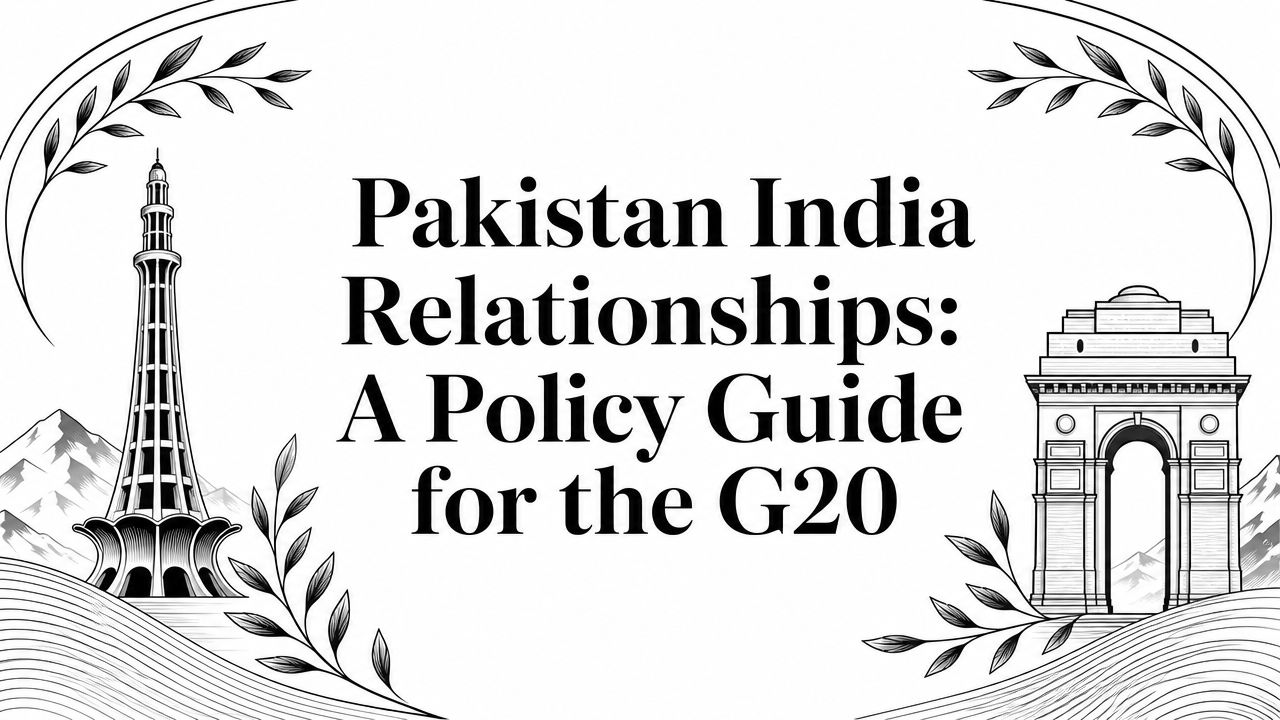
South Asia contains one of the world's most escalation-prone nuclear dyads. That fact alone should place Pakistan India relationships high on the agenda for G20 governments concerned with crisis prevention, supply-chain resilience, and the cross-border effects of domestic polarisation.
The policy problem is wider than a bilateral territorial dispute. India and Pakistan interact through military signalling, water stress, trade restrictions, counterterrorism claims, digital information flows, and politically mobilised diaspora networks in third countries. During periods of tension, these channels do not operate separately. They reinforce one another, shorten decision time, and raise the risk that a limited incident produces diplomatic, economic, or security consequences well beyond the subcontinent.
For G7 and G20 actors, the practical question is not how to engineer a final settlement from outside. The more credible objective is to reduce the frequency of crises, improve verification, and preserve functioning communication during shocks. That requires a narrower policy framework focused on measurable confidence-building steps, crisis-containment tools, and early management of spillover in states with large South Asian diaspora communities.
Readers following related questions of strategic competition, regional instability, and multilateral diplomacy can place this case within broader international relations and current events analysis.
A forward-looking approach matters because the old sequencing has repeatedly failed. Waiting for a grand political breakthrough before pursuing technical risk-reduction has produced long periods of diplomatic drift. A more realistic approach starts lower down: military-to-military communication, notification and verification mechanisms, limited economic openings that can survive political shocks, and public-order coordination in partner countries when overseas tensions begin to spill into domestic politics. That is the level at which outside actors can still have influence.
Table of Contents
- The Enduring Fracture in South Asian Security
- A Legacy of Conflict From 1947 to Today
- The Core Drivers of Modern Tensions
- Economic Interdependence Versus Security Imperatives
- Diplomatic Channels and Confidence-Building Measures
- The Role of Third Parties and Multilateral Forums
- Policy Scenarios and Recommendations for 2026
The Enduring Fracture in South Asian Security
Two nuclear-armed neighbours have fought multiple major wars, faced repeated cross-border crises, and still lack a durable architecture for restraint. For G20 governments, pakistan india relationships therefore present a standing systemic risk, not a periodic regional dispute. The strategic concern is wider than South Asia. A sharp bilateral shock can disrupt crisis diplomacy among major powers, unsettle energy and shipping markets, and intensify communal tensions in diaspora hubs far from the Line of Control.
The record already discussed matters less as history than as a warning about crisis recurrence. Political disputes left unresolved have repeatedly returned through new channels, including conventional military signalling, sub-conventional violence, trade suspension, digital information operations, and coercive domestic messaging. Since nuclearisation, the threshold for all-out war has risen, but the space for limited confrontation has not disappeared. It has become more ambiguous, which increases the risk of misreading intent under time pressure.
Core judgement: The central policy problem is the repeated failure to convert crisis management into durable restraint.
That judgement has direct implications for outside actors. Public appeals for dialogue have limited effect when domestic political incentives reward resolve and punish concession. More useful tools are narrower and more technical: verified military communication procedures, incident-reporting protocols, rules for public signalling during crises, and targeted support for international relations analysis and policy tracking that helps governments assess escalation pathways before they harden.
The relationship should be treated as an interlocking security system. Border incidents, treaty downgrades, commercial restrictions, cyber narratives, and diaspora mobilisation interact with one another. A government that addresses only the immediate flashpoint can miss the second-order effects, especially the way external rhetoric can feed domestic polarisation in London, Toronto, Dubai, or other cities where India-Pakistan tensions can spill into community relations.
For G20 delegates, the policy test is practical. Which interventions still reduce risk when summit diplomacy stalls, trust is low, and neither side is prepared for a political breakthrough? The answer is not a grand bargain. It is a sequenced de-escalation framework built around verifiable confidence-building measures, disciplined signalling, and safeguards against transnational spillover.
A Legacy of Conflict From 1947 to Today
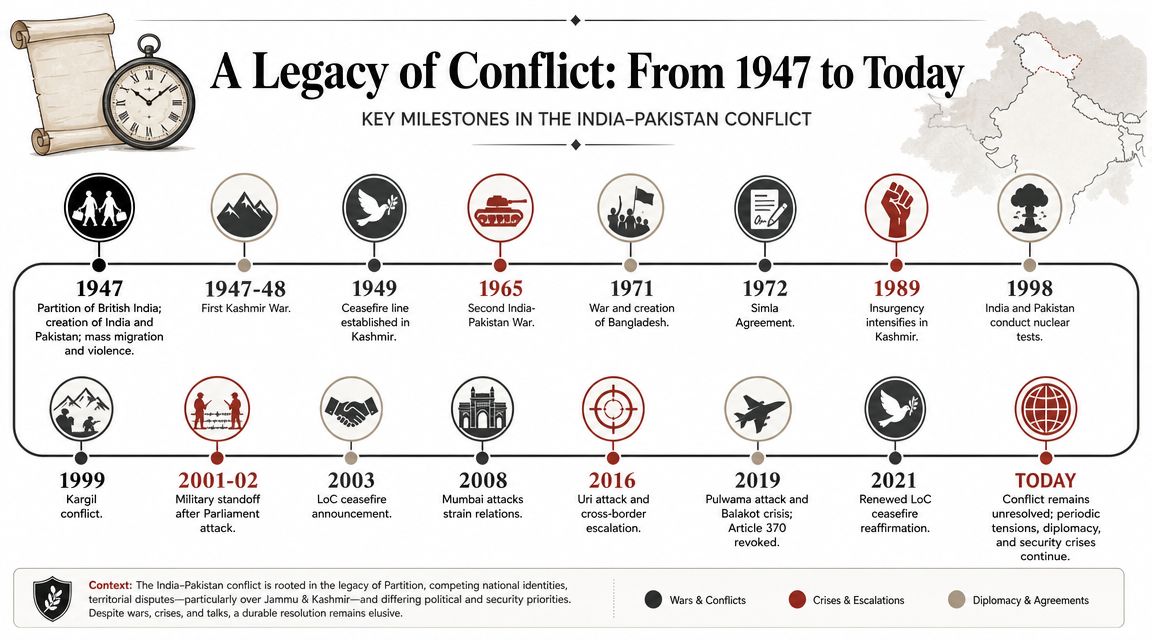
Since independence in 1947, India and Pakistan have fought multiple wars, endured repeated cross-border crises, and added nuclear risk to an already unstable rivalry. For G20 policymakers, that record matters less as background than as a guide to what each side still considers usable under pressure.
Partition as the operating context
The strategic logic of the relationship was set at state formation. Partition created two successor states with competing national projects, contested borders, and incompatible claims over Jammu and Kashmir. Those disputes were absorbed into military doctrine, constitutional politics, and public memory early on.
The result was not only episodic violence. It was the normalisation of coercion as an available policy instrument. Wars in 1947 to 1948, 1965, and 1971 reinforced the expectation, on both sides, that force could still shape bargaining positions even when it failed to produce a durable settlement.
That historical pattern still constrains diplomacy. Officials do not enter negotiations on neutral ground. They operate within institutions shaped by past mobilisations, prior ceasefire failures, and domestic constituencies that often read restraint as weakness. For outside governments assessing South Asia's security trajectory, this is the larger point made in recent analysis on security in Asia after the end of normalcy. The India-Pakistan file is not an isolated bilateral dispute. It is part of a wider regional shift toward thinner crisis buffers and faster escalation cycles.
Nuclearisation changed every subsequent crisis
The overt nuclearisation of both states in 1998 changed the mechanics of confrontation. It narrowed the space for full-scale conventional war while increasing the salience of limited strikes, signalling, and controlled retaliation. Deterrence reduced some forms of conflict. It did not produce stable peace.
This is the central strategic paradox. Nuclear weapons raise the cost of major war, but they can also encourage risk-taking below that threshold if political and military leaders believe escalation can be contained. That logic has shaped subsequent crises, where the contest often turns on speed, perception, and command discipline rather than territorial gain alone.
Past conflict matters as institutional structure, not only as memory. It defines which responses remain thinkable in a crisis.
For G20 actors, the policy relevance is practical rather than historical.
| Historical legacy | Strategic implication today |
|---|---|
| Partition left Kashmir unresolved | Territorial, constitutional, and identity disputes remain fused |
| Repeated wars embedded coercive habits | Crisis recurrence should be treated as structural risk |
| Nuclearisation raised escalation costs | Miscalculation now carries immediate regional and international consequences |
One policy error persists in external engagement: treating the resumption of talks as evidence of stabilisation. In this rivalry, dialogue matters only if it changes operational incentives, improves verification, or lowers the chance that a local incident will trigger military, diplomatic, and social spillover at once. That standard should shape how G7 and G20 governments judge future initiatives, including CBMs that can be monitored, crisis hotlines that are used, and safeguards against escalation in diaspora communities far beyond South Asia.
The Core Drivers of Modern Tensions
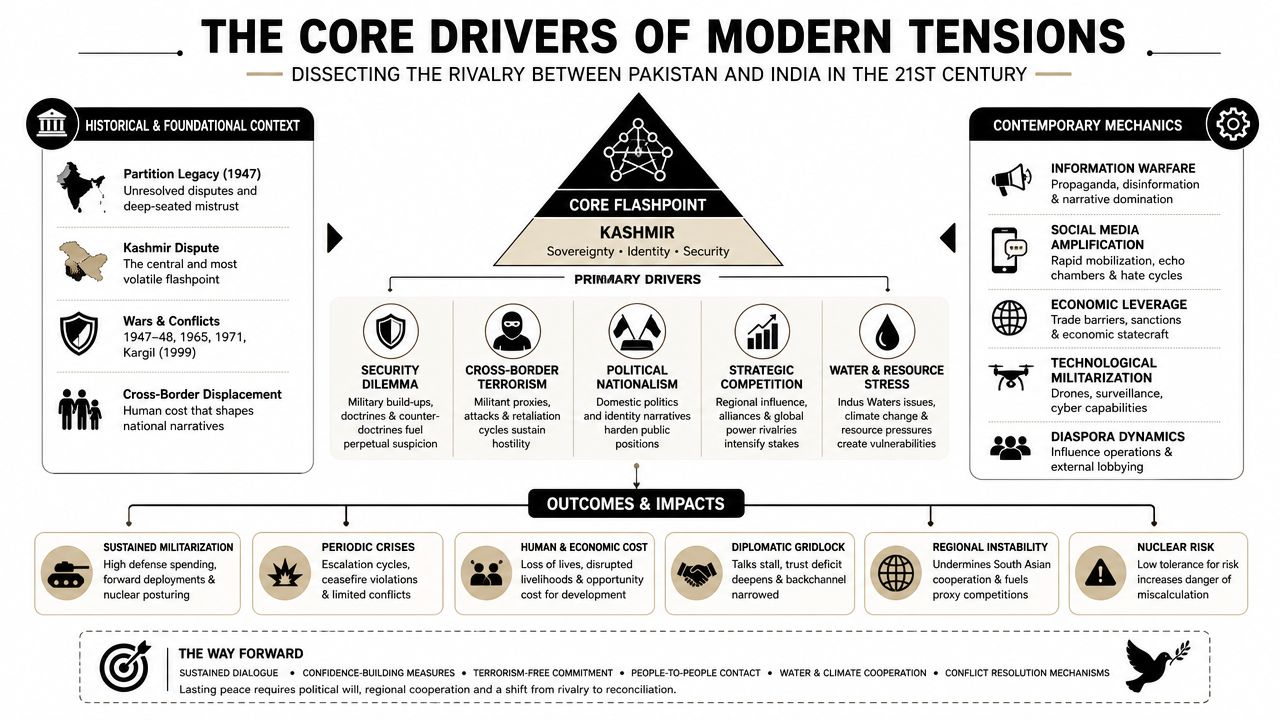
Current tensions can't be understood through Kashmir alone, even though Kashmir remains central. Today's crisis environment is more interconnected. A major security incident can now pull in border management, treaty architecture, trade access and military signalling in rapid sequence.
Near the section's opening, it's useful to visualise that structure.
Kashmir is no longer a standalone file
The Council on Foreign Relations reports that after the April 2025 Pahalgam attack, India suspended the Indus Waters Treaty, closed the Attari crossing, and Pakistan warned that altering river flows would be treated as an “act of war”, while daily cross-Line of Control fire and a broader military strike cycle followed, according to the CFR Global Conflict Tracker. That sequence is analytically important because it shows how a crisis can spread across domains that used to be discussed separately.
This is the modern anatomy of Pakistan India relationships. Water is no longer just a resource question. Trade access is no longer just an economic question. Both now sit inside the same escalation ladder as military moves and public signalling.
For a wider assessment of how regional instability is reshaping strategic assumptions in Asia, see this analysis on security in Asia and the end of normalcy.
Why escalation now travels across domains
The practical implication for G20 governments is that they need better early-warning indicators. Diplomatic downgrading, treaty disruption and border closure should be read as integrated crisis markers. Treating each one as a compartmentalised dispute risks underestimating how quickly coercive pressure can compound.
A more precise way to think about the current system is to separate triggers, transmission channels, and decision points:
- Triggers: A major attack or high-visibility security incident can initiate escalation.
- Transmission channels: Water arrangements, crossing points and Line of Control fire allow the crisis to widen.
- Decision points: Political leaders and military establishments then choose whether to contain, retaliate or signal resolve through further measures.
When treaty mechanisms and border access are disrupted during a crisis, outside governments should treat that as an escalation indicator, not as diplomatic theatre.
That framework also changes what constructive diplomacy looks like. The objective isn't to solve every dispute at once. It's to keep transmission channels from multiplying the consequences of the initial trigger.
Economic Interdependence Versus Security Imperatives
Economic logic argues for greater normalisation. Security logic repeatedly overrides it. That tension is at the centre of Pakistan India relationships, and it explains why geoeconomic potential has remained politically inaccessible.
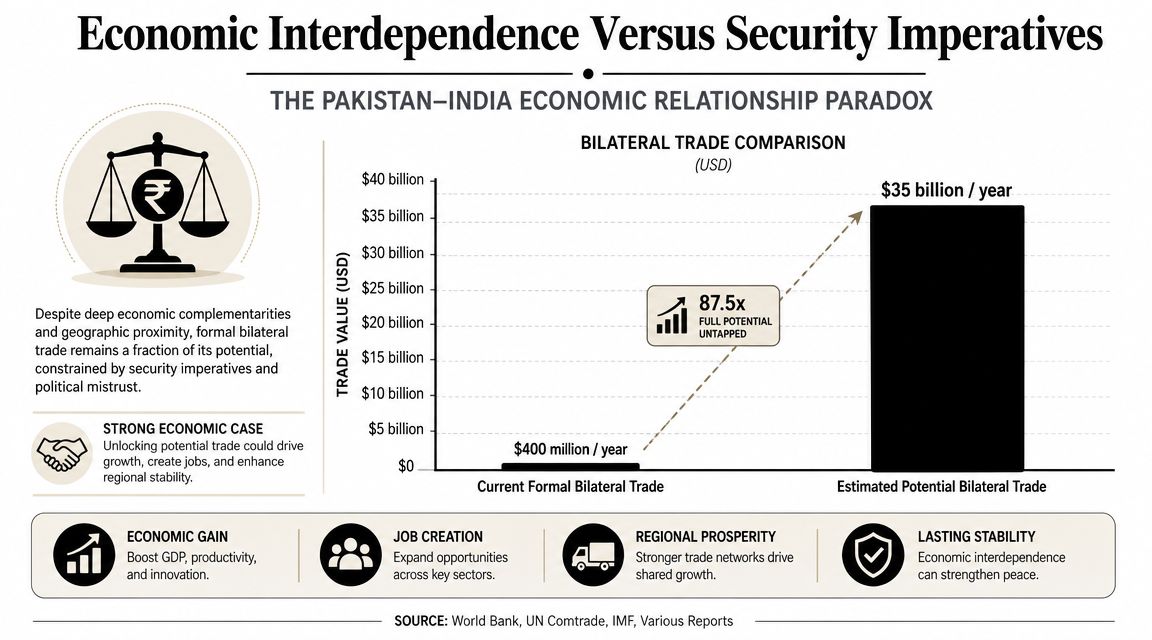
The trade question is political before it is commercial
Formal bilateral commerce is often discussed as though tariffs or logistics were the main constraints. In reality, the primary barrier is political confidence. Trade corridors, customs procedures and market access can only function when both governments believe those channels won't be suspended during the next security shock.
That's why the strongest argument for economic engagement isn't optimism about interdependence. It's institutional design. Trade can contribute to stability only when the rules around crossings, facilitation and dispute handling are insulated from routine political rupture.
A useful comparison is below.
| Economic possibility | Security reality |
|---|---|
| Commercial exchange could create constituencies for predictability | Security incidents can close channels quickly |
| Trade facilitation can lower transaction friction | Border access is vulnerable during crises |
| Economic contact can support limited trust | Strategic mistrust often blocks sustained normalisation |
What outside actors can still influence
Third parties can't manufacture bilateral trust, but they can help design lower-risk interfaces. In practical terms, that means support for customs transparency, technical border procedures, communication protocols around crossings and narrowly framed sectoral arrangements that are easier to verify than broad political commitments.
A realistic policy lens avoids two common errors:
- Overstating the peace dividend: Trade doesn't neutralise sovereignty disputes.
- Underestimating technical gains: Even modest facilitation can reduce the number of friction points available during a crisis.
- Confusing volume with resilience: What matters is not solely more exchange. It's whether exchange can survive stress.
Economic statecraft in this corridor has to start from the assumption that security crises will recur. The question, then, is whether trade and transit mechanisms are brittle or shock-resistant. Most current arrangements remain brittle.
Diplomatic Channels and Confidence-Building Measures
The strongest available evidence suggests that broad normalisation frameworks face persistent institutional limits. Brookings argues that the relationship is marked by low institutional bandwidth for bilateral economic normalisation and that near-term progress is more likely to come from narrowly scoped, verifiable confidence-building measures, including border-monitoring protocols, trade facilitation, and crisis-communication mechanisms, as set out in Brookings' analysis of steps towards rapprochement.
Why grand bargains keep failing
Large political packages fail for a simple reason. They ask the two sides to resolve identity, territorial and security disputes simultaneously, under conditions of low trust and recurring domestic pressure. When a serious incident occurs, the incentive structure shifts back towards deterrence and public firmness.
That doesn't mean diplomacy is futile. It means diplomacy must be sequenced differently. High-level dialogue still matters, especially during acute tension, but it's usually too exposed to political shock to serve as the sole stabilising instrument.
Operational principle: Durable progress comes from arrangements that can be monitored, tested and preserved even when political rhetoric hardens.
What a credible CBM agenda looks like
The most viable pathway is technical, not theatrical. A credible CBM package would focus on verifiability, narrow scope and continuity through crisis conditions.
- Border monitoring protocols that reduce ambiguity around incidents and movement.
- Crisis communication mechanisms that function quickly enough to prevent tactical events becoming strategic signals.
- Trade facilitation measures limited to areas where implementation can be observed and reversed only through clear formal action.
Different actors can support different layers. Bilateral officials own the mechanisms. Third countries can provide technical assistance, quiet diplomatic backing and process design. Multilateral institutions can host expert exchanges where formal bilateral politics would otherwise stall.
The key is to judge every proposal by one question: does it reduce room for miscalculation? If the answer is no, it may still be diplomatically useful, but it isn't a stabilisation tool.
The Role of Third Parties and Multilateral Forums
External actors matter most when they understand the limits of their influence. Pakistan India relationships are not readily mediated from outside because the core disputes are tied to sovereignty, domestic legitimacy and strategic identity. Third parties can help de-escalate. They usually can't impose settlement.
Why outside mediation has narrow limits
Major powers often enter this file with competing motives. Some prioritise crisis prevention. Others see South Asia through the lens of wider strategic competition. Multilateral forums face an additional problem. They can convene, signal concern and encourage restraint, but they rarely offer the confidentiality or political flexibility required for sustained bilateral compromise.
That's why the most constructive third-party role is often indirect. It includes crisis messaging, technical support for practical mechanisms and calibrated diplomatic language that lowers incentives for maximalist signalling.
Readers considering how this fits into current summit diplomacy may want to place it against the broader challenge of the G20 amid geopolitical crisis.
The UK and diaspora spillover
One underexamined dimension is domestic spillover inside G7 states. Instituto Elcano notes that for UK policymakers, India-Pakistan tension affects diaspora politics and civic cohesion, showing up in UK domestic politics, university campuses and community relations, and requiring tools such as counter-extremism and community engagement, as discussed in its analysis of the India-Pakistan dialogue process.
This is more than a social cohesion footnote. It changes the policy map in three ways:
- Foreign policy signalling has domestic effects: Statements by ministers can shape perceptions of bias or neglect within communities at home.
- Campus and local politics can become transmission belts: Bilateral crises abroad may sharpen identity contestation in civic spaces.
- Community resilience is part of national security: Governments need mechanisms that prevent imported geopolitical tension from hardening into domestic polarisation.
A serious G20 approach should therefore treat diaspora management as part of crisis preparedness. That doesn't mean securitising communities. It means recognising that foreign policy shocks can land inside plural democracies through media, political activism and local institutional friction.
Policy Scenarios and Recommendations for 2026
The most plausible near-term future isn't reconciliation. It's structured instability. That doesn't make policy action futile. It makes precision more important.
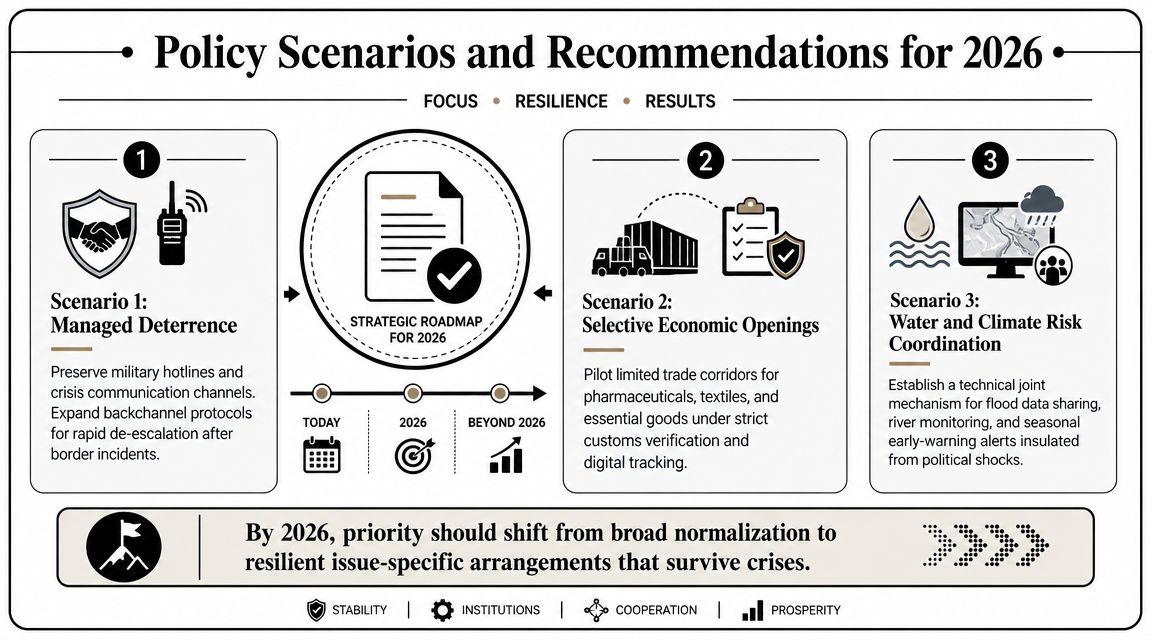
Three plausible scenarios
Managed rivalry is the baseline scenario. Dialogue remains limited, major disputes remain unresolved, but both sides avoid sustained escalation through selective signalling and intermittent communication. Indicators would include functioning crisis contacts, restrained rhetoric around crossings and no further erosion of practical mechanisms.
Accidental escalation is the most dangerous scenario. A trigger event expands across military, water and border-access domains before diplomacy can catch up. Warning signs would include abrupt disruption of treaty practice, closure of transit points and reciprocal signalling that narrows political off-ramps.
Gradual normalisation is the least likely but still possible scenario. It wouldn't begin with a headline political breakthrough. It would start with technical restoration, narrow facilitation and sustained operational contacts that survive periods of tension.
For delegates seeking a sharper Indian strategic context, perspectives on the pivot from Multilateral Development Bank Jobs offers a useful framing of how New Delhi's broader external orientation is evolving.
Recommendations for G20 actors
A workable agenda for 2026 should be disciplined and concrete.
- Fund technical CBMs: Support border-monitoring expertise, crisis communications design and verifiable trade-facilitation measures rather than sponsor expansive peace formulas.
- Coordinate crisis signalling: During acute incidents, G20 capitals should align public messaging around restraint, continuity of technical channels and preservation of treaty mechanisms where possible.
- Build quiet expert platforms: Track-two and technical forums on water management, border procedure and incident communication can preserve contact when political dialogue freezes.
- Prepare for domestic spillover: Governments with large South Asian diasporas should integrate community engagement and civic-cohesion planning into foreign policy contingency work.
- Prioritise early-warning indicators: Treaty disruption, border closures and breakdowns in communication channels should trigger immediate diplomatic attention.
The central lesson is straightforward. Pakistan India relationships won't be stabilised by rhetorical consensus. They'll be stabilised, if at all, by repeated, technical, verifiable acts of restraint that lower the chance of miscalculation. That is where G20 diplomacy has the best chance of being useful.
For more policy analysis, summit briefings and practical multilateral recommendations, follow Global Governance Media. Its coverage helps decision-makers connect regional flashpoints like Pakistan India relationships to the wider G7 and G20 agenda, with a focus on actionable choices rather than generic commentary.