

Narcoterrorism is not just a crime. It is a hybrid threat that merges the violence of terrorism with the business of drug trafficking, and it becomes strategically dangerous because the illegal drug trade has been estimated at roughly $400–500 billion annually, or about 8% of total world trade.
By James Carter
Most policy debates still treat terrorism, organised crime, and narcotics trafficking as adjacent problems. That framing is no longer sufficient. When drug revenue funds politically motivated violence, or when traffickers use terror-like coercion to shape state behaviour, governments face something more corrosive than a law-enforcement challenge. They face a test of sovereignty, institutional resilience, and multilateral coordination.
For G7 and G20 decision-makers, the hard part isn't recognising that the threat exists. It's recognising that what is narcoterrorism can't be answered with a narrow dictionary definition. The term sits in a grey zone between criminal law, sanctions policy, counterterrorism doctrine, anti-money-laundering systems, and foreign policy. That ambiguity is precisely why it matters. A threat that falls between institutional mandates often survives longer than one that fits neatly inside them.
Table of Contents
- The Unseen Threat to Global Governance
- Defining the Narcoterrorism Nexus
- A History of Violence and Coercion
- Distinguishing Narcoterrorism from Related Threats
- The Challenge of a Contested Definition
- Cross-Border Implications for Global Powers
- A Roadmap for International Cooperation
The Unseen Threat to Global Governance
The most surprising feature of narcoterrorism is that its ambiguity has helped conceal its strategic importance. A term without a universally settled legal definition might sound too imprecise for serious policy use. In practice, that's exactly why senior officials should pay attention to it. Ambiguous hybrid threats exploit the seams between institutions.
Why policymakers should treat it as a governance problem
Narcoterrorism erodes state capacity in ways that standard crime metrics often miss. Drug profits can sustain coercive networks over time. Those networks can intimidate officials, corrupt border systems, distort local economies, and weaken public trust in the state's monopoly on force.
That makes narcoterrorism more than a policing issue. It is a governance challenge because it pressures multiple state functions at once: customs, courts, intelligence, financial supervision, diplomacy, and local administration. A government can make arrests and still lose strategic ground if criminal-political networks retain access to cash, logistics, and safe routes.
Practical rule: If a network can convert illicit revenue into durable coercive capacity, the policy response must go beyond criminal prosecution.
Why the G7 and G20 should care
Major economies often encounter narcoterrorism indirectly before they recognise it directly. The first signs may appear as laundering risk, port vulnerability, cargo corruption, sanctions evasion, or violence linked to transnational supply chains. By the time the issue is labelled a national security concern, the underlying financial architecture may already be entrenched.
For multilateral bodies, the central policy question isn't whether drug trafficking and terrorism are connected in every case. They aren't. The critical question is whether governments have a framework for identifying when profit-seeking criminality and political violence begin to reinforce each other. Many still don't.
Defining the Narcoterrorism Nexus
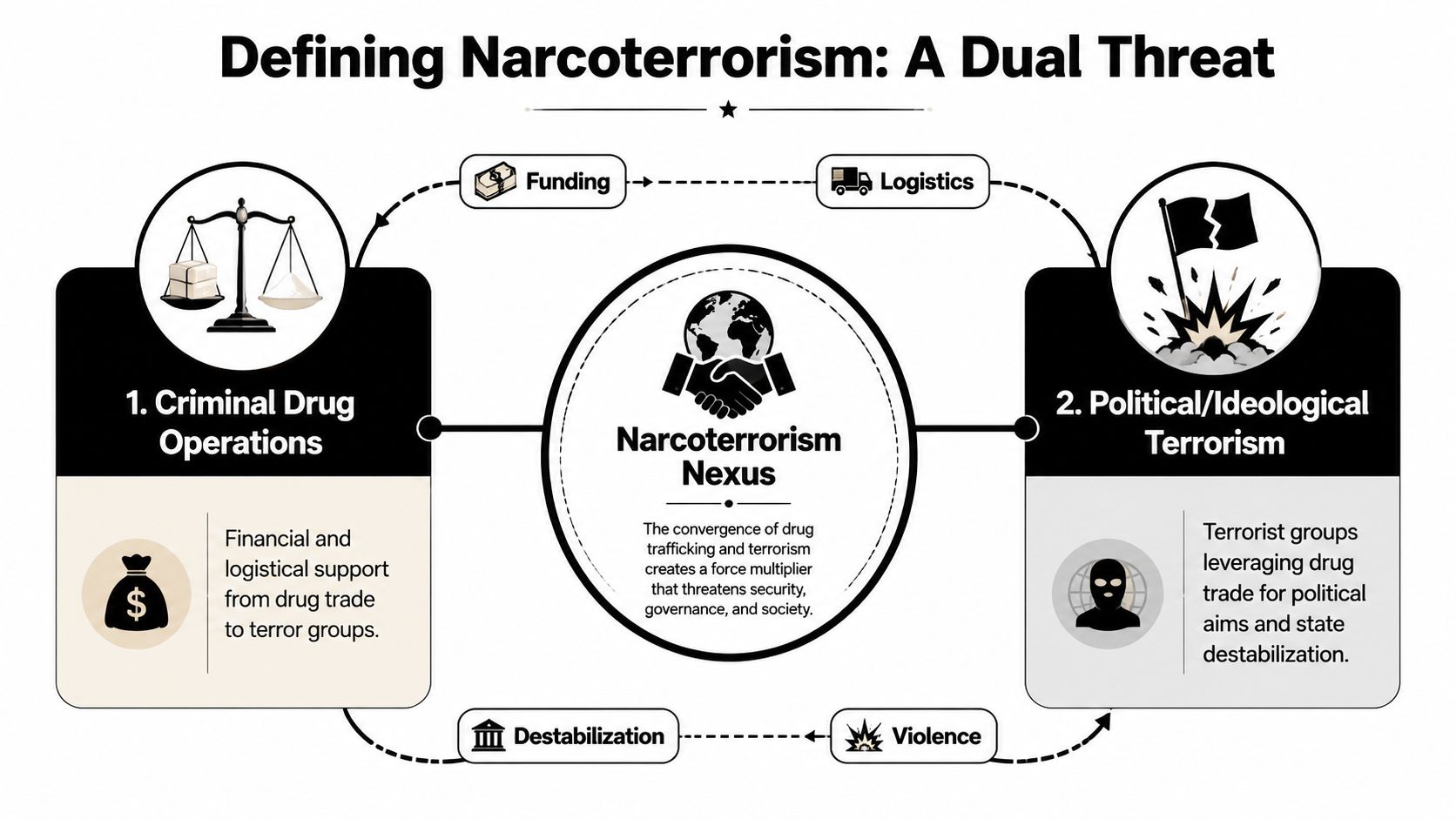
Narcoterrorism is best understood as a relationship, not a single offence. In technical policy terms, it is a financing-and-coercion model rather than a standalone legal category. The US Drug Enforcement Administration has described a narco-terrorist organisation as an organised group that uses drug trafficking to further or fund politically motivated violence against noncombatant targets, while other expert sources note that the term has no universally accepted legal definition, as summarised by Drug Policy Facts on the DEA description.
Two operational models
The first model involves drug trafficking organisations using terror-like violence to protect profits, routes, and influence. Their primary motive may begin as commercial, but their methods can evolve into intimidation aimed at the state itself. When traffickers attack officials, coerce institutions, or seek to alter enforcement behaviour through fear, they move beyond ordinary organised crime.
The second model runs in the other direction. Designated terrorist groups use narcotics trafficking to finance operations. In this version, the political objective comes first, and the drug trade becomes a means of sustaining armed capability, clandestine logistics, recruitment, and operational endurance.
These models can overlap. A network may start in one category and drift into the other as incentives change. That fluidity is one reason why siloed bureaucracies struggle to assess the threat correctly.
A more useful policy test
A practical working test is this:
- Follow the money: If drug revenue materially supports political violence, the case has a narcoterrorism dimension.
- Follow the coercion: If violence is used to preserve trafficking capacity by influencing state behaviour, the case may also fit.
- Follow the institutions: When criminal and political actors share logistics, corruption channels, or protection networks, the risk becomes systemic.
A good policy definition should help agencies act, not just classify. That means linking counterterrorism analysis with illicit-finance investigation, maritime monitoring, customs intelligence, and prosecutorial strategy. Discussions on bridging the illicit finance gap in the Global South are relevant here because weak financial visibility often gives hybrid networks the room to operate across jurisdictions.
Narcoterrorism is most dangerous when governments insist on asking whether a group is criminal or political, instead of asking how money, violence, and state weakness interact.
A History of Violence and Coercion
The term itself has a specific political origin. According to EBSCO's research overview of narcoterrorism, Fernando Belaúnde Terry, the president of Peru, first coined “narcoterrorism” in 1983 in response to drug-trafficker attacks on law enforcement. That origin matters because the phrase did not emerge from academic theory. It emerged from state confrontation with coercive criminal violence.
Peru and the birth of the modern concept
The Peruvian usage captured an early insight that remains relevant. Drug trafficking doesn't become narcoterrorism by its violence alone. Large illicit markets often generate violence. The threshold is crossed when violence is used in a sustained way to intimidate state institutions, shape official decisions, or shield revenue streams from enforcement pressure.
That distinction still helps policymakers avoid conceptual drift. Not every cartel is a terrorist organisation. Not every insurgent group involved in narcotics is reducible to criminality. The term is useful only when it describes a genuine merger of political coercion and drug-financed power.
Why historical cases still matter
Analysts often point to cases such as the Medellín Cartel, the FARC, or the Taliban when explaining the concept. Those examples are instructive because they illustrate different paths into the narcoterrorism nexus. Some actors began as profit-driven criminal networks and escalated into strategic violence against state institutions. Others began as armed political organisations and turned to narcotics as a durable revenue source.
The lesson isn't that all such groups are identical. It's that the relationship between drugs and violence is adaptive. Once a network learns that narcotics revenue can buy resilience, and that coercion can protect narcotics revenue, a self-reinforcing model appears.
Historical cases show a pattern, not a template. Governments fail when they copy one past response onto a different present threat.
The enduring pattern
Three elements recur across time:
- Revenue concentration creates strategic autonomy from lawful markets.
- Violence or intimidation protects routes, personnel, and political influence.
- Institutional corruption lowers the cost of evasion and extends operational life.
That pattern is why narcoterrorism should be read historically as a form of state pressure. It is less about a label than about a method. Networks that combine illicit finance with coercion don't just evade the state. They try to reorder the state's incentives around fear, bribery, and operational fatigue.
Distinguishing Narcoterrorism from Related Threats
Confusion in terminology produces confusion in response. A government that treats narcoterrorism as ordinary drug trafficking may underuse financial intelligence and counterterrorism tools. A government that labels all violent drug crime as terrorism may overreach legally and politically. Precision matters.
A threat matrix for decision-makers
| Threat Type | Primary Goal | Primary Method | Relationship to State |
|---|---|---|---|
| Narcoterrorism | Profit and coercive political influence, or political violence financed by drug revenue | Drug trafficking combined with intimidation, violence, and clandestine logistics | Seeks to weaken, influence, evade, or pressure state institutions |
| Traditional terrorism | Political, ideological, or religious objectives | Violence against noncombatants and symbolic targets | Seeks to compel, punish, or delegitimise the state |
| Organised crime | Profit | Illicit markets, corruption, intimidation, laundering | Usually seeks to avoid attention and preserve illicit business conditions |
| Drug trafficking | Revenue from narcotics markets | Production, transport, distribution, concealment | Often evades the state, but doesn't always aim to influence it through terror-like methods |
| Insurgency | Political control or territorial authority | Armed rebellion, mobilisation, political violence | Seeks to contest or replace state authority |
Where the boundaries matter
Traditional terrorism may never touch the drug trade. Organised crime may be ruthless without pursuing any ideological or political project. Drug trafficking can remain largely commercial. Insurgency may depend on taxation, extortion, or external sponsors rather than narcotics.
Narcoterrorism sits in the overlap. It appears when drug-market income and coercive political violence become mutually reinforcing. That's why the concept is analytically useful despite its ambiguity. It identifies a hybrid risk that ordinary categories only partially capture.
Common misclassification errors
- Calling all cartel violence terrorism: That obscures motive and can distort prosecutorial strategy.
- Treating terrorist financing as separate from drug enforcement: That can leave major revenue channels intact.
- Assuming profit and ideology are mutually exclusive: In practice, groups often combine them.
- Ignoring the role of intimidation against local officials: State weakening often starts far below the national level.
For ministers and senior officials, the policy value of the term lies in triage. It helps identify when a case requires joint action across counterterrorism, organised-crime, customs, and financial authorities, rather than a single-agency response.
The Challenge of a Contested Definition
The legal ambiguity around narcoterrorism isn't a semantic inconvenience. It shapes extradition, sanctions, evidentiary thresholds, inter-agency mandates, and international cooperation. As noted in Wikipedia's overview of narcoterrorism, “narcoterrorism” has no single legal definition, and the term often blurs two distinct ideas: traffickers using terror-like violence to influence states, and terrorist groups using narcotics to finance operations.

Why the lack of definition matters
Law depends on categorisation. Counterterrorism laws, anti-money-laundering rules, sanctions regimes, and organised-crime statutes each have different triggers and consequences. If one jurisdiction treats a network as a terrorist entity while another sees it as a criminal enterprise, cooperation slows down at exactly the point where speed matters.
This ambiguity also affects diplomacy. States may use the label selectively to justify stronger intervention, expanded security assistance, or harsher extraterritorial tools. That doesn't make the threat unreal. It means the label itself has political consequences.
Operational consequences for multilateral policy
A contested definition creates friction in at least four areas:
- Extradition decisions: Courts may ask whether the alleged conduct fits terrorism standards, organised-crime standards, or both.
- Asset freezing and sanctions: Financial measures often depend on legal designation pathways that vary across jurisdictions.
- Intelligence sharing: Agencies may collect relevant material under different authorities, complicating dissemination.
- Mission design: International support packages can become fragmented if police, military, and development actors are working from different threat definitions.
A shared vocabulary doesn't solve the problem on its own. But without one, governments often discover too late that they have been cooperating against different threats under the same name.
For G20 governments, the most realistic objective isn't a perfect universal definition. It is a functional common standard for identifying when narcotics finance and coercive violence intersect in ways that justify joint legal and operational action.
Cross-Border Implications for Global Powers
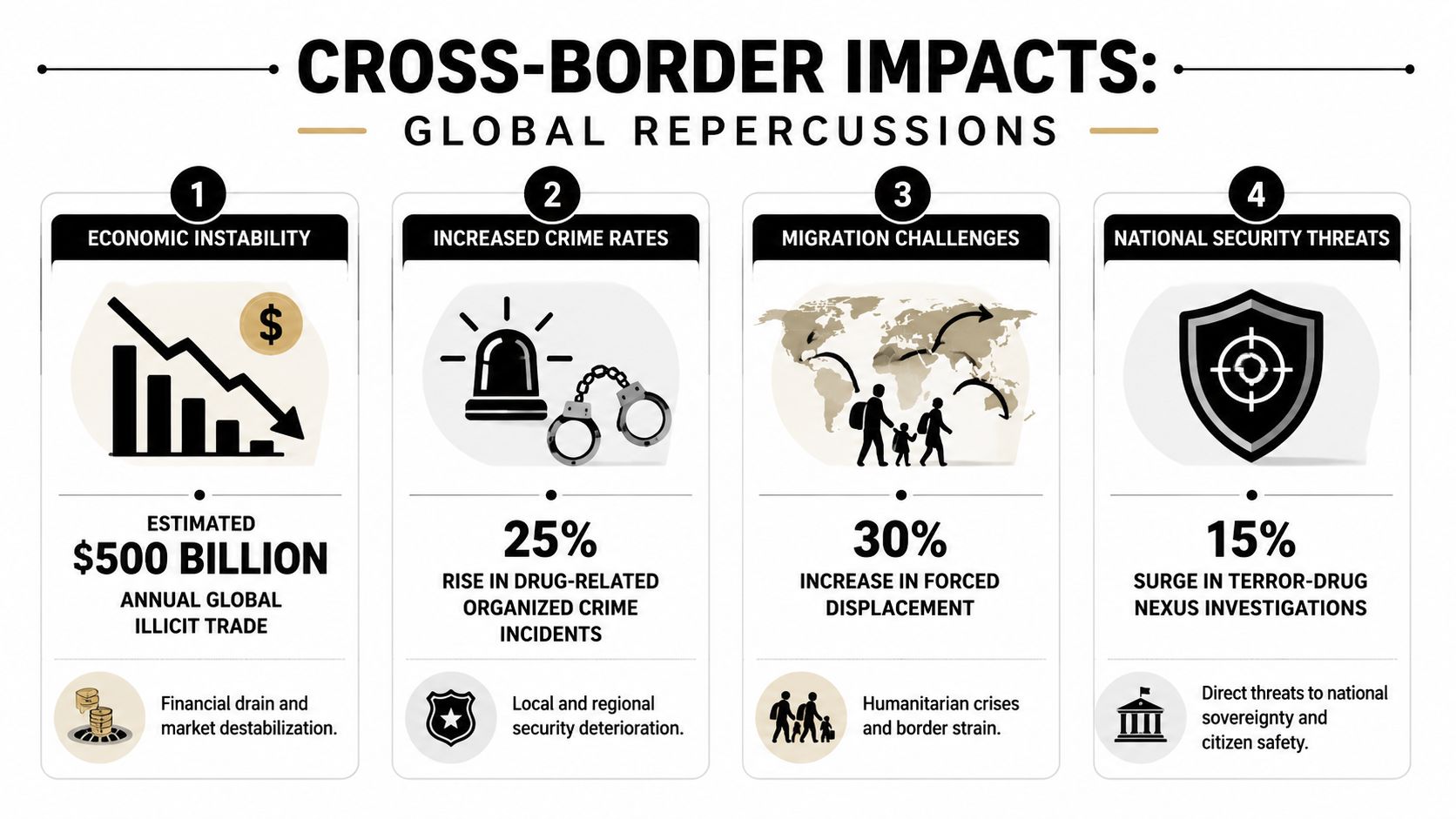
The global significance of narcoterrorism begins with scale. A key statistical anchor is the size of the underlying narcotics economy. The illegal drug trade has been estimated at roughly $400–500 billion annually, equal to about 8% of total world trade, as discussed in JSTOR material on the scale of the illegal drug economy. Those are not peripheral funds. They are resources large enough to sustain logistics, corruption, and long-duration coercion across borders.
Why distant instability becomes a domestic problem
For major economies, narcoterrorism rarely stays confined to producer or transit regions. It moves through maritime trade, financial systems, port infrastructure, freight forwarding, shell entities, and diaspora-linked laundering channels. That means a crisis that begins abroad can materialise at home as corruption risk, gang violence, illicit capital movement, and pressure on policing and courts.
The UK benchmark is instructive. The National Crime Agency states that serious and organised crime, including drug trafficking, causes at least £37 billion in annual social and economic harm in the UK, a point cited through the DEA page referencing the NCA benchmark. The significance isn't merely economic. It shows the scale of harm available to sustain criminal liquidity and coercive capacity inside an advanced economy.
For governments looking at why transnational crime cooperation must deliver, the central insight is straightforward. Cross-border criminal revenue doesn't remain in one functional lane. It spills into governance, trade integrity, and public security.
A short briefing video adds useful context on how the issue is framed in practice.
Strategic implications for the G7 and G20
Three implications follow for global powers.
First, supply-chain security can't be separated from illicit-finance monitoring. Ports and logistics hubs are not just trade assets. They are strategic pressure points.
Second, financial transparency is now part of counter-coercion policy. If governments fail to detect laundering pathways, they indirectly subsidise hostile resilience.
Third, fragile governance abroad creates security costs at home. When producer or transit states lose institutional control, downstream economies bear the burden through crime, instability, and enforcement costs.
A Roadmap for International Cooperation
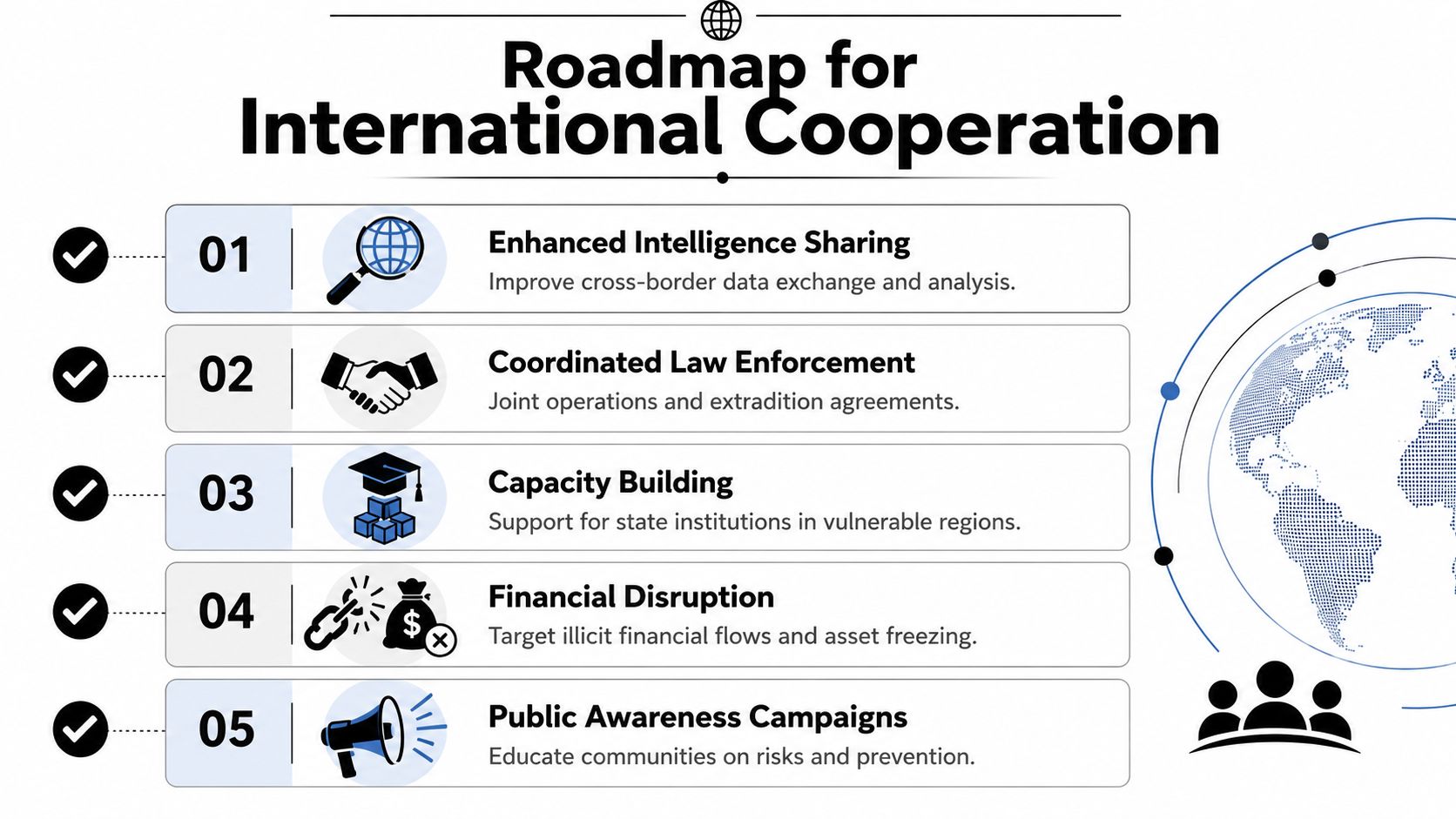
The policy response to narcoterrorism should start from a simple premise. Governments won't solve a hybrid threat with siloed institutions. Criminal investigation, sanctions policy, border security, anti-money-laundering enforcement, and external capacity-building have to work as one system.
Five priorities for multilateral action
Build a functional common definition
G7 and G20 members should align around an operational standard focused on the nexus between drug revenue and coercive political violence. Perfect legal uniformity isn't necessary. Shared decision criteria are.Prioritise financial disruption
Follow the money before the violence escalates. Asset tracing, beneficial ownership transparency, customs intelligence, and cross-border seizure coordination should sit at the centre of strategy, not at the margins.Integrate organised-crime and counterterrorism analysis
Separate databases, legal authorities, and watchlists often miss the overlap that matters most. Hybrid threats require fused analytical cells and clearer referral protocols.Strengthen vulnerable institutions in transit and producer states
Courts, ports, customs services, prosecutors, and financial-intelligence units need durable support. Without institutional resilience, tactical enforcement success won't last.Use multilateral forums to close jurisdictional gaps
Cooperation on extradition, evidence-sharing, sanctions alignment, and investigative support should be treated as core security governance. Current debates on strengthening multilateral law enforcement to confront global threats point in the right direction.
The most effective strategy is not to chase every manifestation of narcoterrorism separately. It is to make the underlying system of finance, movement, and protection much harder to operate.
The larger lesson is that narcoterrorism shouldn't be viewed as an exotic edge case. It is a recurring form of hybrid coercion that emerges wherever lucrative illicit markets meet weak governance and strategic violence. G7 and G20 leaders don't need a new slogan. They need tighter legal coordination, stronger financial disruption, and a more realistic understanding of how criminal revenue becomes political force.
Global governance can't afford to treat narcoterrorism as a niche security topic or a semantic dispute. If you want more evidence-based analysis on the threats shaping multilateral policy, follow Global Governance Media for regular briefings, expert commentary, and practical roadmaps for international cooperation.