

By Eleanor Hart, Senior Policy Analyst
You're likely dealing with this problem already, even if you aren't naming it that way. A counterpart arrives at a negotiation with polished numbers, selective disclosures, and confidence that can't be independently tested. Your team has to decide whether to trust the data, delay the agreement, or sign and absorb the risk later.
That is the operational reality of asymmetries of information. In textbooks, the concept often appears as a market curiosity. In practice, it is one of the main reasons international cooperation stalls, why regulation misses its target, and why summit communiqués struggle to convert into verifiable delivery. The issue isn't only that one side knows more. It's that institutions often lack the means to verify what matters before commitments are made and after they are announced.
For the G7 and G20, this has become a cross-cutting governance problem. Climate frameworks depend on credible reporting. Health security depends on timely disclosure. AI oversight depends on access to model behaviour, training practices, and audit trails that are often held by a narrow set of private actors. Trade, tax, insurance and industrial policy all reveal the same pattern. Decision-makers are asked to govern systems they cannot fully see.
The strategic implication is straightforward. States can't treat information integrity as a technical afterthought. They need to treat it as core infrastructure for cooperation. Where facts can't be shared, standards must align. Where claims can't be trusted, verification must be built. Where interested parties dominate the evidence base, public institutions need independent capacity.
Table of Contents
- Introduction The Knowledge Gap in Global Governance
- The Hidden Architecture of Information Gaps
- Modern Arenas of Information Asymmetry
- Data-Led Case Studies in Global Cooperation
- The Policymakers Toolkit for Levelling the Field
- A Summit Agenda for Information Integrity
- Conclusion The Path Towards Cooperative Intelligence
Introduction The Knowledge Gap in Global Governance
A climate negotiator can secure a political concession in a closed room and still leave without a usable agreement if emissions reporting can't be verified. A health minister can pledge stockpile readiness without proving supply-chain resilience. An AI regulator can publish principles while lacking access to the evidence needed to test whether firms are complying with them. In each case, the apparent problem is sector-specific. The underlying problem is the same.
Asymmetries of information arise when one party holds material knowledge that another party cannot readily observe, assess or validate. In domestic markets, that distorts prices and contracts. In global governance, it distorts trust. That matters because modern multilateralism doesn't run on declarations alone. It runs on shared baselines, comparable data, and institutions capable of checking claims without waiting for a crisis to expose the gap.
Why this is now a system risk
The pressure point has shifted from isolated transactions to whole governance systems. Health, climate and AI all involve complex chains of delegated authority. Governments rely on firms, regulators rely on self-reporting, and international bodies rely on national statistical or administrative systems that don't always measure the same thing in the same way.
That creates a dangerous mismatch. Leaders are expected to act quickly, but verification remains slow, fragmented, or politically constrained.
Core judgement: the greatest risk from information asymmetry is no longer a bad bilateral bargain. It is cumulative institutional misalignment across multiple policy domains at once.
Three consequences follow.
- Trust becomes expensive: every negotiation requires more time, more caveats and more contingency planning.
- Compliance weakens: actors can exploit uncertainty in definitions, timing or disclosure standards.
- Policy legitimacy erodes: publics and markets lose confidence when official claims can't be reconciled across borders.
What senior officials should infer
The standard “lemons” framing is too narrow for the current moment. The key question isn't how to protect an uninformed buyer from a better-informed seller. It is how to design counteracting institutions that prevent information advantages from undermining collective action.
That requires a different posture. Governments need to ask not only who holds the information, but also who verifies it, who standardises it, who can challenge it, and what happens when the answer changes across jurisdictions. Once those questions are brought into view, asymmetries of information stop looking like a niche concept and start looking like a central obstacle to G7 and G20 performance.
The Hidden Architecture of Information Gaps
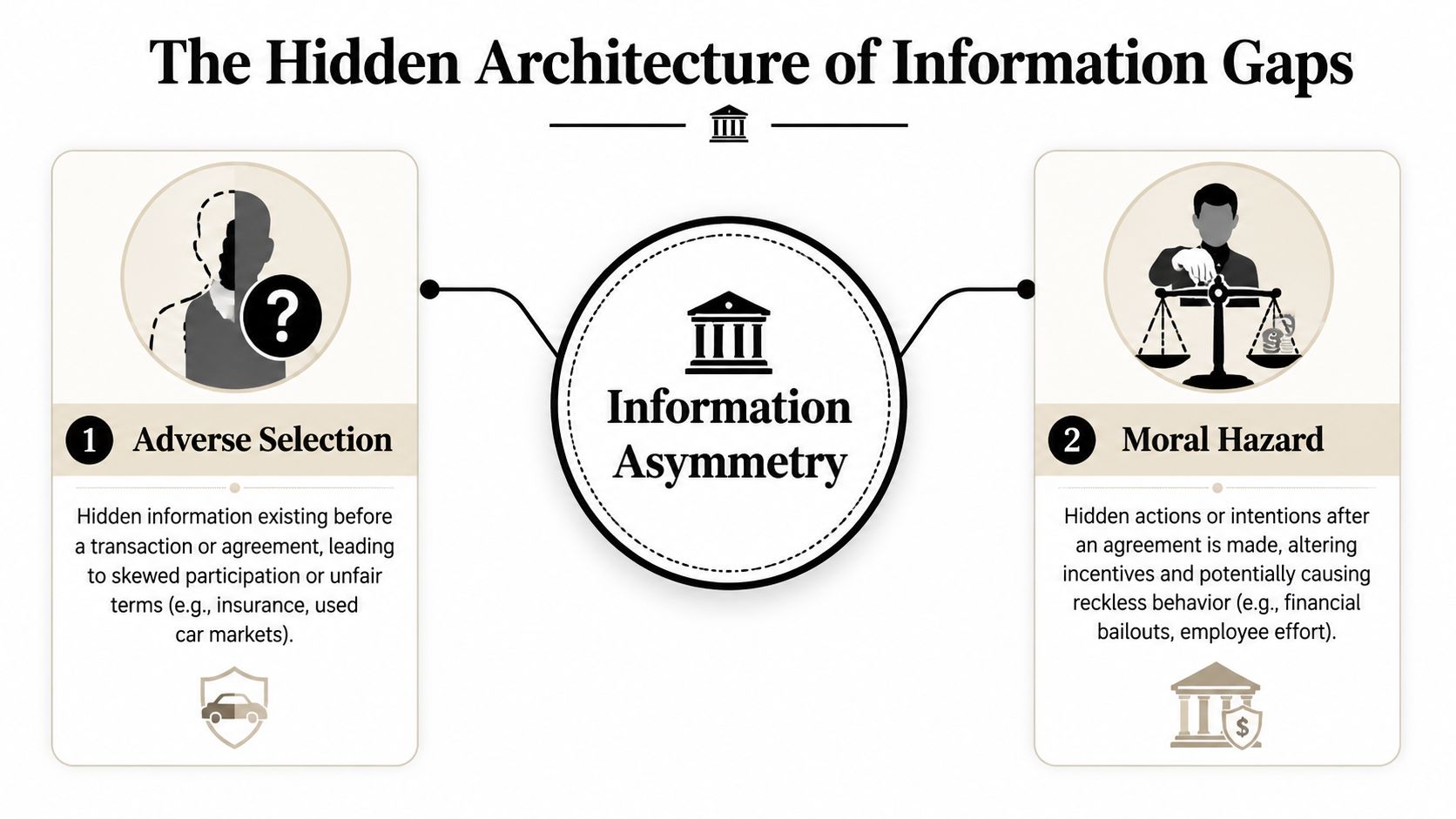
Markets and negotiations fail in recognisable ways when one side knows something the other side doesn't. Two mechanisms matter most. Adverse selection distorts participation before an agreement is made. Moral hazard distorts behaviour after the agreement is signed.
Adverse selection before the deal
Adverse selection appears when one party enters a transaction with hidden characteristics. Insurance remains the clearest policy example because risk is privately known long before the contract is priced. The result isn't just unfairness. It's a measurable reduction in welfare.
In the UK insurance market, asymmetric information reduces annual welfare by approximately £127 million, or 2% of total annual premiums, because higher-risk clients know more about their own risk than insurers do, which distorts coverage and pricing according to NBER analysis of the UK insurance market.
That finding matters for policymakers because it shows the cost of ignorance isn't theoretical. It appears in reduced coverage, mispriced risk, and less efficient allocation of protection. The same logic surfaces in sovereign lending, procurement and export finance. When one side can't distinguish strong from weak risks, it prices for the average. Strong performers then face worse terms than they merit, while weak performers gain room to hide.
Moral hazard after the agreement
Moral hazard starts later. The contract exists, but one side can take actions that the other side can't fully monitor. Think about a bailout framework, a subsidy regime, or a treaty verification arrangement. If the protected party can alter behaviour after receiving support, the original bargain stops reflecting real incentives.
Once hidden action enters the system, enforcement becomes a data problem as much as a legal one.
This is why governance institutions increasingly need structured evidence, audit trails, and interoperable records. Better policy doesn't begin with more declarations. It begins with better observability. That's also why officials should care about data quality itself, not just data volume. A poor underlying structure makes oversight brittle. For readers working on evidence systems, a short primer on what a dataset is and why structure matters for policy use is often more relevant than another high-level debate about transparency.
The deeper policy lesson
A textbook treatment would stop at buyer protection. That's incomplete. Asymmetries of information often punish high-quality participants too, because pooled markets force them to accept average pricing and average trust. This is one reason information failures can drain capacity from otherwise healthy systems.
Consider the implications for international cooperation:
- Verification isn't a secondary function: it shapes who participates and on what terms.
- Disclosure alone isn't enough: self-reporting without comparability can preserve the asymmetry.
- Institutions need design discipline: standards, audits and incentives must work together.
Modern Arenas of Information Asymmetry
Information gaps no longer sit at the edges of global governance. They are embedded in its most sensitive domains.

Statecraft and strategic trust
In state-to-state relations, information asymmetry shapes how governments interpret military capability, industrial resilience, sanctions exposure and treaty compliance. Officials rarely negotiate with complete visibility. They negotiate with partial disclosures, intelligence estimates and politically mediated reporting.
The strategic consequence is that mistrust compounds even when no party is deliberately deceptive. Different definitions, collection methods and reporting cycles can produce divergent realities. That weakens the practical value of summit commitments because each side may be implementing against a different informational baseline.
Health systems and emergency disclosure
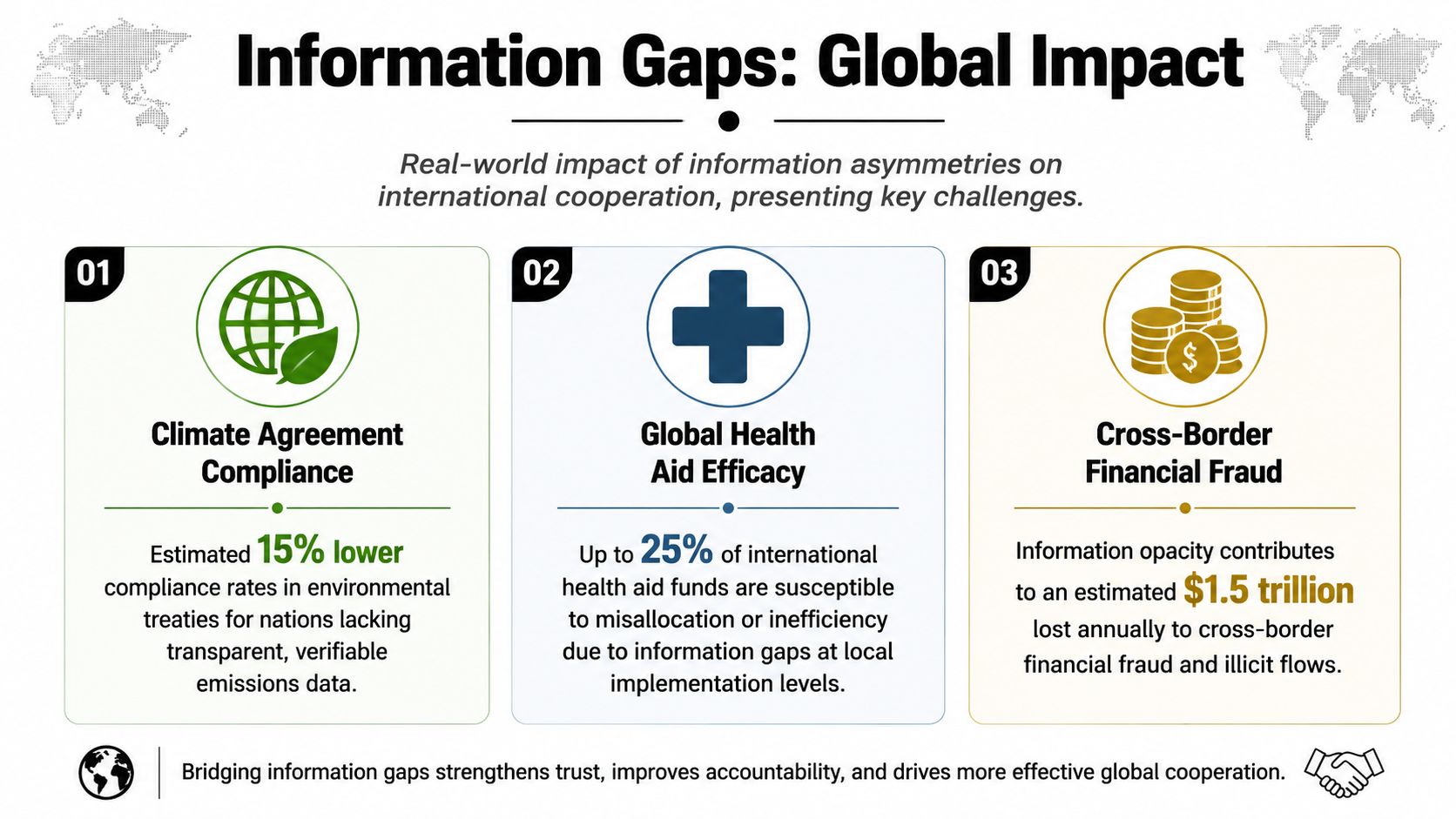
Public health creates a sharper version of the same problem. Governments need timely information from hospitals, labs, firms and foreign counterparts. Yet each actor may have reasons to delay, narrow or frame what it discloses. During a crisis, even small lags in reliable information can alter procurement, border measures and public communication.
This is one reason pandemic preparedness can't be reduced to stockpiles and financing. It depends on institutional habits of reporting, common thresholds for escalation, and trusted channels for verification. Information asymmetry in health is not just a scientific issue. It is a governance issue.
Digital markets and AI governance
The digital economy adds another layer because the most consequential information is often held by firms, not states. Platform operators understand their own systems more fully than regulators do. AI developers know far more than external users about training data provenance, model limitations, evaluation methods and deployment risks. Market concentration intensifies that imbalance.
In UK trade data, this dynamic is already visible. The UK's digital economy shows an export asymmetry of £1.8 billion for information services, where UK sellers hold superior knowledge of transaction value compared with international partners, according to ONS analysis of UK bilateral trade asymmetries. That is more than a statistical curiosity. It demonstrates that high-value digital trade can outpace the ability of counterparties and official systems to record it consistently.
For officials working on platform power, model accountability and cross-border standards, debates about AI governance need to start from this asymmetry, not from the assumption that regulators can request what they need. That's why discussions about the G7 and the future of AI governance should be read through the lens of institutional access to evidence.
A useful briefing follows.
The digital state now governs entities whose internal knowledge is richer than most public oversight systems can independently replicate.
Data-Led Case Studies in Global Cooperation
The effects of information asymmetry become clearest when they disrupt cooperation that leaders describe as strategic priorities.
Vaccine procurement and opaque capability claims
During health emergencies, governments negotiate under pressure with suppliers that know more about production constraints, input bottlenecks and delivery sequencing than public buyers do. The asymmetry doesn't always imply misconduct. It does mean public negotiators often make commitments on timing, cost exposure and national rollout assumptions with incomplete visibility into what industry can reliably deliver.
That weakens accountability on both sides. Ministers can overpromise domestically, while suppliers can preserve discretion by emphasising uncertainty only after contracts harden. The institutional lesson is that emergency procurement needs stronger verification rights, clearer milestone reporting, and shared intelligence across governments to reduce bilateral opacity.
Climate reporting and verification gaps
Climate policy often treats disclosure as if it automatically produces comparability. It doesn't. Companies and governments can report sincerely and still produce figures that aren't operationally aligned because scope boundaries, estimation practices and timing rules differ. That leaves negotiators trying to build enforcement on top of data systems that were never designed to be interoperable.
A useful analogy comes from trade statistics. In UK bilateral trade data, definitional differences explain approximately 30% of the total trade in services asymmetry between UK exports and US imports for 2014 and 2015, and treating those quantified definitional differences consistently would increase the UK service import to US service export asymmetry by around 5%, according to ONS work on UK-US services asymmetries. The climate implication is direct. If definitions diverge, transparency can still produce disagreement rather than trust.
Trade disputes and statistical divergence
The clearest quantified case comes from UK-US trade. Analysis of 2022 data shows a UK export asymmetry with the USA of -$324 million for total exports, while total imports show an asymmetry of $20,574 million, according to the UK government's analysis of asymmetry in UK-US trade in goods statistics. The scale of divergence matters because trade policy relies heavily on mirror statistics, partner comparison and official reporting confidence.
Where the records differ by that extent, policymakers face at least three risks:
- Negotiation error: trade irritants may be misdiagnosed because each side believes a different baseline.
- Regulatory friction: customs, valuation and classification issues become harder to isolate.
- Strategic mistrust: large discrepancies invite political interpretation even when the underlying causes include methodology.
Big statistical gaps don't just confuse analysts. They alter the choices ministers think are available.
This is why asymmetries of information should be treated as a cooperation problem, not just a technical statistical issue. They shape what states think they are governing.
The Policymakers Toolkit for Levelling the Field
The right response to information asymmetry isn't a single reform. It is a portfolio. Different gaps call for different instruments, and the best results usually come from combining them.
Five instruments that matter
Transparency regimes work when actors hold relevant information but have weak incentives to disclose it voluntarily. Mandatory reporting can improve baseline visibility, especially where markets need comparable disclosures rather than bespoke claims.
Information-sharing platforms are most useful where speed and cross-border coordination matter. Public health surveillance and supply chain monitoring depend on institutions that can move validated information across agencies and jurisdictions without waiting for ad hoc requests.
International standards reduce ambiguity before disputes arise. In areas like AI audit practice, digital trade classification or climate accounting, standards can narrow interpretive space and make cross-country comparisons more credible. Readers tracking institutional design choices may find existing debates on data governance frameworks helpful because standards only work when authority, accountability and data architecture line up.
Third-party verification matters when self-reporting is necessary but insufficient. Inspectors, external auditors and independent technical bodies can convert contested claims into actionable findings.
Capacity-building is often the neglected piece. A low-capacity statistical office or regulator cannot deliver information integrity because a summit communique asks for it.
The UK tax gap illustrates the principle neatly. It is primarily an asymmetric information problem because taxpayers know their own taxable income and gains while tax authorities do not. The key mechanism for improving compliance is access to third-party data, as explained in this UK tax analysis on asymmetric information and compliance.
Matching tools to problems
| Problem Type | Primary Tool | G7/G20 Application Example |
|---|---|---|
| Hidden characteristics before agreement | Transparency regime | Comparable disclosure rules in climate-related reporting |
| Hidden actions after agreement | Third-party verification | Independent audit and inspection arrangements |
| Fragmented cross-border reporting | International standards | Common reporting definitions for health, trade or AI |
| Slow or siloed intelligence flows | Information-sharing platform | Shared surveillance and early-warning systems |
| Weak domestic implementation capacity | Capacity-building | Support for national statistical agencies and regulators |
Not every government can build these systems internally at speed. In some cases, teams also need technical means to collect and structure public web data for oversight, market monitoring or procurement intelligence. Used carefully and lawfully, guidance on choosing a web scraping API can help officials and analysts assess how to gather evidence from fragmented digital environments rather than relying only on voluntary disclosures.
Limits policymakers should recognise
No tool is neutral. Transparency can create compliance theatre if disclosures aren't comparable. Verification can become politicised if inspectors lack independence. Data-sharing platforms can fail if states fear exposure more than they value coordination.
That is why the actual policy task is institutional design. Governments need to decide which mix of disclosure, standards, external checks and capability-building fits the risk at hand. The objective isn't perfect information. It is enough verified information to make cooperation durable.
A Summit Agenda for Information Integrity
G7 and G20 leaders should promote information integrity into a standalone agenda item. Not because it is fashionable, but because nearly every priority they already care about depends on it.
Why summit leaders need an integrity agenda
Policymakers often rely on firms and organised interests for highly technical information. That is unavoidable. It is also risky when governments lack the capacity to validate what they are being told. Research on policy adoption shows that information asymmetry between policymakers and firms arises when officials have limited resources, public deliberation is absent, and countervailing lobbying is weak, as discussed in Cambridge research on informational lobbying in ride-hailing and genomics regulation.
That insight should sharpen summit strategy. States cannot rely on interested parties to define the evidence base in areas such as AI safety, health regulation or climate compliance. They need independent verification capacity built into the governance architecture from the start.

What a G20 package should include
A credible summit package would include several linked commitments.
- A working group on data standards: climate, health and digital reporting need interoperable baselines, not parallel declarations.
- An independent AI audit capability: governments need access to expertise that doesn't depend entirely on vendor claims.
- A trade transparency pact: customs, classification and reporting systems should be designed to reduce persistent statistical divergence.
- Support for national evidence institutions: statistical agencies, tax authorities and specialist regulators need resources and legal authority to obtain third-party data.
- A public integrity layer: hearings, structured consultation and technical review can reduce the chance that opaque lobbying becomes de facto policymaking.
For the AI and information integrity agenda, leaders also need practical tools to identify manipulated media and synthetic deception in enterprise and public-sector settings. A grounded survey of top enterprise deepfake solutions is useful in that context because authenticity checks are becoming part of governance infrastructure, not just cybersecurity hygiene.
Strategic test: if a summit commitment depends on self-reporting alone, it is not yet governance-ready.
There is also a less familiar implication. Conventional narratives assume the less informed party is always the main victim. That isn't always true. As noted in Gresham College's discussion of asymmetric information, sellers with inferior products can also be trapped by average pricing in pooled markets. For ministers, the point is broader. Poor information environments don't just exploit the weak. They can lock whole systems into mediocre outcomes by making quality harder to recognise and reward.
Conclusion The Path Towards Cooperative Intelligence
Asymmetries of information are not a side issue in modern governance. They sit underneath trade disputes, tax enforcement, insurance inefficiency, health preparedness and AI oversight. When states can't verify what counterparties, firms or even their own systems report, cooperation slows and credibility weakens.
The answer isn't to wait for perfect visibility. It is to build cooperative intelligence through standards, verification, third-party data access and stronger public institutions. G7 and G20 leaders should treat that as foundational capacity. Not technical housekeeping.
Global challenges now hinge on who can establish credible facts quickly and fairly. Follow Global Governance Media for continuing analysis on G7 and G20 agendas, summit delivery, and the policy tools that can turn international commitments into verifiable outcomes.