


Wireless electrical transmission is not waiting to be invented. It is waiting to be governed. The surprise for many ministers is that the UK's earliest wireless breakthrough was not a laboratory curiosity, but a practical engineering leap, because by March 1897 Guglielmo Marconi had already sent Morse signals across roughly 3 miles on Salisbury Plain, and by 13 May 1897 he had transmitted a message across the Bristol Channel from Flat Holm Island to Lavernock Point near Cardiff, again over about 3 miles (Marconi's UK milestones). That history matters now because the strategic question is no longer whether energy can move without a visible wire. It is whether governments can shape that capability before it hardens into fragmented national regimes.
For G20 energy ministers, the policy significance is larger than charging pads or niche demonstrations. Wireless electrical transmission sits at the intersection of infrastructure security, industrial competitiveness, spectrum policy, and public acceptance. The earliest UK wireless milestones showed that Britain became a global node in long-distance electromagnetic communication, and that same institutional advantage is now reappearing in the rules space around power transfer. In other words, the next contest is not just about physics. It is about standards, consent, and the geopolitical order around energy systems.
Table of Contents
- The Next Energy Revolution Is Unwired
- Understanding Core Wireless Power Technologies
- Current Deployments and Strategic Research Frontiers
- Integrating Wireless Power into National Energy Systems
- Navigating Safety Security and Spectrum Risks
- The Fragmented State of International Governance
- A Roadmap for Multilateral Policy Coordination
The Next Energy Revolution Is Unwired
Wireless electrical transmission is moving from a niche engineering concept to a strategic infrastructure issue. Energy systems are already under strain, and the next wave of demand will test how quickly governments can connect generation, storage, mobility, and digital infrastructure without adding more copper, steel, and trenching. For ministries that usually think in terms of pylons, substations, and interconnectors, the policy question is no longer whether the technology is interesting. It is whether it can reduce bottlenecks in the shift in our energy systems.
The UK offers the clearest reminder that wireless systems often begin as experiments and then become national capabilities. Marconi's 1896 patent work in Britain, the Salisbury Plain Morse tests in March 1897, and the Bristol Channel transmission on 13 May 1897 show how quickly wireless ideas can move from theory to repeatable engineering when institutions align around them (Marconi's UK milestones). The first transatlantic wireless telecommunication message from Poldhu, Cornwall in 1902 then turned Britain into a launch point for global communication infrastructure.
That precedent should not be romanticised. Communication and power are different systems. The policy lesson is sharper. Once a wireless technology becomes technically dependable, rule-setting quickly becomes the battleground. States that lead on standards and spectrum can shape markets far beyond their own borders.
Policy takeaway: wireless power becomes geopolitics the moment states decide which frequencies, safety limits, and interoperability rules define market access.
The broader energy transition makes that governance question more urgent. If wireless electrical transmission remains confined to consumer charging, the policy stakes stay narrow. If it begins to support grid resilience, remote connections, emergency deployment, or specialised industrial loads, it becomes part of the architecture of sovereign energy systems. That is why ministers should read it through a strategic lens, not as a gadget trend.
A useful starting point for that wider frame is the economics of infrastructure choice, especially the way capital allocation now determines industrial winners and losers. The debate is no longer only about decarbonisation. It is about which countries can connect low-carbon power fastest and most securely, a theme explored in Global Governance Media's energy transition coverage.
Understanding Core Wireless Power Technologies
Wireless power is not a single technology. It is a family of methods with different distance limits, safety profiles, and policy consequences. That distinction matters because ministers often hear the phrase and assume one universal solution. The engineering reality is narrower. Short-range transfer is mature and tightly controlled, while long-distance transfer remains much harder to scale.
Near-field systems work like a transformer with a gap
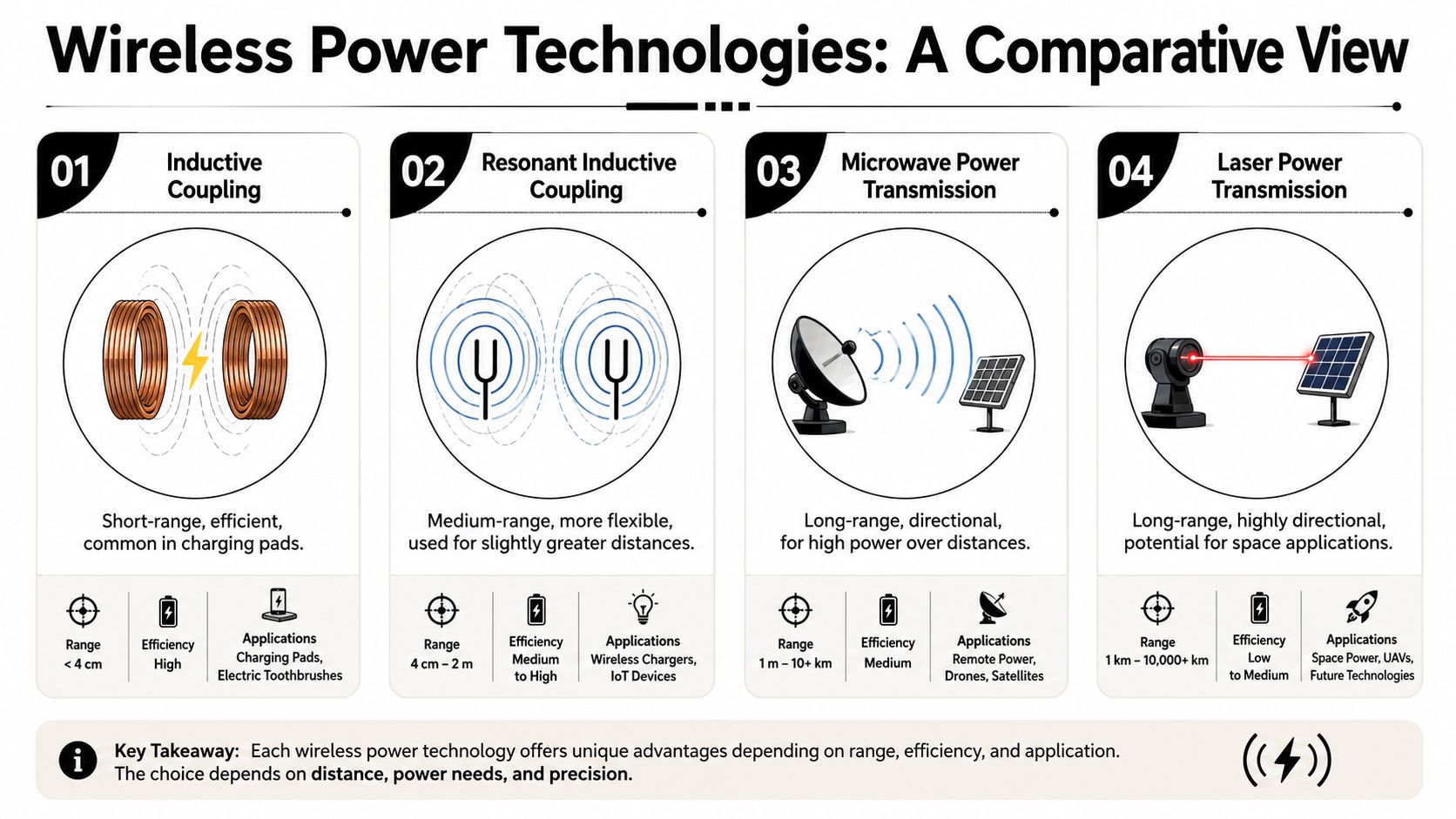
The simplest way to understand inductive coupling is as a transformer with air between the coils. Electricity in the transmitter coil creates a magnetic field, and a nearby receiver coil captures that field and turns it back into electrical current. These systems are common in charging pads and aligned industrial docks because efficiency depends on proximity and alignment, so the range stays short by design.
Magnetic resonant induction and resonant inductive coupling extend the same principle. By tuning the transmitter and receiver to the same resonant frequency, engineers can maintain usable transfer across a somewhat greater gap, but still only in short-range conditions. For policy purposes, the key point is that these are not bulk transmission tools. They are controlled proximity systems.
Far-field systems serve different strategic purposes
Microwave power transmission and laser power transmission are designed for distance rather than close coupling. That makes them attractive for specialised cases, including space concepts and long-range beaming. It also makes them more sensitive to line-of-sight constraints, beam control, and public safety rules.
| Technology Type | Effective Range | Typical Efficiency | Power Capacity | Primary Use Case |
|---|---|---|---|---|
| Inductive Coupling | Short range | High when aligned | Lower to moderate | Charging pads, docked devices |
| Resonant Inductive Coupling | Short to moderate range | Improved over basic inductive systems | Moderate | Flexible charging at close distance |
| Microwave Power Transmission | Long distance | Highly dependent on conditions | Potentially high | Directional beaming, remote links |
| Laser Power Transmission | Long distance | Highly dependent on alignment and atmosphere | Potentially high | Space and specialised remote applications |
The policy lesson is direct. Near-field systems fit managed, local infrastructure. Far-field systems belong in high-scrutiny regulatory environments because they raise different questions about beam control, interference, and public tolerance. Ministers should avoid treating the two as substitutes.
The UK's current regulatory treatment reflects that split. ETSI EN 303 417 covers non-radio-frequency-beam wireless power transmission systems in bands including 79-90 kHz, and it specifies technical characteristics and measurement methods for compliance rather than assuming power alone solves the problem (ETSI EN 303 417). That is the model to watch, power transfer as an engineering discipline constrained by electromagnetic compatibility, not as a freeform alternative to cabling.
Practical rule: if a system depends on precise coil alignment, it belongs in the infrastructure and device category. If it needs beam control across distance, it belongs in the national security and spectrum category.
The clearest way to brief ministers is to separate use cases before discussing ambition. Short-range systems can be procured and standardised. Long-range systems need governance architecture first, because they will fail politically if they are allowed to look speculative, unsafe, or commercially opportunistic.
Current Deployments and Strategic Research Frontiers
The near-term evidence for wireless electrical transmission is strongest in controlled charging environments. Public transport, fleet depots, and industrial sites prize repeatability over spectacle. They need equipment that can tolerate dirt, weather, misalignment, and heavy daily use. That is why wireless systems are already being tested where uptime matters more than distance.
The ITU-R research on EV wireless charging is important because it marks the point at which the technology has shown credible performance under managed conditions. Systems operating at 79-90 kHz in the 3 kW and 7.7 kW classes were found usable without harmful interference to selected incumbent systems under practical conditions (ITU-R EV wireless charging research). That does not make wireless charging a general substitute for cables. It does show that kilowatt-level inductive transfer already sits within the reach of spectrum management and interference controls.
Where the technology is mature
For ministers, the policy significance is straightforward. Public and fleet charging is the most technically mature use case. These deployments are short-range, predictable, and compatible with regulated bands. They are also easier to procure because the value proposition is visible, less land-intensive, and bounded by operations rather than open-ended infrastructure claims.
Strategic research is moving into more ambitious territory. Optical wireless power, microwave beaming, and space-linked concepts all aim to move energy without physical conductors over greater distances. A recent experimental report described an 800-watt laser power transmission test over more than 8 km with reported efficiency around 20%, but that remains experimental and does not yet translate into domestic deployment prospects in Britain. The policy signal is clear. Long-range power is advancing, but in uneven steps that require separate assessment rather than blanket enthusiasm (recent experimental report).
Why the frontier matters even before deployment
One speculative UK-facing idea imagines a north Scotland to south England satellite power relay replacing 600+ miles of pylons, but it remains a concept rather than a funded programme. The broader relevance is political, not technical. It shows how quickly the sector is attracting proposals that frame wireless systems as substitutes for major infrastructure, especially where planning delays and land-use conflicts are severe.
That matters for G7 and G20 decision-makers because early-stage experimentation shapes future bargaining power. States that invest now in domestic testing capacity, safety expertise, and standards influence will be better placed to set the terms later. The policy task is to build that capacity while the technology is still being defined, and to connect it to wider grid resilience planning, including the kind of work discussed in resilient grid planning for a sustainable energy future.
Integrating Wireless Power into National Energy Systems
The policy issue is whether wireless power can do something cables cannot, support national energy systems in ways that matter for resilience, access, and continuity. In the UK, the debate is already moving beyond niche charging and toward grid operations, where the relevant measures are restoration time, connection backlogs, and service reliability. That shift matters because it moves wireless transmission from consumer convenience into infrastructure strategy.
National Grid Electricity Distribution's wireless power transmission innovation project with Space Solar is testing whether ground-based wireless technology could supplement overhead lines and underground cables, with the stated aim of improving network resilience and speeding up grid connections, especially for storm response and remote areas (National Grid Electricity Distribution project). The company's broader innovation overview treats wireless electricity transmission as a developing concept, while Parliament has pointed to rising electricity demand in the years ahead. The policy question is whether the technology can be proven at the scale where it competes with conventional assets on cost, efficiency, and deployment speed.
What makes grid integration attractive
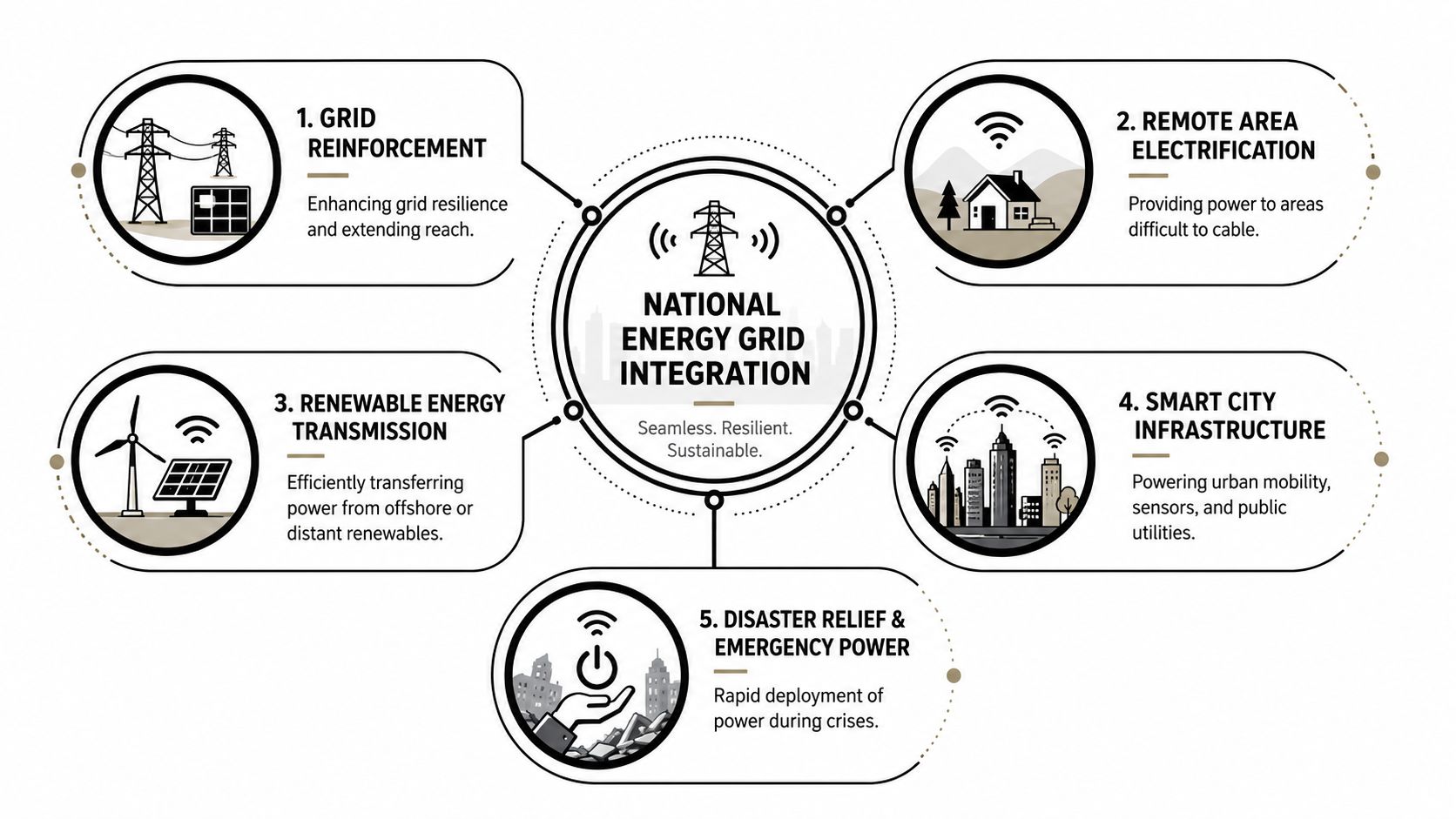
Wireless links are most attractive where the grid is hardest to reinforce quickly. That includes storm-damaged areas, temporary bypass routes, and locations where new lines face slow permitting or political resistance. They can also provide supplementary capacity when operators need a rapid reinforcement option before a full build-out is available. These are operational advantages, not claims that wireless systems can replace the whole grid.
The UK policy gap is still plain. National Grid's own innovation material frames wireless electricity as a concept, while Parliament has noted electricity demand could reach around 570 TWh by 2050 (National Grid innovation overview). Ministers still lack a clear evidence base on where wireless links can compete with pylons on cost, efficiency, and delivery speed.
That gap matters for three reasons.
- Grid reinforcement: Wireless links may let operators add temporary or targeted reinforcement without the legal and planning friction of major new corridors.
- Remote connectivity: Places that are difficult to cable could receive faster service if wireless links prove reliable for specific, bounded tasks.
- Emergency restoration: After storms or other disruptions, a deployable link may restore critical service faster than conventional repair sequencing.
Decision rule: if a technology cuts the time between a grid problem and a temporary fix, it deserves pilot funding even before it can replace permanent infrastructure.
Wireless systems also add operational flexibility. They can be deployed where physical access is constrained, which makes them relevant to resilience planning and to the wider task of building resilient grids. That is why the issue belongs in energy security discussions, not only innovation portfolios. It also links directly to practical operator guidance such as understanding wireless signal strength, because performance in the field depends on how well transmission conditions are maintained under real network stress.
Ministers should avoid treating wireless transfer as a substitute for the existing system. The near-term model is hybrid. Wireless links fill gaps, support contingencies, or accelerate specific connections while conventional infrastructure remains the backbone.
Navigating Safety Security and Spectrum Risks
The core constraint on wireless electrical transmission is institutional, not technical. Governments have to judge safety, security, and spectrum compatibility at the same time, because failure in any one of those areas can stop deployment.
Safety concerns start with electromagnetic exposure and extend to how systems are engineered and supervised. The UK's current approach through ETSI EN 303 417 shows that deployment depends on detailed electromagnetic compatibility conditions, not only on raw power output. That matters because it shifts the debate from abstract concern to measurable compliance. If systems are standardised against defined conditions, regulators can supervise them with far more confidence.
Security and interference are governance problems, not afterthoughts
Wireless grids also create cybersecurity exposure. Any architecture that coordinates transmitters, receivers, beam management, or load switching creates a digital attack surface, which means security has to be built into procurement and certification from the outset.
Spectrum is the other binding constraint. Wireless power operates in a crowded electromagnetic environment beside telecoms, navigation, and industrial systems that already depend on tightly managed frequencies. Field performance also depends on signal quality, which is why understanding wireless signal strength is relevant to the wider policy debate, even though power systems and communications systems use radio conditions for different purposes.
The cyber policy layer matters as well. Attribution in attacks is already difficult in conventional digital conflict, as discussed in Model Diplomat's treatment of attribution in cyber attacks. Wireless power networks would inherit that problem, and may intensify it if cross-border beams, remote controls, or distributed certification chains become normal. Governments should assume hostile actors will test these systems early.
The safest deployment model is the one that treats wireless power as critical infrastructure from day one, with testing, logging, incident response, and spectrum discipline built into the design.
None of these risks are fatal. They are familiar state problems. Regulators know how to manage exposure limits, telecoms interference, and cyber hardening when they have clear standards and accountable operators. What they cannot manage is ambiguity. If a wireless system is described as groundbreaking but tested as if it were a consumer accessory, public trust will collapse at the first incident.
The Fragmented State of International Governance
The governance problem is already visible in the rulebook. The UK's technical path is being shaped by ETSI EN 303 417, while Ofcom's Draft IR 2030 framework is part of the alignment effort on interface requirements. That is a sensible start, but it also exposes a deeper coordination problem. When one jurisdiction settles standards before others, global suppliers face duplication, and countries with weaker rule-setting capacity become rule takers.
For G7 and G20 members, the geopolitical issue is straightforward. If wireless power remains regulated through disconnected national processes, the market will splinter. Manufacturers will have to design for multiple compliance regimes. Infrastructure developers will face uncertainty about interoperability. Smaller states will import frameworks instead of shaping them. That is how trade friction emerges in sectors that need early standardisation.
Why harmonisation matters before scale
The strategic mistake would be to wait until deployment is widespread. By then, locked-in technical choices become harder to change. Multilateral bodies should use existing channels to define the minimum common requirements for safety, interoperability, and spectrum use before commercial scale arrives. The policy case for early coordination is set out in shaping the world's energy future through G7 and G20 governance, because fragmented rule-making at the outset usually hardens into long-term market power.
That urgency is heightened by the broader policy gap in bulk transmission. National Grid's innovation material makes clear that the UK still lacks a solid evidence base on whether wireless electrical transmission could reduce the need for new pylons, even against projected electricity demand of around 570 TWh by 2050. If even one advanced economy cannot yet answer scale, cost, and efficiency questions with confidence, then international bodies should not assume the market can regulate itself.
The governance agenda should therefore be organised around three tasks.
- Set common safety baselines so that national regulators are not reinventing exposure and compatibility rules independently.
- Create interoperability guidance so that equipment built in one market can function in another without hidden technical barriers.
- Coordinate spectrum planning so that power transfer does not generate avoidable conflict with telecoms and navigation systems.
The diplomatic opportunity is real. Countries that agree rules early can create an investable market. Countries that do not will end up exporting uncertainty. For ministers in the G20, that difference matters because infrastructure finance follows rule clarity. Wireless power also inherits the cyber and attribution problem already visible in digital conflict, as discussed in attribution in cyber attacks. That makes governance more than a standards exercise. It is part of wider state capacity, and it will shape whether the technology becomes a managed infrastructure layer or a source of recurring disputes.
A Roadmap for Multilateral Policy Coordination
Wireless electrical transmission needs a phased governance strategy, not a single declaration. Policymakers should treat it as a sequence of evidence tests, standard-setting steps, and investment decisions. That is the only credible way to keep the technology inside democratic oversight while leaving room for innovation. For ministers shaping G20 and G7 coordination, the broader implication is clear, governance has to move at the pace of technical validation, not political aspiration. A useful reference point for that wider effort is shaping the world's energy future through G7 and G20 governance.
The first phase should be joint research and standardisation. Governments should pool funding for grid-relevant pilots, especially in environments where short-range and managed-spectrum systems can be tested safely. That includes public transport depots, emergency restoration settings, and remote connection use cases. Shared testing data would help regulators compare like with like instead of relying on isolated national experiments. It would also reduce the risk that early national choices harden into incompatible technical paths.
The second phase should be pilot programmes with regulatory sandboxes. These should not be publicity exercises. They should require pre-agreed metrics for safety, interference, uptime, and maintenance burden. If a pilot cannot demonstrate those basics, it should not advance. That discipline is necessary because the policy gap around scale, cost, and efficiency remains unresolved in the UK debate and likely elsewhere.
The third phase should be spectrum harmonisation. G7 and G20 ministers have a critical role to play here. Wireless power will not scale globally if each country chooses different operating assumptions without coordination. Harmonisation would lower manufacturing costs, reduce regulatory arbitrage, and make cross-border deployment less brittle. It would also give telecoms and navigation authorities clearer expectations, which matters in systems where energy transfer and radio governance intersect.
The fourth phase should be infrastructure investment alignment. Public finance institutions, export credit agencies, and climate funds should be told explicitly that wireless power may supplement, not immediately replace, conventional assets. That framing matters because it prevents false competition between pylons and wireless systems. The right model is hybrid resilience, with each technology assigned to the use case where it performs best.
The fifth phase should be public communication and acceptance. Without transparent communication, spectrum debates will turn into fear politics. Ministers should insist on clear disclosure, incident reporting, and plain-language explanation of benefits and limits. A technology that touches both energy and electromagnetic space has to earn trust, not assume it. The political cost of weak communication would fall first on regulators, then on deployment timelines.
For that reason, G20 members should establish a dedicated task force on wireless energy governance, linked to existing work on energy security, standards, and digital infrastructure. The task force should map which use cases are mature, which are experimental, and which are not yet plausible. It should also define what evidence would justify moving from pilots to procurement. That would give governments a common sequence for decision-making instead of a patchwork of ad hoc approvals.
The strategic prize is not just a new technology category. It is a more adaptable energy system. If governments coordinate early, wireless electrical transmission can become a useful supplement to national grids, an enabler of resilience, and a platform for future industrial advantage. If they do not, markets will fragment first and align later at far higher cost.