

By Eleanor Hart, Senior Policy Analyst
The most common advice on this subject is also the least useful: just avoid saying “Third World” and replace it with “developing world”. That swap sounds modern, but it often preserves the same analytical mistake. It treats a vast range of countries as if they form one coherent bloc, even though today's policy work depends on distinctions in income, poverty, institutional capacity, and exposure to shocks.
For diplomats, aid officials, and G7 or G20 communicators, the issue isn't semantic etiquette. It's operational accuracy. If your language blurs material differences between partner countries, you can misframe trade risk, flatten climate responsibilities, and weaken the credibility of formal statements. A workable developing world definition has to do more than sound polite. It has to describe reality well enough to support decisions.
Table of Contents
- The Problem with a Simple Label
- The Evolution of a Contested Term
- How Development Is Measured Today
- A Table of Competing Classifications
- Critiques and Political Implications of the Developing Label
- Navigating the Lexicon Global South LMICs and Other Alternatives
- Recommendations for Policy and Communications
The Problem with a Simple Label
A simple developing world definition no longer holds up under scrutiny. The phrase still appears in speeches, briefing notes, and media coverage, but it implies a single developmental condition where none exists. That's increasingly hard to defend when the core indicators used by international institutions are designed to capture divergence, not sameness.
The strongest reason to retire the blanket label is empirical. The World Bank's poverty framework shows that the global picture has changed dramatically over time. Its extreme-poverty line is US$2.15 a day (2017 PPP), and the number of people living below that line fell from more than 1.9 billion in 1990 to under 700 million in 2019, according to the World Development Indicators dataset. That is not a story of one undifferentiated “developing world”. It is a story of uneven transitions.
Why the phrase misleads
A binary label suggests two things that aren't true.
- It suggests geography is destiny. In practice, modern development analysis compares countries through income, health, education, and living standards over time.
- It suggests a common trajectory. Many countries have improved on some dimensions while remaining vulnerable on others.
- It suggests diplomatic convenience is harmless. It isn't, because categorisation shapes who gets treated as a trade opportunity, a fragile partner, or a financing priority.
Practical rule: If a term can't help officials distinguish between countries with very different fiscal capacity, poverty burdens, and risk profiles, it's too blunt for policy use.
That matters in real institutions, not just in academic debate. A ministry preparing export support, an embassy drafting a summit readout, and a development bank assessing country exposure all need more precision than “developing world” can offer.
The real problem for policymakers
The phrase also carries a hidden political assumption: that development is a ladder with one endpoint and one accepted model of progress. That assumption can alienate partner governments and distort analysis at the same time.
For that reason, a serious developing world definition can't be just a cleaned-up synonym for older language. It has to reflect what officials measure, compare, and fund. Once that standard is applied, the term becomes much harder to defend in formal communication.
The Evolution of a Contested Term
“Developing world” often sounds like neutral administrative language. Historically, it was anything but neutral.
From geopolitical shorthand to development language
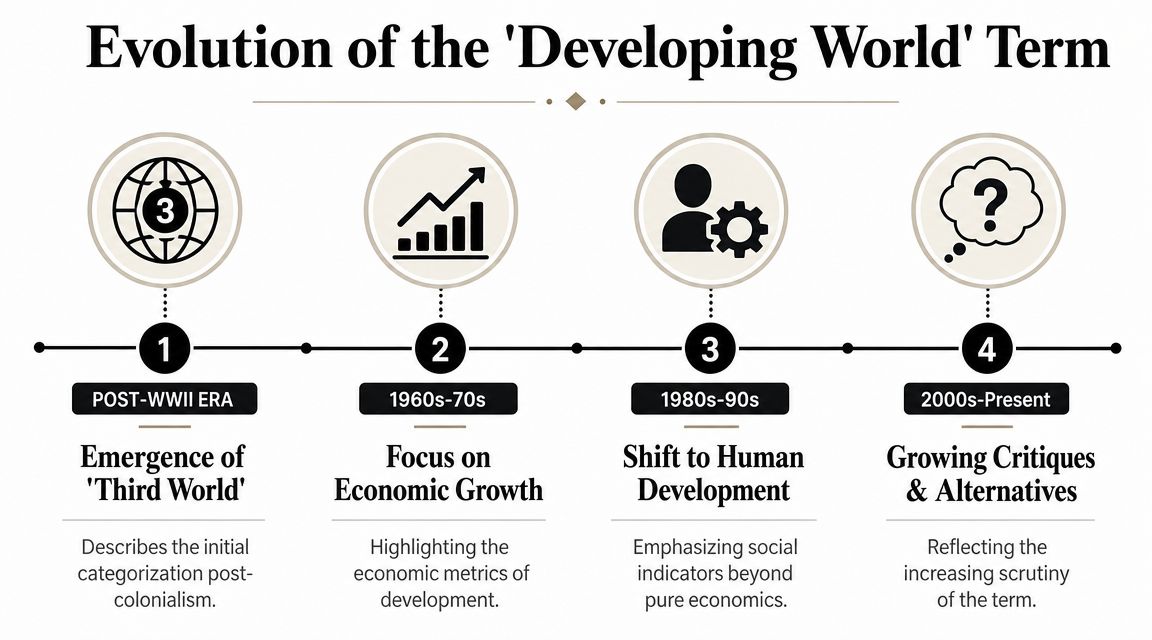
The label emerged from a political ordering of states before it became a development category. Early postwar usage drew on the Cold War's “Three Worlds” framework, which sorted countries by strategic alignment and political economy. That system was never designed to compare institutional capacity, poverty reduction, or structural transformation. Yet some of its hierarchy carried over when “developing world” replaced more openly ideological language.
Decolonisation accelerated that shift. Newly independent states entered international institutions demanding recognition, finance, and policy space, while donor governments and multilateral agencies needed broad categories for aid administration and diplomatic messaging. “Developing” became a convenient umbrella term because it sounded forward-looking and less blunt than earlier labels such as “underdeveloped” or “backward.” The change in tone mattered. The underlying aggregation problem did not.
The result was a category that mixed very different cases: commodity exporters with middle-income profiles, populous low-income countries with large poverty burdens, and small states with narrow fiscal margins. For policymakers, that history matters because the term was built for diplomatic convenience before it was asked to carry analytical weight.
The UK's own institutional evolution illustrates the point. Its development machinery changed shape across decolonisation, the rise of specialised aid administration, and the later integration of development policy into foreign policy. Those reforms reflected changing ideas about state responsibility, poverty reduction, and international influence. They did not produce a single stable definition of who belongs to the “developing world.”
For a longer historical perspective on uneven progress and reversals across countries, see this analysis of the highs and lows in the global development trajectory.
Why the history still matters
This history still shows up in current diplomacy. In G7 and G20 settings, the phrase can imply a bloc with shared interests and similar capacities, even where negotiating positions diverge sharply on debt, energy transition, food security, industrial policy, or climate finance. In aid discussions, it can flatten the distinction between countries that need concessional support and countries that are better understood as trade, investment, or technology partners.
Language affects bargaining power. It shapes who is treated as a rule-maker, who is treated as a recipient, and who is expected to justify domestic policy choices to external actors.
That is why the term creates friction even when used without hostile intent. Many officials hear more than description in it. They hear an older ranking of states, repackaged in softer language and repeated through communiqués, donor frameworks, and summit talking points.
For diplomatic communication, the practical lesson is straightforward. Use the broad label sparingly, explain the basis for any grouping, and prefer terms tied to a specific institutional purpose, such as income category, borrowing status, regional grouping, or negotiating coalition. Precision lowers the political cost of classification and improves the quality of policy discussion at the same time.
How Development Is Measured Today
The practical question is not whether a country belongs to a vaguely defined “developing world.” The practical question is which metric a ministry, lender, or summit process is using, and for what decision.
The UK policy baseline
In UK policy work, the baseline is usually operational rather than ideological. Officials tend to sort countries through formal statistical systems, especially income groupings used across aid analysis, trade assessment, and development finance. “Developing world” may still appear in speeches or media shorthand, but it carries little precision for actual programme design.
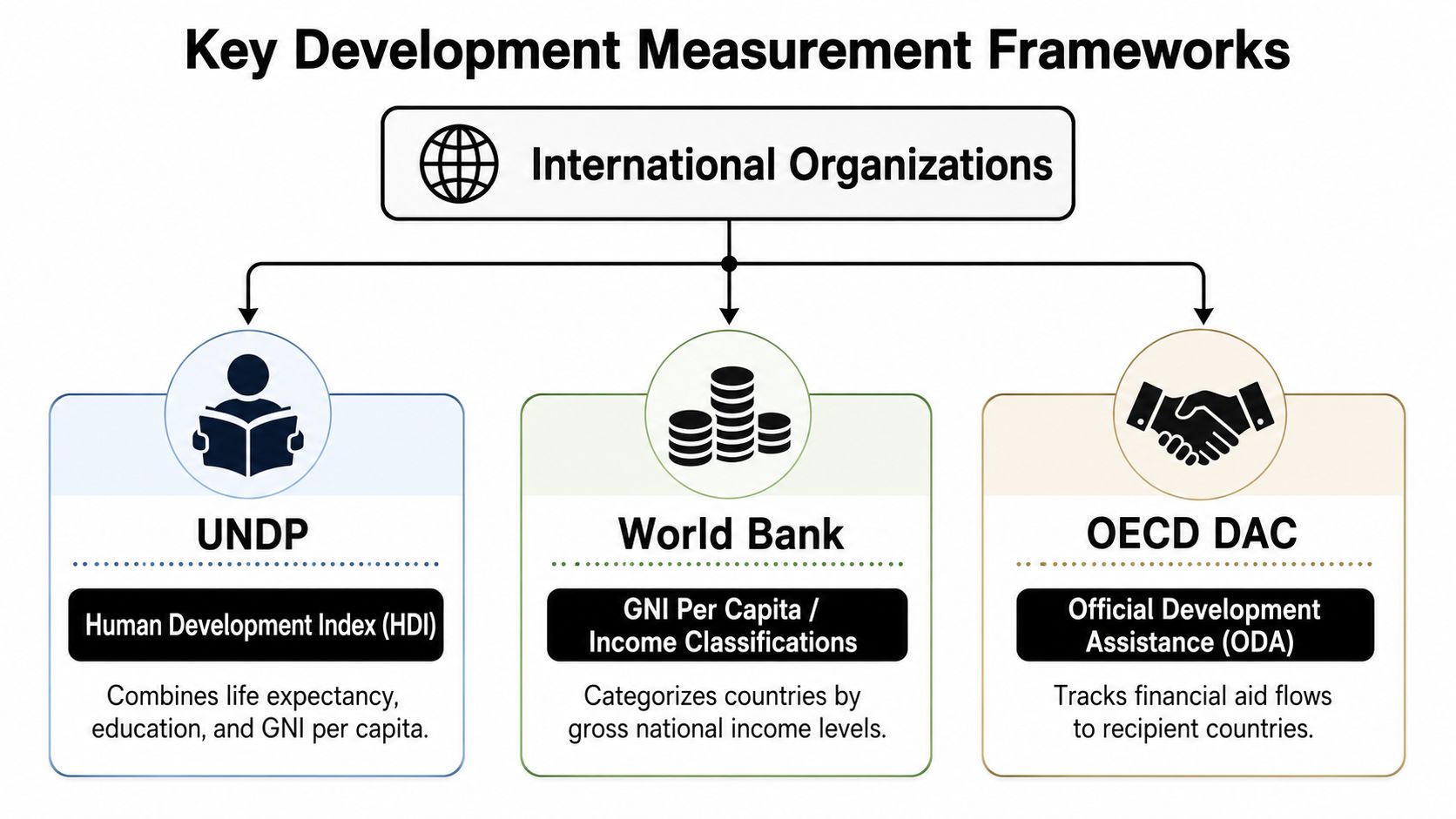
As noted earlier, the World Bank groups economies into four income bands using GNI per capita and periodically updates the thresholds. For policy teams, the point is less the label itself than the administrative consequences attached to it. Income status can shape eligibility discussions, comparison sets, and the way a country is positioned in cross-government analysis.
That has direct diplomatic consequences. A country described as a low- or middle-income partner is being placed in a statistical category. A country described as part of the “developing world” is being placed in a political narrative. Those are not interchangeable acts, particularly in G20 and G7 settings where the language of development can affect arguments over concessional finance, market access, climate responsibility, and technology transfer.
For readers tracking how development terminology connects to wider multilateral benchmarks, this overview of global progress on the Sustainable Development Goals adds useful context.
Why measurement changed the vocabulary
Once institutions began using standardised indicators, broad civilisational labels became less useful for policy. An aid agency deciding where to target concessional resources needs more than a general impression of relative poverty. Trade officials assessing market opportunities need a different set of signals again. Diplomats preparing summit language need terms that do not accidentally overstate common interests across highly unequal states.
Three measurement logics now shape official usage:
| Framework | What it captures | Why officials use it |
|---|---|---|
| Income classification | Relative national income levels | Budget allocation, eligibility screening, broad comparison |
| Human development approaches | Health, education, and living standards | Social policy framing and welfare analysis |
| Poverty and vulnerability measures | Deprivation, exposure, and constraints | Targeting, programming, and risk assessment |
These systems do different jobs. Income categories help officials sort countries quickly for financing and comparison. Human development measures widen the lens by asking whether gains in national income translate into longer lives, schooling, and living standards. Vulnerability measures matter because aggregate growth can coexist with food insecurity, climate exposure, debt stress, or sharp regional inequality.
The analytical mistake is to treat these frameworks as substitutes for one another. A middle-income economy can still contain very high poverty rates. A country with rising income can remain acutely vulnerable to external shocks. A state with strong social indicators may still lack the fiscal space expected of a traditional “developed” economy.
For diplomatic communication, the recommendation is straightforward. Use the category that matches the policy instrument. If the issue is aid eligibility, cite the income grouping. If the issue is welfare outcomes, use a human development measure. If the issue is fragility or climate exposure, say so directly. “Developing world” rarely carries that level of discipline, and in negotiations, imprecision is not neutral.
A Table of Competing Classifications
Policymakers encounter several classification systems at once. Some are historical, some technical, and some openly political. The problem isn't that one is universally right and the others are wrong. The problem is that users often slide between them without noticing the assumptions they carry.
Comparison of global classification systems
| System | Core Criterion | Primary Use Case | Key Limitation |
|---|---|---|---|
| Three-World Model | Cold War political alignment | Historical analysis and interpretation of post-war international relations | Outdated for present policy use and analytically weak for economic comparison |
| World Bank income levels | GNI per capita grouping | Aid analysis, trade assessment, country comparison, official statistical work | Income alone doesn't capture governance quality, inequality, or structural vulnerability |
| Global South | Shared political identity, post-colonial experience, and unequal position in global order | Diplomacy, advocacy, solidarity language, South-South cooperation discourse | Politically resonant but imprecise, and not all members share the same economic realities |
| Developing world | Broad shorthand for non-high-income or less industrialised countries | General media and loose policy language | Homogenises diverse countries and often obscures the basis of classification |
A useful discipline is to ask one question before using any term: what exactly is being grouped, and for what purpose? If the answer is political solidarity, “Global South” may fit. If the answer is income comparison, World Bank bands are stronger. If the answer is historical narrative, the Three-World model may still appear, but only as a retrospective frame.
The phrase “developing world” usually fails this test because its use case is unstable. It often stands in for several different concepts at once, which is why it creates confusion in formal settings.
Critiques and Political Implications of the Developing Label
The main critique of the label isn't just that it's old-fashioned. The deeper problem is that it obscures differences that matter in policy, then invites political arguments on top of that weak analytical base.
A label that hides difference
“Developing” sounds like a neutral participle. In practice, it often implies a shared stage of history. That is hard to sustain when countries grouped under the label differ sharply in productive structure, fiscal room, poverty concentration, and diplomatic weight.
The term also invites a paternal frame. It can suggest that some countries are complete and others are still catching up to a model defined elsewhere. That's why many officials now prefer narrower terms tied to income, vulnerability, or specific institutional conditions.
A few consequences follow from that:
- Analytical compression: Distinct economies get discussed as if they face the same policy constraints.
- Diplomatic friction: Partner governments may hear condescension even when none was intended.
- Negotiation slippage: Broad labels can be mobilised strategically in trade and climate debates, where categorisation affects obligations and expectations.
Broad labels don't stay broad for long. In negotiations, they get converted into claims about priority, burden, and entitlement.
Why wording affects negotiations
Semantics proves strategic. In trade, finance, and climate discussions, labels shape coalitions and frame responsibility. A term that appears harmless in an op-ed can become consequential in a communiqué.
The policy challenge is not only reputational. It is technical. UK-facing international analysis increasingly works through differentiated risk rather than a simple developed versus developing split. The point is especially clear in sanctions, aid targeting, and export credit work, where analysts must distinguish between countries with different governance trajectories and economic structures.
A short explainer helps underline how development language intersects with wider multilateral politics:
The diplomatic lesson is straightforward. If officials use one category for unlike cases, they may end up debating the wrong issue. They may discuss “the developing world” when the actual divide concerns debt exposure, commodity dependence, or institutional resilience. That weakens both diagnosis and diplomacy.
Navigating the Lexicon Global South LMICs and Other Alternatives
A better vocabulary starts with matching the term to the task. No replacement works everywhere. Each alternative carries a different kind of precision, and each signals something different to the audience.
Choose the term that matches the task
Low- and middle-income countries (LMICs) work best when the subject is income grouping, financing, or broad development comparison. The term is technical. It doesn't claim political unity, and that restraint is often an advantage.
Global South is different. It carries political meaning rooted in post-colonial identity, unequal power, and collective voice in global governance. It may be the right term in speeches about representation, reform, or solidarity, but it is weaker as a statistical category. This essay on a view from the Global South captures why the term remains politically potent.
Least Developed Countries (LDCs) should be used when a formal UN category is intended. It is narrower, more specific, and generally preferable to vague formulations when eligibility, vulnerability, or targeted support is under discussion.
“Emerging economies” can also be useful, though it should be handled carefully. It foregrounds growth, markets, and transition. That can be appropriate in investment and trade contexts, but it can understate poverty, fragility, or uneven internal development.
A practical language test
Before choosing a term, officials should ask three questions.
Is the grouping statistical or political?
If it's statistical, choose a technical category. If it's political, acknowledge that openly.Does the term help the reader act?
A useful category should guide targeting, comparison, or negotiation strategy.Could the audience read it as hierarchical?
If yes, revise the wording or specify the metric.
Language test: If you can't explain in one sentence why these countries belong in the same category, you probably need a different category.
This is why the developing world definition remains so contested. The phrase sits awkwardly between analysis and rhetoric. It sounds descriptive, but it often performs ideological work without admitting it.
Recommendations for Policy and Communications
Officials do not need a ban on broad development language. They need a rule for when broad language is acceptable, when it obscures policy trade-offs, and when it creates avoidable diplomatic friction. That is not a semantic concern. In aid allocation, trade positioning, and G7 or G20 drafting, category choice affects who is grouped together, which problems are treated as comparable, and what kind of response appears legitimate.

A working protocol for official language
For policy use, the strongest starting point is a decision-based classification rather than a civilisational label. If the task is aid targeting, analysts should classify countries by poverty burden, fiscal capacity, exposure to shocks, and institutional constraints. If the task is trade diplomacy, they should distinguish market size, diversification, commodity dependence, and financial vulnerability. A single term such as “developing world” cannot do all of that work.
The practical case for disaggregation is straightforward. As noted in this policy backgrounder on developing nations, many states placed in the “developing” category share a history of lower industrialisation and lower living standards than advanced economies, yet their current conditions vary widely in income, economic structure, and state capacity. That variance matters. A lower-middle-income economy expanding manufacturing exports does not present the same policy profile as an upper-middle-income commodity exporter facing concentration risk, even if both are routinely described with the same shorthand.
A usable protocol follows from that distinction.
- In technical documents, use technical categories. LMICs, LDCs, small island developing states, or named income bands are clearer than “developing world”.
- In diplomatic speeches, make the political choice explicit. If a delegation uses “Global South”, it should do so because representation, bargaining power, or historical grievance is part of the message.
- In operational comparisons, state the variable that matters. Say debt distress, food insecurity, export concentration, climate vulnerability, or governance trajectory.
What diplomatic teams should change now
The immediate reforms are procedural. Ministries and missions should treat development terminology as a drafting control issue, not a stylistic preference. That means setting house rules for communiqués, briefing notes, speeches, and negotiating lines.
| Communication setting | Preferred approach | Avoid |
|---|---|---|
| Aid or programme design | Define eligibility by income, poverty, fragility, or vulnerability criteria | Referring to “developing countries” without stating the basis for inclusion |
| Trade and investment briefings | Specify market structure, industrial capacity, and transition risk | Treating all non-high-income economies as a single commercial category |
| G7 or G20 communiqués | Use politically intentional terms, then define the coalition or issue area | Switching among “Global South”, “developing world”, and “emerging economies” as if they are interchangeable |
Drafting practice should then be tightened in four ways.
- Write the criterion into the sentence. Readers should not have to infer why a country is in the group.
- Separate coalition language from analytical language. A negotiating bloc is not the same thing as a statistical class.
- Remove implied hierarchy. Terms that suggest some states are earlier versions of others often weaken the credibility of the document.
- Default to country or region-specific wording where possible. It usually improves accuracy and lowers the political cost of the statement.
These changes are modest, but their effects are real. More precise language improves targeting in development finance, reduces confusion in trade analysis, and helps diplomats avoid signaling condescension where partnership is the stated goal.
For more analysis like this, explore Global Governance Media, where policymakers, diplomats, and global affairs professionals can find timely, evidence-based coverage of the ideas shaping G7, G20, and multilateral decision-making.