

The most common advice on America in decline is also the least useful. It asks for a verdict, as if the United States had either collapsed or remained unchanged, when the underlying shift is more awkward and more important for G7 and G20 delegates, a movement from post-Cold War dominance towards a more multipolar order. The United States is still the largest economy and a superpower, but Brookings notes that its share of world GDP has eased from 28% to around 25%, a relative narrowing that matters precisely because it changes the terms of global coordination Brookings on whether America is declining.
For policymakers, that distinction matters more than the headline. Relative adjustment affects bargaining power in trade, finance, sanctions, defence planning, and the credibility of global rules, even when absolute American capacity remains formidable. The policy question is not whether the United States has fallen off a cliff, it is whether the world should prepare for a longer period in which Washington remains central but no longer sets the rhythm alone. For a multilateral audience, that is the difference between managing a transition and misreading a collapse.
Table of Contents
- Introduction Framing the Debate Beyond the Headlines
- Defining Decline The Six Key Metrics of National Power
- The Evidence Base US Trends and International Benchmarks
- Drivers of Change Internal Pressures and External Challenges
- Countervailing Strengths America's Enduring Advantages
- Future Scenarios and Global Implications for the G7 and G20
- Policy Pathways Strengthening Resilience at Home and Abroad
Introduction Framing the Debate Beyond the Headlines
The sharpest versions of the America in decline argument still rely on a misleading test. They treat national power as if it were a single contest of output or prestige, even though G7 and G20 delegates know that global governance depends on something more specific, whether the leading power can still provide rules, liquidity, deterrence, and coordination when crises spread across borders. Brookings usefully separates decline from collapse, and that distinction matters. A lower U.S. share of world GDP signals a more distributed system, not the disappearance of American power Brookings on whether America is declining.
That relative shift changes the strategic environment for every major economy. Washington can still lead, but it is more likely to do so through coalition-building than through automatic deference. For governments in Europe, Japan, India, and the Gulf, the practical lesson is clear, work with the United States where interests converge, but do not assume American primacy will absorb every shock or close every institutional gap.
Practical rule: judge American power by what it can still organise, not only by what it can still dominate.
A sober analysis also has to resist the temptation to equate public anxiety with structural collapse. Pew found that many Americans expect a weaker economy and greater inequality by 2050, yet that perception does not erase the United States' remaining hard-power and soft-power advantages Pew on perceptions of American decline. The deeper issue for multilateral institutions is direction. If the United States remains capable but less effortless, forums such as the G20 will have to function more like coordination arenas among unequal but still powerful states, and less like venues anchored by one unquestioned organiser. That is why debates about international relations and current events matter for governance as much as they do for strategy.
The right question is not whether America has already declined. It is how far the centre of gravity has shifted, and what sort of global order that shift is likely to produce.
Defining Decline The Six Key Metrics of National Power
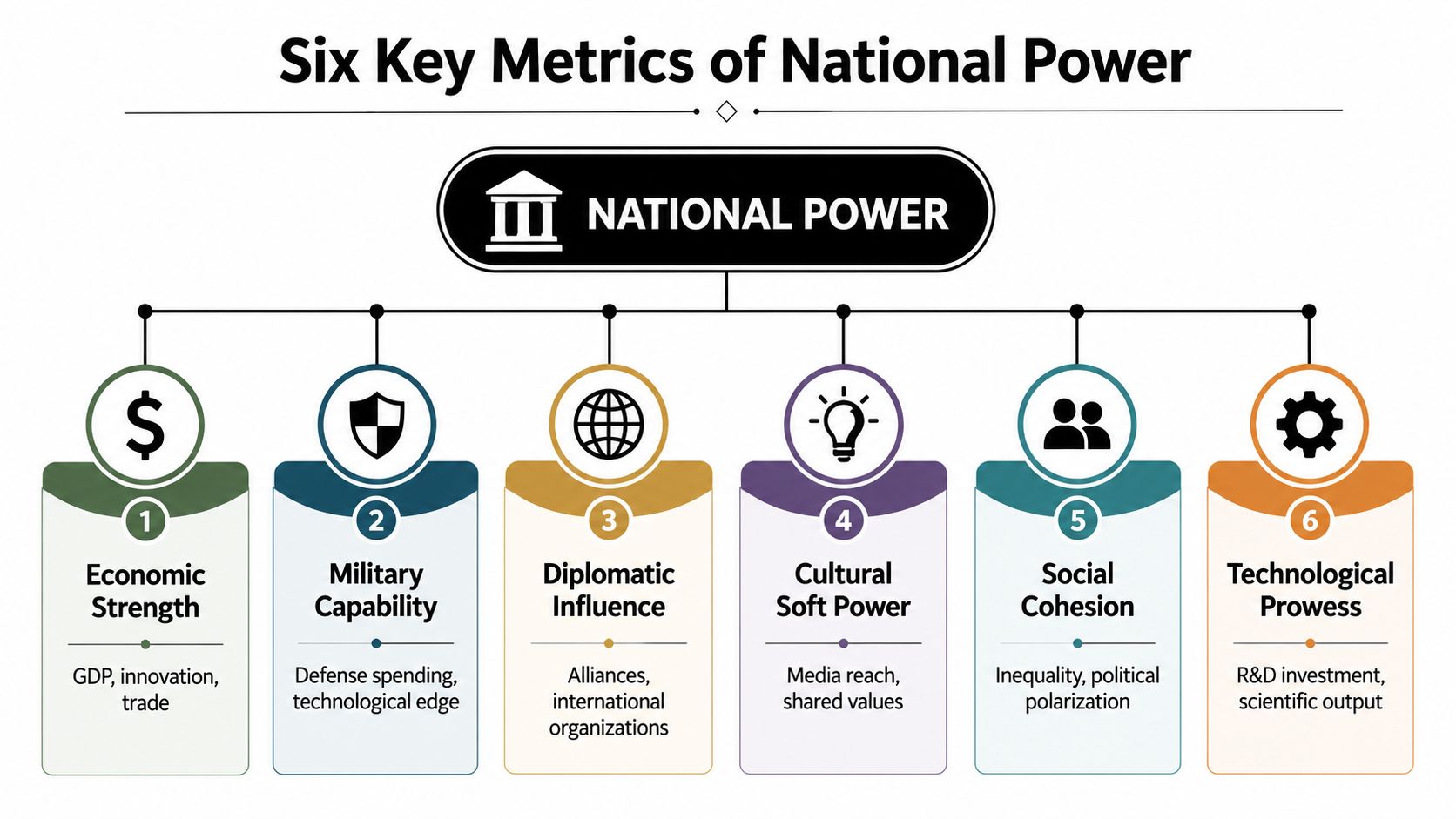
Assessing decline requires a framework that distinguishes impression from capability. For policymakers, especially those in the G7 and G20, the relevant question is how shifts in national power alter bargaining power, crisis management, and the stability of multilateral rules. A useful way to do that is to examine six dimensions of national power, Economic Strength, Military Capability, Diplomatic Influence, Cultural Soft Power, Social Cohesion, and Technological Prowess. Each captures a different channel through which a state shapes outcomes, and each can weaken even when the others still hold.
Economic Strength and military capability
Economic Strength is the capacity to generate output, attract capital, and sustain fiscal burdens over time. For the United States, it remains the most visible foundation of power because economic scale still supports defence spending, sanctions policy, research ecosystems, and alliance management. The broad lesson is that a large economy can still become more contested in relative terms even while it remains immense in absolute size.
Military Capability goes beyond hardware. It includes logistics, global basing, force projection, and the ability to absorb new technology into doctrine and operations. A state can field a large military and still struggle to convert force into political results, which is why military power deserves separate attention. For the G7 and G20, that distinction matters because security guarantees shape market confidence, energy flows, and the credibility of crisis response.
Diplomatic influence and cultural soft power
Diplomatic Influence is the ability to assemble coalitions and shape agenda terms in institutions such as the G7, G20, IMF, and UN system. That influence can weaken before raw power does. It rests on credibility, consistency, and the belief among other states that following a lead produces shared gains rather than one-sided exposure.
Cultural Soft Power is the least mechanical of the six, but it still matters. It includes media reach, higher education, cultural exports, and the attraction of American norms. Public concern about America's future does not mean these advantages have disappeared, only that their political halo is less automatic than it once was. Pew on perceptions of American decline
Social cohesion and technological prowess
Social Cohesion matters because power depends on internal consent. A country marked by deep polarisation, high distrust, or institutional gridlock may retain resources but lose speed and flexibility. That is why social strain can matter as much as a short-run economic slowdown, especially when external shocks demand quick coordination.
Technological Prowess captures innovation systems, research depth, and the speed with which discoveries move into practical use. It often works as a force multiplier across the other pillars. Where technology leads, productivity, military systems, and financial influence usually follow, and where it falls behind, the effects spread across the wider system.
Policy lens: no single metric settles the decline debate. The task is to identify which pillars are weakening, which are adapting, and which still carry the system.
The Evidence Base US Trends and International Benchmarks
The strongest reading of the evidence is relative adjustment, not collapse. America still remains a central power, but its weight inside the system has changed. That distinction matters for G20 delegates, because the question is not whether the United States disappears from the top tier, but how a more distributed order affects rules, coordination, and crisis management.
Macroeconomic indicators point in that direction. Brookings notes that the U.S. share of world GDP has fallen from 28% to around 25%, while also arguing that this does not by itself show a fundamental loss of American power. The same analysis says U.S. GDP rose 21% in constant dollars between 2000 and 2010, a period that included the dot-com shock and the financial crisis, so the economy was still expanding through severe disruption.
That combination defines the debate. The United States can grow in absolute terms and still lose relative influence as other economies expand faster. For multilateral institutions, that means fewer assumptions of automatic American primacy and more need to manage a system shaped by several centres of economic and strategic power.
Comparative National Power Metrics 2026
| Metric | United States | China | European Union |
|---|---|---|---|
| Economic scale | Largest economy, but a smaller share of world output than before | Major competing centre of global output | Large collective economy, but politically fragmented |
| Military capability | Global force projection and alliance network | Expanding strategic reach | Strong capabilities in some states, less integrated collectively |
| Diplomatic influence | Central in many multilateral forums | Rising influence across institutions and regions | Significant regulatory and diplomatic weight |
| Cultural soft power | Persistent global reach through education, media, and alliances | Growing, but less embedded in liberal institutions | Strong cultural assets, especially through member states |
| Social cohesion | Pressured by polarisation and institutional conflict | Different internal constraints, less transparent political contestation | Varies by member state, affected by fragmentation |
| Technological prowess | Deep innovation ecosystem and research capacity | Rapidly advancing in several domains | Strong science base, uneven commercial scale |
The table is deliberately comparative rather than exhaustive. A multilateral audience needs to see how the United States compares with other poles that shape trade rules, technology standards, and security alignment. The European Union still has substantial regulatory influence, but its fragmented political structure limits unified strategic action. China is the clearest external comparator, and the policy issue is not only rivalry. It is whether the international system can absorb more than one centre of rule-setting without chronic fragmentation.
The same comparison applies to diplomacy. If Washington no longer sets the pace by default, coalition-building becomes more expensive and more consequential. That is especially visible in issues that cut across economic policy and security, including relations with China, where bilateral choices now carry wider effects for supply chains, standards, and institutional cohesion.
Population and fiscal capacity
Demography places a more concrete constraint on long-term power. The U.S. Census Bureau reported that between July 1, 2024, and July 1, 2025, the population grew by only 1.8 million people, or 0.5%, reaching 341.8 million. It also said the slowdown was driven largely by a historic decline in net international migration. That matters because slower population growth narrows the long-run base for labour supply, tax receipts, and domestic demand.
The same Census release points to a projected 0.2% growth rate in 2026, which would amount to near-zero growth by historical American standards. RAND's earlier analysis provides a useful baseline, showing that between 2000 and 2010 U.S. GDP rose 21% while population increased 10%. The shift from that earlier pattern to today's demographic slowdown has implications for fiscal sustainability and strategic flexibility, especially if leaders are expected to sustain both domestic investment and international commitments.
For G20 policymakers, the broader lesson is straightforward. A country can remain wealthy, dynamic, and militarily formidable while facing tighter demographic and fiscal space. That does not end American leadership, but it makes leadership more conditional, more contested, and more dependent on whether domestic capacity keeps pace with external obligations.
Drivers of Change Internal Pressures and External Challenges
The debate over America in decline turns on two kinds of pressure, internal strain and external contestation. The internal side is more than a single election or a passing budget fight. It is the accumulated stress placed on institutions that are meant to absorb conflict and preserve legitimacy. Brookings identifies two clear mechanisms of institutional decline, election manipulation and executive overreach, and those are measurable governance failures, not loose complaints about partisanship Brookings on democratic decline in the United States.
Once political actors start to believe that elections can be tilted unfairly, or that executives can push beyond their limits with little restraint, confidence in rules weakens. The loss is larger than any single policy outcome. It is the expectation that state power will be used predictably, and that expectation matters to allies as much as to domestic institutions.
For G7 and G20 delegates, that credibility gap has practical consequences. Crisis coordination depends on continuity, and continuity depends on institutions that can survive domestic pressure without improvisation at every turn.
Internal constraints and external rivalry
Deloitte's U.S. forecast expects real GDP growth of 2.0% in 2026, slowing to 1.8% in 2027 as AI investment moderates Deloitte U.S. outlook analysis. Even if that does not amount to an emergency, the direction is clear. Slower growth leaves less room to carry public liabilities, fund defence commitments, and finance long-term domestic renewal at the same time.
The external side is sharper. The United States now faces a field in which rivals can contest standards, markets, and supply chains with real effect. China is the most visible case, and the broader strategic picture is a more crowded system of regional powers that can block consensus even when they cannot dominate it. That makes American primacy less decisive and coalition management more important, especially as competition with China intensifies across technology, trade, and strategic influence, as discussed in this analysis of U.S.-China relations.
- Political Polarisation: It makes durable consensus harder, especially on fiscal policy, trade strategy, and alliance burden-sharing.
- Institutional Erosion: When election rules and executive powers become contested, trust in governance falls.
- Slower Growth: A weaker growth outlook reduces room for error in public finance and strategic spending.
- External Contestation: Rivals now exploit gaps in standards, technology, and diplomatic coordination.
The internal and external pressures reinforce each other. A more divided United States is less able to answer geopolitical rivalry, and a more contested international environment magnifies the costs of domestic weakness. For G7 and G20 delegates, the key point is that American decline is not a single event. It is a feedback loop between institutions at home and competition abroad.
Countervailing Strengths America's Enduring Advantages
A serious assessment of America in decline has to account for the counterweight. The United States still draws on deep reserves of hard power and soft power, and slower growth or political strain has not eliminated those advantages. Public concern about the country's direction is real, as noted earlier, but the more useful analytical point for G7 and G20 delegates is that domestic unease has not yet erased America's ability to shape markets, security arrangements, and governance outcomes.
Institutional depth remains one of the clearest sources of resilience. So does a culture of innovation that still attracts capital, talent, and partnerships from abroad. Alliance architecture matters as well. No other power combines a comparable military footprint with such a wide network of formal and informal security relationships, which gives Washington a degree of coordination power that still matters in crises and in setting rules.

For a multilateral audience, the key issue is not whether America remains flawless. It is whether a less confident United States can still function as a system anchor. The answer is yes, but only unevenly, and only when domestic institutions continue to transmit credibility abroad. For a closer look at how this debate intersects with G20 diplomacy, see the discussion of America's role in the G20 in 2026.
What matters for international partners is not nostalgia for American dominance. A weakened United States is still a consequential one. Cooperation remains possible in trade, sanctions coordination, artificial intelligence governance, and crisis diplomacy, but it will likely require more deliberate bargaining, clearer reciprocity, and a sharper understanding among partners that U.S. engagement will be selective rather than automatic.
Future Scenarios and Global Implications for the G7 and G20
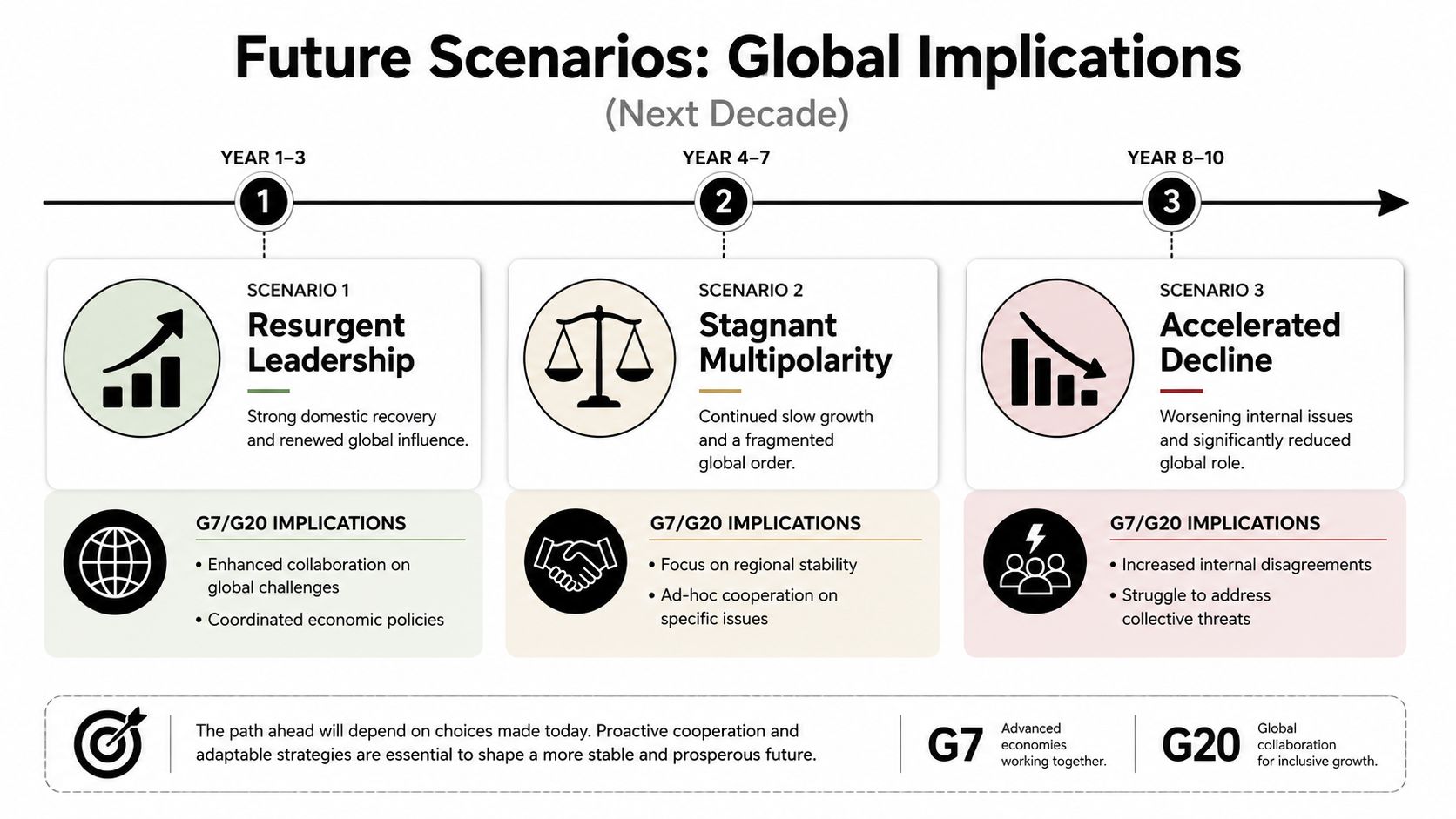
The next decade is unlikely to produce a clean break in American power. A more realistic reading is a contest among three trajectories that differ in scale, not in logic. One path is Managed Adjustment, in which the United States remains central but accepts a more balanced global role. Another is Resurgent America, where domestic repair, innovation, and institutional renewal restore some of the confidence that has eroded. The third is Accelerated Fragmentation, where internal stress and external pressure combine to weaken Washington's ability to coordinate with others.
Managed adjustment
For the G20, this is the most plausible and the most governable outcome. American leadership becomes more selective and less universal, yet still meaningful. Alliances remain in place, while partners assume more responsibility for regional security, economic stabilisation, and crisis management.
That continuity has real value. It reduces the risk of abrupt institutional shock and gives governments time to adapt to a more distributed order. The danger is complacency, because managed adjustment can look stable until a crisis reveals how far bargaining power has already shifted away from Washington.
Resurgent America
This scenario depends on domestic performance improving enough to reverse the broader mood of decline. The central question is not whether the United States can innovate, because it can. The question is whether politics, fiscal choices, and demographic constraints allow that innovation to translate into broad-based capacity. As the Census Bureau has noted, slower population growth makes that task harder, even if it does not make it impossible.
For the G7 and G20, a stronger United States would be welcome, but it should not become the basis of strategy. Partners need institutions that remain functional even when Washington is performing well. That is the lesson for any serious multilateral agenda, including the issues discussed in America's role in the G20 in 2026.
Accelerated fragmentation
This is the most dangerous path. It combines weak institutional confidence, slower growth, and sharper international competition. The result would not necessarily be retreat. It would be inconsistency.
A fragmented America can still act decisively in a crisis, but it will struggle to sustain cooperative leadership over time. For the G20, that means more veto points, more episodic engagement, and more difficulty turning broad commitments into enforceable action. The gap between what is technically possible and what is politically deliverable would widen, and multilateral forums would feel that strain first.
The strategic conclusion is straightforward. G7 and G20 members should plan for a world in which American support remains valuable but is no longer automatic. That requires broader coalition-building, stronger regional capacity, and agreements that can survive shifts in Washington rather than relying on one administration's momentum.
Policy Pathways Strengthening Resilience at Home and Abroad
The policy response has to run on two tracks. In the United States, the priority is institutional repair. That means protecting election integrity, limiting executive overreach, investing in education and research, and treating fiscal capacity as a strategic asset rather than a bookkeeping issue. The point is not to chase an artificial restoration of past dominance, but to preserve the domestic foundations that still make American leadership possible.
For the G7 and G20, the task is different. Partners should build institutions that assume relative power shifts are permanent. That means deeper coordination on debt sustainability, trade resilience, technology standards, and crisis response, while also widening burden-sharing in security and development. It also means resisting the temptation to frame every American setback as proof of irreversible collapse. That kind of language makes cooperation harder, not easier.
The most practical strategy is to prepare for a United States that remains central, but no longer singular. That is a manageable future if governments treat it realistically.
If you are shaping policy for the next G7 or G20 cycle, revisit your assumptions about American leadership and global institutional design. Read more analysis, compare scenarios, and use this framework to inform your briefing notes at Global Governance Media.