

By Daniel Mercer, Senior Sovereign Risk Analyst
The most important lesson from the central bank of the russian federation is not that sanctions fail. It is that a central bank can remain operational, legally autonomous on paper, and firmly embedded in state strategy at the same time. That combination matters more for crisis endurance than many Western policy models assumed.
The modern Central Bank of the Russian Federation was established on 13 July 1990, when the Russian Republic transformed a branch of the USSR’s State Bank into the CBR to assert local control over monetary policy during the Soviet collapse, as set out in the Bank of Russia’s institutional history. For G7 officials, that origin story is not archival detail. It helps explain why the institution still behaves like both a conventional central bank and a strategic armature of state resilience.
That duality has sharpened under sanctions. In one register, the CBR still looks familiar to any finance ministry or G20 central bank watcher: policy rate setting, inflation management, market supervision, and reserve positioning. In another, it uses tools that sit closer to emergency economic administration than to orthodox inflation targeting. The result is a hybrid policy model that deserves closer study by sanctioning countries and by states preparing for possible financial isolation.
Table of Contents
- Introduction The Indispensable Role of Russia's Central Bank
- Understanding the CBRs Mandate and Governance Structure
- Analysing the Legal and Constitutional Framework
- Exploring the Monetary and Macroprudential Toolkit
- Deconstructing the Balance Sheet and International Reserves
- A Case Study in Crisis Response and Sanctions Resilience
- Conclusion A New Chapter in Global Financial Governance
Introduction The Indispensable Role of Russia's Central Bank
The central bank of the russian federation is one of the clearest modern examples of a monetary authority preserving financial order under external coercion by using two toolkits at once. Its significance lies less in any single rate decision than in its ability to combine conventional central banking with administrative controls, supervisory intervention, and state-backed crisis management inside one command structure.

That duality makes the CBR a priority case for anyone assessing sanctions effectiveness, reserve resilience, or spillover risks to the wider financial system. External pressure on a large economy does not operate in a vacuum. It is filtered through domestic institutions that can redirect liquidity, influence foreign exchange pricing, relax prudential rules, and shape depositor and corporate behaviour during stress.
For analysts in G7 and G20 finance ministries, the central question extends beyond whether sanctions constrain Russia. It is how far the CBR can offset those constraints by shifting between market-based instruments and direct controls without a visible breakdown in monetary authority.
Three points follow.
- Institutional continuity: The CBR emerged from the late Soviet and early post-Soviet monetary transition and has accumulated crisis-management experience across repeated episodes of inflation, banking stress, exchange-rate pressure, and sanctions.
- Systemic centrality: Its role extends beyond note issuance and interest-rate setting. It sits at the core of Russia’s monetary transmission, financial supervision, and market functioning.
- Policy toolkit duality: It can move from orthodox inflation management to emergency administrative action within the same institution, which shortens response times and concentrates operational control.
The CBR is best understood as a central bank designed to defend monetary sovereignty under conditions of political and financial contestation.
That has direct implications for sanctions policy. A framework focused only on frozen assets, payment restrictions, or capital-market access can understate the target state’s room for internal adjustment. The Russian case shows that a capable central bank can absorb part of the initial shock by acting simultaneously as lender of last resort, prudential regulator, foreign-exchange manager, and gatekeeper over capital flows.
The broader lesson is uncomfortable but important. In an era of geoeconomic fragmentation, central bank effectiveness may depend not only on independence and predictability, but also on whether a state can fuse orthodox monetary policy with discretionary crisis controls quickly enough to stabilise expectations. The CBR offers a working, if costly, model of that fusion.
Understanding the CBRs Mandate and Governance Structure
The CBR’s mandate matters because its governance model compresses monetary authority, supervision, and crisis execution into a single command structure. For sovereign risk analysis, that institutional design is as important as the policy rate itself.
The core point is not only that the central bank of the russian federation targets inflation and protects the ruble. It is that the same institution also oversees banks, insurers, pension funds, securities markets, and key parts of financial market infrastructure. That concentration of authority changes how Russia absorbs shocks.
Why the mega regulator model matters
The decisive institutional shift came in 2013, when the CBR took on mega-regulator functions across much of the financial sector. In a fragmented system, a central bank must coordinate with separate supervisors before turning a monetary decision into a system-wide stabilisation measure. In Russia’s case, those functions sit much closer together.
That produces a form of policy toolkit duality. Conventional instruments such as the key rate, refinancing operations, and liquidity provision can be paired quickly with supervisory forbearance, resolution measures, trading restrictions, or market-specific interventions. For outside policymakers, this means the CBR should be assessed not only as a monetary authority, but as an institution that can convert macroeconomic judgment into administrative action with limited bureaucratic delay.
| Function | Conventional central bank role | CBR mega regulator effect |
|---|---|---|
| Monetary policy | Sets rates and manages liquidity | Links rate decisions to supervisory and market measures |
| Financial stability | Monitors banks | Tracks stress across banks, insurers, pensions, and securities markets |
| Crisis response | Coordinates with other regulators | Can implement multi-channel responses within one institution |
This structure has a strategic consequence. Sanctions or external funding shocks do not hit a set of loosely connected agencies. They hit a central node that can observe stress migration across the financial system and respond before it becomes a visible solvency event or payment disruption.
What the governance model implies for policymakers
The CBR still frames its public stance through familiar central banking objectives, especially inflation control and financial stability. That signalling matters. Even in a sanctions-distorted economy, the continued use of orthodox policy language can help preserve domestic confidence if market participants believe decisions are being made through a recognisable hierarchy rather than through improvised political instruction.
For G7 officials, the more important inference is operational. A central bank that also supervises non-bank finance can detect where pressure is being displaced. Stress may move from banks into insurers, broker balance sheets, pension assets, or domestic market liquidity. A narrower central bank sees only part of that chain. The CBR can see more of it and act faster.
That does not make the model universally transferable. It does, however, offer a practical lesson for states facing financial isolation. Resilience rises when conventional monetary tools and state-directed crisis measures can be deployed through one institution, under one mandate, with a short decision chain. In the Russian case, governance is therefore not a background detail. It is a central part of the country’s sanctions-adjustment capacity.
Analysing the Legal and Constitutional Framework
The legal architecture of the central bank of the russian federation is central to understanding its credibility. Formal independence is not a decorative clause. In monetary systems under stress, it shapes whether market participants see policy as coherent or merely political.
The constitutional core
The key provision is Article 75 of the 1993 Russian Constitution, which gives the CBR its special status, including exclusive currency issuance and the duty of protecting the ruble. That framework is reinforced by Federal Law No. 86-FZ of 10 July 2002, as summarised in this historical and legal overview of the bank’s establishment.
Those two legal anchors matter because they do three things at once:
- Define monopoly power: Only the CBR can issue the national currency.
- Separate competencies: The bank is not formally subordinate to ordinary executive instruction.
- Create policy continuity: Monetary authority survives changes in wider political and economic conditions.
This de jure structure gives the CBR a recognisable central banking identity. That’s important for external analysis because legal form affects operational space. A central bank with constitutional grounding can justify restrictive or unpopular measures as fulfilment of mandate rather than ad hoc political compliance.
Formal independence and practical statecraft
Still, legal autonomy and practical autonomy aren’t the same. In Russia’s political economy, the more useful analytical question isn’t whether the CBR is independent in the abstract. It is whether its legal independence gives it enough room to choose instruments that preserve macro-financial stability, even when those instruments align with wider state priorities.
A short comparison helps:
| Dimension | What the law suggests | What analysts should test in practice |
|---|---|---|
| Mandate | Ruble protection and issuance authority | Whether policy choices remain internally coherent |
| Autonomy | Separation from federal powers | Whether the bank can act quickly without visible political contradiction |
| Credibility | Constitutional status | Whether households and firms still treat it as a genuine anchor |
Legal independence is most valuable when it allows a central bank to impose discipline on the domestic system, not when it signals distance from the state for its own sake.
That distinction is important for sanctions policy. If a target state’s central bank is legally insulated enough to manage its own toolkit, then external financial pressure may not produce immediate policy confusion. It may instead harden internal coordination. In that scenario, sanctions still bite, but the transmission channel changes. The costs arrive through slower growth, asset substitution, and institutional adaptation rather than through instant monetary collapse.
Exploring the Monetary and Macroprudential Toolkit
The central bank of the russian federation matters because it can do two things at once. It can run a familiar inflation and liquidity framework, and it can direct balance-sheet adjustment across the financial system when market signals alone are too weak or too slow. That dual capacity is the core of its policy relevance under sanctions.

The conventional toolkit
At the conventional level, the CBR still operates through the standard channels used by major central banks. The key rate sets the price signal for ruble liquidity and influences funding costs, credit demand, and inflation expectations. Liquidity operations help banks handle short-term stress and keep payments functioning. Reserve requirements and other market operations affect how far financial institutions can expand risk and how quickly monetary tightening passes into the banking system.
These tools are ordinary in form. Their significance lies in the setting in which they are used.
In a relatively open economy, policy transmission depends heavily on cross-border finance, portfolio flows, and private market pricing. In Russia’s case, the transmission mechanism has had to work under external restrictions, impaired capital access, and recurring pressure on confidence. That raises the value of instruments that can stabilise domestic funding conditions even when external anchors weaken.
Why macroprudential powers change the transmission channel
The CBR’s macroprudential role gives it a second line of control. It does not only influence the cost of money. It can also alter supervisory treatment, capital expectations, regulatory forbearance, and sector-specific constraints across the institutions that carry monetary policy into the broader economy.
That combination matters more than the legal labels suggest.
A central bank that only adjusts rates must wait for banks and markets to respond. The CBR can tighten or ease monetary conditions, observe stress through its supervisory perimeter, and then modify prudential settings to prevent disorderly deleveraging. In practical terms, that means one institution can manage both the signal and part of the enforcement mechanism.
This is the CBR’s policy toolkit duality. Conventional tools preserve monetary discipline. State-directed crisis measures preserve system functionality when ordinary transmission breaks down.
For analysts assessing sanctions resilience, this distinction is not academic. A system with integrated monetary and prudential authority can absorb external pressure in ways that look inconsistent from a market-liberal perspective but remain internally coherent. Rate policy can restrain inflationary pressure while supervisory flexibility, capital controls, or directed regulatory relief limit immediate financial fragmentation. The result is not costless stability. It is managed stability.
The broader lesson for G20 policymakers is clear. Economic isolation does not eliminate central banking. It can push central banks toward a hybrid operating model in which orthodox instruments and administrative controls are used together. Countries studying how resilient banks support anti-fragile financial systems should pay attention to this interaction, because Russia’s experience offers a playbook for crisis management under constrained external access, even if the growth and welfare costs remain substantial.
Deconstructing the Balance Sheet and International Reserves
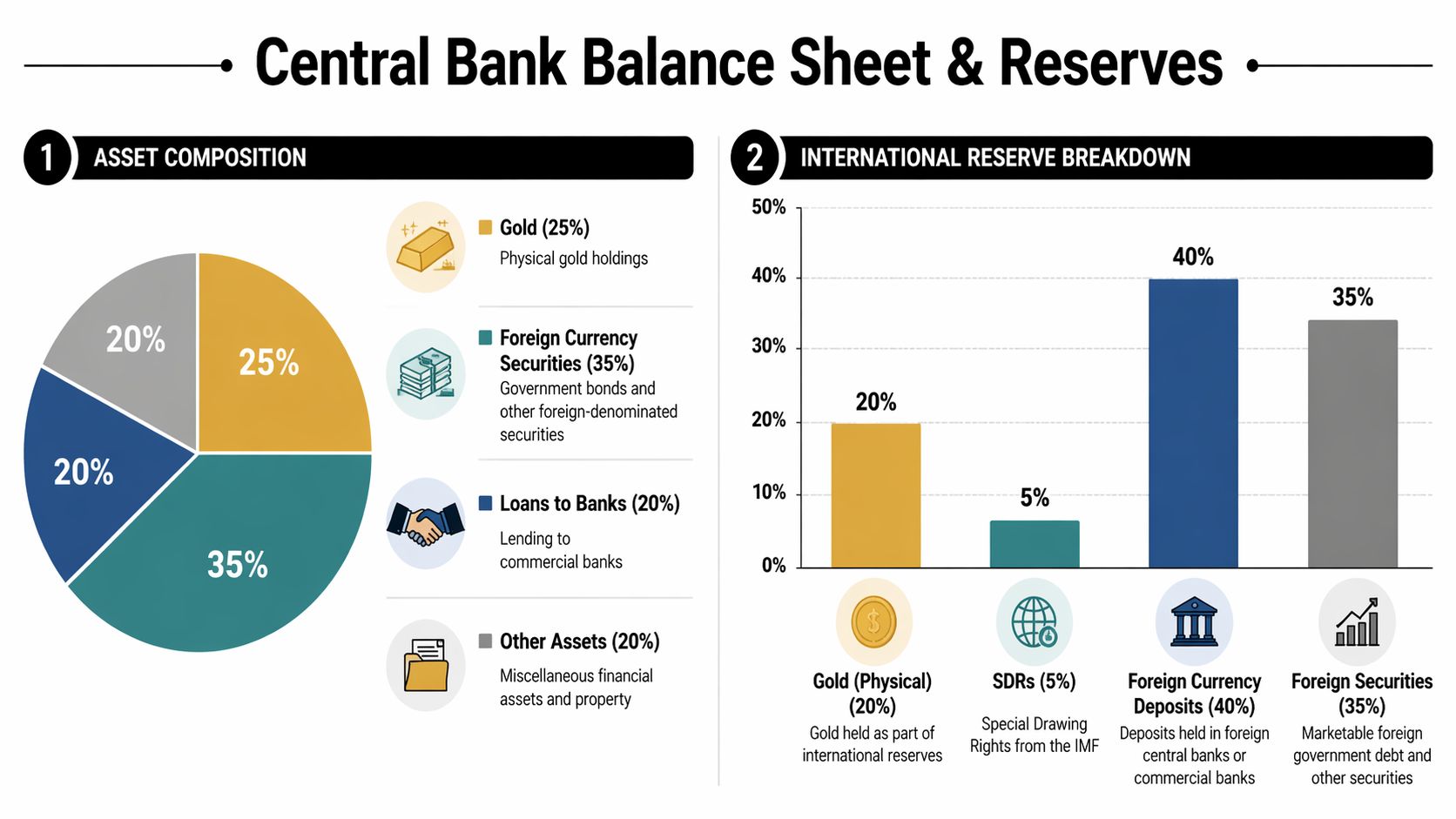
The central bank of the russian federation’s balance sheet is one of the clearest records of how a major central bank adapts under financial isolation. For Russia, reserve management is no longer a narrow question of liquidity and return. It is a question of political usability under sanctions.
Reserve composition as strategic signalling
A well-documented shift in the CBR’s reserve structure captures this logic. The bank cut its dependence on US dollar assets and increased its use of Chinese yuan, as reflected in the Global SWF profile of the CBR. The change matters less as a portfolio preference than as a sanctions lesson. An asset only functions as a reserve if it can be mobilised when stress arrives.
That point has wider relevance for sovereign risk analysis. Reserve adequacy is usually discussed in terms of import cover, intervention capacity, and liquidity. Sanctions force a fourth test. Whether the reserve holder can access and deploy those assets in a geopolitical confrontation.
The CBR’s policy toolkit duality becomes visible on the asset side of the balance sheet. Conventional reserve management still aims at liquidity, safety, and currency stability. State-directed adaptation changes the definition of safety itself, placing more weight on jurisdictional control, settlement access, and insulation from Western legal reach.
Three implications follow.
- For reserve managers: asset composition now reflects legal and geopolitical risk as much as duration or credit quality.
- For G7 policymakers: reserve freezes can alter how non-aligned states rank safety, convertibility, and sovereign control.
- For other emerging economies: Russia offers a practical, if costly, example of diversification driven by coercive risk rather than by standard optimisation.
Why institutional ownership matters
The same source indicates that the CBR has also held majority ownership stakes in major financial institutions, including Vneshtorgbank and Sberbank. That feature complicates any simple reading of the balance sheet. The institution is not operating only as a monetary authority with external assets on one side and liabilities on the other. It also sits closer to the state banking core than most G7 central banks would consider desirable.
| Role | Standard expectation | CBR reality |
|---|---|---|
| Central bank | Monetary authority | Monetary authority plus market supervisor |
| Reserve manager | Custodian of external assets | Reserve manager adapting to sanctions risk |
| Financial sector actor | Arm’s-length from commercial banks | Also linked to key state banking institutions |
For sanctions policy, this matters because balance-sheet analysis becomes inseparable from state capacity analysis. Ownership links, reserve allocation, and supervisory authority can work together. That interaction gives the CBR more channels to preserve domestic financial functioning than a narrower inflation-targeting institution would have. Analysts examining capital market development under strategic constraint should read the CBR through that lens.
The broader conclusion is uncomfortable but clear. Russia’s central bank has treated its balance sheet as both a monetary instrument and a buffer against external coercion. That does not make the model efficient, transparent, or easily replicable. It does make it instructive. For countries exposed to sanctions risk, the CBR shows how conventional central banking can merge with state-directed financial defence inside a single institutional balance sheet.
A Case Study in Crisis Response and Sanctions Resilience
The sharpest insight into the central bank of the russian federation comes from crisis behaviour, not from legal design or institutional charts. Under pressure, the CBR revealed a policy logic built on two tracks at once: it retained the language of central banking while deploying measures that looked more like wartime financial administration.

The dual track response
One of the clearest verified examples is the requirement for exporters to “convert 80 percent of their revenue into rubles”, combined with limits on capital withdrawals, as discussed in the Atlantic Council analysis of the CBR’s sanctions-era toolkit. Those aren’t just support measures around monetary policy. They are direct interventions into foreign exchange behaviour and capital mobility.
The logic was straightforward even if the instruments were unusual. A standard rate response tries to make domestic currency more attractive. Mandatory conversion goes further by creating direct ruble demand. Capital withdrawal limits reduce pressure on domestic liquidity and on foreign exchange buffers. Together, they form a coercive stabilisation package.
That combination deserves close attention because it reveals how the CBR thinks in a crisis:
- First, preserve the domestic currency’s role inside the economy.
- Second, slow balance-sheet exit routes.
- Third, support financial institutions long enough to prevent disorderly repricing.
The CBR's approach diverges from most textbook comparisons. Many Western analyses still separate “monetary policy” from “capital controls” as if they belong to different policy worlds. In the Russian case, they became parts of one integrated playbook.
The CBR did not choose between market instruments and administrative instruments. It used both, in sequence and in combination.
A broader policy discussion on sanctions exposure, cyber risk, and illicit channels has to account for that integration, especially where financial stress can migrate through non-market pathways such as payment restrictions or cross-border evasive networks. That’s one reason work on cyber sanctions, war, and illicit financial flows belongs in the same analytical frame as central banking.
What G7 analysts should take from the case
The following briefing clip is useful background for officials tracking how sanctions and monetary responses interact over time.
The larger lesson is not that these measures are universally effective. It is that they buy time. Time, in sanctions strategy, is often the decisive variable. If a targeted state can prevent a near-term currency and banking crisis, it can shift the contest from immediate destabilisation to slower economic attrition.
That has four consequences for G7 finance ministries.
- Expect adaptation, not passivity. Large sanctioned economies can redesign domestic financial behaviour quickly.
- Treat capital controls as core policy, not noise. They can reinforce or partly substitute for conventional tightening.
- Watch supervisory flexibility closely. Formal market prices may reveal less than changes in regulatory treatment.
- Assume imitation risk. Other states observing Russia will study the CBR’s sequencing under pressure.
The important conclusion is that the CBR offers a template for financial self-defence under isolation. It is not a model that liberal financial systems should want to emulate wholesale. But it is one they need to understand in operational detail.
Conclusion A New Chapter in Global Financial Governance
The central bank of the russian federation has become one of the clearest case studies of monetary power in an age of economic fragmentation. Its significance lies less in any single decision than in the architecture it reveals: a central bank can defend financial order through a blend of constitutional authority, broad supervisory reach, reserve repositioning, and coercive crisis tools.
For G7 policymakers, that should change how sanctions effectiveness is judged. The relevant benchmark isn’t whether pressure causes immediate monetary disorder. The better question is whether sanctions degrade the target’s strategic options faster than the target can redesign its own financial operating model. In Russia’s case, the CBR has shown a capacity to absorb shocks by combining conventional legitimacy with exceptional controls.
That creates a more demanding agenda for multilateral financial diplomacy.
- Sanctions design must become more institutional. It isn’t enough to freeze assets or restrict access. Policymakers need a view of how the target central bank can reroute adjustment domestically.
- Reserve policy needs a geopolitical lens. The CBR’s shift away from USD dependence and toward yuan exposure underscores how reserve composition now reflects coercion risk as much as market preference.
- Financial fragmentation is no longer theoretical. The Russian case shows how a major economy can adapt its monetary and supervisory framework around that fragmentation rather than suffer from it.
The CBR’s experience is a warning and a guide. It warns sanctioning states against simplistic assumptions. It guides them towards a more serious understanding of institutional resilience.
The hardest conclusion is also the most useful one. Future sanctions contests won’t be decided only by who controls access to the dominant financial networks. They will also be shaped by which states have central banks capable of fusing market policy with administrative control at speed. That is the CBR’s real policy lesson, and it extends well beyond Russia.
For deeper G7 and G20 analysis on sanctions policy, central banking, sovereign risk, and global financial governance, follow Global Governance Media and subscribe for ongoing briefings.