

By Daniel Hart, Senior Policy Analyst
The most useful starting point for any serious discussion of charity and africa is a contradiction. In 2017, the United Kingdom allocated 50.8% of its bilateral Official Development Assistance to Africa, totalling £3.0 billion, yet 39% of Africa’s population still lived in extreme poverty according to British Online Archives’ review of UK aid in Africa. That single contrast should end the stale argument over whether aid is “good” or “bad”.
The core policy question is different. It’s whether G7 and G20 governments are designing a system that moves money, authority and accountability in ways that compound long-term capability. Too much debate still treats African development finance as a one-channel problem, usually framed around donor generosity. It isn’t. It’s an ecosystem problem involving state aid, private philanthropy, local giving, intermediary structures, reporting systems and the broader political economy in which resources are either amplified or drained away.
That broader lens matters because the old donor-recipient framing misses one of the most strategically important facts in the entire debate. African societies aren’t passive targets of charity. They already sustain strong domestic traditions of giving, volunteering and mutual support. For G7 and G20 working groups, the implication is clear: policy should stop treating Africa primarily as a destination for external benevolence and start treating it as a partner ecosystem whose internal institutions, incentives and leadership structures determine whether external capital sticks.
Table of Contents
- Re-evaluating Charity and Africa Beyond Aid Narratives
- The Scale and Scope of Philanthropic Flows
- Governance and the Localisation Challenge
- Measuring Impact and Ensuring Accountability
- Case Studies in Charitable Intervention
- The Future of Finance and the Trade not Aid Doctrine
- Policy Recommendations for G7 and G20 Leaders
Re-evaluating Charity and Africa Beyond Aid Narratives
The conventional charity debate remains trapped in a false binary. One side points to lifesaving programmes and humanitarian necessity. The other points to dependency, leakage and weak long-run outcomes. Both identify real features of the system, but neither captures the full operating logic.

The harder truth is that charity and africa intersect through multiple channels that behave differently. Bilateral ODA follows diplomatic and budgetary rules. Large private philanthropy often follows foundation strategy and intermediary networks. Community giving follows trust, reciprocity and local legitimacy. These channels don’t automatically reinforce each other. In many cases, they operate in parallel.
Why the old argument underperforms
A donor can spend more and still strengthen the wrong layer of the system. A charity can deliver visible outputs and still weaken local problem-solving if local organisations remain subcontractors rather than agenda-setters. A government can cut aid and call it reform while doing little to address the structural conditions that keep external support necessary in the first place.
Strategic implication: The effectiveness question isn’t only how much money enters African economies. It’s who controls it, who verifies it, and whether it builds local institutional depth.
For policymakers, this requires a shift from moral posturing to systems design. The useful unit of analysis isn’t a single grant or a single charity appeal. It’s the architecture that links financing, implementation and public accountability.
What a policy lens should focus on
Three practical lenses are more relevant than the usual rhetoric:
- Capital flow design: How much reaches African-led institutions directly.
- Institutional incentives: Whether donor rules reward compliance theatre or problem-solving.
- Feedback quality: Whether reporting systems measure durable outcomes or only immediate activity.
That’s also why debates about aid effectiveness should sit alongside debates about investment, governance and African agency, as explored in this analysis of opportunities for Africa in global governance. The issue isn’t generosity alone. It’s the political and administrative structure through which generosity is converted into power, services and resilience.
The Scale and Scope of Philanthropic Flows
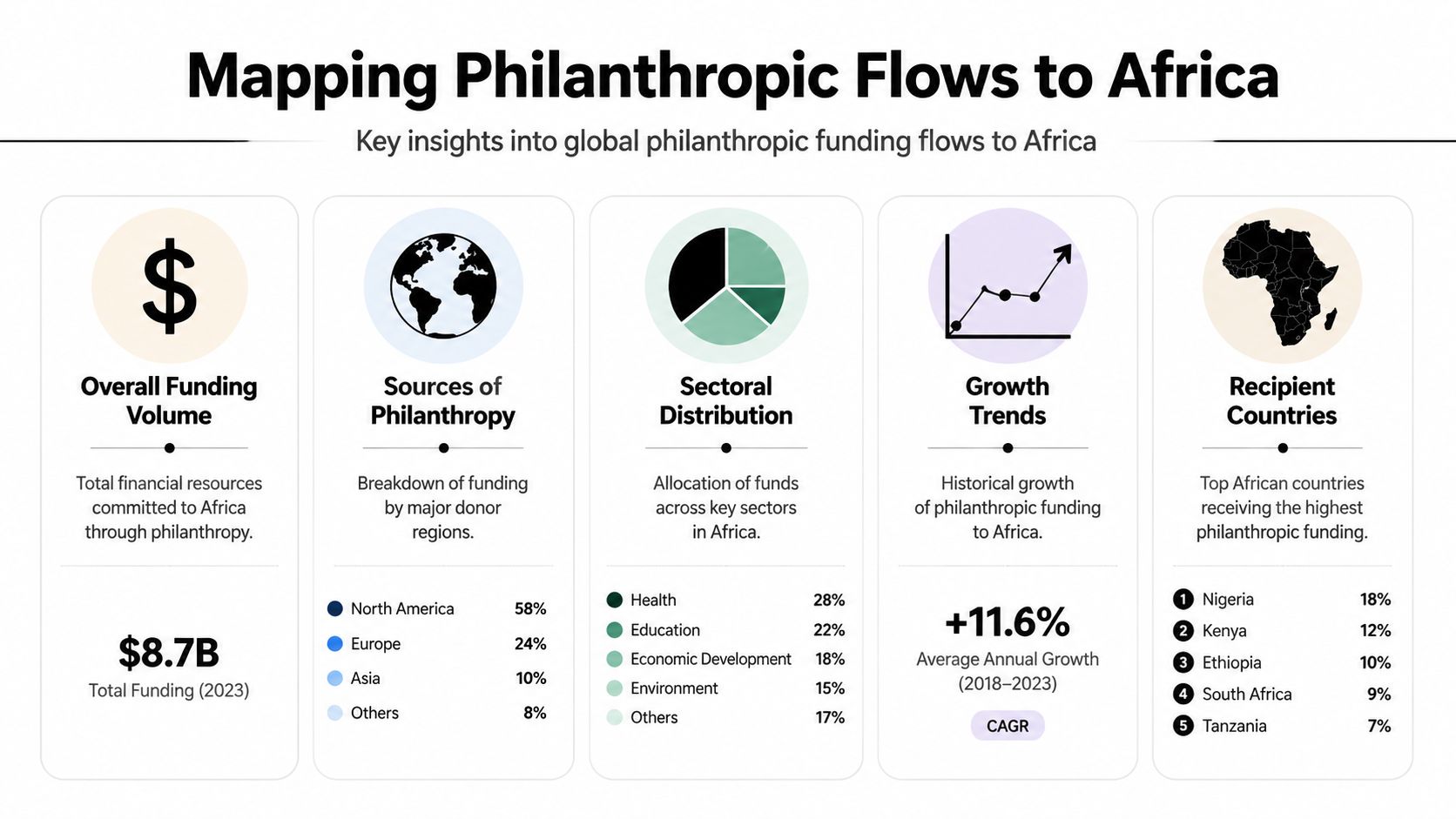
The first analytical mistake in this field is to map only external finance. That creates the impression that charity in Africa is principally a North-to-South transfer story. It isn’t. The more accurate map includes official aid, large-scale foreign philanthropy and African domestic giving systems, all of which shape incentives on the ground.
Africa is not only a recipient
One of the most underused facts in policy discussions is that Africa is the world’s most generous continent, with donors contributing 1.54% of their income on average, above the global figure of 1.04%. The same World Giving Report 2025 material published by the East Africa Philanthropy Network notes that six African nations are in the top 10 globally and 72% of Africans give money, compared with 64% globally.
That data should alter how G7 and G20 governments think about partnership. Local giving isn’t a cultural footnote. It’s a functioning social financing system. Where donors ignore it, they often duplicate existing networks or displace them with external administrative structures that are less trusted and less adaptive.
Three funding logics operate at once
A useful policy distinction is between three broad logics:
| Funding logic | Primary actor | Typical strength | Core risk |
|---|---|---|---|
| Official aid | Bilateral and multilateral institutions | Scale and policy reach | Bureaucratic distance |
| Large private philanthropy | Foundations and major donors | Flexibility and thematic focus | Weak local accountability |
| Community giving | Local households, faith networks and community groups | Trust and social legitimacy | Limited formal infrastructure |
This distinction matters because each stream answers a different question. Official aid can underwrite national systems. Private philanthropy can take targeted risks. Community giving can identify genuine local priorities. Effective policy doesn’t choose one and reject the rest. It aligns them.
The policy trap in current debates
Too much donor analysis still treats African generosity as morally admirable but operationally secondary. That’s a mistake. If people on the ground already support local causes at high rates, then external funding should be designed to strengthen those circuits rather than route around them.
External philanthropy works best when it adds institutional capacity to trusted local ecosystems rather than replacing them with imported compliance structures.
For G7 and G20 actors, the practical lesson is simple. Stop seeing African domestic giving as background context. Treat it as part of the core delivery environment. If ODA, foundation grants and domestic philanthropy pull in different directions, fragmentation is built into the model from the outset.
Governance and the Localisation Challenge
The central operational weakness in contemporary charity and africa isn’t a lack of goodwill. It’s the routing of money through structures that concentrate decision-making far from the communities in question.

The most revealing figure here comes from the funding chain itself. From 2010 to 2019, only 14% of large-scale gifts from non-African funders reached African NGOs directly, according to Bridgespan’s analysis of large-scale giving in Africa. The rest was largely intermediated through Northern headquarters.
Why intermediation changes outcomes
Intermediation is not neutral. It shapes programme design, reporting burdens, staffing patterns and who gets to define success. When an African organisation sits several steps downstream from the original donor, it usually inherits constraints rather than authority. It must fit pre-set theories of change, donor timelines and external branding requirements.
That model can still produce activity. It often struggles to produce institutional durability.
- Decision rights stay upstream: Strategy is often set in donor capitals or foundation headquarters.
- Administrative layers multiply: Funds pass through organisations that must cover their own operating costs.
- Local leadership narrows: African organisations become implementers instead of strategic principals.
This is why localisation shouldn’t be treated as a communications slogan. It is a governance reform agenda.
Localisation is a power question
The practical challenge isn’t whether local actors can deliver. In many sectors, they already do. The challenge is whether donor systems are willing to transfer enough authority to let proximate institutions shape programmes from the outset.
A more serious localisation framework would require funders to change procurement, risk and due diligence practices. It would also require them to accept that capability grows through use. If local organisations never control substantial resources directly, they never get the chance to build the financial, managerial and political infrastructure that donors later say is missing.
A wider debate about African agency in multilateral systems runs through this discussion of strengthening Africa’s voice in global governance. The same principle applies here. Representation without authority is cosmetic.
A short briefing below captures the policy tension well:
What G7 and G20 officials should infer
The localisation debate is often framed as an ethical issue. It is that, but it is also a performance issue. Funding chains that privilege remote intermediaries create slower feedback, weaker ownership and thinner institutional memory where services are delivered.
Operational test: If the people closest to implementation cannot reshape programme choices, the system is local in labour but not local in governance.
That distinction matters. It explains why many externally funded programmes appear active yet leave local systems only marginally stronger after the funding cycle ends.
Measuring Impact and Ensuring Accountability
If localisation is the core governance issue, accountability is the core legitimacy issue. Governments and charities can’t defend cross-border spending on the basis of intent. They need credible evidence that money was used for purposes that were clear, verifiable and materially relevant.
That requirement remains unevenly met. A 2023 Charity Commission review found reporting gaps for overseas projects, with 15% of large international charities failing to provide adequate impact metrics, according to the Charity Commission record and review material. For a policy audience, the issue isn’t merely weak disclosure. It’s impaired decision-making.
The reporting problem is structural
Many charities remain better at describing activity than proving effect. They count trainings, distributions, partnerships and beneficiaries reached. Those metrics have administrative value, but they don’t tell ministers, legislatures or taxpayers whether a programme altered capability, resilience or service quality in ways that lasted.
Accountability fails when donors can describe expenditure precisely but cannot describe changed conditions with the same confidence.
That gap also distorts funding incentives. Organisations learn that visible motion is easier to report than complex change. As a result, systems can reward scale of activity over depth of institutional gain.
From outputs to outcomes
| Metric Type | Traditional Output (Example) | Meaningful Outcome (Example) |
|---|---|---|
| Service delivery | Number of items distributed | Whether target communities sustained access after programme support ended |
| Training | Number of staff trained | Whether trained staff changed practice and remained in role |
| Partnership | Number of local partners engaged | Whether local partners gained budget authority and strategic control |
| Health or education support | Number of sessions delivered | Whether the local system can continue delivery without external management |
This isn’t an argument for abandoning output metrics. It’s an argument for subordinating them to outcome logic.
What better accountability would look like
A stronger model would rest on three shifts:
- Comparable reporting frameworks across charities, foundations and public programmes.
- Independent verification of overseas claims where public money or tax-advantaged donations are involved.
- Local participation in evaluation, so that affected organisations and communities are not merely subjects of assessment but contributors to it.
The strategic point for G7 and G20 officials is straightforward. Without stronger evidence standards, the debate over aid effectiveness becomes permanently ideological. One side cites moral necessity. The other cites disappointment. Neither side can adjudicate clearly because the measurement architecture is too weak.
Case Studies in Charitable Intervention
The policy lessons become clearer when viewed through contrasting intervention models. One model strengthens local capacity because it treats African institutions as principals. The other weakens system development because it confuses delivery with durable change.
A stronger model
Consider an African-led public health or livelihoods initiative backed by external financing but governed through local institutions. In this model, outside partners provide capital, technical support and access to international networks, but local organisations define operating priorities, manage implementation and shape adaptation when conditions change. That arrangement usually produces less donor theatre and more institutional learning.
The advantage isn’t romantic localism. It’s practical alignment. Staff who work inside the context can adjust faster, identify informal constraints earlier and build trust more credibly than remote actors. External partners still matter, especially where procurement reach or specialist expertise is needed, but they support local decision-making rather than substitute for it.
The most durable charitable interventions don’t merely deliver services. They leave behind stronger local organisations that can negotiate, manage and adapt after foreign attention shifts elsewhere.
A weaker model
Now consider the opposite pattern. A well-funded programme enters with a predetermined design, visible branding and heavy reporting requirements managed primarily outside the target country. Local groups are contracted to execute tasks, but they don’t own strategy, data or long-term financing relationships. Initial implementation may appear efficient because centralised templates are already in place.
The weakness emerges later. Once the project cycle closes, local organisations often retain neither the authority nor the unrestricted resources to continue at the same level. Community expectations, however, have been raised. Dependency isn’t always created by receiving aid. It is often created by programme architectures that withhold long-term control from local actors.
The practical lesson
For policymakers, the distinction isn’t between charity that cares and charity that doesn’t. It is between interventions that treat local institutions as part of the solution architecture and interventions that treat them as delivery appendages.
That should shape procurement standards, grant terms and diplomatic messaging. A programme can be generous and still be structurally extractive if it mines local legitimacy without transferring corresponding authority.
The Future of Finance and the Trade not Aid Doctrine
The next phase of the debate is already here. Political language in donor countries is shifting from aid towards trade, investment and commercial partnership. That shift reflects fiscal pressure, domestic politics and dissatisfaction with legacy aid models. It also reflects a valid intuition that long-run development requires productive economic transformation, not permanent external subsidy.
The risk is that “trade not aid” becomes a slogan rather than a serious policy doctrine. UK aid to Africa fell 22% in 2024-25, while reports also showed that African countries lost over £50bn in illicit financial flows in 2024, according to African Relief’s discussion of the policy shift. That juxtaposition matters. If policymakers celebrate aid reduction while doing too little on capital leakage, tax transparency and fair trading conditions, they may merely shrink one inflow without addressing a much larger outflow.
Trade not aid only works with rules
Trade can support development. Investment can deepen productive capacity. But neither becomes development policy by default. The quality of trade regimes, debt conditions, customs systems, tax cooperation and anti-corruption enforcement determines whether growth opportunities are broad-based or narrowly captured.
A useful future-facing frame appears in this analysis of the African Investment Forum and financial governance. The point isn’t to replace philanthropy with markets as if one automatically corrects the other. The point is to align finance, governance and development strategy.
The strategic implication for G20 forums
G20 discussions should treat charity policy as one piece of a wider financial justice agenda. If illicit flows continue at large scale, then even well-designed charity and aid systems will struggle to offset systemic losses. Conversely, if trade and investment frameworks improve but local social infrastructure remains underfunded, the gains may not reach vulnerable populations quickly enough.
That’s why the future isn’t aid versus trade. It’s a question of whether G7 and G20 governments can build a coherent package in which philanthropic finance, public development finance and economic governance reinforce rather than undermine each other.
Policy Recommendations for G7 and G20 Leaders
The evidence points to a clear conclusion. The central task isn’t to defend or abolish charity. It’s to redesign the ecosystem through which charitable and public resources operate in Africa.
Reform the funding chain
G7 and G20 governments should require far stronger localisation standards in both ODA and publicly supported philanthropic partnerships. Direct funding to African-led organisations should become the default presumption where fiduciary conditions permit, not the exceptional case. Intermediaries should have to justify their role in terms of specialised value added, not inherited donor habit.
Procurement rules also need revision. Current systems often reward institutions that are already fluent in donor compliance language, even when they are far removed from implementation realities. Governments should build grant pathways and contracting models that let capable African organisations access funding without being forced into subordinate roles.
Standardise impact transparency
Cross-border philanthropy needs a common accountability floor. G7 and G20 leaders should champion reporting standards that distinguish clearly between activity, outcomes and institutional strengthening. Charities and foundations that receive public funds, tax benefits or official partnership status should disclose impact claims in a form that allows comparison across programmes.
Independent verification should be normal for major overseas portfolios. So should public explanation when programmes underperform. Failure isn’t the problem. Opaque failure is.
Connect aid policy to economic justice
Aid ministries can no longer operate as if development outcomes are separable from illicit flows, trade asymmetries and financial governance. The policy shift towards trade should therefore be paired with stronger action on transparency, beneficial ownership, anti-corruption enforcement and cooperation against cross-border capital leakage.
A credible G20 package would combine three things:
- Sharper localisation commitments in aid and philanthropic channels.
- Stronger reporting rules for overseas charitable spending.
- Broader financial governance reforms that reduce the structural drain on African economies.
Treat African institutions as strategic counterparts
This is the most important recommendation. G7 and G20 leaders should stop designing Africa-facing charity policy around a mental model of external rescue. African societies already generate significant giving, volunteering and civic solidarity. International policy should amplify those capabilities.
Decision rule for leaders: Fund what builds local authority, measure what changes long-term conditions, and reform the global rules that allow value to leave faster than charity can replace it.
Upcoming summits should move beyond rhetorical endorsement of localisation, accountability and partnership. Those ideas are already well known. What’s missing is binding administrative practice.
The credibility of donor governments now depends less on how eloquently they speak about solidarity and more on whether they are willing to redistribute control, tighten evidence standards and confront the financial structures that keep charitable effort from achieving its full effect.
For more analysis like this, follow Global Governance Media for data-led briefings, summit-focused commentary and practical policy insight on the choices facing G7 and G20 leaders.