

By Dr James Holloway
More than 110 active armed conflicts are now under way globally, the highest level since the Second World War, and 52% of chief risk officers rank state-based armed conflict as the top risk in 2025, according to S&P Global’s geopolitical risk analysis. That single data point changes how policymakers should read international relations current events. We’re not watching a sequence of isolated crises. We’re living through a systemic breakdown in the assumptions that underpinned relative strategic order for decades.
The old habit of sorting risks into separate boxes, security, energy, trade, technology, climate, no longer works. A war in Eastern Europe reshapes budget priorities in London. Pressure in the Gulf feeds directly into household energy bills in the UK. US-China rivalry reaches boardrooms through sanctions, supply chains and AI governance. Public support for climate action holds up, but trust in multilateral delivery erodes when domestic costs rise.
For G7 and G20 policymakers, that means the core challenge isn’t only crisis management. It’s governing as shocks now travel quickly across domains and institutions react at different speeds. Some forums can mobilise finance. Others can convene. Some can signal unity. Few can impose strategic coherence.
This briefing argues that today’s fractured international environment should be understood as a test of institutional adaptability. The immediate question isn’t whether multilateralism survives in principle. It’s whether states can make it useful under conditions of rivalry, fragmentation and political distrust.
Table of Contents
- Introduction A World on the Brink
- Explaining the Fracturing World Order
- Mapping Today's Geopolitical Flashpoints
- The New Economic Battleground of Trade and Technology
- The Climate and Energy Security Dilemma
- Assessing the Response of Multilateral Forums
- A Roadmap for Collective Action in a Divided World
Introduction A World on the Brink
Armed conflict, trade restrictions, energy disruption and climate shocks are now hitting governments at the same time. The policy problem is no longer how to respond to a single crisis. It is how to allocate fiscal, diplomatic and institutional capacity across several interacting ones without weakening deterrence, growth or political consent at home.
That pressure is already reshaping state priorities. In the UK, higher defence spending has become part of a wider reordering of national strategy rather than a temporary wartime adjustment, as noted earlier. Similar choices are emerging across the G7, where resilience now sits alongside inflation control, industrial policy and alliance management. For G7 and G20 policymakers, the central question is no longer whether geopolitical risk affects economic governance. It is which risks are material enough to change budget baselines, supply-chain rules and multilateral negotiating positions.
A simple event-by-event reading misses the larger shift. The system is becoming more transactional, more regionalised and less forgiving of policy lag. Governments are using sanctions, export controls, investment screening, energy arrangements and ad hoc coalitions more often because formal institutions are slower to produce enforceable outcomes. The result is a world in which security policy, macroeconomic policy and technology policy increasingly operate on the same strategic timeline.
The term polycrisis can obscure more than it explains. Used carefully, it describes a condition in which shocks in one domain quickly alter the policy menu in another. A shipping disruption raises inflation risk. Higher energy costs narrow fiscal space. Tighter budgets then constrain defence procurement, climate investment or external assistance. For ministers preparing G7 communiqués or G20 workstreams, this means performance should be judged less by rhetorical unity than by whether forums can contain spillovers across sectors.
Three implications stand out.
- Security expenditure is becoming a standing budget assumption: defence, civil preparedness and infrastructure protection are moving closer to the core of medium-term fiscal planning.
- Foreign policy now carries a domestic price signal: electorates assess sanctions, aid, trade exposure and alliance commitments through household costs, employment effects and industrial competitiveness.
- Multilateral credibility will depend on delivery: forums retain value when they coordinate finance, standards and crisis response at a speed that national governments cannot match alone.
This is the lens used by our analysis of the fault lines shaping global governance. International relations current events matter because they reveal whether existing institutions can still convert shared concern into measurable collective action.
Explaining the Fracturing World Order
The most useful way to understand today’s environment is not as the arrival of a neatly multipolar order. It’s a more unstable condition than that. The stabilising assumptions associated with Pax Americana have weakened, but no replacement architecture has yet taken hold.
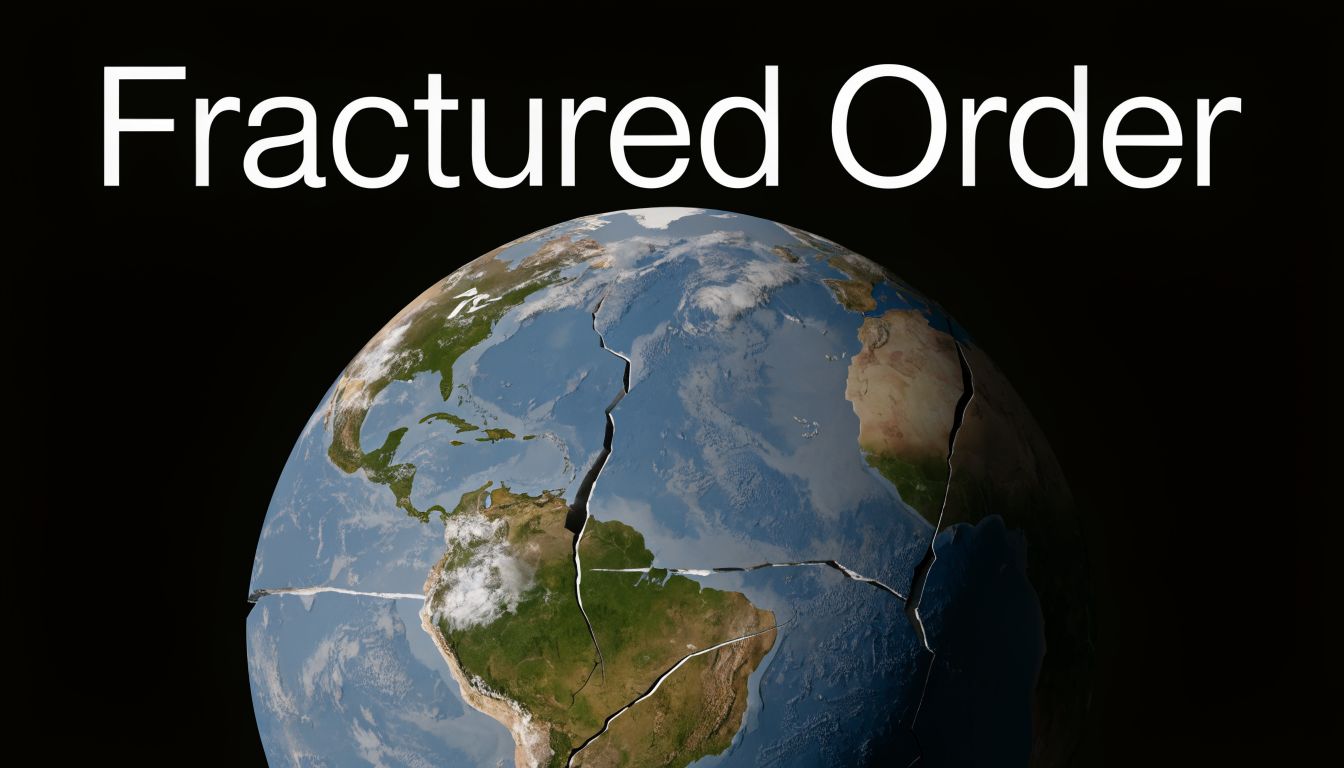
What follows is a world of partial alignments, selective cooperation and recurrent coercion. States are no longer asking only whether international rules exist. They’re asking who can enforce them, who can evade them, and which coalitions can still act when formal institutions stall. That’s why a piece such as Fault Lines Exposed captures the mood of the present moment better than older language about a stable liberal order.
From hierarchy to contested space
Under a more hierarchical order, smaller and middle powers could often assume that strategic shocks would eventually be absorbed by a dominant centre. That assumption has eroded. The United States remains central, but it no longer acts as a universally accepted guarantor of strategic predictability.
The result resembles a crowded junction without a functioning traffic system. The major powers still move with force, but everyone else must constantly anticipate collision, diversion or blockage. In that setting, revisionist powers see opportunity, allies seek hedging room and institutions struggle to convert declarations into enforcement.
The defining problem of the current order isn’t simply rivalry. It’s the absence of a trusted mechanism for containing rivalry before it spills across regions and sectors.
Why middle powers matter more
Countries such as the UK become more significant than conventional rankings might suggest. In a fractured system, influence often belongs to states that can bridge forums, shape packages, convene allies and translate strategic intent into institutional action.
That role is increasingly visible in European security diplomacy, sanctions coordination and summit politics. The point isn’t that middle powers can replace superpowers. They can’t. The point is that fragmented orders create premium demand for states that can connect the military, economic and diplomatic tracks of policy.
A second shift follows from that. Norms are now sustained less by universal consensus and more by active coalitions. In practice, rules survive where groups of capable states keep operationalising them through aid, financing, technology standards and political backing. Where that effort weakens, vacuums form quickly.
Mapping Today's Geopolitical Flashpoints
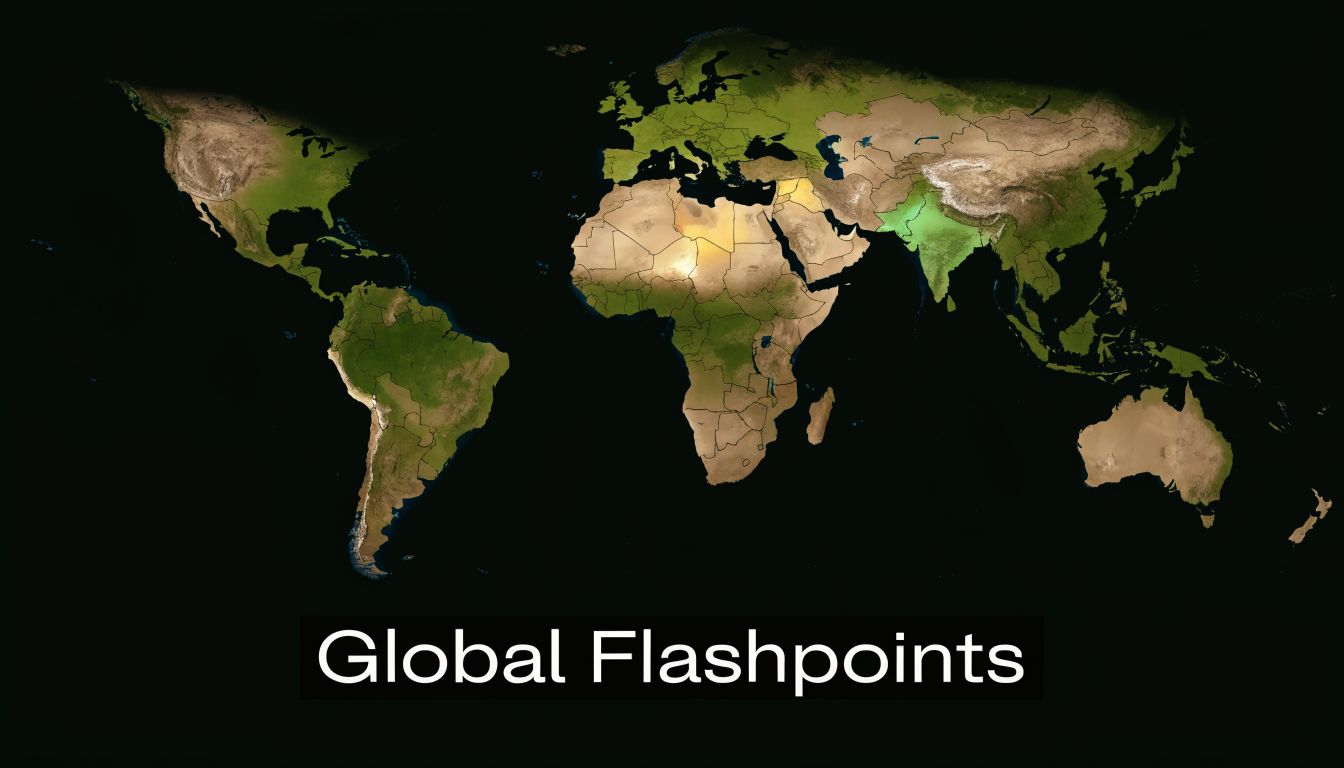
Two theatres now shape far more than regional security. According to the World Economic Forum’s 2025 inflection points analysis, the EU’s end-2025 commitment of a $105 billion loan to Ukraine would cover roughly two-thirds of Kyiv’s financial needs over the following two years. The same briefing also notes a 15.2% rise in UK household energy costs tied to disrupted Persian Gulf shipments. For G7 and G20 policymakers, that pairing matters because it shows how war finance and energy exposure now feed directly into summit agendas, fiscal planning and coalition management.
Ukraine and the politics of endurance
The war in Ukraine has entered a phase where state capacity matters as much as territorial control. Budget support, air defence supply, reconstruction financing and sanctions enforcement now shape the military balance because they determine whether Kyiv can keep the state functioning under sustained attack.
That changes the policy test for the G7. Success is no longer measured only by battlefield headlines. It is measured by whether coalition members can maintain predictable financing, keep defence production aligned with Ukrainian requirements and limit sanction circumvention over time.
The UK’s role sits in coalition mechanics. London has helped align European security diplomacy with practical instruments such as training, sanctions coordination and political signalling. In a period of looser transatlantic discipline, states that can connect Washington, Brussels and key middle powers have greater strategic weight than aggregate GDP rankings alone would suggest.
A second implication is often missed. Ukraine is also a rehearsal for how advanced economies sustain long-duration support under electoral pressure. That makes the war relevant to a wider debate over how the US-China split is straining the world trading system, because both cases test whether coalitions can absorb economic costs in pursuit of strategic aims.
The Gulf shock and domestic consequence
The Gulf presents a different but related stress test. Maritime disruption in and around the Persian Gulf can transmit rapidly into inflation, energy pricing and public confidence in governments far from the theatre itself.
That transmission channel is what places Gulf instability on the same page as Ukraine for finance ministries and summit sherpas. The first-order question is security. The second-order question is whether governments can shield households and industry from the economic effects of insecurity at sea.
Too many policy debates still separate military escalation from domestic political risk. In practice, electorates often feel the energy bill before they absorb the strategic briefing. For G20 members, that means shipping security, energy stockpiles, insurance costs and coordination on market stabilisation deserve as much attention as declaratory diplomacy.
A short explainer from the video below helps place those wider security and economic linkages in context, particularly the way regional confrontation can spill into shipping routes, energy markets and alliance decision-making.
Why these flashpoints matter to summit agendas
Ukraine and Gulf instability expose the same weakness in multilateral practice. Governments can still issue joint statements. They struggle more when asked to produce durable burden-sharing arrangements, common financing tools and protection against cross-border economic shocks.
For the G7, the relevant metrics are clear.
- Coalition durability: whether members can sustain multi-year support packages, replenish stockpiles and keep domestic backing intact.
- Economic resilience: whether governments can cushion households and firms from conflict-driven price shocks without derailing fiscal credibility.
- Operational delivery: whether summit commitments translate into shipping protection, energy coordination, sanctions implementation and timely disbursement of finance.
A flashpoint becomes system-shaping when it rewrites budget choices, public tolerance and the working agenda of every major summit.
That is where both theatres now sit. They are no longer isolated crises. They are performance tests for whether the G7 and G20 can still convert shared concern into measurable action.
The New Economic Battleground of Trade and Technology
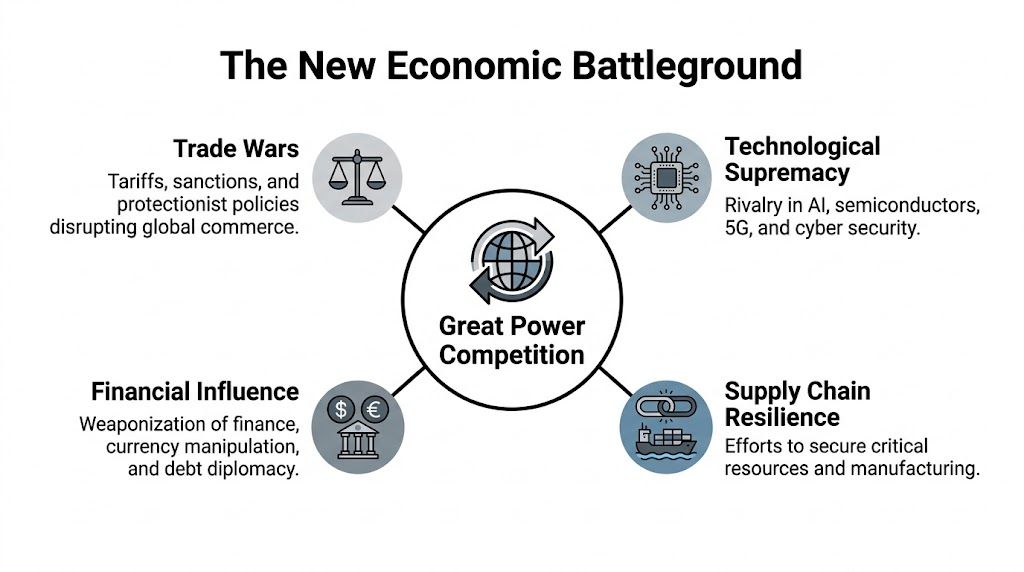
Strategic rivalry no longer sits apart from economic policy. It runs through it. Tariffs, sanctions, export controls, investment screening and standards-setting now function as instruments of statecraft rather than technical policy choices.
Electrostates and petrostates
The useful distinction here is between electrostates and petrostates. It isn’t a perfect binary, but it captures a real contest. One camp seeks advantage through AI, clean technology, semiconductors, grid systems and critical minerals. The other still draws power from hydrocarbons, commodity chokepoints and legacy energy dependence.
The UK sits awkwardly inside this struggle. It’s tied to advanced service sectors, regulatory diplomacy and green transition ambitions, yet it remains exposed to external shocks and alliance-driven policy moves. The costs are already visible. UK exports to China dropped 12% in 2025, while 71% of UK ESG executives reported supply chain disruptions from global green bloc shifts, according to the analysis cited by Foreign Policy on the electrostates versus petrostates rivalry.
That combination matters more than either number alone. Falling exports show market exposure. Supply chain disruption shows operational vulnerability. Together they describe a strategic economy under pressure from decisions taken elsewhere.
What this means for firms and finance ministries
For companies, the new economic battleground isn’t just about geopolitical awareness. It’s about redesigning risk management around political fragmentation. For finance ministries, it means industrial strategy, trade policy and national security can’t be handled in separate silos.
One useful framing appears in Confronting the US-China split in the world trading system, which treats commercial decoupling as a practical governance problem rather than a rhetorical one. That’s the right lens. The question isn’t whether states prefer openness in principle. It’s which dependencies they’re still willing to tolerate.
A concise policy checklist follows.
- Trade policy: Governments should identify sectors where market access depends on political goodwill rather than commercial competitiveness alone.
- Technology governance: AI rules, semiconductor policy and data regimes now shape alliance structures as much as they shape innovation ecosystems.
- Supply chain planning: Firms need redundancy in critical inputs, especially where sanctions or bloc politics can interrupt procurement.
- Financial statecraft: Capital access, insurance, compliance and export finance increasingly operate as strategic tools.
Working assumption: Economic interdependence still exists, but it no longer guarantees restraint. In many sectors, it now creates leverage points for coercion.
That’s the defining change.
The Climate and Energy Security Dilemma
Climate diplomacy has entered a harsher political environment. The old assumption was that decarbonisation could be presented as a shared long-term good and gradually embedded through targets, subsidies and summit communiqués. That approach now collides with a more immediate demand. Citizens want affordability and security first.
In the UK, that tension is unusually clear. 62% of Britons support renewable transitions, but only 28% trust G20 delivery on net-zero pledges, while domestic energy bills are up 15% year-on-year, according to the polling and reporting highlighted by the Reuters Institute discussion of community information needs. The lesson is not that public support for climate action has collapsed. It hasn’t. The lesson is that support and trust are no longer the same thing.
Public consent is now a strategic variable
That distinction should alter how ministers think about climate policy. Voters may back the direction of travel while doubting the competence, fairness or delivery capacity of the institutions managing it. In political terms, that’s a dangerous mix. It allows opponents of transition to attack not only cost but credibility.
For the G20, this creates a legitimacy problem. International commitments often sound coherent at summit level but fragmented at household level. If governments can’t connect global pledges to visible domestic protection, climate cooperation starts to look abstract, elite and unevenly distributed.
Three implications follow.
- Energy security and climate policy must be narrated together: Treating them as rival agendas weakens both.
- Distribution matters as much as ambition: Households judge transitions through who pays, who benefits and who gets shielded.
- Summit language needs operational follow-through: Without delivery mechanisms, trust gaps widen.
The policy mistake to avoid
The most common error is to assume that geopolitical shocks automatically strengthen the case for transition in the public mind. Strategically, that can be true. Politically, it’s often incomplete. Citizens may accept the argument for more domestic renewable capacity and still reject the way governments handle short-term costs.
Climate policy now succeeds or fails at the intersection of geopolitics, household economics and institutional trust.
That’s why energy ministers, treasury officials and summit sherpas need a common operating picture. The question is no longer whether green transition is desirable. It’s whether democratic states can make it feel secure, fair and credible during an era of external disruption.
Assessing the Response of Multilateral Forums
Multilateral institutions haven’t failed uniformly. Some have performed better than critics allow. Others remain trapped between legitimacy and effectiveness. The central issue is variation. Different forums can do different things, and policymakers lose time when they expect one institution to solve a problem built for another.
The G7 tends to work best when speed, coordination among like-minded states and political signalling matter most. The G20 is more useful when global buy-in, financial legitimacy and broad agenda-setting are required. The UN system remains indispensable for legitimacy and humanitarian machinery, but major power contestation often limits coercive action.
That asymmetry explains much of the frustration in current international relations current events. States still need multilateral platforms, but they increasingly use them in narrower, more pragmatic ways. The challenge is to stop treating forum choice as ceremonial. It’s now a strategic decision.
Where institutions still perform
The most effective responses usually share three traits. First, they match the forum to the function. Second, they narrow objectives rather than overload communiqués. Third, they rely on coalitions willing to implement outcomes beyond the summit room.
That logic sits behind calls for institutional adaptation, including arguments advanced in Towards a new international architecture. Formal universality still matters. But in practice, progress often depends on smaller groups building instruments that broader bodies can later legitimise or scale.
2026 Multilateral Action Scorecard
| Global Challenge | Primary Forum | Response Status | Key Obstacle |
|---|---|---|---|
| Ukraine war finance and political coordination | G7 and European partners | Action agreed | Burden sharing over time |
| Energy security under conflict pressure | G7 and G20 | Under negotiation | Divergent exposure and domestic politics |
| AI governance and technology standards | G7 and G20 | Under negotiation | Strategic rivalry between major powers |
| Trade fragmentation and sanctions spillover | G20 | Gridlocked | Conflicting national industrial strategies |
| Humanitarian coordination in active conflicts | UN system | Partial action | Security paralysis among major powers |
| Climate credibility amid rising costs | G20 | Under negotiation | Public distrust in delivery |
Institutions still matter. What’s changed is that they no longer compensate for weak political alignment. They merely reflect it.
That is a harder world for summit diplomacy, but not an impossible one.
A Roadmap for Collective Action in a Divided World
The practical answer to fragmentation isn’t nostalgia for a vanished order. It’s building a more resilient form of cooperation around realistic functions. That means accepting that no single forum will manage all dimensions of the current crisis environment.
The first priority is functional minilateralism. Small groups such as the G7 should focus on areas where alignment is already strong enough to act, financial support packages, sanctions coordination, critical infrastructure resilience and baseline AI governance principles. Waiting for universal consensus in these areas often means waiting too long.
The second priority is selective G20 bargaining. Broader forums still matter where legitimacy and scale are essential, especially on energy stability, financial resilience and cross-border economic spillovers. The aim should be narrower, implementable bargains rather than maximal declarations.
Third, governments should treat domestic legitimacy as part of foreign policy capacity. If voters don’t trust delivery, even sound international strategies become politically brittle. Public consent is now a strategic asset.
A credible roadmap looks like this:
- Build coalitions that can act quickly on security and technology.
- Use larger forums to lock in broader economic and political acceptance.
- Tie international commitments to visible domestic protection.
- Reform institutions through use, not only through formal redesign.
The larger point is simple. Multilateralism doesn’t need more reverence. It needs better operating discipline. In a divided world, cooperation survives when states make it practical, limited where necessary and ambitious where possible.
Global challenges now move faster than most institutions built to manage them. If you want sharper analysis, summit-focused briefings and data-led perspectives on the choices facing the G7 and G20, follow Global Governance Media.