

By Daniel Mercer
The most surprising fact about US relations with China isn't how confrontational they now appear. It's how recently the relationship was defined by fast-deepening interdependence. According to the Council on Foreign Relations, bilateral trade rose from about $5 billion in 1980 to $231 billion in 2004, an increase of roughly 4,520% after diplomatic normalisation (Council on Foreign Relations analysis of US-China relations). That scale of integration wasn't a side effect of détente. It became one of the central facts of the international economy.
That era has closed. The relationship hasn't ended, but its organising logic has changed. What was once framed as engagement with strategic differences is now best understood as managed rivalry under conditions of mutual exposure. The practical consequence for diplomats is not only that Washington and Beijing disagree more often. It's that their competition now reaches into export controls, investment screening, clean-tech supply chains, advanced computing, academic exchange, and the operating assumptions of allied economies.
For the UK and other middle powers, that shift is easy to misread. Too much commentary still treats the issue as a bilateral contest to be watched from the sidelines. In reality, allied states sit inside the system being reshaped. They face compliance burdens from US technology controls, market pressure from redirected Chinese exports, and policy dilemmas over where to align tightly, where to hedge, and where to preserve room for selective cooperation. The most important question isn't whether US-China tensions are rising. It's how their new structure redistributes risk across sectors that allies depend on.
Core judgement: The centre of gravity in US relations with China has moved from diplomacy first and commerce second to security first, technology next, and commerce under constraint.
That change affects four domains at once. It alters the economic map through tariffs, controls, and supply-chain reconfiguration. It sharpens security frictions, especially in the Indo-Pacific. It places technology at the heart of strategic competition. And it complicates global governance by narrowing the space for cooperation while making crisis management more necessary.
Diplomats at the G20 don't need another broad description of rivalry. They need a framework for judging where competition can be bounded, where exposure is becoming intolerable, and where allied resilience still lags behind policy rhetoric. That's the real task now.
Table of Contents
- Introduction Navigating the Most Consequential Relationship
- From Engagement to Estrangement A Brief History
- The Current State of US-China Relations
- Recent Developments and Summit Outcomes
- US Policy Options and Allied Perspectives
- Key Risks and Future Scenarios for 2030
- Conclusion Actionable Recommendations for a Stable Future
Introduction Navigating the Most Consequential Relationship
US relations with China now shape far more than the bilateral agenda. They influence the operating environment for trade ministers, central banks, regulators, defence planners, university leaders, and firms managing globally distributed production. The relationship has become the main channel through which geopolitical rivalry is transmitted into everyday economic governance.
That matters because the rivalry is no longer confined to symbolic signalling or periodic diplomatic friction. It is being codified through state action. Washington has shifted towards a more securitised approach in which technology, investment, and strategic supply chains are treated as national security concerns. Beijing has responded with tighter industrial policy and countermeasures. The result is a relationship that still contains large areas of contact, but much less trust about what interdependence is for.
For allied governments, particularly in Europe, this produces a problem of timing. Many still debate the strategic meaning of the US-China shift as if the decisive transition lies ahead. In fact, much of it has already happened. The issue now isn't whether a more restrictive era is arriving. It's whether allied policy has adapted quickly enough to distinguish between acceptable exposure and strategic vulnerability.
Why the allied lens matters
The UK case illustrates the point. British firms depend on transatlantic and East Asian flows in semiconductors, electronics, clean technology, and digital infrastructure. When Washington tightens export controls or investment restrictions, the direct target may be Chinese capability. But the indirect effects land across allied supply chains through price changes, sourcing constraints, compliance costs, and regulatory uncertainty. That second-order impact is too often treated as peripheral. It isn't peripheral. It is one of the central policy consequences of the new era.
A sober reading therefore starts from three propositions:
- Competition is durable: The relationship has moved into a sustained period of strategic competition, not a temporary downturn in an otherwise stable pattern.
- Interdependence hasn't disappeared: Exposure remains deep, which means coercive tools and defensive policies can spill across borders quickly.
- Middle powers need a sector lens: Abstract debate about alignment misses where actual risk is concentrated, especially in semiconductors, advanced computing, universities, and regulated services.
Stability now depends less on restoring trust than on building rules, buffers, and communication channels that can operate without it.
That's a less ambitious objective than the language of partnership that once shaped policy. It is also more realistic.
From Engagement to Estrangement A Brief History
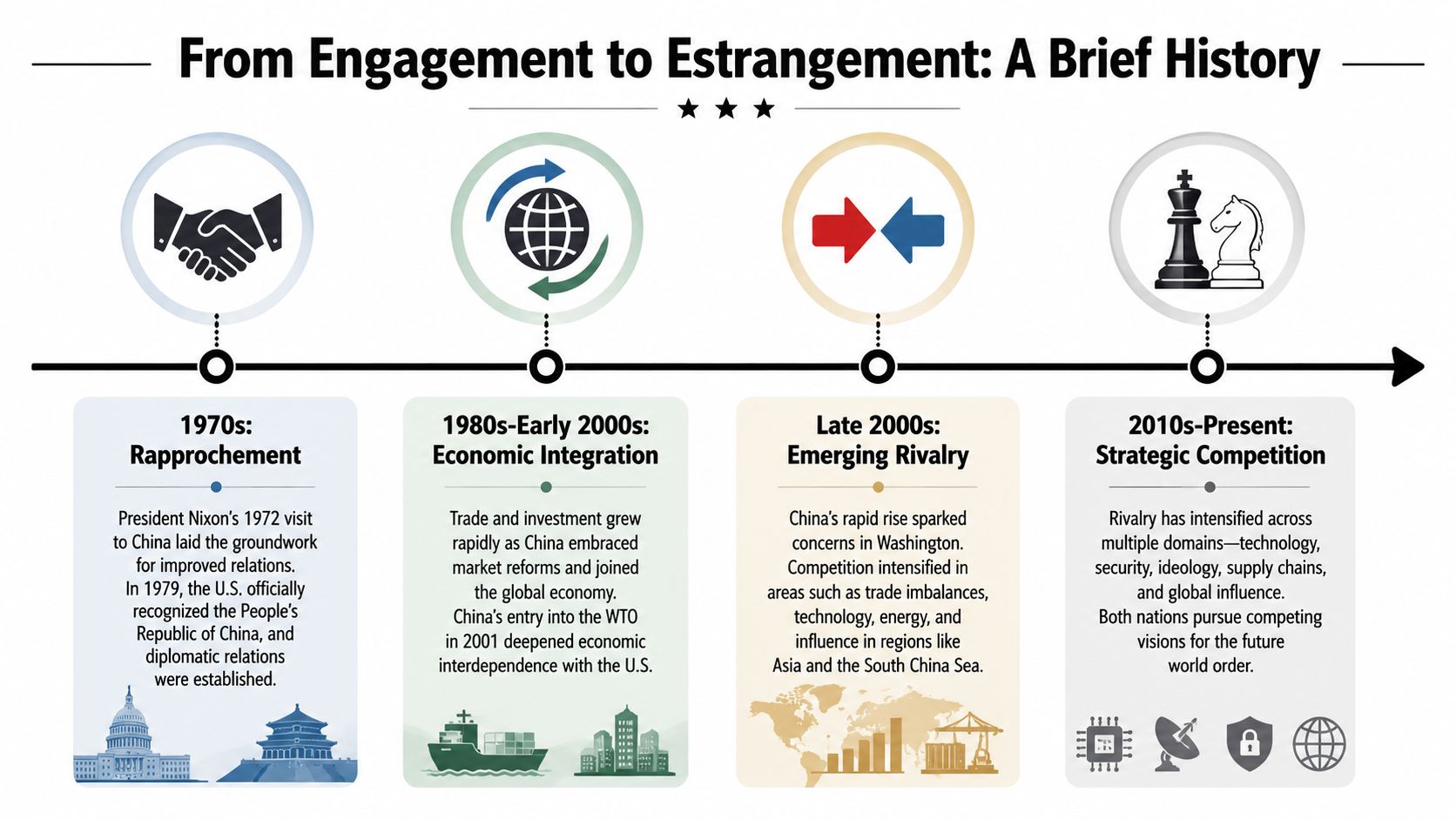
The historical arc matters because today's tensions didn't emerge from a relationship that was always adversarial. They emerged from one that was deliberately rebuilt, rapidly expanded, and then reinterpreted.
A foundational milestone came with the establishment of formal diplomatic ties on 1 January 1979, after the two governments issued their joint communiqué in December 1978, ending more than two decades of non-recognition after the 1949 revolution and Cold War rupture (US Embassy history of US-China relations). That diplomatic reset followed President Nixon's visit in 1972 and the opening of Liaison Offices in 1973. The strategic logic at the time was clear. Both sides had reasons to move beyond outright hostility.
The engagement bargain
Normalisation created the political conditions for a much broader transformation. In the decades that followed, economic ties became central to the relationship. What began as strategic opening developed into a model in which commercial integration was expected to stabilise politics, moderate behaviour, and bind both countries into a wider international order.
For a long period, that assumption appeared plausible. Policymakers in Washington could point to rising trade, expanding corporate exposure, educational links, and practical channels of communication as evidence that engagement was producing a durable framework. Beijing, for its part, could use access to markets and technology while preserving substantial control over its domestic political model.
Why estrangement took hold
The weakness in that bargain was that each side attached different expectations to the same process. Washington increasingly judged the relationship through the lens of unmet convergence. Beijing regarded interdependence as a means to advance its interests. As strategic suspicion grew, the very ties once celebrated as stabilising came to be viewed as vectors of influence and vulnerability.
That reinterpretation matters more than any single event. Estrangement didn't result merely from harsher rhetoric. It came from a change in official beliefs about what trade, technology exchange, and market access meant. Once policymakers started seeing advanced supply chains as strategic terrain, the old distinction between economic policy and national security policy began to collapse.
The decisive shift in US relations with China wasn't the return of disagreement. It was the loss of confidence that interdependence would soften it.
By the late phase of engagement, policymakers were no longer asking how commerce could support the relationship. They were asking which forms of commerce might weaken national resilience, transfer strategic advantage, or create coercive dependency. That intellectual shift laid the foundation for the current policy regime.
The historical lesson for diplomats
Three lessons stand out from this trajectory.
- Diplomatic opening can coexist with deep mistrust: Normalisation created official ties, not strategic alignment in any permanent sense.
- Economic integration can change strategic incentives: Once supply chains become essential, they become political.
- Reversal is uneven: Relationships don't move neatly from engagement to rupture. They harden domain by domain.
For G20 officials, that last point is the most important. The world isn't watching a simple return to Cold War logic. It is navigating a more complex order in which rivalry and contact persist together, but under far stricter political conditions.
The Current State of US-China Relations
The relationship today is best understood as a multi-domain competition with selective channels of cooperation. Different policy communities often isolate their own piece of the puzzle. Trade officials focus on tariffs and market access. Defence ministries focus on deterrence. Technology regulators focus on controls. Yet the operational reality is that these domains now reinforce one another.
The table below provides a quick reference point.
| Domain | Primary Points of Friction | Areas of Limited Cooperation |
|---|---|---|
| Economy and trade | Tariffs, market distortion, supply-chain dependence, investment scrutiny | Continued commercial exchange where restrictions don't apply |
| Security and military | Taiwan, maritime tensions, force posture, risk of miscalculation | Crisis communication and deconfliction mechanisms |
| Technology competition | Semiconductors, AI-related chips, chipmaking tools, standards and controls | Narrow technical dialogue where interests overlap |
| Human rights and diplomacy | Sanctions, political signalling, mutual accusations, diplomatic mistrust | Functional diplomatic engagement to manage broader tensions |
| Climate and global governance | Differing priorities, trust deficit, competition over industrial strategy | Selective coordination where both sides see practical benefit |
Economy and trade
The economic relationship hasn't disappeared. But its character has changed. Carnegie describes a shift from broad commercial interdependence to a securitised, technology-focused regime, with the United States expanding export and investment controls aimed at advanced semiconductors, AI-related chips, and chipmaking tools, while China responds with tighter industrial policy and countermeasures (Carnegie analysis of US-China relations for the 2030s).
For allies, the bilateral story becomes misleading in this regard. UK exposure isn't defined only by direct trade with China. It is also shaped by dependence on systems that run through the United States and East Asia at the same time. Semiconductor availability, procurement timelines, compliance obligations, and the cost of critical components can all shift when Washington adjusts controls targeted at China. Policymakers who look only at bilateral trade balances miss that transmission mechanism.
The issue is especially relevant in sectors connected to industrial strategy. Anyone tracking China's latest five-year planning priorities will recognise that domestic capability, technological upgrading, and resilient production chains remain central to Beijing's policy direction. That means economic competition is no longer just about access. It is about strategic position inside future industries.
Security and military
Security competition sits underneath every other domain. The most dangerous feature of the current relationship isn't just rivalry. It is the risk that military signalling, deterrence postures, and political commitments could outpace crisis management. Even when economic channels remain open, security mistrust can narrow the room for compromise elsewhere.
For middle powers, the practical implication is that supply-chain planning can't be separated from regional stability. A disruption in East Asia would not remain an Indo-Pacific problem. It would become a global manufacturing, shipping, insurance, and inflation problem almost immediately.
Technology competition
Technology is now the sharpest edge of US relations with China. Export controls on chips and chipmaking tools are not routine trade measures. They are attempts to shape the upper boundary of another major power's technological advancement. That makes them strategically significant and politically difficult to reverse.
This is also the domain where allied coordination is hardest. Governments need to decide which technologies are security-sensitive and which are being pulled into a broader political logic by default. If that distinction remains blurred, firms will face a policy environment defined by uncertainty rather than clear boundaries.
Operational test: If officials can't explain why a sector is security-critical, they probably aren't ready to regulate it effectively.
Human rights and diplomacy
Diplomatic friction remains intense, and values-based disputes continue to poison trust. Yet diplomacy still performs an essential function. It preserves channels through which each side can signal limits, clarify intent, and prevent every dispute from escalating into a systemic confrontation.
That doesn't make diplomacy conciliatory. In the current context, diplomacy is often managerial rather than enacting fundamental change. Its role is to stop a hard relationship from becoming unmanageable.
Climate and global governance
The common assumption is that climate and global governance can be insulated from strategic rivalry more easily than trade or security. That assumption is only partially correct. Cooperation remains possible where interests align, but it is more fragile than before because industrial policy, technology control, and geopolitical signalling now spill into climate-relevant sectors as well.
For G20 diplomats, the implication is straightforward. Functional cooperation won't survive on goodwill. It will need compartmentalised arrangements, narrow mandates, and enough political discipline on both sides to prevent every dispute from contaminating every forum.
Recent Developments and Summit Outcomes
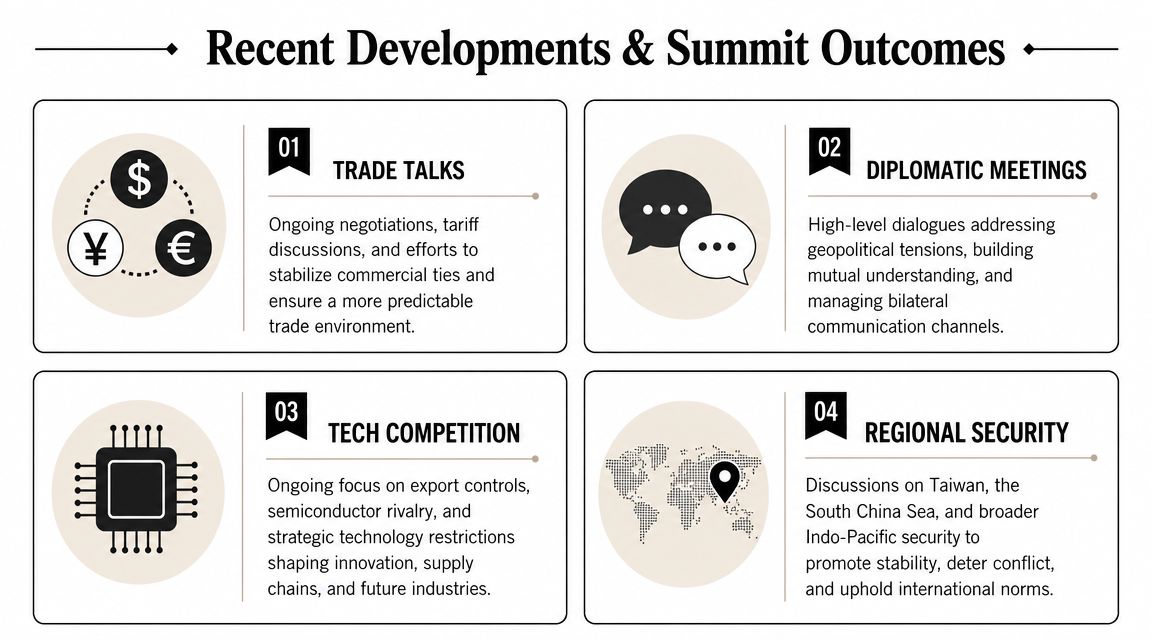
Recent policy developments confirm that the relationship is hardening economically even when leaders continue to pursue high-level contact. The diplomatic and economic tracks now move in parallel, but they no longer move in the same direction.
The clearest evidence is in tariff and control policy. The Biden administration finalised tariff increases to 100% on Chinese EVs, 50% on solar cells, and 25% on EV batteries, critical minerals, steel, and aluminium, alongside tighter rules on AI chips and semiconductor tools (overview of recent US-China tariff and control measures). This isn't a marginal adjustment. It signals a deliberate tightening of economic competition around sectors tied to future industrial advantage.
What recent measures mean in practice
The headline numbers matter, but their strategic meaning matters more. These measures do at least three things at once.
- They narrow the policy space for a return to old-style engagement: Once controls are tied to national security, they become politically costly to relax.
- They reshape allied markets indirectly: Producers shut out of one market can redirect output elsewhere, increasing pressure in Europe and the UK.
- They expand compliance as a strategic burden: Firms exposed to Chinese content in clean-tech and electronics supply chains face more due diligence, more scrutiny, and more uncertainty.
That last point deserves more attention from allied governments. The burden doesn't fall only on customs authorities or trade lawyers. It reaches procurement decisions, subsidy design, and the viability of domestic industrial strategies. A government may want to support green manufacturing at home while also restricting strategic dependencies. Those objectives can collide quickly when supply chains remain globally entangled.
Why summitry still matters
Even in a more coercive policy environment, summitry and high-level dialogue retain value. Not because they can restore the assumptions of the past. They can't. Their value lies in reducing ambiguity, preserving contact during crises, and identifying narrow areas where escalation can be slowed.
That's an unglamorous function, but it's indispensable. Diplomatic meetings matter most when they create mechanisms rather than atmospherics. The relevant question after any summit isn't whether leaders exchanged constructive language. It's whether officials left with clearer crisis channels, more predictable procedures, or bounded understandings on specific disputes.
Recent summit outcomes should be judged less by rhetorical thaw and more by whether they lower the probability of policy surprise.
For G20 actors, the lesson is practical. Don't confuse continued dialogue with strategic stabilisation. But don't dismiss dialogue either. In an adversarial relationship with dense economic linkages, regular communication is a form of risk management.
US Policy Options and Allied Perspectives
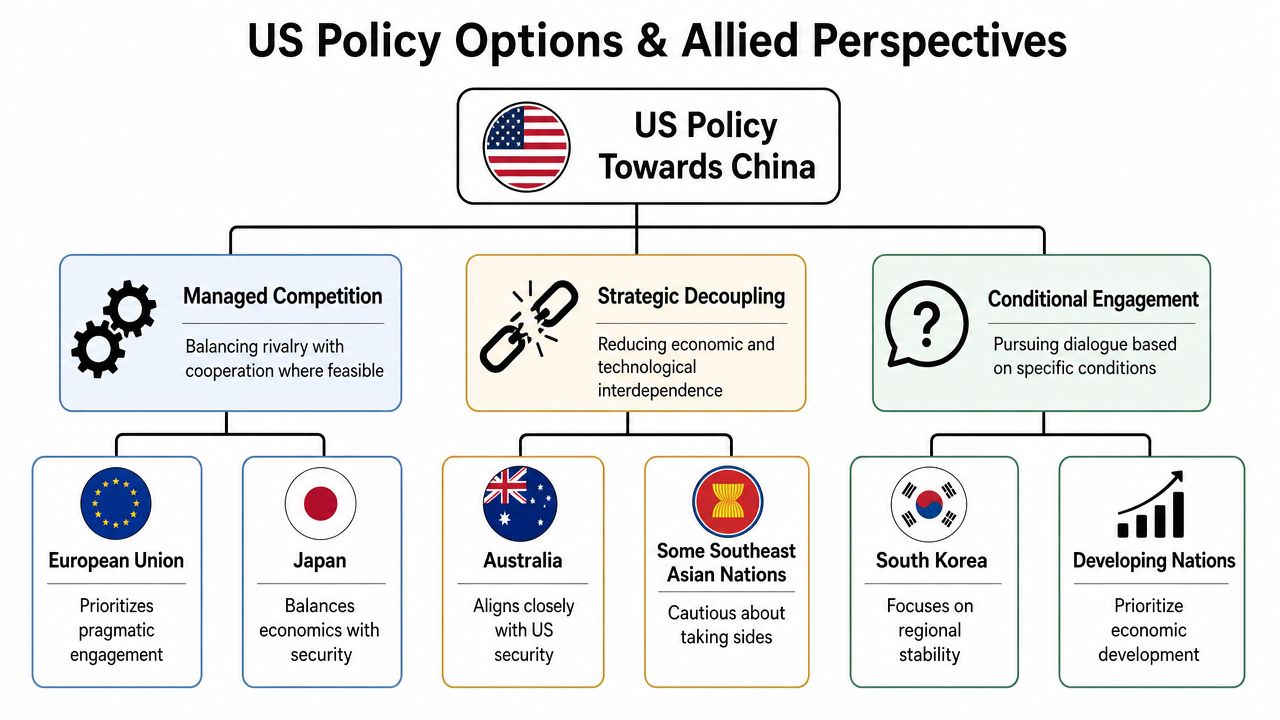
Washington now faces a strategic choice that is often presented too crudely. The debate is usually framed as a binary between engagement and decoupling. That framing obscures the harder truth. The fundamental policy challenge is to decide where competition must be sharpened, where exposure must be reduced, and where contact remains necessary despite mistrust.
PRIF has described a broader process of strategic decoupling, and the evidence gap on what that fragmentation costs allies remains substantial, especially when analysis stays focused on bilateral tension rather than UK or EU exposure through supply chains, investment screening, and technology restrictions (PRIF analysis of fraying US-China ties). That gap has become a policy problem in its own right.
Managed competition
Managed competition is the most plausible baseline because it accepts rivalry without assuming complete rupture. It combines deterrence, targeted controls, alliance coordination, and continued diplomatic contact. Its strength is realism. It recognises that strategic trust is weak, but that both sides still have reasons to avoid uncontrolled escalation.
Its weakness is implementation. Managed competition only works if governments define boundaries clearly. If every area of exchange is gradually recategorised as strategic, the model drifts towards undeclared decoupling.
For allies, this is often the least disruptive option. It allows room to align with Washington on high-sensitivity technologies while preserving economic relationships in lower-risk sectors. That approach is more sustainable than broad severance, but it requires detailed sector analysis rather than slogans.
Strategic decoupling
Strategic decoupling has intuitive appeal in sensitive sectors. Governments don't want critical systems dependent on geopolitical rivals. In semiconductors, advanced computing, and certain infrastructure layers, reducing dependency may be prudent.
The problem comes when a narrow concept becomes a general doctrine. Broad decoupling would impose costs that many allied governments still haven't mapped with enough precision. It could also generate fragmentation inside the very coalition Washington wants to strengthen if allies perceive the burden as uneven or the objectives as vague.
Officials who want a better map of that challenge should follow debates on the US-China split in the world trading system, where the key issue is no longer abstract disruption but how competing rulesets affect actual policy space for third countries.
Conditional engagement
Conditional engagement tries to preserve dialogue and cooperation in specific areas while accepting hard competition elsewhere. It is often criticised as indecisive. That criticism misses its main advantage. In a structurally adversarial relationship, selective engagement can protect useful channels without pretending that strategic rivalry is temporary.
The risk is drift. If conditions aren't explicit, engagement can become symbolic while the underlying relationship worsens. If conditions are too rigid, diplomacy loses practical utility.
A sensible allied position should therefore combine three habits of mind:
- Be strict on chokepoint technologies
- Be pragmatic on non-strategic trade
- Be disciplined about evidence on second-order allied costs
Allied strategy shouldn't be judged by how loudly governments align. It should be judged by whether they can absorb shocks without sacrificing policy autonomy.
That is where too many current debates remain thin. They describe alignment as a political stance rather than a resilience problem.
Key Risks and Future Scenarios for 2030
Forecasts about US relations with China often swing between false certainty and strategic fatalism. Both are unhelpful. The relationship is too consequential, and too entangled, to fit a single linear prediction. What matters is scenario discipline. Policymakers need to ask which pathways are plausible, what signals would indicate movement towards them, and which risks would hit allies first.

Scenario one managed rivalry with hard guardrails
In this scenario, competition remains intense but bounded. Export controls stay in place. Tariffs and industrial policies continue to distort trade. Security tensions remain high. Yet both sides maintain enough communication to prevent crisis from becoming rupture.
This is probably the most stable of the plausible paths, but it is not comfortable. It would still leave allies navigating compliance costs, industrial pressure, and recurring diplomatic shocks. Stability here means contained risk, not restored trust.
Scenario two fragmented blocs with selective overlap
A second scenario produces a world of partially separated technology and industrial ecosystems. The United States and China each tighten control over critical technologies and strategic supply chains. Trade persists, but under more political conditions and with more screening.
For the UK and Europe, this would be the scenario in which policy incoherence becomes most costly. Governments would need to choose where to build domestic capacity, where to coordinate with allies, and where limited cross-bloc commerce remains acceptable. The strategic debate would move from whether fragmentation is occurring to how much fragmentation can be managed.
Officials concerned with the security dimension of this future should track East Asian security dynamics, because military stress in the region would accelerate economic separation elsewhere.
Scenario three crisis driven rupture
The most dangerous scenario is not a deliberate decision for total decoupling. It is a crisis that triggers a rapid political response. A security shock could lead governments to impose sweeping restrictions faster than firms and allied administrations can adapt.
That would create a cascade of disruptions far beyond the immediate theatre of confrontation. Access to components, shipping reliability, insurance, procurement cycles, and market confidence could all deteriorate at once. Middle powers would then discover, under pressure, which dependencies had been tolerated for too long.
This discussion captures the larger strategic dilemma.
The central mistake is to assume that tomorrow's order will be either open or closed. It is more likely to be selectively open, heavily policed, and periodically unstable.
That is why scenario planning matters. It doesn't predict the future. It prepares governments to recognise it early.
Conclusion Actionable Recommendations for a Stable Future
The central lesson from US relations with China is that policymakers can no longer rely on old categories. Economic integration hasn't prevented strategic rivalry. Yet rivalry hasn't dissolved interdependence either. That leaves governments in a harder world, one in which resilience, signalling, and coordination matter more than broad theories of engagement.
The speed of the old integration should remain a warning. After normalisation, bilateral trade expanded from about $5 billion in 1980 to $231 billion in 2004, roughly 4,520%, according to the Council on Foreign Relations. That record shows how quickly commercial exposure can become systemic. It also explains why unwinding or securitising that exposure now creates such broad consequences for allies and institutions.
Three recommendations follow.
Build allied policy around sectors not slogans
Governments should stop treating China policy as a single line of alignment. They need a sector-by-sector framework that distinguishes critical technologies from ordinary commercial exposure. Semiconductors, AI-related tools, regulated digital infrastructure, and certain research pathways demand stricter treatment than lower-risk sectors.
Institutionalise crisis management
Diplomatic channels must be regular, technical, and insulated from political theatrics where possible. Military-to-military communication, trade consultation mechanisms, and regulatory contact should be treated as safeguards, not concessions. In a more adversarial era, communication is part of deterrence.
Close the allied evidence gap
The UK, EU, and other middle powers need better analysis of how US-China fragmentation affects investment screening, sourcing risk, subsidy policy, higher education links, and regulated services. Without that, governments will continue to debate grand strategy while underestimating where actual vulnerability sits.
A stable future won't come from pretending that strategic competition can be reversed. It will come from managing it with discipline. Washington should define narrower, more credible priorities. Beijing should recognise that coercive responses deepen balancing behaviour abroad. Allies should focus less on rhetorical positioning and more on practical resilience.
If G20 governments can do those three things, they won't solve the rivalry. But they can reduce the odds that it spills into a wider systemic fracture that none of them can control.
For more rigorous analysis, summit-focused briefings, and practical multilateral policy insight, explore Global Governance Media.