


France’s 2026 G7 presidency has put a priority on forging new partnerships on development between developed and developing countries. Since their 1975 start, G7 summits have made the most commitments on development, consistently placing poverty reduction at the centre of their agenda and agreements. Yet compliance with these commitments has varied, revealing gaps between ambition and implementation. The Évian Summit comes at a pivotal moment, as overlapping crises threaten progress towards the rapidly approaching deadline of the 2030 Agenda for Sustainable Development and its Sustainable Development Goals.
Deliberation
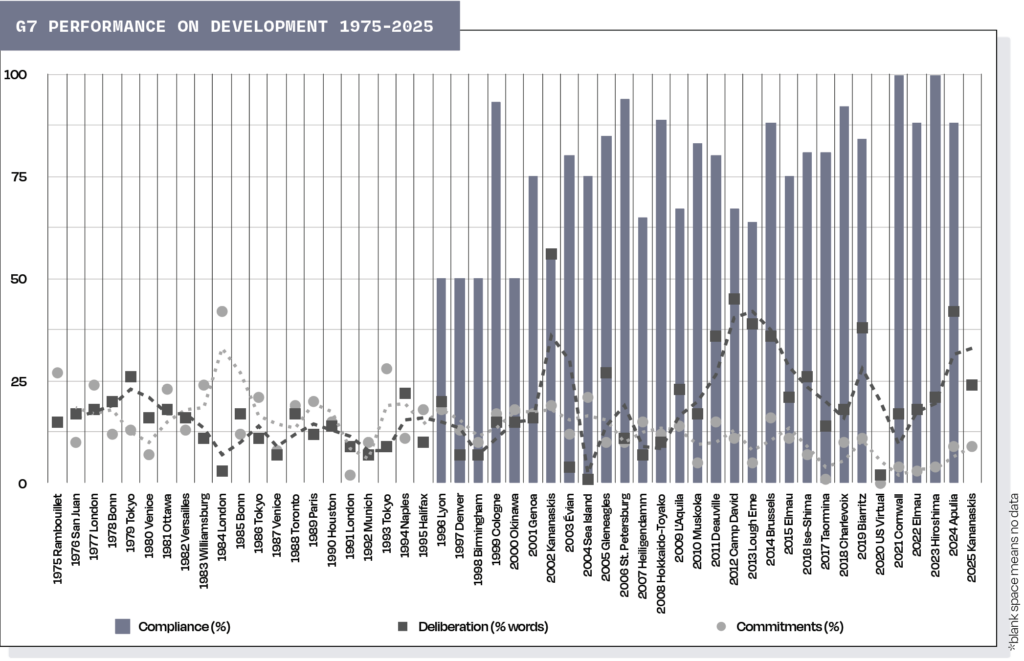
Since 1975, G7 leaders have devoted an average of 18% of the words in their communiqués to development. They began in 1975 with 15%. Lows came in 1984 with 3%, in 2003 with 4% and in 2004 with only 1%. The peak of 56% occurred in 2002. From 2011 to 2014, there were several highs, 36% in 2011, 45% in 2012, 39% in 2013 and 36% in 2014. After declines during the next few summits, 2019 saw a relative high of 38%. A steep decline came in 2020 amid the Covid-19 crisis, with only 2% of words on development. Yet this rose sharply to 17% in 2021, 18% in 2022, 21% in 2023, up to 42% in 2024, and back to 24% in 2025.
Commitments
Since 1975, G7 leaders have made 818 commitments on development, the most on any subject, with an average of 16 per summit. They made four at Rambouillet in 1975 for 27% of the total and the highest number of any topic that year. In 1976 they made only one, for 10%. The most development commitments came in 2004 with 53, for 21%. They made none in Covid-afflicted 2020, 14 (3%) in 2022, 29 (4%) in 2023, 44 (9%) in 2024 and 13 (9%) in 2025. At French-hosted summits, the number of development commitments has generally fallen. The 1982 Versailles Summit produced three (13%), Paris 1989 12 (20%), Lyon 1996 23 (18%), Évian 2003 24 (12%), 2011 Deauville 29 (15%) and Biarritz 2019 8 (11%).
However, in terms of proportion rather than quantity, the 1984 summit peaked at 42%, and the 2017 summit had only 1% and there was none in 2020.
Compliance
G7 members complied with their leaders’ development commitments at an average of 77%, based on 62 priority commitments made between 1996 and 2024 assessed by the G7 Research Group. This is just below the G7’s all-subject average of 78%. G7 development compliance started slowly, with lows of 50% for 1996, 1997 and 1998, but gradually rose, with much variation each year. Compliance soared to 93% with the 1999 commitments but plummeted back to 50% for 2000. It rose to 75% for 2001, declined to 55% for 2002, and then rose to 80% for 2003. After a decline to 75% for 2004, it rose again to 85% for 2005 and to 94% for 2006. Compliance then fluctuated between commitments made in 2007 with 65%, and for 2015 with 75%. Then came continued highs: 81% for 2016 and 2017, 92% for 2018, 84% for 2019, 100% for 2021, 88% for 2022, 100% for 2023 and 88% for 2024.
High compliance on development consistently came from low-cost actions directly within leaders’ control. Commitments explicitly referencing sustainable development, including the SDGs, achieved an average of 93%. Commitments mentioning development more broadly averaged 90%; so did those containing a one-year implementation deadline.
Commitments related to financing or funding, excluding those solely on aid, followed closely at 88%. Development commitments that referred to finance ministers had 87% compliance. Compliance was higher when G7 development ministers met before the summit: across 11 such years, the nine ministerial meetings produced an average of 81% compliance, whereas the two post-summit meetings achieved only 65%. But commitments focused on Africa, debt relief, and aid or assistance had significantly lower compliance of 77%, 75% and 74%, respectively.
Recommendations
To increase compliance with their development commitments, G7 leaders at Évian should thus prioritise financing and funding commitments for sustainable development and implementing the Heavily Indebted Poor Countries Initiative and wider debt relief measures.
In doing so, they would reaffirm the G7’s founding pledges of 1975, when leaders committed, through the International Monetary Fund and other international forums, to stabilising the export earnings of developing countries, assisting them in financing their deficits and ensuring that the poorest countries receive priority. Reconnecting today’s agenda with these original commitments also underscores the need for short, one-year implementation timetables and explicitly linking development promises with the financial mechanisms required to deliver them, while renewing investment in foreign aid to generate the resources necessary to achieve the SDGs.