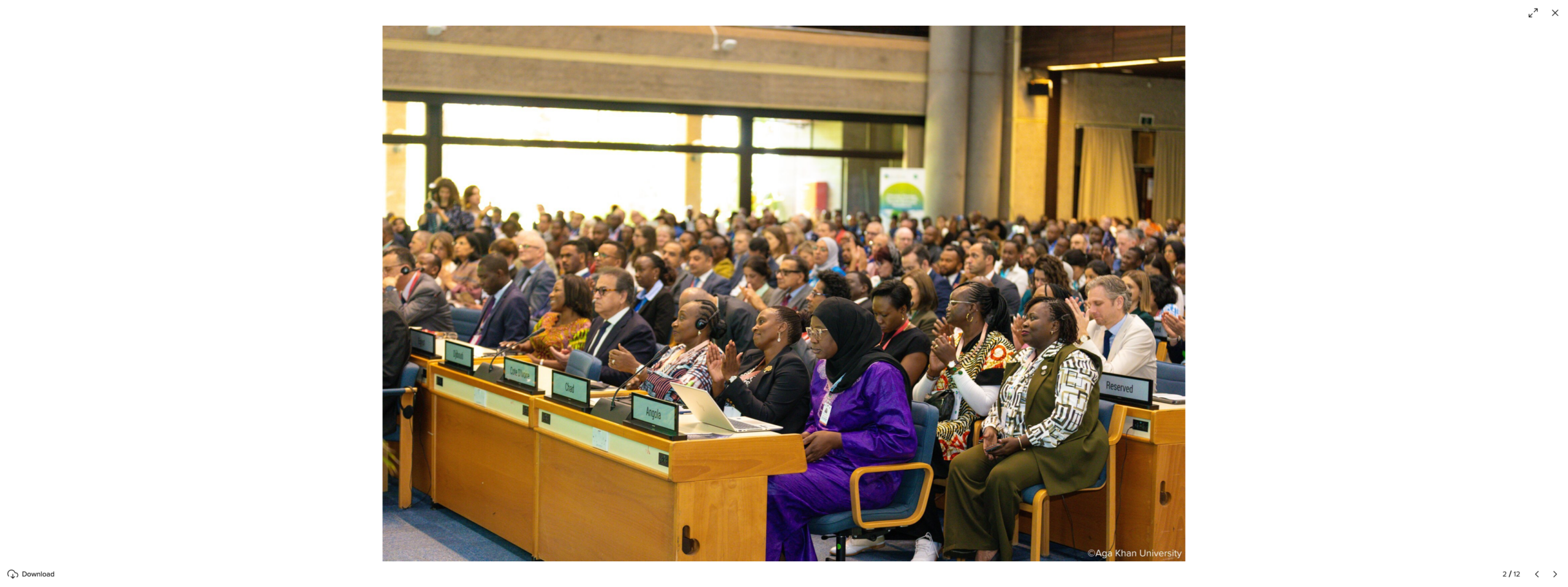



At the 2025 Kananaskis Summit, G7 leaders took significant steps in multilateral digital technology governance. The summit produced concrete, actionable initiatives and frameworks for information and communications technology, digitalisation, artificial intelligence and quantum – including new working groups and clear mandates for international collaboration and standard setting. These actions aimed to ensure growth, resilience and competitiveness in members, with attention to global inclusion and security. Quantum was raised as a significant strategic priority for the first time, resulting in the Kananaskis Common Vision for the Future of Quantum Technologies. It highlighted quantum’s potential for economic and national security benefits and risk management, especially in areas such as health, finance and energy. The 2026 Évian Summit under French leadership is expected to focus on improving AI safety and on establishing strong international governance for AI and quantum innovation, securing supply chains and critical infrastructure for both energy and the digital transition, as well as addressing common principles for online safety for minors and the digital divide. This marks a clear evolution to more operational, inclusive and security-conscious digital technology policy within the G7.
Deliberation
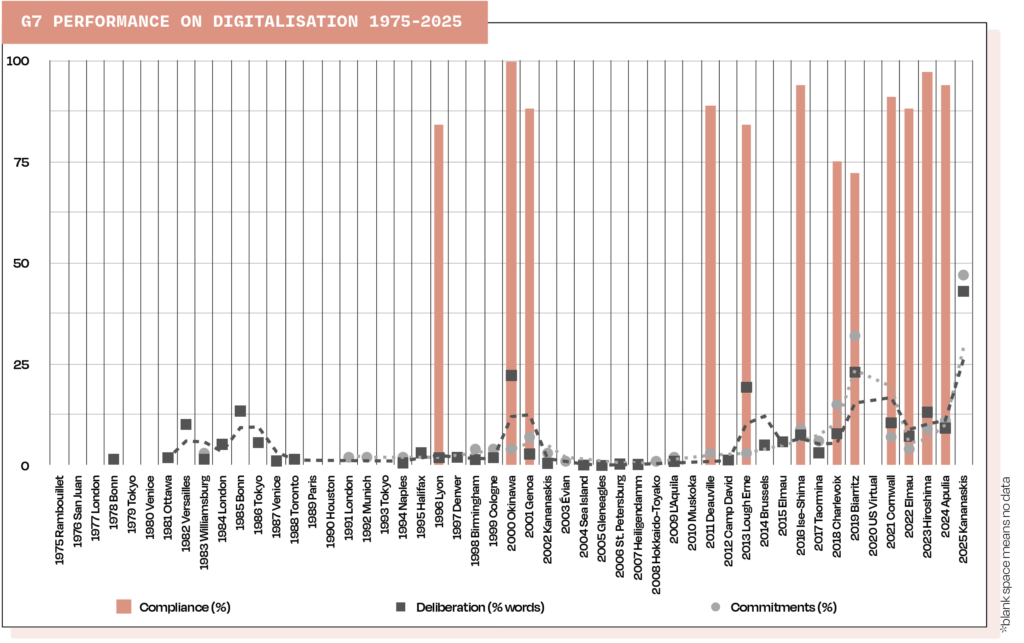
ICT, digitalisation, AI and quantum have assumed growing significance on the G7 agenda since 2009. Leaders have produced 25,886 words on these topics in their communiqués, averaging 517 words (for 13% of the total) per summit. The issue was mentioned briefly in 2000 as ‘‘bridging the digital divide’’, and at every summit from 2009 onwards except in 2010, 2012 and 2020. Leaders’ focus on these issues has grown since: between 2014 and 2025, the G7 averaged 1,867 words per summit on them. The 2025 summit had the most with 2,157 words (43%). The 2023 summit produced 3,927 words (13%), with the highest number of words – which would have been even higher had the Hiroshima AI Process been launched at the summit in May rather than in October.
Commitments
G7 summits have now produced 332 future-oriented, politically binding, collective commitments on ICT, digitalisation, AI and quantum. Together they rank 14th, slightly behind macroeconomic policy with 339 commitments. Most of these commitments – 271 – were made since 2016, averaging 27 per summit during these years. The first time AI commitments appeared was in 2018, with 23. Then the 2023 summit produced 37 commitments, the most on these subjects to that time. In 2025, G7 leaders produced a new peak of a record 70 commitments on AI, quantum, digitalisation and ICT, and pioneered the global summit governance of quantum technology.
The 2024 and 2025 summits made the most commitments on AI over and above any other
technology-related commitments. Here AI took over 85% of the 33 technology-related commitments in 2024 and just over 67% of the 70 in 2025.
Compliance
G7 members’ compliance with their leaders’ commitments on these subjects averaged 74%, based on the 22 priority commitments assessed by the G7 Research Group. This is just below the G7’s overall average of 78%. Compliance peaked at 100% for 2000, followed by 97% for 2023. The lowest was 72% for 2019 and 75% for 2018. Compliance for 2024 was 94%. By December 2025, the six related commitments made in 2025 averaged 83%.
Compliance with the 22 assessed commitments is led by the United Kingdom at 90%, closely followed by the European Union at 88% and Canada at 86%. Then come the United States, France and Germany, tied at 76%. Japan has 71%. Italy has 51%.
Recommendations
The G7 Évian Summit offers an opportunity to increase leaders’ commitments and compliance by agreeing on and implementing a globally interoperable framework for safe technological development. Rapid adoption of AI together with growing concerns on cyber risks, AI safety and AI-driven misinformation create a need for continuing leadership on AI governance globally. Security risks that are rising to the fore with advances in quantum suggest that the G7 leaders should also prioritise leadership in advancing cybersecurity protection and standards and supporting the transition in the financial sector – and other sectors – to quantum-resistant cryptography.
To bridge the gap between policy commitments and practical enforcement, at Évian leaders could seek to mandate interoperable reporting frameworks to govern high-risk AI, and institute mutual security recognition to streamline global cloud and cryptographic standards. And to spur compliance, they should make more commitments on AI, on using AI and quantum to counter foreign interference, on strengthening G7 institutions and on holding ministerial meetings working on these issues. Together, these actions could help reduce regulatory splintering, enforce transparency and ensure equitable access to the computational resources necessary for the AI-quantum century.