


By Daniel Mercer
Britain may sit above one of the largest estimated shale gas resources in Europe and still offer one of the clearest warnings against assuming that resource size equals deliverable supply. The Bowland Shale holds an estimated 1,329 trillion cubic feet of gas, more than 400 times the UK’s annual demand, yet in the decade before the moratorium only 3 wells underwent high-volume hydraulic fracturing, and none produced commercial gas because of induced seismicity, according to the National Audit Office review of fracking for shale gas in England.
That’s the policy paradox at the heart of fracking in the UK. On paper, the country appears resource-rich. In practice, the industry is dormant. Geology, public consent, legal ambiguity and operating constraints collided hard enough to stop development before it reached commercial proof.
For G7 and G20 energy ministers, the British case matters beyond Britain. It shows how quickly energy security arguments can outrun delivery realities. It also shows that weak alignment between geology, regulation and social licence can turn a strategic resource into a political liability. That lesson is highly relevant to countries trying to balance supply resilience, inflation pressure and net-zero commitments within the wider global energy transition debate.

The central lesson isn’t that shale gas can never work outside North America. It’s narrower and more useful than that. Governments shouldn’t promise strategic gains from unconventional gas unless they’ve tested four conditions first: recoverability, regulatory clarity, local consent and system compatibility with climate policy. The UK struggled on all four.
Table of Contents
- Introduction The UK Fracking Paradox
- A Turbulent History from Prospect to Moratorium
- The Science and Technology of Shale Gas Extraction
- The UKs Complex Regulatory and Legal Framework
- Economic Realities Versus Political Promises
- Stakeholder Impasse Industry Activists and Communities
- Policy Pathways for G7 and G20 Nations
- Frequently Asked Questions on UK Fracking
Introduction The UK Fracking Paradox
The British debate over shale gas has often been framed as a choice between energy security and environmental caution. That framing is too simple. The more important issue is that the UK had an apparently vast resource base but never established the practical conditions for extraction at scale.
This is why fracking in the UK deserves attention from ministers beyond Westminster. The case is not just about whether governments should support or oppose shale gas. It’s about how states make energy decisions under uncertainty. A large estimated resource can shape headlines, party platforms and investor narratives long before policymakers know whether that resource is technically recoverable, commercially viable or politically governable.
A strategic lesson hiding in plain sight
The British experience reveals three layers of risk that often get treated separately but should be assessed together.
- Subsurface risk: geology may look promising at basin level but fail at commercial well level.
- Operational risk: technically permitted activity may still trigger disruptions that end a project’s credibility.
- Governance risk: once law, regulation and public communication drift apart, even limited field activity can escalate into a national political dispute.
Practical rule: Treat shale gas estimates as the start of policy analysis, not the conclusion.
The UK case became a paradox because its energy debate focused heavily on quantity in the ground, while the decisive barriers emerged above ground. That distinction matters for G7 and G20 countries weighing domestic gas development against import dependence, electricity reliability and industrial competitiveness.
Why this case still matters
The moratorium froze operations, but the strategic questions didn’t disappear. They shifted. Britain now offers a live case study in how governments should evaluate unconventional fossil resources during the transition to lower-emissions systems.
Three implications stand out:
- Resource abundance doesn't guarantee resilience. Supply security depends on deliverability, not geology alone.
- Regulatory architecture must be coherent before testing scales up. Ambiguity compounds conflict.
- Public consent is not a communications problem. It’s a core condition of infrastructure policy.
That’s why the UK belongs in G7 and G20 ministerial discussions. It shows how difficult it is to build a new domestic fossil fuel industry in a mature democracy once local risk, climate politics and legal uncertainty begin reinforcing each other.
A Turbulent History from Prospect to Moratorium
The UK’s shale gas debate unraveled before a domestic industry had the chance to prove it could operate at scale. That is the central historical fact. Britain did not move from exploration to production and then to political backlash. It moved from prospectivity to dispute, with only limited field evidence in between.
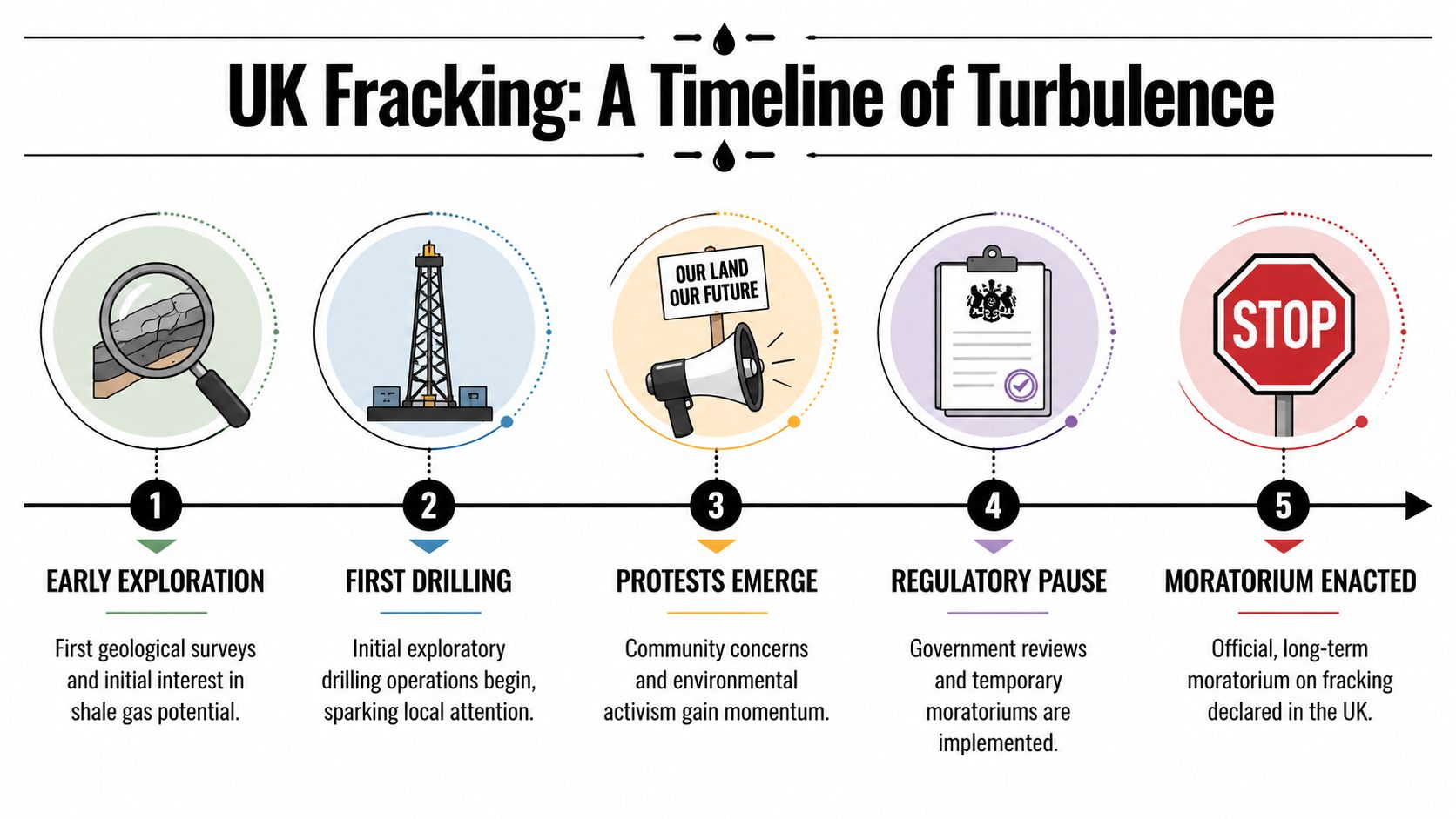
Hydraulic fracturing itself was not new to Britain. It had been used for decades in some conventional onshore oil and gas wells. The political rupture came when that established technique was recast as the basis for a new shale gas industry, backed by claims about energy security, lower import dependence and economic renewal. Expectations rose quickly. Operational proof did not.
From technical practice to strategic controversy
This distinction matters. Conventional fracking in the UK was a niche engineering method. Shale development was presented as a national energy option. Once ministers, regulators, operators and local communities were drawn into that wider argument, each exploratory well carried significance far beyond its commercial value.
The sector then ran into a problem that has shaped the UK case ever since. It never produced a long enough record of uneventful operations to build institutional confidence. Instead, the public saw a sequence of tests, pauses, reviews and contested assurances. In policy terms, that is a poor foundation for a new extractive industry.
A short chronology explains the speed of the shift:
- Conventional precedent: fracturing existed in the UK as a limited well-stimulation technique, largely outside public debate.
- Shale exploration phase: operators, especially Cuadrilla, became the public face of a proposed domestic shale gas sector.
- Seismic incidents: tremors associated with operations changed the issue from an energy policy debate into a question of local risk and state control.
- Moratorium: government halted fracking after concluding that seismic effects could not be predicted with sufficient confidence.
Why the seismic issue became politically decisive
The turning point was not just that tremors occurred. It was that they occurred during the industry’s formative phase, before trust had been earned and before commercial value had been demonstrated. At Preese Hall in 2011, Cuadrilla’s operations triggered earthquakes that reached magnitude 2.3 and deformed well casings, as noted earlier in the article. That moved seismicity from a technical issue into the center of national policy.
Government responded with a traffic light system designed to manage induced seismicity while keeping development possible. In theory, this was a balanced regulatory compromise. In practice, it exposed the contradiction at the heart of the UK approach. Ministers were signalling support for shale gas while also acknowledging that operations had created risks requiring highly visible stop rules and repeated intervention.
That framework did not restore confidence. It made uncertainty legible.
Each operational pause strengthened the view that the state had not settled the terms on which shale gas could proceed. Local opposition gained force, national politics hardened, and the industry remained stuck at the demonstration stage. By the time the government imposed a moratorium in 2019, the decision reflected more than geophysical caution. It reflected the failure to establish a credible social and regulatory basis for extraction.
The UK case became a policy paradox because the country had prospective resources, political interest and technical capability in principle, yet still failed to create the conditions for sustained development.
That is the deeper historical lesson. Resource endowment did not determine the outcome. Timing, public consent, and regulatory credibility did. Once the early history of a sector is defined by disruption rather than reliable delivery, reputational damage becomes structural. In Britain, shale gas never became an operating industry. It became a prolonged test of whether the state could align geology, governance and public legitimacy.
The Science and Technology of Shale Gas Extraction
Hydraulic fracturing is not an experimental mystery. It is a mature extraction technique. The UK paradox arose because a known technology met unusually restrictive operating conditions, difficult geology, and low public tolerance for error.
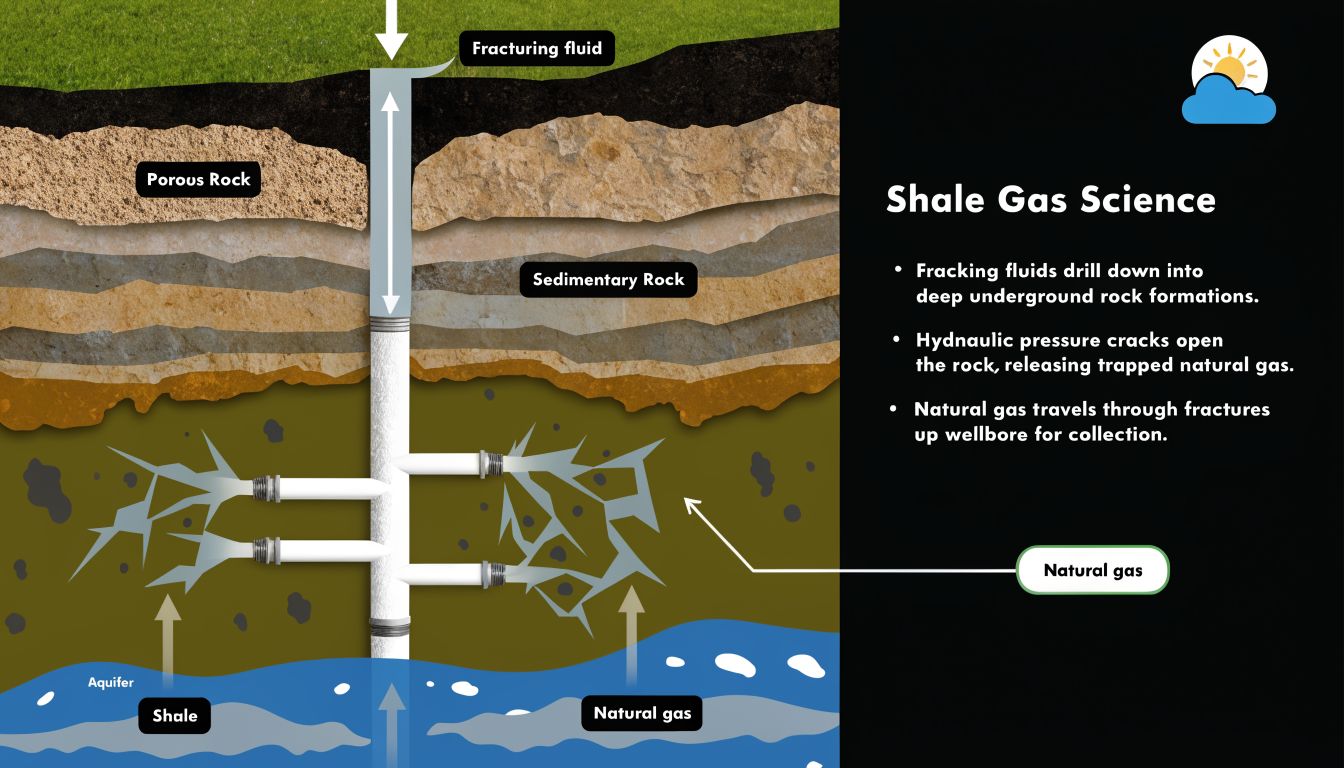
What happens underground
Shale holds gas in rock with very low permeability, so the technical objective is to create conductive pathways that allow hydrocarbons to flow to the well. Operators first drill vertically to the target depth, then extend the well horizontally through the shale layer. Steel casing and cement are installed to isolate the well from surrounding formations. The horizontal section is then perforated in stages, and fluid is pumped at high pressure to open fractures in the rock. Sand serves as the proppant that helps keep those fractures open after pumping stops.
In UK operations, the fracturing fluid was reported as mostly water and sand, with a small proportion of chemical additives. In the documented examples most often cited in the British debate, those additives were presented as non-hazardous.
The technical sequence is straightforward. Commercial production is not. A shale sector only works if this sequence can be repeated across many wells with predictable flow rates, acceptable decline curves, and limited interruption.
Why repeatability mattered more than technical feasibility
This distinction is often missed. A single successful well test can show that gas is present and that fractures can be created. It does not show that extraction can be scaled into an industry.
That matters in the UK because shale development depended on multi-stage horizontal wells operating with consistency, not on proof that fracturing was physically possible. If fracture performance varies across the formation, or if wells face repeated pauses, the economics weaken quickly. Capital costs arrive early. Revenue depends on continuous operations and repeatable output.
In other words, the central question was not whether engineers could fracture British shale. It was whether they could do so often enough, predictably enough, and within the operating limits imposed by UK conditions.
Monitoring became part of the engineering system
British shale extraction was defined by unusually visible control measures. Operators were required to monitor induced seismicity in real time, gather baseline environmental data, and work within strict operational limits. Those requirements were not peripheral. They shaped how the technology could be deployed in practice.
A short visual explainer is useful here:
Two technical implications follow from that design:
- Fracturing performance and regulatory tolerance were linked. If a fracture stage triggered a pause, operational planning, equipment use, and drilling schedules were disrupted.
- Resource potential and recoverable supply were not the same thing. Gas in place has limited policy value if extraction cannot proceed with sufficient continuity to support commercial development.
This is why the UK experience carries wider relevance for G7 and G20 energy ministers. Shale gas is often discussed as a resource question. Britain showed that it is equally a systems question. Geology, well engineering, seismic response, and social acceptance all determine whether a resource becomes supply. Countries can possess prospective shale basins and still fail to establish an extractive model that is technically repeatable, politically durable, and economically investable.
The UKs Complex Regulatory and Legal Framework
Britain did not lack regulators. It had a dense oversight structure. The problem was that regulatory presence didn’t automatically produce regulatory clarity.
A multi-agency model with one weak point
In the UK model, operators faced scrutiny from multiple institutions. The North Sea Transition Authority, the Environment Agency and the Health and Safety Executive all had roles in approving plans, assessing environmental controls and monitoring safety conditions. Operators also needed a Hydraulic Fracture Plan and had to work within the seismic traffic light regime and wider statutory constraints described in the earlier technical discussion.
On paper, that appears sound. For many policymakers, the analysis concludes here. It shouldn't. Multi-agency oversight only works when the underlying legal definitions are stable enough to support consistent enforcement.
Why definition matters in energy governance
One of the least appreciated weaknesses in fracking in the UK was definitional. UK legislation on “associated” and “relevant” hydraulic fracturing has been widely described as ambiguous, contradictory and difficult to enforce, as outlined in the analysis summarised on the UK fracking legal debate. That ambiguity created loopholes and uncertainty around what activity fell inside the intended regulatory perimeter.
This isn't a drafting footnote. It goes to the core of state capacity. If legislators and regulators cannot define the activity with precision, several consequences follow:
- investors face uncertainty over compliance and permitting risk
- communities struggle to understand what the rules do and don't cover
- ministers lose credibility when policy pledges sound broader than the legal instruments behind them
Governance insight: A legally vague ban or consent regime can intensify conflict because each side believes the state is either overreaching or failing to act.
That problem is especially important for countries trying to keep energy transition policy credible while preserving supply options. Britain’s experience suggests that governments should align legal drafting with technical practice before political controversy peaks, not after. That principle is directly relevant to ministers thinking about keeping the energy transition on track while securing supply.
The deeper lesson is that shale governance isn't just about permits and inspections. It’s about whether the legal system can describe the industry in a way that survives challenge, reassures the public and gives operators a rulebook they can use.
Economic Realities Versus Political Promises
Britain’s fracking debate exposed a policy paradox. A country can sit above a very large gas resource and still fail to turn that endowment into commercially credible supply.
The economic case was always narrower than the politics suggested. Domestic shale gas could strengthen resilience only if operators could produce at scale, at competitive cost, and within a regulatory and social environment stable enough to support long-cycle investment. In the UK, each of those conditions was uncertain.
Resource size is not economic value
Much of the public argument blurred the difference between gas in place and gas that can be produced profitably. Carbon Brief’s summary of the evidence captures the gap clearly: the Bowland Shale has been estimated at about 1,300 Tcf in place, recoverable volumes have been put far lower, individual wells require substantial water inputs, and replacing half of UK gas imports would imply thousands of wells over a 15-year period (Carbon Brief’s summary of UK fracking evidence). For policymakers, the strategic point is straightforward. Large headline resource numbers do not resolve questions of deliverability.
That distinction mattered more in Britain than in many political statements. A shale project is not judged on subsurface potential alone. It is judged on drilling intensity, water access, waste handling, traffic movements, grid and pipeline links, insurance, financing costs, and the probability that operations will be delayed or suspended.
In the UK, those surface and policy variables were not secondary. They were central to commercial viability.
UK vs US Shale Gas A Comparative Overview
| Factor | United Kingdom | United States (Typical) | Policy Implication |
|---|---|---|---|
| Resource narrative | Large estimated resource base, but low expected recoverability in the UK context | Shale development became associated with sustained commercial output in several basins | Ministers should separate geological potential from likely market supply |
| Geology | More faulted and geologically complex | Often treated as more conducive to repeatable shale development | Complex geology raises drilling risk, cost and uncertainty |
| Water demand | High per well, with local supply constraints in some areas | Large water use also appears in US basins, but operating conditions differ | Water planning should be assessed as part of energy security policy |
| Surface footprint | Dense population and stronger local conflict risk | In many areas, more operational space and established supply chains | Planning friction can become a binding economic constraint |
| Regulatory continuity | Tight seismic thresholds and stop-start operating risk | Different state-level frameworks and operating conditions | Investors price policy interruption alongside geological risk |
The comparison with the United States is often mishandled. British advocates frequently cited the US shale boom as proof of concept, but the analogy was incomplete. The US combined favourable basins, a larger onshore service sector, more extensive mineral development experience, and a different pattern of land use and local tolerance for industrial activity. Transplanting the headline outcome without those enabling conditions overstated what UK shale could plausibly deliver.
The result was a recurring gap between political promise and economic reality. Claims about lower import dependence were not necessarily wrong in principle. They were incomplete because they assumed a development pathway that Britain’s geology, infrastructure constraints, planning system and consent deficit did not support.
Three strategic conclusions follow:
- Commerciality depends on the full operating system, not on resource estimates alone.
- A large drilling requirement can turn domestic supply into a politically costly form of energy security.
- If governments communicate gross resource figures as if they were likely output, they create credibility risks that are hard to reverse.
For G7 and G20 ministers, the UK case offers a useful warning. Resource abundance does not guarantee extraction success. Where geology is uncertain, public consent is weak and regulation lacks predictability, the economic case can unravel long before production reaches strategic scale.
Stakeholder Impasse Industry Activists and Communities
Britain’s fracking impasse was a governance failure as much as an energy dispute. The conflict hardened because the main stakeholders were judging the same policy through different tests: commercial viability, local disruption, climate compatibility and political legitimacy. That is the core of the UK fracking paradox. Resource potential did not translate into an operable project because consent, regulation and geology never aligned at the same time.
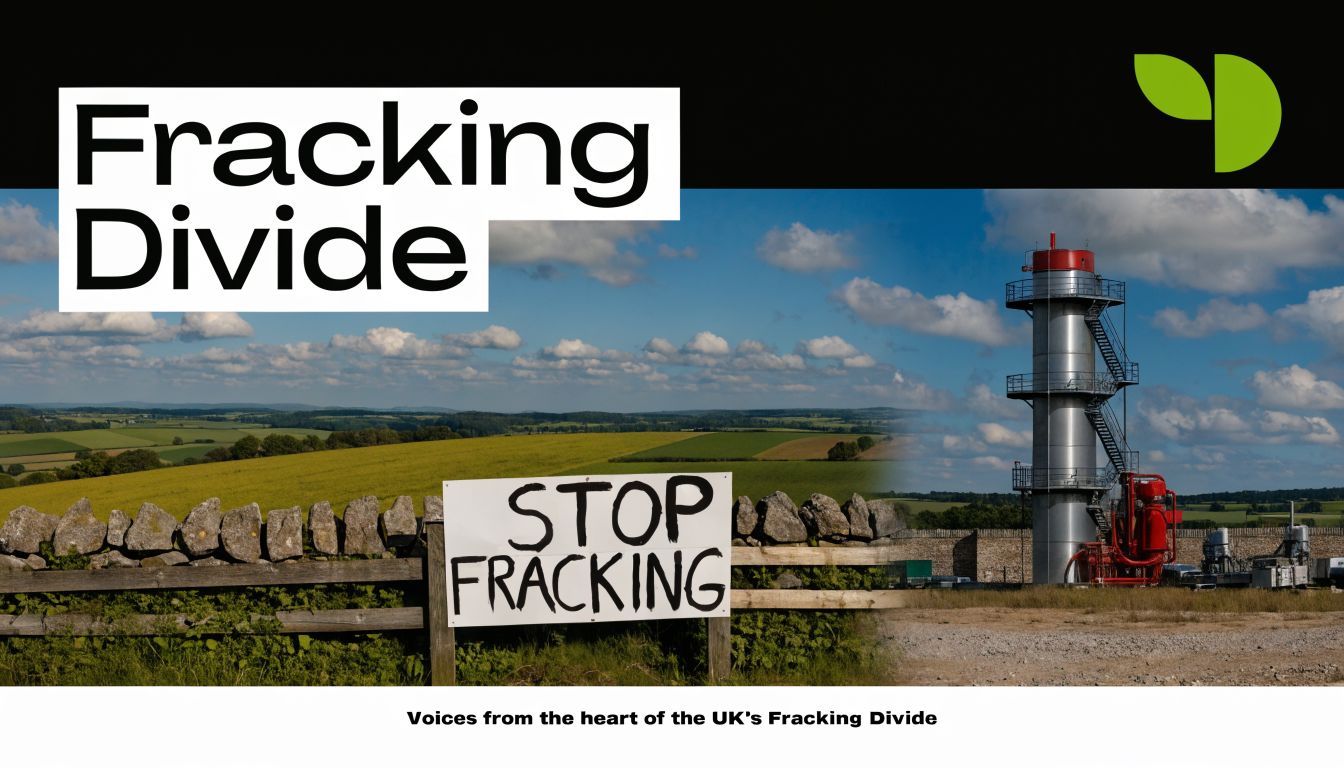
Four groups, four definitions of the problem
Industry largely treated shale gas as a question of energy security, investor confidence and future optionality. That logic did not disappear with the moratorium. As Global Witness analysis of current UK fracking debates noted, licence holders still included firms with an interest in preserving a route back to development, while public support remained weak.
Communities assessed the issue at site level. Residents near proposed developments focused on heavy vehicle movements, noise, land-use change, pressure on local oversight and the credibility of assurances after earlier seismic events. National arguments about supply security carried less weight because the perceived costs were concentrated locally while the claimed benefits were diffuse.
Environmental groups framed shale gas as a systems problem. Their case went beyond individual well pads or planning objections. They linked unconventional gas to methane risk, carbon lock-in and the risk that a new fossil fuel push would weaken the credibility of wider net-zero policy.
Government tried to preserve strategic flexibility while avoiding political damage. Ministers wanted the option of domestic production during periods of energy stress, but they also faced a straightforward constraint. Any renewed disruption at a test site could rapidly become a national political issue.
Why the stalemate endured
The dispute persisted because the parties were not contesting a single factual question. They were contesting which level of analysis should govern the decision.
Industry asked whether the UK should leave a domestic resource untested. Communities asked why a small number of places should absorb the disruption attached to a nationally framed policy. Campaigners asked whether a country with legal climate commitments could justify opening a new onshore gas frontier. Government asked whether any approval could survive the next tremor, protest cycle or court challenge.
Those positions were internally coherent. They were also difficult to reconcile.
Public opposition to energy infrastructure is often less about abstract hostility to supply and more about allocation. Who bears the burden. Who captures the benefit. Who decides whether the safeguards are credible. Once those questions dominate, technical arguments alone stop being decisive.
That is why the UK case matters beyond Britain. Social licence is not a communications issue to address after permits are issued. In contested resource sectors, it functions as an operating condition. If local consent is weak, regulatory authority is disputed and strategic messaging overstates likely gains, even sizeable resources can remain politically stranded.
Policy Pathways for G7 and G20 Nations
Britain’s shale gas experience should not be read as a universal ban on unconventional development. It should be read as a warning against policy sequencing errors. Governments got ahead of evidence, then tried to stabilise the system after conflict had already hardened.
A decision test before political commitments
Any G7 or G20 government considering shale gas should apply four tests before making strategic promises.
Geological realism
Require independent assessment of likely recoverability, not just resource size. Political messaging built on headline basin estimates creates false confidence.Legal precision
Define the regulated activity clearly. If legislation leaves loopholes or contradictory categories, every later decision becomes harder to defend.Operational governability
Stress-test whether the industry can function under the country’s actual seismic, water, land-use and planning constraints.Consent architecture
Build local participation and compensation frameworks that are transparent and credible before sites become symbols of imposed national policy.
What ministers should do differently
The strongest policy lesson from fracking in the UK is that energy security planning must be integrated. Ministers shouldn't treat subsurface appraisal, legal design, climate alignment and community consent as separate workstreams.
A more credible pathway would include:
- Independent pre-commitment reviews: governments should test geological and infrastructure assumptions before announcing strategic gains.
- Single-definition legislation: laws should describe the activity in a way regulators, courts, operators and communities all understand.
- Transparent climate fit: any shale proposal should show how it sits within national decarbonisation policy rather than pretending the issue can be deferred.
- Local burden accounting: transport, water use, monitoring and physical environment disruption should be openly assessed where activity would occur.
- Exit criteria: governments should decide in advance what evidence would trigger suspension or termination.
A shale strategy without a public legitimacy strategy is not an energy plan. It is a short-lived political campaign.
For many countries, the prudent conclusion may be that shale gas is not worth pursuing under current conditions. For others, the lesson may be procedural rather than prohibitive. In either case, the UK has already done part of the work by showing what happens when ambition outruns coherence. Ministers weighing security and decarbonisation should apply those lessons to broader G20 climate action choices.
Frequently Asked Questions on UK Fracking
Could fracking make the UK energy independent
The evidence suggests that this claim should be treated cautiously. Britain has a large estimated shale resource, but earlier sections showed that recoverability, geology, regulation and public opposition all constrain what could be produced. A large resource base is not the same thing as an assured domestic supply system.
Why didn’t the UK replicate the US shale model
The British context differed in several ways discussed above. The UK faced more complex geology, tighter constraints around seismicity, denser settlement patterns, stronger local conflict and a more contested political environment. The US comparison was influential rhetorically, but it was a poor guide to likely UK outcomes.
Is the main problem environmental opposition or technical failure
It was the interaction of both, alongside legal ambiguity and weak political trust. UK shale development did not fail for one reason. It stalled because technical disruption, governance complexity and social resistance reinforced each other.
Does the moratorium mean the issue is over
Not entirely. Corporate interest has not disappeared, and the legal and political debate can re-emerge whenever energy security becomes more salient. What has changed is the burden of proof. Any revival case would now need to overcome a much more sceptical public and policy environment.
What should ministers outside the UK learn from this case
They should learn that unconventional gas policy cannot be built on resource estimates alone. Successful decision-making requires alignment between geology, law, operations, public consent and climate strategy. If any one of those fails, the whole proposition can unravel.
For more evidence-led analysis on energy security, climate governance and G7/G20 policy choices, visit Global Governance Media.