

When G7 leaders gather in Évian in June, gender equality will occupy a markedly different place on the agenda than it once did. Previously framed as a mainstreamed component of G7 cooperation, embedded in economic, development and foreign policy priorities, it now risks being edged out by a convergence of geopolitical crises, economic pressures and a more fragmented political consensus among members.
Deliberation
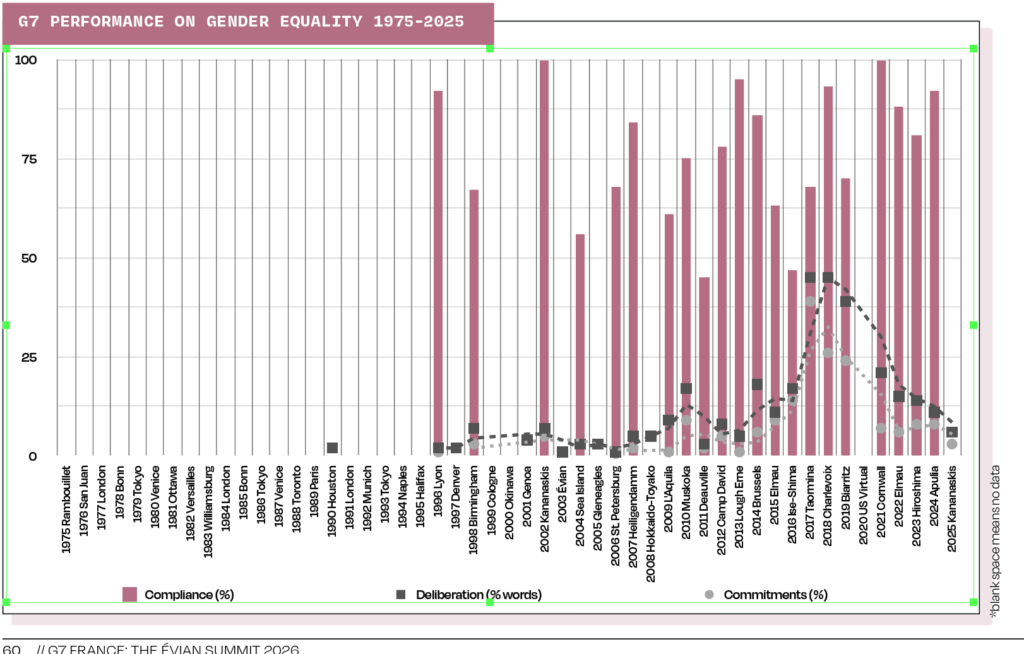
G7 leaders first addressed gender equality in 1990, but not consistently until 2001. Their attention steadily increased from 2014 until 2019. The issue was absent in 2020 but reappeared at all summits up to 2025. G7 communiqués averaged 878 words on gender equality at each summit, for 6% of the total words from 1975 to 2025.
The most attention came in 2017 and 2018. The 2017 communiqué contained 3,888 words (for 45% of the total) and increased to 5,086 words (45%) in 2018, the most extensively mainstreamed amount. The 2024 communiqué contained 2,178 words (11%) and the 2025 ones contained 310 (6%).
In 2016 the G7 began releasing standalone documents on gender equality, with two issued in 2018 and three in 2019. They included statements on education for women and girls in developing countries, gender-based violence in a digital context and the Biarritz Partnership on Gender Equality. This practice stopped in 2020.
Commitments
Since 1975, the G7 has made 470 public, collective, precise, future-oriented and politically binding commitments on gender equality, accounting for almost 6% of the total identified by the G7 Research Group. Most were made between 2015 and 2018. Before 2015, most were gender-related commitments with other issues at their core, including addressing HIV/AIDS, improving maternal and child health, and improving educational outcomes for girls in Africa. Gender quality itself became the focus in 2015, with 34 (9%) commitments, followed by 48 (14%) in 2016, and 71 in 2017 (39%). In 2018, the G7 made a record 82 (26%) commitments on gender equality. In 2019 this dropped significantly to 17 (24%) and then none in 2020. There were 30 (7%) in 2021, 32 (6%) in 2022, 53 (8%) in 2023, 38 (8%) in 2024 and 4 (3%) in 2025.
Compliance
G7 members averaged 74% compliance with these gender commitments, based on the 53 assessed for compliance by the G7 Research Group. This is slightly below the overall 78% average across all subjects.
The gender commitments with the highest compliance focused on health, including improving maternal, newborn and child health outcomes for women and promoting access to education for girls, and with commitments that invoked legal action or human rights. Commitments with the lowest compliance focused on supporting refugee and internally displaced women and girls affected by conflict and disaster, and on gender-based violence.
The highest compliance came with commitments made in 2002 and 2021 with 100% each, in 2013 with 95%, in 2018 with 93%, in 1996 and 2024 with 92% each, in 2022 with 88%, in 2014 with 86% and 2023 with 81%. The lowest compliance came with commitments made in 2011 with 45% and 2016 with 47%.
The highest complying G7 member is Canada with 87%, followed by the United Kingdom with 86% and the European Union with 80%. In the middle are Germany with 79%, the United States with 74% and France with 72%. The lowest compliers are Japan with 65% and Italy with 53%.
Recommendations
The highest complying summits, averaging 90%, had a high degree of internal G7 institutional support: they coincided with two G7 ministerial meetings on gender equality and the creation of one of the five gender-related official and multistakeholder bodies, councils, partnerships, forums and initiatives, including the Gender Equality Advisory Council. The lowest complying summits, averaging 61%, came on commitments made in years when only one such ministerial meeting took place.
The highest complying summits also dedicated a larger percentage of their communiqués – on average 14% – to gender equality, compared to the 12% average for the lowest complying summits.
Core gender commitments averaged 72% compliance. Gender-related commitments averaged 76%, with those with the highest compliance linking gender equality to health, specifically to maternal and newborn health, AIDS, and reproductive health. Commitments with the lowest compliance lacked specificity, but committed to or support gender equality and women’s empowerment broadly.
The presence of compliance catalysts, such as text on how to implement a commitment, generally improves compliance. Gender commitments with embedded catalysts average 76% compliance, while commitments with none average 73%. The catalysts that coincide with the highest compliance refer to an implementation target or a G7 body, invoke legal instruments or mobilise a certain dollar amount.