


The origins of the G7 are rooted in the collapse of the Bretton Woods system of fixed exchange rates in the early 1970s. The first summit in 1975 at Rambouillet sought to steady a world economy reeling from an oil shock and the abandonment of the gold standard.
Over time, G7 commitments on international institutional reform have evolved through distinct stages of its global governance.
In the 1970s and 1980s, the G7 acted as a crisis manager, focusing on stabilising the international monetary system and addressing the debt crisis. In the 1990s, it assumed the role of architect, reshaping and preparing multilateral financial institutions for 21st-century challenges. From 2000 to 2016, it functioned as a development catalyst, modernising lending frameworks and institutional charters to support transition economies, while also implementing the landmark 2010 reforms that enhanced the voice and representation of emerging markets. Conversely, since 2017 the G7 has entered a phase of institutional disengagement and policy stagnation regarding IFI reform.
Deliberation
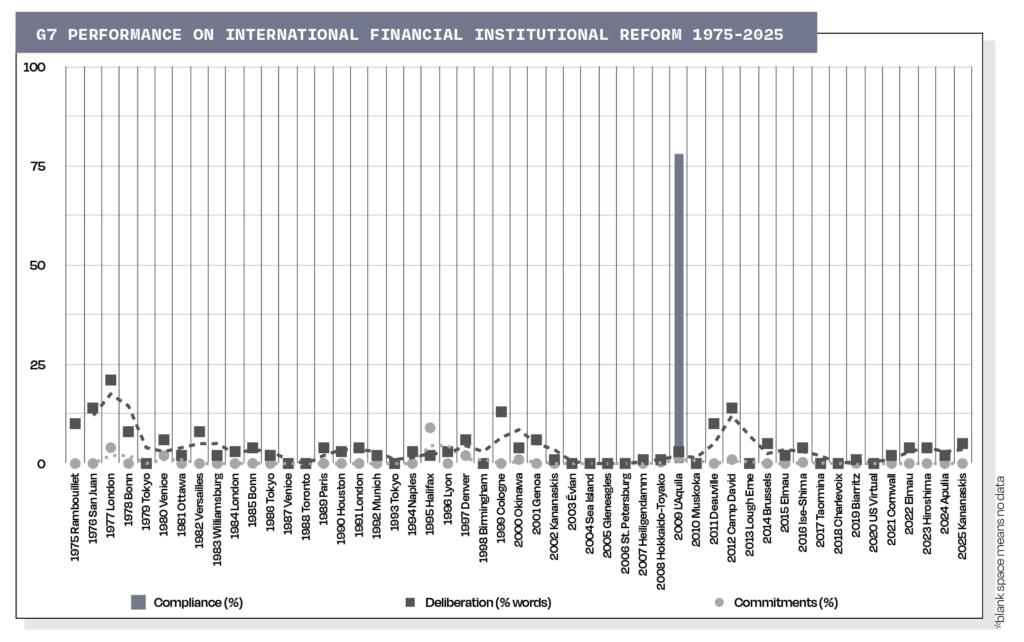
From 1975 to 2025, G7 leaders’ public conclusions on IFI reform contained 12,377 words in 135 paragraphs in 43 documents, averaging 243 words per summit. Coverage peaked in 2011 with 1,457 words (for 10% of the total), and in 1999 with 1,258 words (13%). Variations across summits include 2023 with 810 words (4%), 2016 with 572 words (4%), 1996 with 392 words (3%) and 1992 with 169 words (2%). Among the summits with the lowest levels were 1983 with 46 words (2%), 1981 with 54 words (2%), 2019 with 29 words (1%), and 2025 with 65 words (5%). There were 14 summits with no words, most recently in 2017, 2018
and 2020.
Commitments
Between 1975 and 2025, G7 summits produced 23 commitments on IFI reform, representing less than 1% of the 7,843 total commitments and ranking 30th by subject. There was more engagement in the first 25 years with its 14 commitments, but the subsequent 26 summits saw a steady drop to nine commitments. No commitments on IFI reform have been made in the past nine years, a pattern previously seen between 1994 and 1986.
The 1995 summit reached a peak with seven commitments, taking 9% of the total. The 2009 summit had four (2%), 1980 had one (2%) and 1997 had three (2%), followed by 1977 with two (4%) and 2012 with two (1%). Single commitments were made in 1985, 2000, 2008 and 2016 – accounting for 1% or less of the total for those summits.
The pattern in the number of commitments reflects systemic threats that create political will for changes. During the 2008–2012 global financial crisis, the G20 became the primary forum for IFI reform, with broader geopolitical legitimacy for negotiating shifts in IFI quota and voice.
Compliance
The G7 Research Group has assessed compliance with only one commitment on IFI reform. That commitment, made in 2009, averaged 78% compliance. Germany, Japan, the United Kingdom, the United States and the European Union had full compliance, and the remaining members – including Russia, which was then a member – had partial compliance.
Full compliance required action in three areas: expanding the International Monetary Fund’s New Arrangements to Borrow, implementing the IMF quota and voice reforms that had been agreed to in 2008, and implementing competitive processes for selecting the heads and senior officials of international financial institutions. Partial compliance reflected action in only two of those areas.
The assessment revealed a two-tier pattern. While there was universal success in the mobilization of capital, through the expansion of the New Arrangements to Borrow, systemic institutional reforms varied. The high-scoring members demonstrated full compliance by funding the IMF, adopting the Amendment on Voice and Participation, and formally endorsing a merit-based, transparent selection process for IFI leadership. The members that achieved partial compliance – specifically Canada, France and Italy – failed to take steps towards implementing competitive selection processes for IFI leadership. In contrast, Russia did not fully comply, as it was the only member that had not adopted the Amendment on Voice and Participation, reflecting concerns over quota reduction; however, it supported more competitive leadership selection within IFIs.
Recommendations
The G7’s trajectory on IFI reform reveals a paradox: it excels at resource mobilisation during systemic shocks, as seen in the universal success in funding the NAB, but struggles with structural institutional reform. The 78% compliance rate for the 2009 summit suggests that financial stabilisation is politically easier than redistributing institutional power. The key challenge for the G7 is reconciling its role as a global financial ‘firewall’ with the growing demand for a more inclusive and transparent governance architecture that reflects 21st-century economic realities.