

Trade has been on the G7’s agenda since the first summit in 1975. Under France’s 2026 presidency, the G7 continues to address trade, with a focus on non-market practices in order to improve economic resilience and address global imbalances. In February trade ministers met to discuss inclusive global growth through policies to combat industrial overcapacity and unfair practices, modernising the multilateral trading system to strengthen critical mineral supply chains, and improving small parcel flows and e-commerce. They met again on 5–6 May to continue those discussions.
Deliberation
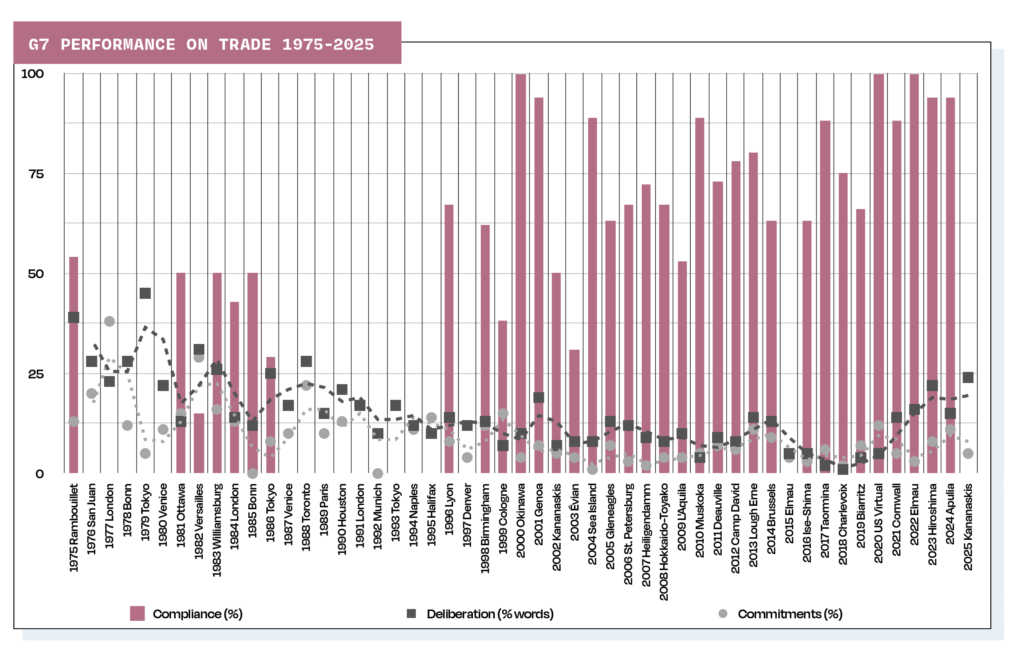
G7 leaders’ communiqués have dedicated 64,688 words to trade, averaging 1,268 words (14% of the total) at each summit since 1975.
From 1975 to 1999 trade averaged 20% per summit. It dipped to 8% per summit between 2000 and 2020, and rose to 18% between 2021 and 2025. This trend may reflect the realisation of gains from trade liberalisation and tariff reductions, and slowing trade growth followed by a shift from expanding trade to managing institutional stagnation.
G7 summits with the highest percentage of words on trade were 1979 with 45%, 1975 with 39%, 1982 with 31%, and 1976 and 1978 both with 28%. The 2025 Kananaskis Summit returned close to these levels, with 24%.
Commitments
Between 1975 and 2025, G7 leaders made an average of 10 commitments on trade per summit. The most were made in 2023 and 2024 with 51 commitments each (8% and 11% respectively), followed by 2013 with 24 (11%), and 2021 and 1977 both with 21 commitments (5% and 38%).
By proportion, 1977’s 21 commitments constituted 38% of the 51 commitments made there. Next came 1982 with 29%, followed by 1988 with 22%, 1976 with 20%, and 1991 and 1993 with 17% each. Most recently, Kananaskis in 2025 had 5%.
Compliance
Compliance by G7 members with the 55 trade commitments assessed from 1975 to 2024 by the G7 Research Group averaged 70%. This is below the G7’s overall 78% compliance on all subjects. Trade compliance averaged 100% for 2000, 2020 and 2022. The next highest compliance came from 2001, 2023 and 2024 with 94% each, then 89% from 2004 and 2010, and 88% from 2017 and 2021.
From 2004 to 2024 compliance averaged 78%, compared with only 52% from 1975 to 2003.
By December 2025, compliance with the one trade commitment assessed from the Kananaskis Summit – to establish standards-based markets for critical minerals supply chains – was only 25%.
Recommendations
From 2020 to 2024, compliance on trade averaged 96% and was accompanied by an increase in the percentage of trade
conclusions.
Since 1975, the six summits with the highest compliance came among the summits that averaged 22 commitments per summit, or more than double the average of 10 trade commitments per summit since 1975.
The G7’s trade agenda has expanded since 2020 to include trade’s link to supply chains, climate change, critical minerals and security. Trade commitments explicitly related to these issues have achieved higher compliance than the others in the trade sector. Commitments that refer to the World Trade Organization average 79% compliance.
To avoid merely repeating the same trade commitments and to promote leadership, the G7 and its trade ministers should put forward a roadmap on WTO reform for the next two years, with a concrete plan to restore the dispute settlement mechanism and create drafts on industrial subsidies and state-owned enterprises ahead of the next WTO ministerial meeting in 2028.
To produce outcomes through rule making, the G7 could coordinate backing for an e-commerce agreement and an environmental goods and services deal while pushing for a permanent moratorium on customs duties on electronic transmissions.
The G7 should upgrade existing supply chain resilience initiatives into operational systems for data sharing about disruptions and coordinating response protocols such as export restrictions or emergency sourcing. This could include a continued focus on critical minerals, semiconductors or food systems.
The G7 should establish a common framework on economic security and broker more comprehensive agreements in light of the lack of solidarity among the international community in their approach to export controls and principles for trade-restrictive tools, while supporting open trade.
The G7 should expand aid-for-trade initiatives such as digital customs standards and green exports. It should also prioritise partnerships with African economies and Indo-Pacific partners and support WTO accession pathways.