

By Eleanor Whitfield, Senior Policy Advisor for a G20 Delegation
In 2021, donors entrusted major global health organisations with over $14 billion, representing roughly 21% of all development assistance for health, according to the United Nations overview of global health financing and outcomes. That single figure changes how policymakers should frame global health initiatives. These aren’t peripheral aid instruments. They are core assets in security policy, fiscal diplomacy, supply chain resilience, and state reputation.
The harder question is no longer whether global health initiatives matter. It’s whether the current model still matches the post-pandemic world. Disease-specific funds remain effective at mobilising money and political attention, yet governments now expect more: stronger national systems, clearer accountability, and demonstrable value for money at home as well as abroad. That tension now sits at the centre of G7 and G20 debates.
Table of Contents
- The Architecture of Global Health Cooperation
- Mapping the Global Health Ecosystem
- Understanding Financing and Governance Models
- Evaluating Effectiveness and Accountability
- Recent Trends and G7 G20 Commitments
- Case Studies in Action
- Policy Recommendations for 2026 and Beyond
The Architecture of Global Health Cooperation
Global health initiatives are often treated as grant vehicles. That understates what they’ve become. In practice, they are governance mechanisms that sit between sovereign governments, multilateral agencies, philanthropic actors, and delivery partners. They distribute funds, set incentives, shape procurement choices, and influence which health priorities receive sustained political attention.

The institutional significance of these arrangements became especially clear after the pandemic. Governments now view health financing through a wider lens that includes economic continuity, migration pressures, emergency preparedness, and strategic competition. A minister attending a G20 sherpa meeting isn’t discussing health in isolation. They’re weighing fiscal constraints, public trust, geopolitical influence, and the credibility of multilateralism itself.
Why architecture matters
The term architecture matters because fragmentation has consequences. When financing flows through multiple channels with separate reporting, planning, and oversight demands, recipient governments can struggle to align external support with national priorities. Donor governments face a different problem. They may fund several initiatives at once but still lack a single, defensible view of system-wide impact.
That’s why institutional design has become a policy issue in its own right. The most effective debate isn’t about choosing between vertical disease programmes and broader system strengthening as if they were mutually exclusive. It’s about determining when targeted instruments are justified, what safeguards should accompany them, and how governance can force alignment with national health systems.
Practical rule: If an initiative can’t show how it strengthens country capability beyond a single disease objective, its strategic value is incomplete.
The post-pandemic agenda is also pushing health diplomacy closer to mainstream summit politics. Funding decisions now affect wider negotiations on debt, development finance, technology sharing, and crisis response. For policymakers trying to interpret this environment, a useful framing is to see global health initiatives as both operational tools and diplomatic signals.
For a wider institutional context, the debate on reshaping the global health architecture is increasingly centred on whether the system can remain politically legitimate while becoming more integrated.
Mapping the Global Health Ecosystem
Think of the ecosystem as an orchestra. Some actors set the score. Some finance the performance. Others deliver on the ground. Confusion starts when policymakers assume they all do the same job.
Who sets norms and convenes
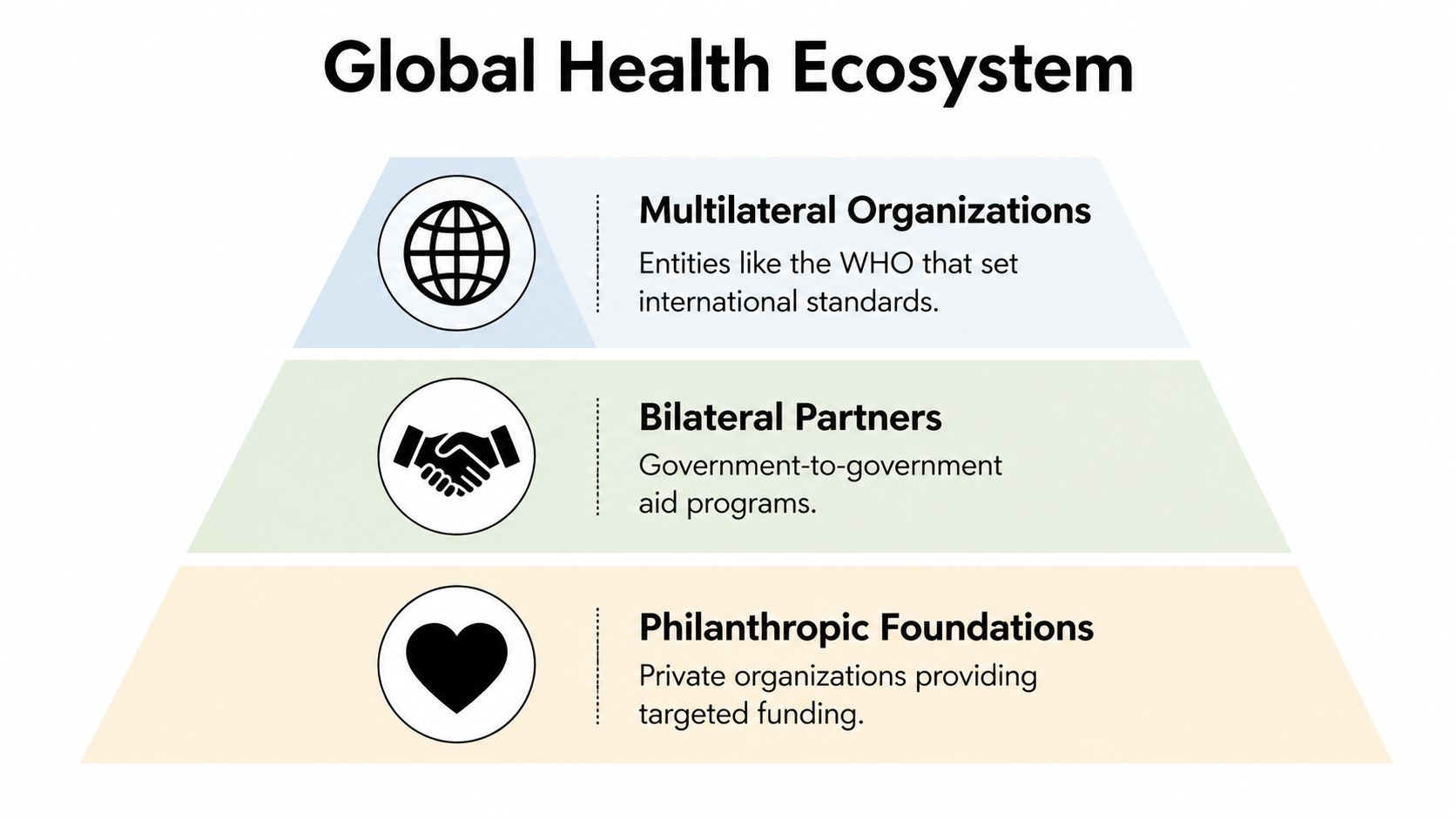
At the multilateral level, organisations such as WHO play a coordinating role. Their authority comes less from direct delivery and more from standard setting, legitimacy, and convening power. In diplomatic terms, they help establish the common language through which states negotiate surveillance, preparedness, and health priorities.
That role differs from a financing platform. Norm-setters don’t always control the largest budgets, but they influence what counts as acceptable policy and how crisis response is organised.
Who finances and shapes incentives
The major financing mechanisms operate differently. The Global Fund is the clearest example of pooled, mission-driven financing around priority diseases. Other alliances, including vaccine-focused partnerships, have often been designed to mobilise resources rapidly, reduce market uncertainty, and concentrate political attention where governments think delay would be costly.
This layer matters because funding architecture shapes behaviour. If a financing mechanism rewards disease-specific outputs, health ministries and implementing partners will organise around those outputs. If it rewards integration and national planning, the system behaves differently.
Who drives bilateral influence
Bilateral donors, including development ministries and aid agencies, remain central because they connect health spending to foreign policy. They can move quickly, tie funding to diplomatic goals, and press for reforms in governance or procurement. But bilateral strength can also increase fragmentation if separate reporting systems and political priorities pull countries in different directions.
A donor government usually wants three things from this layer:
- Visibility: Clear evidence that public money supported defined outcomes.
- Influence: A governance seat or bargaining power in multilateral forums.
- Flexibility: The ability to redirect support when crises or domestic politics shift.
Who implements
Non-governmental organisations, humanitarian agencies, local providers, and technical partners sit at the delivery end. They often supply speed, field access, and specialist expertise. Yet implementation isn’t neutral. Every delivery channel creates its own accountability chain, staffing model, and reporting burden.
The ecosystem works best when each actor’s role is explicit. It works worst when every institution claims to coordinate, fund, and deliver at the same time.
For policymakers, the key isn’t memorising institutional acronyms. It’s recognising where influence lies. Agenda-setting power, financing power, and implementation power rarely rest in the same place.
Understanding Financing and Governance Models
Different financing models produce different political incentives. That’s why governance design matters as much as budget size. A donor can increase funding and still weaken coherence if the model fragments decision-making or sidelines country ownership.
Three common models
The first model is pooled multilateral financing, where multiple donors channel resources through a common mechanism. The Global Fund is the foundational reference point. It was established in 2001 as a coordinated financing mechanism, and by 2021 donors had entrusted such organisations with over $14 billion, roughly 21% of all development assistance for health, according to the United Nations account of global health cooperation. The same UN summary notes that these investments contributed to a 40% reduction in maternal deaths and more than halving of under-5 child deaths between 2000 and 2023.
The second model is market-shaping partnership finance, typically used when governments want to influence access, supply, or affordability in a specific area such as vaccines. The attraction is strategic focus. The risk is that success in one product area can obscure whether broader delivery systems are improving.
The third model is bilateral aid, where one government funds another state or channels support through selected partners. Bilateral finance can align tightly with foreign policy and allow fast course correction. It can also create parallel systems if reporting, staffing, and procurement bypass national structures.
Comparison of Global Health Financing Models
| Model | Primary Mechanism | Governance Structure | Key Advantage | Common Critique |
|---|---|---|---|---|
| Pooled multilateral fund | Donor resources combined in one financing platform | Multi-stakeholder boards with donor and partner representation | Scale and coordination | Decision-making can be distant from country systems |
| Market-shaping alliance | Funding linked to access and procurement incentives | Partnership governance across public and private actors | Focused leverage on a defined problem | Narrow design can leave system gaps untouched |
| Bilateral aid | Direct government-to-government or donor-selected channels | Donor-led oversight with diplomatic control | Flexibility and political responsiveness | Higher risk of fragmentation across programmes |
What boards really decide
Governance isn’t procedural detail. Boards decide whose priorities count, which evidence is privileged, and how trade-offs are made. Representation therefore has strategic consequences. If recipient countries have limited influence, a formally multilateral system can still behave like a donor-driven one. If donors have limited oversight, domestic support can erode when fiscal pressure rises.
A good ministerial test is straightforward:
- Does the governance model reward integration with national systems?
- Can the donor explain accountability in plain fiscal terms?
- Will the model survive a change in domestic political mood?
That third point now matters more than many global health advocates admit. In donor capitals, financing must compete with visible domestic needs. The argument for sustained engagement therefore has to combine ethics, security, and institutional efficiency.
For related debate on fiscal design, the discussion on financing universal health coverage is useful because it highlights how funding structure shapes policy outcomes long before money reaches the clinic level.
Evaluating Effectiveness and Accountability
Success stories are real. So is the accountability problem. Both must be held together if donor governments want credible policy.
Where effectiveness is strongest
Disease-focused initiatives are often strongest when the objective is narrow, urgent, and technically definable. They can mobilise capital quickly, create visible campaigns, and build coalitions around a recognisable threat. That’s one reason they’ve remained politically durable.
But a system can post impressive disease-specific gains while still leaving ministries with duplicate reporting channels, external staffing dependencies, and weak primary care integration. The result is a paradox. The programme may work, while the system remains vulnerable.

The donor government dilemma
The UK case makes the tension harder to ignore. Critiques summarised in this review of global health initiatives and UK accountability concerns argue that parallel systems create domestic opportunity costs, with NHS waiting lists hitting 7.6 million as of early 2026. The same source notes that UK ODA cuts from 0.7% to 0.5% of GNI in 2021 exacerbated domestic health challenges, while only 60% of GHI funds yielded measurable UK-tracked outcomes.
Those figures don’t prove that international health commitments are misguided. They do prove that the political standard has changed. A donor government now has to defend external spending under conditions of domestic strain, labour tension, and public impatience with opaque metrics.
Accountability has two audiences. Partner countries want alignment and predictability. Taxpayers in donor countries want traceable value and institutional discipline.
That dual-accountability problem is why return-on-investment debates have sharpened. Traditional health metrics remain important, but they don’t answer every political question a treasury or parliament will ask. Ministers increasingly want to know whether a contribution reduced future crisis costs, strengthened trusted institutions, and avoided creating dependency on parallel structures.
Beyond output counting
A stronger accountability framework should include more than expenditure tracking and short-term outputs. It should test whether a programme leaves behind local capability, cleaner data governance, and simpler administrative demands on health ministries.
Three practical filters help.
- System effect: Did the initiative strengthen the national health system, or merely operate beside it?
- Governance effect: Did partner governments gain voice over priority-setting and implementation choices?
- Political durability: Could the donor defend the programme during a period of domestic austerity or service backlogs?
A sharper critique has also entered the debate. Some analysts describe parts of the model as a form of health colonialism, where donor visibility can outrank local equity and decision-making. Whether one accepts that label or not, the warning is strategically important. Legitimacy weakens when recipient governments and local communities conclude that programmes answer first to external branding, not national priorities.
Recent Trends and G7 G20 Commitments
The post-pandemic agenda is changing global health initiatives in two directions at once. Governments want tighter preparedness and surveillance capacity, but they also want stronger political justification for every external commitment. That combination is pushing G7 and G20 discussions towards resilience, reciprocity, and technology governance.

AI governance moves from niche to summit agenda
AI is no longer a side discussion in health diplomacy. It now sits inside wider debates about surveillance, diagnostics, equity, and data-sharing rules. The strategic appeal is obvious. If digital tools improve detection, triage, and forecasting, governments gain earlier warning and more efficient deployment of limited health capacity.
The governance challenge is just as obvious. Data-sharing across borders raises questions about trust, interoperability, and who benefits from the underlying infrastructure.
An emerging UK-linked example appears in the World Economic Forum discussion of health equity and AI-related implementation gaps. It notes that the November 2025 G7 AI Health Compact mandates data-sharing for equity, while UK implementation lags at 15% of underserved clinics. The same source points to a brain drain critique, citing 1,200 NHS doctors moving to Australia in 2024.
Reciprocal resilience is becoming the political language
The old language of donor generosity is giving way to the language of mutual protection. In practical terms, governments now justify international health spending by linking it to domestic resilience, migration management, and supply continuity. That shift will likely harden, not soften.
This has two implications. First, health ministries will need to work more closely with finance, interior, and foreign ministries. Second, summit commitments will increasingly be judged by whether they produce reciprocal rather than purely external benefits.
“Future legitimacy will depend on whether global health commitments are seen as shared risk management, not discretionary altruism.”
A related point for summit diplomacy is that technology rules are becoming part of burden-sharing. Countries that contribute funds may also demand standards on data access, workforce retention, and local capability transfer.
A useful reference point for that evolving agenda is the discussion of G20 and G7 convergence in a new global health order.
Summit politics now includes capability retention
The workforce issue is becoming impossible to separate from financing debates. If global health initiatives rely too heavily on volunteerism or short-cycle external expertise, they may weaken local capability rather than deepen it. The same concern applies to donor countries facing shortages at home.
A short briefing video helps frame the broader diplomatic context:
For G7 and G20 negotiators, the emerging test is whether future commitments can combine preparedness, digital governance, workforce sustainability, and national ownership in one package. That is a much higher bar than the pre-pandemic model had to meet.
Case Studies in Action
One way to understand the policy trade-off is to compare a focused success with a coordination failure.
A success in concentrated institutional design
Vaccine alliances are often cited positively because they show what happens when a financing mechanism has a clear purpose, disciplined governance, and a defined market objective. The policy lesson isn’t that narrow initiatives are always superior. It’s that a tightly designed mechanism can solve a specific access problem when roles are clear and incentives are aligned.
For donor governments, that matters. It shows that specialised global health initiatives can generate real value when the mission is concrete, the financing logic is understood, and procurement power is used strategically rather than diffusely.
A persistent coordination problem
By contrast, outbreak response has repeatedly exposed what fragmentation looks like in practice. When institutions operate with overlapping mandates, uneven authority, and separate reporting chains, delays multiply. Political leaders may assume the system is coordinated because many actors are present. Operationally, the opposite can be true.
That kind of failure is instructive because it isn’t just about capacity. It’s about governance friction. Who has authority to declare urgency, release funds, align partners, and support national systems without building yet another temporary structure?
The lesson from contrasting cases is simple. Focus works when coordination is built in from the start. Coordination fails when everyone assumes someone else owns the system.
For policymakers, the practical takeaway is that future initiatives should be judged not only by what they target, but by what they leave behind institutionally after the emergency or campaign ends.
Policy Recommendations for 2026 and Beyond
G7 and G20 governments should stop treating the choice between vertical initiatives and system strengthening as binary. The workable position is disciplined integration. Disease-focused financing will remain necessary in some contexts, but every new commitment should be required to show how it strengthens national capability, reduces administrative duplication, and transfers authority rather than just funding.
A credible reform package should include four moves.
- Tie new funding to integration plans: Every major contribution should be accompanied by a country-facing plan for alignment with national systems, including procurement, reporting, and workforce implications.
- Upgrade accountability metrics: Donor governments should assess not only outputs, but also governance quality, local capability gains, and whether programmes can be defended politically during domestic fiscal stress.
- Rebalance voice in governance: Recipient countries need stronger influence over priority-setting if multilateral legitimacy is to hold.
- Treat workforce and data as strategic assets: AI deployment, data-sharing, and volunteer programmes should be evaluated against equity, retention, and local training impact, not just speed of rollout.
The strategic conclusion is clear. Global health initiatives still matter, but the old political settlement around them is over. Future legitimacy will depend on proving that international spending strengthens both partner-country resilience and the credibility of donor governments at home. G20 leaders should push for a model that is fewer layers deep, more accountable, and harder to fragment.
Global health governance is being rewritten in real time. For sharper analysis on summit commitments, financing reform, and the future of multilateral cooperation, follow Global Governance Media.