

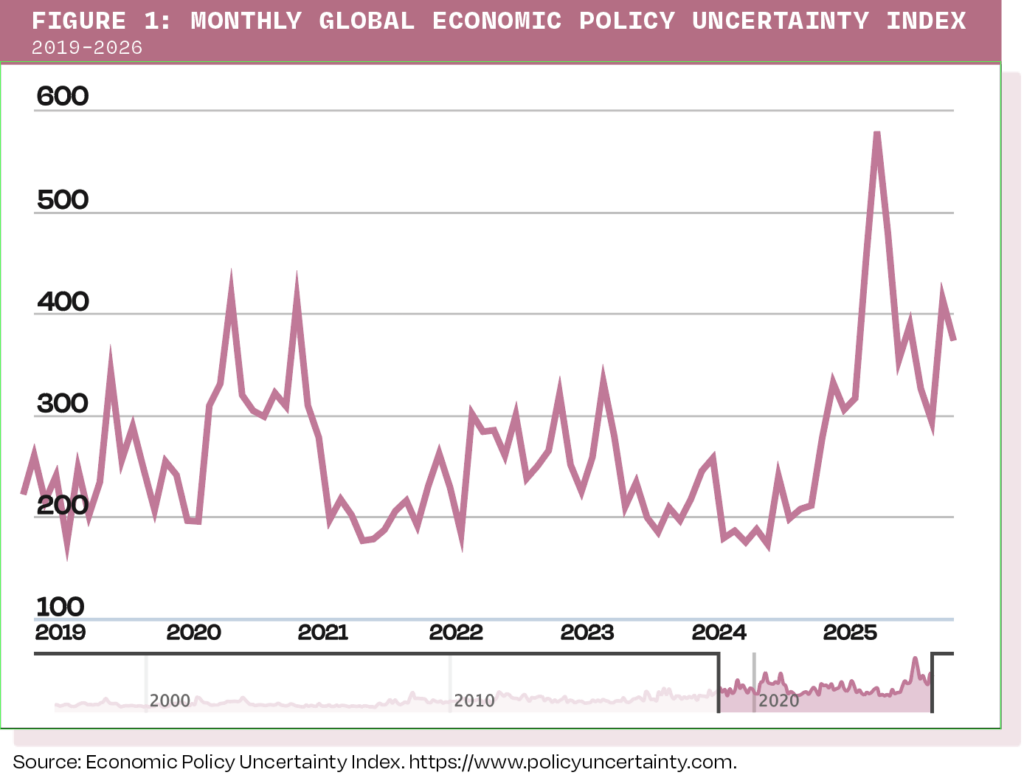
Global economic growth and financial stability are subject to divergent forces, and G7 members are experiencing a slowdown in 2026 due to geopolitical events and adverse shocks. Economic uncertainty refers to the risks associated with undefined and unpredictable future policies and regulatory frameworks, which can have adverse impacts on the investment and spending decisions of businesses and households. The Economic Policy Uncertainty Index developed by Scott Baker, Nicholas Bloom and Steven Davis shows growing uncertainty in recent years (see Figure 1). That uncertainty likely reflects the succession of major shocks (such as the 2020 pandemic crisis and Russia’s 2022 invasion of Ukraine) and structural challenges such as the development of artificial intelligence.
Volatility and policy uncertainty
In the first three months of 2026, the index portrays a remarkable level of instability due to geopolitical pressures and turmoil in fossil fuel supply. These shocks hit the global financial system with negative effects that can last for the next four quarters. Consumers and firms alike postpone their purchases and investments because of this instability.
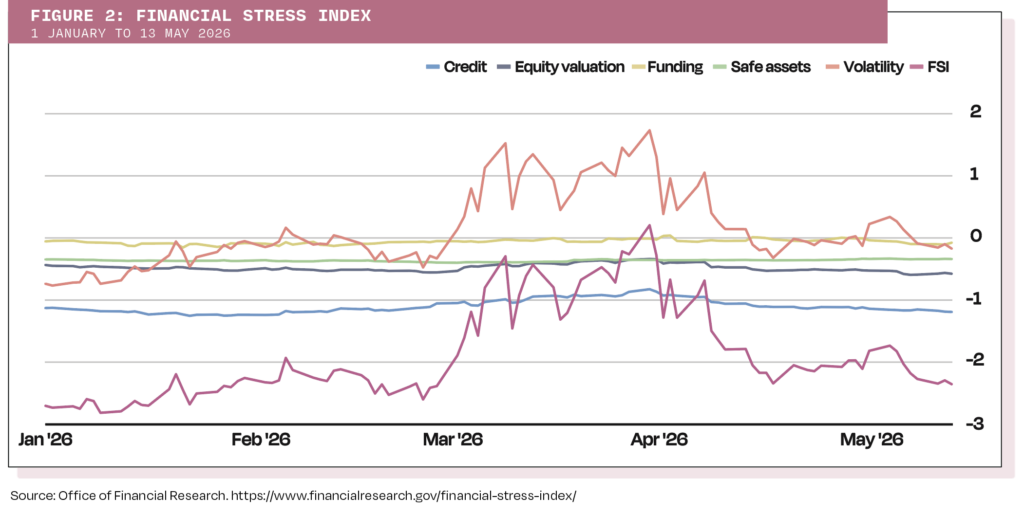
In fact, the global financial system in 2026 is characterised by growing volatility and negative returns. The structural interconnection among global financial markets reduces the opportunities to hedge against adverse shocks. The Office of Financial Research’s Financial Stress Index measures a higher volatility than in previous years, especially in the bond and equity markets (see Figure 2).
In order to reduce the economic and financial risks, G7 members should stabilise their geopolitical relations, especially in the Middle East, Asia and Russia, and implement domestic stabilisation policies on inflation and supply chains. The Évian Summit in June can be a productive opportunity to relieve global tensions and restore certain diplomatic relationships that have weakened over the last few months.
Emerging sources of systemic risk
Threats to financial stability also come from the digital financial system and the development of AI. Digital assets and, in particular, crypto assets exhibit remarkable volatility, but trading in these markets is largely unsupervised and the risks are unmonitored. Crypto trading consumes significant electricity, which can be undermined by long-lasting oil shocks that reduce energy supplies. The impressive growth rate of digital finance over the last few years requires clear action by regulators and government, especially to safeguard weak investors. The European Union has introduced some form of regulation of digital financial institutions, with the Market in Crypto Asset regulation, but other countries and jurisdictions have decided to leave the digital financial system free to operate and grow. This regulatory asymmetry is to the detriment of investors’ welfare and market stability. To reduce regulatory arbitrage, G7 leaders should agree on a common set of incentives for players in the digital financial system.
The threats related to AI have been discussed at previous G7 leaders’ summits, most recently at Apulia in 2024 in Italy and Kananaskis in 2025 in Canada. As part of its digital strategy, the European Union has started to supervise and limit the use of artificial intelligence with the AI Act, which comes into force in June 2026. From an economic perspective, the accelerating use of AI poses new challenges; in particular, the massive amount of investments in the AI sector over the last two years can become a source of systemic risk, if the productive capacity does not increase as well. Similarly to the digital financial system, G7 leaders should agree on common principles of a digital strategy for AI.