

By Adrian Mercer
Only 17% of SDG targets are currently on track, a reality highlighted in the review discussed here. For G7 and G20 leaders, that figure changes the policy question. The issue is no longer whether sustainable development is desirable. It is whether governments can build delivery systems that turn commitments into investable, monitorable, politically durable action.
That requires a sharper definition of sustainable development solutions. Most commentary still treats them as a catalogue of worthy initiatives: cleaner energy, better health systems, greener transport, fairer trade. Policymakers already know that list. What they need is an operating model that connects policy design, institutional capacity, financing, implementation sequencing, and accountability.
The harder truth is that sustainable development rarely fails because leaders lack ambition. It fails because institutions can't coordinate across sectors, because ministries optimise for narrow wins, because local data isn't reliable enough to steer spending, and because trade-offs are treated as communications problems rather than governing problems. For a broader view of the international context, see this analysis of the highs and lows in the global development trajectory.
Table of Contents
- An Urgent Crossroads for Global Development
- Decoding Sustainable Development Solutions
- The Four Architectures of Effective Solutions
- Sectoral Pathways in Climate Health and Trade
- An Implementation Roadmap That Confronts Trade-Offs
- Monitoring Progress and Closing the Data Gap
- A Call for Decisive G20 Leadership on Sustainable Action
An Urgent Crossroads for Global Development
Sustainable development solutions now sit at the centre of economic security, social stability, and geopolitical credibility. Leaders who still frame the agenda as a specialist environmental concern are governing with an outdated map. The SDGs have become a practical test of state capability.
What matters most is the shift from ambition to implementation. A declaration can align ministries for a week. A delivery architecture can align them for a decade. That distinction is especially important for large economies, where fragmented mandates, fiscal pressures, and political turnover routinely weaken long-term plans.
Practical rule: judge any proposed solution by whether it can survive contact with budgets, elections, and administrative reality.
The strategic implication for G20 governments is straightforward. They need integrated policy portfolios, not isolated flagship programmes. A climate plan that ignores housing costs will stall. A growth strategy that ignores environmental spillovers will create new liabilities. A social policy that can't be measured at local level won't retain Treasury confidence for long.
Three questions should shape cabinet-level decision-making:
- Can it scale: not in pilot conditions, but across regions, agencies, and electoral cycles.
- Can it be measured: using trusted indicators that ministers, local authorities, and investors can all recognise.
- Can it manage trade-offs: because almost every serious reform produces winners, losers, and timing mismatches.
Those questions separate rhetoric from sustainable development solutions that work.
Decoding Sustainable Development Solutions
A sustainable development solution isn't a single intervention. It's closer to a well-designed operating system. If one component fails, the others absorb pressure and keep the whole structure functioning.
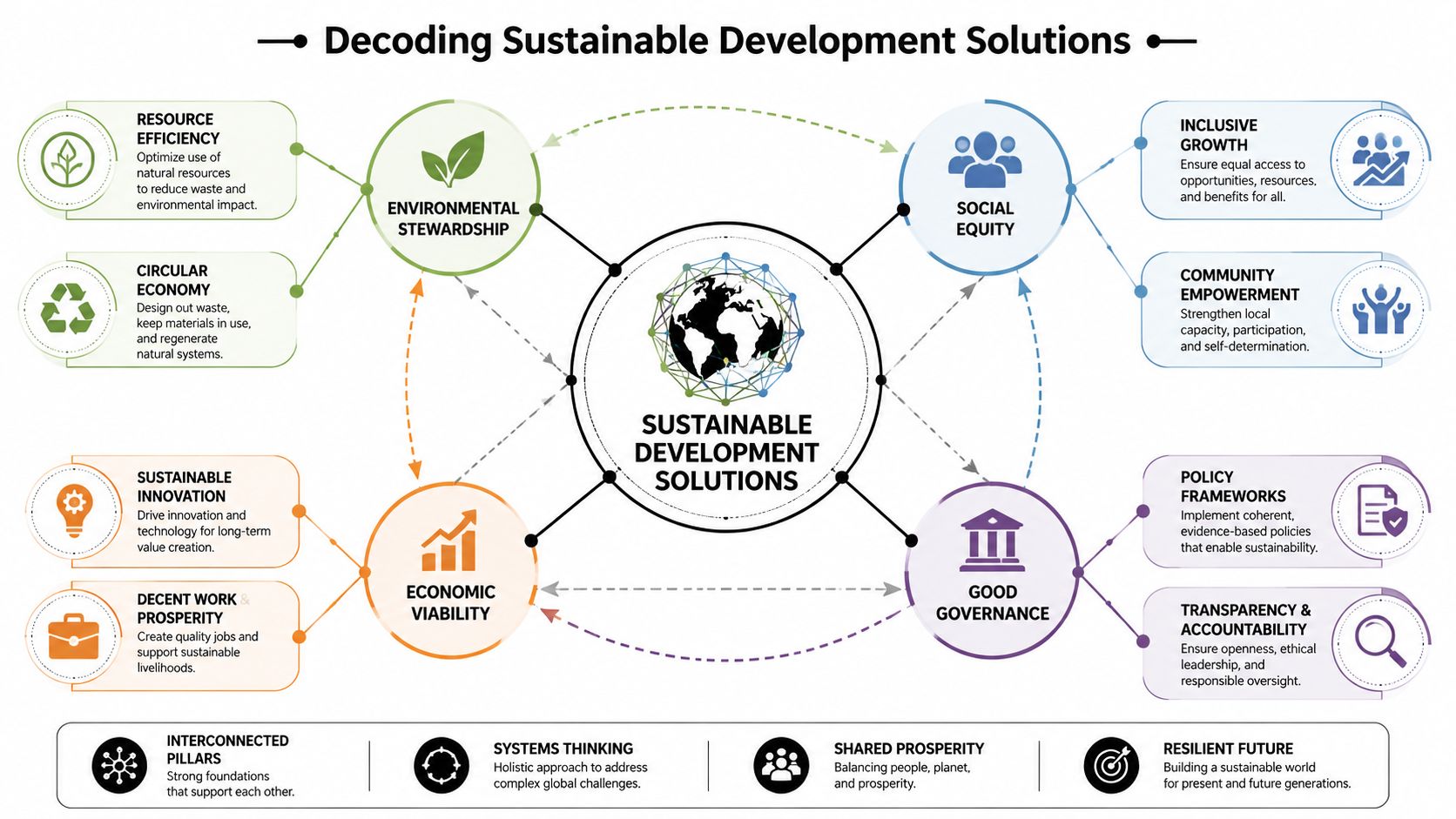
A solution is a system not a project
Think of a resilient city. Its transport network, public health systems, energy supply, labour market, and land use rules aren't separate policy silos in practice. They interact constantly. When energy costs rise, household welfare changes. When housing moves farther from employment centres, transport emissions change. When air quality worsens, health burdens rise and productivity falls.
That is why durable sustainable development solutions must work across environmental stewardship, social equity, economic viability, and good governance at the same time. If a proposal improves one pillar while weakening the others, it may still be useful policy, but it isn't a complete sustainable development solution.
A simple packaging example makes the point. Businesses that want lower-impact materials can't focus only on disposal outcomes. They also need procurement standards, cost discipline, supply-chain reliability, and consumer trust. For a grounded industry example, teams looking at circular product design can discover eco-friendly food packaging, which shows how material choices connect operational practicality with sustainability goals.
A practical test for policymakers
Leaders should apply a tougher screen before endorsing any initiative. Ask whether it does four things well:
| Test | What to look for |
|---|---|
| Multi-outcome value | It improves more than one policy objective without hiding obvious spillovers |
| Institutional fit | Existing agencies can govern it, or government has a credible plan to build capability |
| Financial durability | Funding can outlast political cycles and short-term shocks |
| Public legitimacy | Citizens and affected sectors can understand who benefits, who pays, and why |
A measure that looks efficient inside one ministry can become inefficient once cross-government spillovers are counted.
That is where many strategies fail. They optimise for visible announcements rather than system performance. G20 leaders should resist that bias. The better test is whether the intervention strengthens the state's long-run ability to coordinate, monitor, and adapt.
The Four Architectures of Effective Solutions
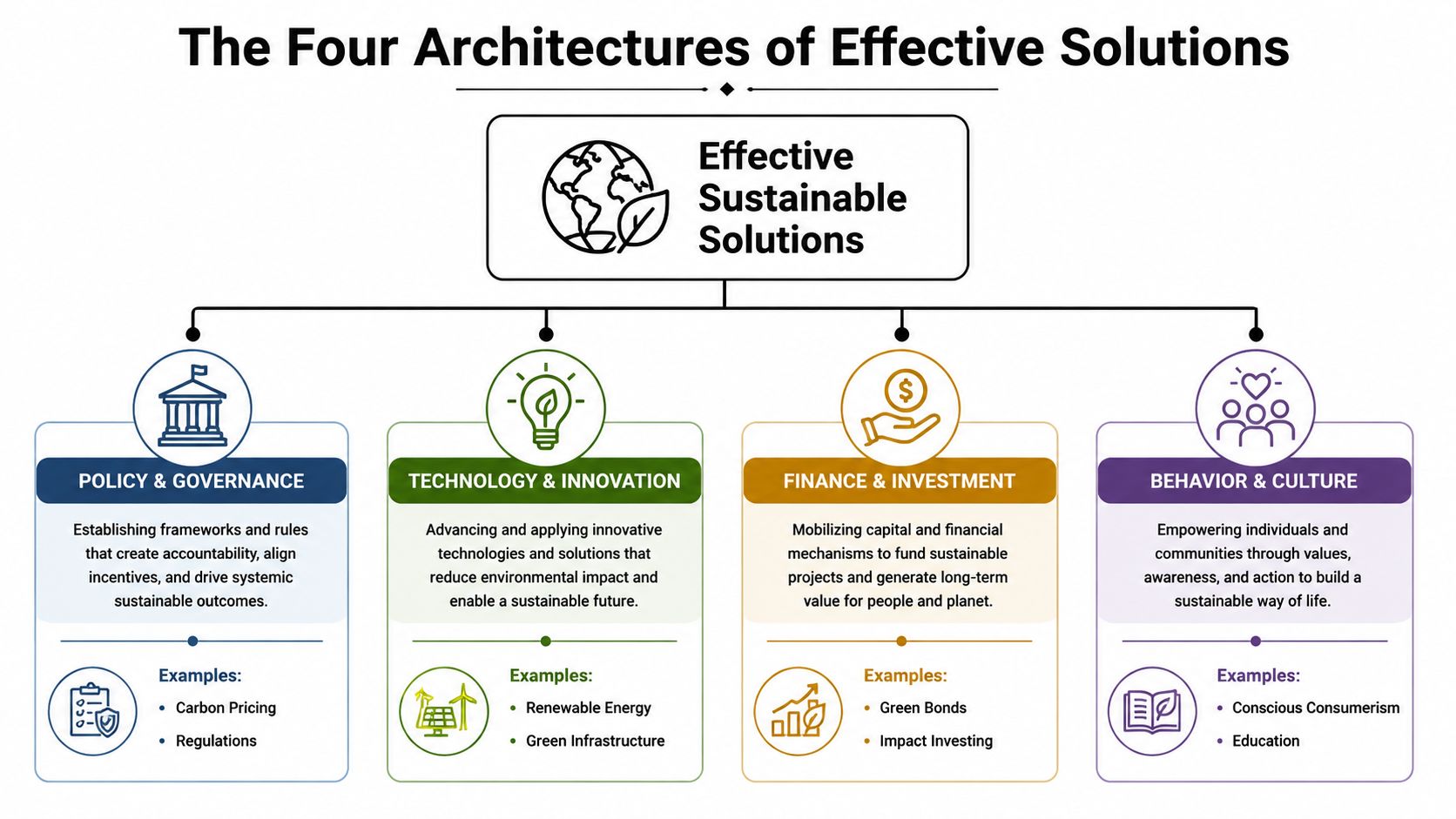
Effective sustainable development solutions usually rely on four architectures working together. Governments often overinvest political attention in one and underbuild the others. That creates fragile reform.
Early institutional design matters. The UK offers a useful example of policy architecture moving from the UK Sustainable Development Strategy in 2005 to alignment with the UN 2030 Agenda after 2015, with the Office for National Statistics publishing public SDG progress data through the framework described by the United Nations on data for sustainable development.
Policy and institutional architecture
Policy sets incentives. Institutions make those incentives credible.
Regulation, standards, procurement rules, planning frameworks, and reporting requirements all shape market behaviour long before individual firms make investment decisions. Yet policy without institutional enforcement quickly becomes symbolic. Independent regulators, credible statistical agencies, transparent budgeting, and stable legal frameworks are what turn intent into compliance.
A useful distinction helps here:
- Policy architecture changes the rules of the game.
- Institutional architecture determines whether those rules are applied consistently.
Without both, reform remains vulnerable to delay, lobbying pressure, and departmental drift.
A visual summary helps illustrate the point.
Technology and finance architecture
Technology expands the frontier of what's feasible. Finance decides what gets deployed at speed.
In energy, digital infrastructure, grid modernisation, storage, and electrification tools can change performance dramatically, but only when capital is available on terms that institutions can absorb. The same logic applies in water systems, public health intelligence, and trade logistics. Innovation doesn't matter if public procurement can't buy it, if regulators can't certify it, or if financing structures punish long payback periods.
Green bonds, blended finance, guarantees, and transition-oriented public investment can matter qualitatively. Their real function isn't branding. It is risk allocation. Good financial architecture lowers the penalty for acting early.
Behaviour and delivery architecture
Policy, institutions, technology, and finance still won't deliver if households, firms, and frontline agencies don't change behaviour. That is why delivery architecture deserves equal weight.
Leadership test: if implementation depends on citizens changing habits, government must pair incentives with clarity, convenience, and trust.
Behavioural change is often treated as a communications task. It isn't. It involves service design, local administrative capability, enforcement credibility, and feedback mechanisms. Recycling systems, transport shifts, vaccination campaigns, and energy efficiency retrofits all depend on whether the public experience is organised well enough to sustain participation.
Sectoral Pathways in Climate Health and Trade
The value of sustainable development solutions becomes clearer when viewed through sector pathways rather than abstract doctrine. Climate, health, and trade all demonstrate the same governing lesson. Single-instrument strategies underperform.
Climate requires scale not marginal adjustment
The UK's record is instructive. Territorial greenhouse gas emissions fell by about 53% between 1990 and 2023, yet the Climate Change Committee says a far steeper rate of change is still required to meet the legally binding Sixth Carbon Budget, which it estimates as a 78% fall by 2035 versus 1990 in the assessment referenced here.
That matters because it rules out the politics of marginalism. Incremental efficiency gains won't be enough. Governments need coordinated deployment of low-carbon power, building retrofits, industrial electrification, and transport demand reduction. Those aren't separate workstreams. They are a combined transition programme.
For policymakers examining co-benefits across portfolios, this discussion of policy at the intersection of climate and health is particularly relevant.
Health and trade depend on institutional coherence
In health, resilience depends on surveillance, public communication, procurement, workforce planning, and fiscal readiness. If one of those elements breaks, the whole system weakens. A technically strong disease-monitoring platform doesn't help much if institutions can't share information quickly or fund response capacity.
Trade poses a similar challenge. Governments want resilient and equitable supply chains, but that requires more than tariff discussions. It requires standards alignment, customs modernisation, digital traceability, trusted data exchange, and dispute-resolution mechanisms that businesses believe will hold.
A practical comparison shows the pattern:
- Climate: infrastructure build-out must be matched by planning reform and patient capital.
- Health: intelligence systems must be matched by institutional authority and emergency financing.
- Trade: digital tools must be matched by interoperable rules and administrative competence.
In every sector, delivery depends less on identifying a clever instrument than on assembling a coherent package of instruments.
That is the core lesson G20 leaders should carry into summit negotiations. Sector success doesn't come from choosing between growth, resilience, and inclusion. It comes from designing instruments that force ministries to pursue them together.
An Implementation Roadmap That Confronts Trade-Offs
One of the most damaging myths in this field is that sustainable development solutions naturally reinforce one another. Sometimes they do. Often they don't.
Recent analysis notes that a key challenge in achieving the 2030 Agenda is the management of trade-offs that arise when governments pursue selected targets without accounting for spillovers, as discussed in the earlier-cited review on the global implementation gap. That is a governing problem, not a messaging problem.
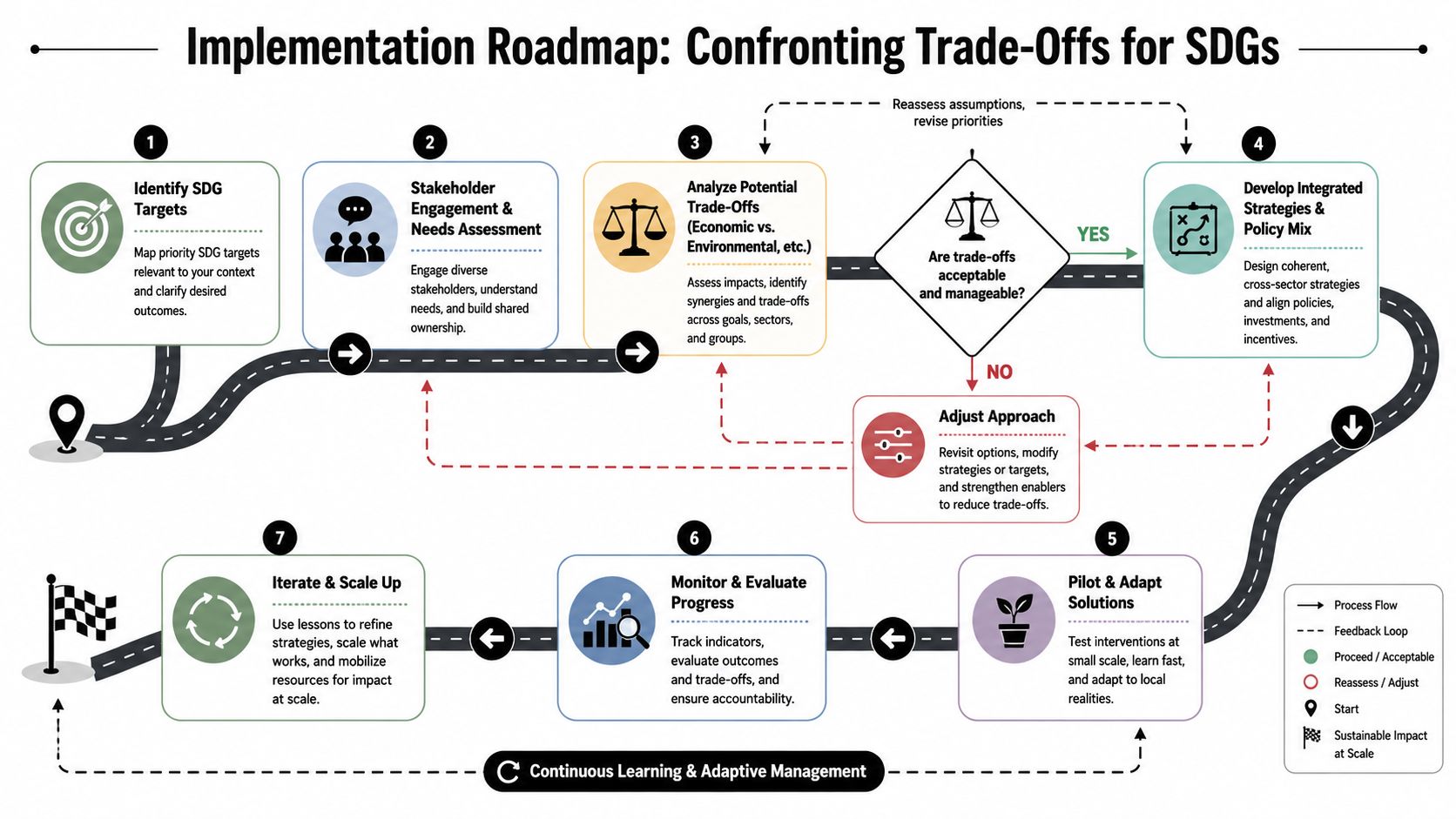
Why easy wins can mislead
Governments often cherry-pick reforms that are politically saleable and administratively convenient. That approach creates three risks.
- First-order success with second-order damage: growth or infrastructure gains may come with biodiversity, housing, or inequality costs.
- Short-term consensus with long-term instability: politically easy sequencing can defer the hard reforms that determine eventual success.
- Sector capture: the best-organised interests can shape implementation faster than diffuse public interests can respond.
The result is familiar. Cabinets celebrate a launch, but the reform later stalls because ministries never agreed on burden-sharing, local authorities weren't funded to deliver, or affected communities withdrew consent.
A governing sequence for hard choices
A stronger implementation roadmap should follow a disciplined sequence.
- Define the primary objective clearly. Decide what must not fail. In some contexts that will be affordability. In others it will be emissions, resilience, or social protection.
- Map likely spillovers early. Treat trade-offs as a design parameter, not as a later communications issue.
- Rank interventions by system effect. Prefer measures that enable wider change across departments.
- Sequence for legitimacy. Early actions should build administrative credibility and visible fairness.
- Use pilots carefully. Pilots are useful when they test operational design, not when they postpone difficult national decisions.
- Build dispute-resolution mechanisms. Conflicts between ministries, regions, or sectors need a formal route to resolution.
- Adapt with evidence. Implementation should be iterative, but adaptation must follow clear metrics.
Negotiation insight: sustainable policy isn't the art of avoiding conflict. It's the discipline of deciding which conflicts to resolve first, and on what terms.
Leaders who govern this way won't promise frictionless progress. They will deliver more durable progress.
Monitoring Progress and Closing the Data Gap
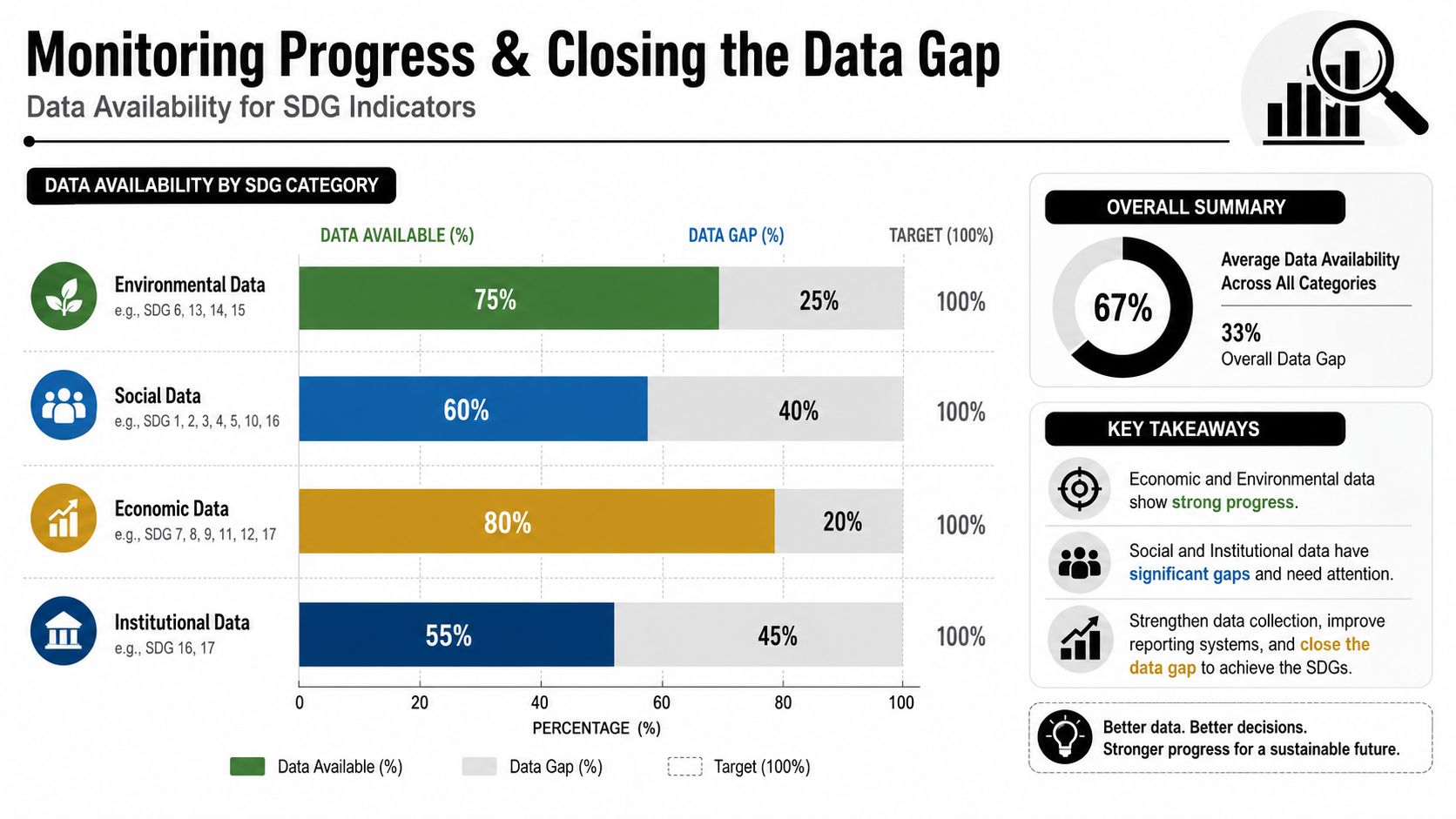
Many governments don't suffer from a shortage of strategies. They suffer from a shortage of trusted measurement. That is a more serious constraint than it appears, because public investment, procurement, and regulatory credibility all depend on whether decision-makers can prove that outcomes are improving.
The SDG Index offers one useful compact lens. Its methodology uses 17 key indicators, one per SDG, to create a headline measure of national performance in the framework described by the SDG Index and Dashboards methodology. The broader SDSN network behind this work spans over 2,100 member institutions across six continents and is coordinated through 59 National and Regional Networks, which shows the scale of the evidence ecosystem available to policymakers.
Measurement is part of the solution
High-level dashboards are useful, but they don't solve the local monitoring problem. Ministers need data they can use to allocate spending, assess regional delivery, and compare programme performance over time. If indicators aren't comparable or trusted, coordination breaks down.
That is why the data gap is an implementation issue in its own right. Effective national data systems require stronger leadership, shared standards, open data collaboration, and ample long-term funding, according to the SDSN discussion of how to fight SDG data gaps. The same discussion notes that the UK statistical system, like many others, faces acknowledged capacity and governance constraints in producing comparable, user-centric sustainability data.
For readers tracking broader accountability questions, this assessment of sustainable development goals progress gives useful policy context.
What stronger data systems look like
A credible national monitoring model should include:
- Common standards: departments and local authorities need compatible definitions, not parallel reporting cultures.
- Open collaboration: data should move across public agencies and, where appropriate, external partners.
- Long-term funding: statistical capability can't be built on short budget cycles.
- User-centred design: indicators must help decision-makers act, not just report upward.
A final point matters for G20 leaders. Data systems are often treated as administrative overhead. That is a strategic mistake. Measurement infrastructure is part of sovereign capability. It determines whether governments can steer transitions intelligently, defend spending decisions, and correct failure before it becomes politically irreversible.
A Call for Decisive G20 Leadership on Sustainable Action
G20 leaders don't need another catalogue of aspirations. They need a governing doctrine for delivery. The evidence points to four priorities.
First, treat sustainable development solutions as integrated systems. Policy, institutions, finance, technology, and behaviour must reinforce one another. A weak link in any one of those areas will slow the whole portfolio.
Second, confront trade-offs directly. Real implementation involves collisions between affordability and speed, between growth and environmental limits, and between national priorities and local realities. Governments that deny those tensions usually intensify them.
Third, invest in measurement as seriously as in policy design. A state that can't measure outcomes reliably can't allocate capital well, can't hold delivery agencies accountable, and can't sustain public trust when reforms become difficult.
Fourth, lead multilaterally with practical discipline. The G20 is most valuable when it aligns standards, de-risks investment, strengthens institutional learning, and makes implementation easier across borders. That is where summit diplomacy can still produce concrete value.
The strategic case is clear. Sustainable development is no longer a peripheral agenda. It is the operating framework for resilience, competitiveness, legitimacy, and security in an era of overlapping shocks. Leaders who understand that will build states that can adapt. Leaders who don't will inherit more brittle economies and more distrustful societies.
The next round of G20 action should therefore focus less on new declarations and more on delivery architecture, sequencing choices, and data credibility. That is how sustainable development solutions move from conference language into governing reality.
Global challenges need clearer choices and more practical analysis. For deeper coverage of G7 and G20 agendas, data-led policy briefings, and expert perspectives on climate, health, trade, and multilateral cooperation, visit Global Governance Media.